|
시장보고서
상품코드
1913307
자동차 부싱 시장 예측 : 기회, 성장 요인, 업계 동향 분석(2026-2035년)Automotive Bushing Market Opportunity, Growth Drivers, Industry Trend Analysis, and Forecast 2026 - 2035 |
||||||

세계 자동차 부싱 시장은 2025년에 1,668억 달러로 평가되었으며, 2035년까지 연평균 복합 성장률(CAGR) 5.2%로 성장하여 2,761억 달러에 이를 것으로 예측됩니다.
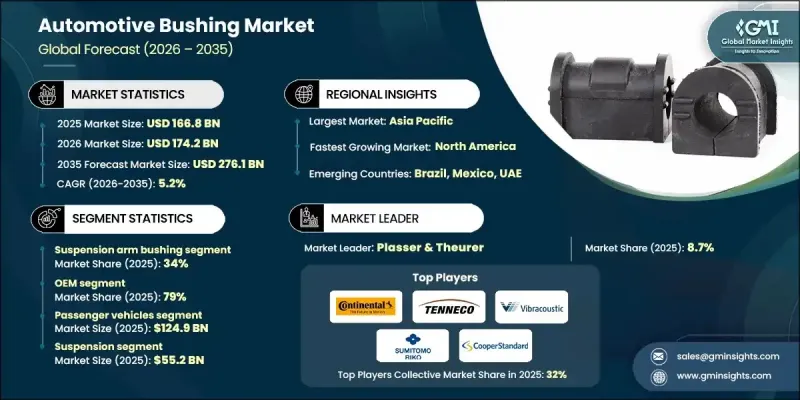
시장 확대의 배경에는 모든 차량 플랫폼에서 운전 쾌적성의 향상, 소음 및 진동의 저감, 내구성의 향상에 대한 수요 증가가 있습니다. 전동화 모빌리티와 첨단 차량 구조로의 전환이 가속화됨에 따라 정밀 설계된 부싱 솔루션의 필요성이 더욱 커지고 있습니다. 자동차 제조업체 및 부품 공급업체는 신뢰성, 안전성, 장기적인 성능을 강력하게 강조하며 부시를 서스펜션, 섀시 및 파워트레인 시스템의 핵심 요소로 자리매김하고 있습니다. 재료 과학, 디지털 설계 및 시스템 통합의 지속적인 발전은 제품 개발을 재구성하고 수명을 연장하고 성능을 최적화하며 전체 차량의 역학을 향상시킬 수 있습니다. 승용차, 상용차, 전동화 차량의 세계 생산량이 증가함에 따라 선진적이고 통합된 부시 솔루션에 대한 수요는 성숙한 자동차 시장과 신흥 시장 모두에서 계속 강화되고 있습니다.
| 시장 범위 | |
|---|---|
| 시작 연도 | 2025년 |
| 예측 연도 | 2026-2035년 |
| 시작 금액 | 1,668억 달러 |
| 예측 금액 | 2,761억 달러 |
| CAGR | 5.2% |
서스펜션 암 부싱 부문은 2025년에 34%의 점유율을 차지했으며, 2026년부터 2035년까지 연평균 복합 성장률(CAGR)은 4.6%를 보일 것으로 예측됩니다. 이 부문은 차량의 안정성, 승차감, 진동 격리에 중요한 역할을 하기 때문에 지배적인 지위를 차지합니다. 다양한 차종 카테고리에서의 견고한 수요가 채택을 뒷받침하고 있습니다. 이러한 부품은 다양한 운전 조건 하에서 조타 정확도, 정렬 일관성 및 서스펜션 시스템의 무결성을 유지하는 데 필수적이기 때문입니다.
OEM 부문은 2025년에 79%의 점유율을 차지했으며, 2035년까지 연평균 복합 성장률(CAGR) 5.5%로 성장할 것으로 예측됩니다. OEM의 이점은 높은 생산량과 부시를 신차 플랫폼에 직접 통합함으로써 지원됩니다. 제조업체는 성능 기준, 내구성 및 규제 요구 사항을 충족하기 위해 이러한 부품에 의존하며 OEM 공급은 금액 및 수량 양면에서 가장 큰 기여 요인이되었습니다.
중국 자동차 부싱 시장은 2025년에 42%의 점유율을 차지했으며 309억 달러 규모를 창출했습니다. 이 나라의 주도적 지위는 대규모 자동차 제조거점과 전동 차량 생산의 급속한 확대로 추진되고 있습니다. 견고한 국내 수요와 첨단 차량 시스템의 보급 확대가 중국 지역의 우위성을 계속 강화하고 있습니다.
자주 묻는 질문
목차
제1장 조사 방법과 범위
제2장 주요 요약
제3장 업계 인사이트
- 생태계 분석
- 공급업체 현황
- 수익률
- 비용 구조
- 각 공정에 있어서의 부가가치
- 밸류체인에 영향을 주는 요인
- 혁신
- 업계에 미치는 영향요인
- 성장 촉진요인
- 세계 자동차 생산 대수 증가
- 전기자동차 및 하이브리드차의 급속한 보급
- 승차감과 NVH 저감에 대한 주목의 고조
- 부싱 재료와 설계의 진보
- 업계의 잠재적 위험 및 과제
- 원재료 가격 변동
- 고급 부싱 솔루션의 높은 비용
- 시장 기회
- 확대하는 애프터마켓 교환 수요
- 스마트 센서 탑재 부싱
- 애프터마켓의 확대와 차량 플릿의 현대화
- 경량 재료와 고급 복합재료
- 성장 촉진요인
- 성장 가능성 분석
- 규제 상황
- 북미
- 미국 연방 자동차 안전 기준(FMVSS)
- 캐나다 자동차 안전 기준(CMVSS)
- 유럽
- 독일에서의 TUV 및 BaFin의 컴플라이언스
- 프랑스 DGITM 가이드라인
- 영국 차량 인증 기관(VCA) 규제
- 이탈리아 교통부 준수 규정
- 아시아태평양
- 중국 공업정보화부(MIIT) 가이드라인
- 일본 국토교통성 기준
- 한국 국토교통부(MOLIT) 규제
- 인도 도로교통부(MoRTH) 및 인도 규격 협회(BIS) 가이드라인
- 라틴아메리카
- 브라질 DENATRAN 및 ANFAVEA 규정
- 멕시코 SCT 및 NOM 표준
- 중동 및 아프리카
- 아랍에미리트(UAE) 도로 교통국(RTA) 가이드라인
- 사우디아라비아 교통총국(GAT)의 규제
- 북미
- Porter's Five Forces 분석
- PESTEL 분석
- 기술과 혁신 동향
- 현재의 기술 동향
- 자동화와 로보틱스
- AI와 머신러닝
- 사물인터넷(IoT)
- 신규기술
- 하이퍼커넥티드 차량 시스템
- 조립용 서비스형 로보틱스(RaaS)
- AI를 활용한 예지보전과 동적 자원 배분
- 현재의 기술 동향
- 가격 동향
- 지역별
- 제품별
- 비용 내역 분석
- 특허 분석
- 지속가능성과 환경면
- 지속가능한 대처
- 폐기물 감축 전략
- 생산에 있어서의 에너지 효율
- 친환경 이니셔티브
- 탄소발자국에 관한 고려 사항
- 이용 사례 시나리오
- OEM 및 Tier 1 공급업체의 조달 및 선정 기준
- 재료 선정과 성능 트레이드 오프 분석
- 전기자동차(EV) 및 하이브리드 차량에 의한 부싱 설계에 미치는 영향
- 자사 제조인지 외주인지 판단과 수직 통합 전략
제4장 경쟁 구도
- 소개
- 기업의 시장 점유율 분석
- 북미
- 유럽
- 아시아태평양
- 라틴아메리카
- 중동 및 아프리카
- 주요 시장 기업의 경쟁 분석
- 경쟁 포지셔닝 매트릭스
- 전략적 전망 매트릭스
- 주요 발전
- 합병 및 인수
- 제휴 및 협업
- 신제품 발매
- 사업 확대 계획과 자금 조달
제5장 시장 추정 및 예측 : 유형별, 2022-2035
- 서스펜션 암 부싱
- 엔진 마운트
- 서브프레임 부싱
- 서스펜션 마운트
- 하이드로 부싱
- 댐퍼 탑 마운트
제6장 시장 추정 및 예측 : 차량별, 2022-2035
- 승용차
- 해치백
- 세단
- SUV
- 상용차
- 소형 상용차(LCV)
- 중형 상용차(MCV)
- 대형 상용차(HCV)
제7장 시장 추정 및 예측 : 용도별, 2022-2035
- 서스펜션
- 엔진
- 섀시
- 변속기
- 배기
- 인테리어
제8장 시장추정 및 예측 : 판매채널별, 2022-2035
- OEM
- 애프터마켓
제9장 시장추정 및 예측 : 지역별, 2022-2035
- 북미
- 미국
- 캐나다
- 유럽
- 영국
- 독일
- 프랑스
- 이탈리아
- 스페인
- 벨기에
- 네덜란드
- 스웨덴
- 아시아태평양
- 중국
- 인도
- 일본
- 호주
- 싱가포르
- 한국
- 베트남
- 인도네시아
- 말레이시아
- 라틴아메리카
- 브라질
- 멕시코
- 아르헨티나
- 중동 및 아프리카
- 아랍에미리트(UAE)
- 남아프리카
- 사우디아라비아
제10장 기업 프로파일
- Global Player
- BOGE Rubber &Plastics
- Continental
- Cooper-Standard
- Dana
- Federal-Mogul Motorparts
- MAHLE
- NTN
- Sumitomo Riko
- Tenneco
- Vibracoustic
- Regional Player
- Aisin Seiki
- Anchor Rubber
- GMB
- Hengst
- JTEKT
- Koyo Seiko
- Mobis
- NSK
- Reydel Automotive
- Toyoda Gosei
- 신흥기업
- Jatco Bushing Solutions
- Lydall Performance Materials
- Minda Industries
- Sona BLW Precision Forgings
- Thor Automotive Components
The Global Automotive Bushing Market was valued at USD 166.8 billion in 2025 and is estimated to grow at a CAGR of 5.2% to reach USD 276.1 billion by 2035.
Market expansion is driven by increased demand for improved driving comfort, reduced noise and vibration, and higher durability across vehicle platforms. The accelerating shift toward electrified mobility and advanced vehicle architectures is further increasing the need for precision-engineered bushing solutions. Automakers and component suppliers are placing strong emphasis on reliability, safety, and long-term performance, positioning bushings as critical elements within suspension, chassis, and powertrain systems. Continuous progress in material science, digital design, and system integration is reshaping product development, enabling improved lifespan, optimized performance, and better overall vehicle dynamics. As global production volumes rise across passenger, commercial, and electrified vehicles, demand for advanced and integrated bushing solutions continues to strengthen across both mature and emerging automotive markets.
| Market Scope | |
|---|---|
| Start Year | 2025 |
| Forecast Year | 2026-2035 |
| Start Value | $166.8 Billion |
| Forecast Value | $276.1 Billion |
| CAGR | 5.2% |
The suspension arm bushing segment held 34% share in 2025 and is expected to grow at a CAGR of 4.6% from 2026 to 2035. This segment holds a dominant position due to its essential role in vehicle stability, ride quality, and vibration isolation. Strong demand across multiple vehicle categories continues to support adoption, as these components are critical for maintaining handling accuracy, alignment consistency, and suspension system integrity under varying operating conditions.
The OEM segment held 79% share in 2025 and is forecast to grow at a CAGR of 5.5% through 2035. OEM dominance is supported by high production volumes and direct integration of bushings into new vehicle platforms. Manufacturers rely on these components to meet performance standards, durability requirements, and regulatory expectations, making OEM supply the largest contributor in both value and volume terms.
China Automotive Bushing Market held 42% share and generated USD 30.9 billion in 2025. The country's leadership is driven by its large-scale vehicle manufacturing base and rapid expansion of electrified vehicle production. Strong domestic demand and widespread adoption of advanced vehicle systems continue to reinforce China's dominant regional position.
Key companies operating in the Global Automotive Bushing Market include Continental, Vibracoustic, Tenneco, Cooper-Standard, Sumitomo Riko, MAHLE, Dana, NTN, BOGE Rubber & Plastics, and Federal-Mogul Motorparts. Companies in the Automotive Bushing Market are strengthening their competitive position through material innovation, platform-specific design, and closer collaboration with vehicle manufacturers. Leading players are investing in advanced engineering capabilities to improve durability, comfort, performance, and weight efficiency. Strategic partnerships with OEMs help suppliers align product development with next-generation vehicle platforms. Expansion of global manufacturing footprints is being used to support regional demand and improve supply reliability.
Table of Contents
Chapter 1 Methodology & Scope
- 1.1 Market scope and definition
- 1.2 Research design
- 1.2.1 Research approach
- 1.2.2 Data collection methods
- 1.3 Data mining sources
- 1.3.1 Global
- 1.3.2 Regional/Country
- 1.4 Base estimates and calculations
- 1.4.1 Base year calculation
- 1.4.2 Key trends for market estimation
- 1.5 Primary research and validation
- 1.5.1 Primary sources
- 1.6 Forecast
- 1.7 Research assumptions and limitations
Chapter 2 Executive Summary
- 2.1 Industry 3600 synopsis, 2022 - 2035
- 2.2 Key market trends
- 2.2.1 Regional
- 2.2.2 Type
- 2.2.3 Vehicle
- 2.2.4 Application
- 2.2.5 Sales Channel
- 2.3 TAM Analysis, 2026-2035
- 2.4 CXO perspectives: Strategic imperatives
- 2.4.1 Executive decision points
- 2.4.2 Critical success factors
- 2.5 Future outlook and strategic recommendations
Chapter 3 Industry Insights
- 3.1 Industry ecosystem analysis
- 3.1.1 Supplier Landscape
- 3.1.2 Profit Margin
- 3.1.3 Cost structure
- 3.1.4 Value addition at each stage
- 3.1.5 Factor affecting the value chain
- 3.1.6 Disruptions
- 3.2 Industry impact forces
- 3.2.1 Growth drivers
- 3.2.1.1 Rising global vehicle production
- 3.2.1.2 Rapid adoption of electric and hybrid vehicles
- 3.2.1.3 Increasing focus on ride comfort and NVH reduction
- 3.2.1.4 Advancements in bushing materials and designs
- 3.2.2 Industry pitfalls and challenges
- 3.2.2.1 Raw material price fluctuations
- 3.2.2.2 High cost of advanced bushing solutions
- 3.2.3 Market opportunities
- 3.2.3.1 Growing aftermarket replacement demand
- 3.2.3.2 Smart and sensor-enabled bushings
- 3.2.3.3 Aftermarket expansion and vehicle fleet modernization
- 3.2.3.4 Lightweight materials and advanced composites
- 3.2.1 Growth drivers
- 3.3 Growth potential analysis
- 3.4 Regulatory landscape
- 3.4.1 North America
- 3.4.1.1 U.S. Federal Motor Vehicle Safety Standards (FMVSS)
- 3.4.1.2 Canada Motor Vehicle Safety Standards (CMVSS)
- 3.4.2 Europe
- 3.4.2.1 Germany TUV & BaFin Compliance
- 3.4.2.2 France DGITM Guidelines
- 3.4.2.3 UK Vehicle Certification Agency (VCA) Regulations
- 3.4.2.4 Italy Ministry of Infrastructure & Transport Compliance
- 3.4.3 Asia Pacific
- 3.4.3.1 China MIIT Guidelines
- 3.4.3.2 Japan MLIT Standards
- 3.4.3.3 South Korea MOLIT Regulations
- 3.4.3.4 India Ministry of MoRTH & BIS Guidelines
- 3.4.4 Latin America
- 3.4.4.1 Brazil DENATRAN & ANFAVEA Regulations
- 3.4.4.2 Mexico SCT & NOM Standards
- 3.4.5 Middle East and Africa
- 3.4.5.1 UAE Roads & Transport Authority (RTA) Guidelines
- 3.4.5.2 Saudi Arabia General Authority for Transport (GAT) Regulations
- 3.4.1 North America
- 3.5 Porter's analysis
- 3.6 PESTEL analysis
- 3.7 Technology and Innovation Landscape
- 3.7.1 Current technological trends
- 3.7.1.1 Automation & robotics
- 3.7.1.2 AI & machine learning
- 3.7.1.3 Internet of things (IoT)
- 3.7.2 Emerging technologies
- 3.7.2.1 Hyper-connected vehicle systems
- 3.7.2.2 Robotics-as-a-service (RaaS) for assembly
- 3.7.2.3 AI-driven predictive maintenance & dynamic resource allocation
- 3.7.1 Current technological trends
- 3.8 Price trends
- 3.8.1 By region
- 3.8.2 By product
- 3.9 Cost breakdown analysis
- 3.10 Patent analysis
- 3.11 Sustainability and Environmental Aspects
- 3.11.1 Sustainable practices
- 3.11.2 Waste reduction strategies
- 3.11.3 Energy efficiency in production
- 3.11.4 Eco-friendly initiatives
- 3.11.5 Carbon footprint considerations
- 3.12 Use case scenarios
- 3.13 OEM & Tier-1 procurement and selection criteria
- 3.14 Material selection & performance trade-off analysis
- 3.15 EV & hybrid vehicle impact on bushing design
- 3.16 Make-vs-buy & vertical integration strategies
Chapter 4 Competitive Landscape, 2025
- 4.1 Introduction
- 4.2 Company market share analysis
- 4.2.1 North America
- 4.2.2 Europe
- 4.2.3 Asia Pacific
- 4.2.4 Latin America
- 4.2.5 Middle East & Africa
- 4.3 Competitive analysis of major market players
- 4.4 Competitive positioning matrix
- 4.5 Strategic outlook matrix
- 4.6 Key developments
- 4.6.1 Mergers & acquisitions
- 4.6.2 Partnerships & collaborations
- 4.6.3 New product launches
- 4.6.4 Expansion plans and funding
Chapter 5 Market Estimates & Forecast, By Type, 2022 - 2035 ($ Bn, Units)
- 5.1 Key trends
- 5.2 Suspension arm bushing
- 5.3 Engine mounts
- 5.4 Subframe bushing
- 5.5 Suspension mounts
- 5.6 Hydro bushing
- 5.7 Damper top mounts
Chapter 6 Market Estimates & Forecast, By Vehicle, 2022 - 2035 ($ Bn, Units)
- 6.1 Key trends
- 6.2 Passenger vehicles
- 6.2.1 Hatchbacks
- 6.2.2 Sedans
- 6.2.3 SUV
- 6.3 Commercial vehicles
- 6.3.1 Light commercial vehicles (LCV)
- 6.3.2 Medium commercial vehicles (MCV)
- 6.3.3 Heavy commercial vehicles (HCV)
Chapter 7 Market Estimates & Forecast, By Application, 2022 - 2035 ($ Bn, Units)
- 7.1 Key trends
- 7.2 Suspension
- 7.3 Engine
- 7.4 Chassis
- 7.5 Transmission
- 7.6 Exhaust
- 7.7 Interior
Chapter 8 Market Estimates & Forecast, By Sales Channel, 2022 - 2035 ($ Bn, Units)
- 8.1 Key trends
- 8.2 OEM
- 8.3 Aftermarket
Chapter 9 Market Estimates & Forecast, By Region, 2022 - 2035 ($ Bn, Units)
- 9.1 Key trends
- 9.2 North America
- 9.2.1 US
- 9.2.2 Canada
- 9.3 Europe
- 9.3.1 UK
- 9.3.2 Germany
- 9.3.3 France
- 9.3.4 Italy
- 9.3.5 Spain
- 9.3.6 Belgium
- 9.3.7 Netherlands
- 9.3.8 Sweden
- 9.4 Asia Pacific
- 9.4.1 China
- 9.4.2 India
- 9.4.3 Japan
- 9.4.4 Australia
- 9.4.5 Singapore
- 9.4.6 South Korea
- 9.4.7 Vietnam
- 9.4.8 Indonesia
- 9.4.9 Malaysia
- 9.5 Latin America
- 9.5.1 Brazil
- 9.5.2 Mexico
- 9.5.3 Argentina
- 9.6 MEA
- 9.6.1 UAE
- 9.6.2 South Africa
- 9.6.3 Saudi Arabia
Chapter 10 Company Profiles
- 10.1 Global Player
- 10.1.1 BOGE Rubber & Plastics
- 10.1.2 Continental
- 10.1.3 Cooper-Standard
- 10.1.4 Dana
- 10.1.5 Federal-Mogul Motorparts
- 10.1.6 MAHLE
- 10.1.7 NTN
- 10.1.8 Sumitomo Riko
- 10.1.9 Tenneco
- 10.1.10 Vibracoustic
- 10.2 Regional Player
- 10.2.1 Aisin Seiki
- 10.2.2 Anchor Rubber
- 10.2.3 GMB
- 10.2.4 Hengst
- 10.2.5 JTEKT
- 10.2.6 Koyo Seiko
- 10.2.7 Mobis
- 10.2.8 NSK
- 10.2.9 Reydel Automotive
- 10.2.10 Toyoda Gosei
- 10.3 Emerging Players
- 10.3.1 Jatco Bushing Solutions
- 10.3.2 Lydall Performance Materials
- 10.3.3 Minda Industries
- 10.3.4 Sona BLW Precision Forgings
- 10.3.5 Thor Automotive Components