|
시장보고서
상품코드
1913325
보안 관제실 시장 : 시장 기회, 성장 요인, 산업 동향 분석 및 예측(2026-2035년)Security Control Room Market Opportunity, Growth Drivers, Industry Trend Analysis, and Forecast 2026 - 2035 |
||||||

세계의 보안 관제실 시장은 2025년에 115억 달러로 평가되었으며, 2035년까지 연평균 복합 성장률(CAGR) 6.2%로 성장하여 208억 달러에 이를 것으로 예측됩니다.
시장의 발전은 도시화 가속화, 스마트시티 구상 투자 증가, 공공안전 및 국가안보에 대한 주목을 받고 있으며, 중요한 인프라 및 교통망의 지속적인 확충에 의해 추진되고 있습니다. 공공 부문 및 민간 부문 모두가 감시, 조정 및 대응 능력을 향상시키기 위해 중앙 집중화된 보안 운영을 점점 우선시하고 있습니다. 보안 관제실은 실시간 의사결정과 통일된 모니터링을 지원하는 고도로 통합된 운영 환경으로 진화하고 있습니다. 고급 지휘 통제 플랫폼에 대한 의존도가 높아짐에 따라 상황 인식이 향상됨과 동시에 신속한 인시던트 관리 및 업무 연속성이 실현되고 있습니다. 도시, 기업, 인프라 사업자가 탄력성(회복력)과 리스크 경감을 추구하는 가운데 세련된 제어실 환경에 대한 수요는 계속 증가하고 있습니다. 이 기세는 전체 보안 생태계의 신뢰성, 상호 운용성 및 운영 효율성 향상을 목표로 하는 현대화 노력을 통해 더욱 강화되고 있습니다.
| 시장 범위 | |
|---|---|
| 시작 연도 | 2025년 |
| 예측 연도 | 2026-2035년 |
| 시작 시 가치 | 115억 달러 |
| 예측 금액 | 208억 달러 |
| CAGR | 6.2% |
급속한 도시 개발로 정부는 인구 밀도, 이동성 및 안전성을 보다 효과적으로 관리하기 위해 인프라 업그레이드를 추진하고 있습니다. 모니터링, 조정 및 긴급 대응 기능을 단일 운영 환경에 통합하는 중앙 집중식 지침 시설은 도시 관리 전략의 필수 요소가 되고 있습니다. 이러한 시설은 인시던트 발생 시 실시간 가시성과 신속한 대응을 지원하여 공공 부문에서 선진적인 지령실 투자 수요를 강화하고 있습니다. 정부는 또한 개선된 조정 및 데이터 중심 인식을 필요로 하는 진화하는 위협에 대처하기 위해 보안 능력을 확대하고 있습니다. 관제실은 모니터링 시스템 및 통신 시스템으로부터의 통합 데이터 스트림을 통한 지속적인 모니터링 및 대응의 핵심 거점으로서 역할을 점점 완성하고 있습니다.
하드웨어 분야는 2025년 58억 달러 시장 규모를 기록했습니다. 신뢰할 수 있는 실시간 모니터링을 실현하는 첨단 시각화 시스템, 센서, 디스플레이 기술의 도입 확대가 수요를 지원하고 있습니다. 공공 서비스, 교통, 중요 시설의 인프라 업데이트는 하드웨어 집약적인 관제실 솔루션의 도입을 더욱 가속화하고 있습니다.
온프레미스 부문은 2025년 69억 달러에 달했습니다. 정부 기관 및 중요한 자산 운영자의 강한 수요가 이 부문을 계속 지원하고 있으며, 데이터 제어의 현지화 및 시스템의 신뢰성이 최우선 사항이기 때문입니다. 도시 및 교통 인프라의 지속적인 현대화는 성능의 일관성 및 저지연 운영으로 온프레미스 도입을 추진하고 있습니다.
북미의 보안 관제실 시장은 2025년 34.6%의 점유율을 차지했습니다. 지역 성장은 관제실 및 긴급 통신 시스템, 실시간 분석 플랫폼, 여러 행정 수준에 걸친 협력 대응 프레임워크의 통합에 의해 지원됩니다. 투자 우선순위는 상호 운용성 향상, 운영 가시성 강화, 협력 대응 능력 향상에 중점을 둡니다.
자주 묻는 질문
목차
제1장 조사 방법 및 범위
제2장 주요 요약
제3장 업계 인사이트
- 생태계 분석
- 공급자의 상황
- 이익률
- 비용 구조
- 각 단계에서의 부가가치
- 밸류체인에 영향을 주는 요인
- 혁신
- 업계에 미치는 영향요인
- 성장 촉진요인
- 도시화의 진전 및 스마트 시티 투자 증가
- 공공 안전 및 국토 안보에 대한 우려 고조
- 중요 인프라 및 운송 네트워크 확대
- 통합 지휘 통제 시스템 채용 확대
- 기업의 중앙 집중식 보안 운영에 대한 수요 증가
- 과제 및 어려움
- 높은 초기 자본 및 시스템 통합 비용
- 사이버 보안 위험 및 데이터 프라이버시에 대한 우려
- 성장 촉진요인
- 성장 가능성 분석
- 규제 상황
- 북미
- 유럽
- 아시아태평양
- 라틴아메리카
- 중동 및 아프리카
- Porter's Five Forces 분석
- PESTEL 분석
- 기술 및 혁신 동향
- 현재의 기술 동향
- 신흥 기술
- 신흥 비즈니스 모델
- 컴플라이언스 요건
- 지속가능성에 대한 노력
- 공급망의 탄력
- 지정학적 분석
- 디지털 전환
제4장 경쟁 구도
- 서문
- 기업의 시장 점유율 분석
- 지역별
- 북미
- 유럽
- 아시아태평양
- 라틴아메리카
- 중동 및 아프리카
- 시장 집중도 분석
- 지역별
- 주요 기업의 경쟁 벤치마킹
- 제품 포트폴리오 비교
- 제품 라인의 넓이
- 기술
- 혁신
- 지역별 사업 전개 비교
- 세계적인 사업 전개 분석
- 서비스 네트워크의 커버율
- 지역별 시장 침투율
- 경쟁 포지셔닝 매트릭스
- 리더기업
- 챌린저
- 팔로워
- 틈새 기업
- 전략적 전망 매트릭스
- 제품 포트폴리오 비교
- 주요 발전(2022-2025년)
- 합병 및 인수
- 제휴 및 공동 사업
- 기술적 진보
- 확대 및 투자 전략
- 지속가능성에 대한 노력
- 디지털 전환의 대처
- 신흥 및 스타트업 경쟁의 동향
제5장 시장 추계 및 예측 : 제공별(2022-2035년)
- 하드웨어
- 디스플레이 시스템
- 프로젝터
- KVM 스위치 및 제어기기
- 운영자 워크스테이션 콘솔
- 네트워크 인프라 설비
- 서버 및 스토리지 시스템
- 기타
- 소프트웨어
- 비디오 관리 시스템(VMS)
- 물리 보안 정보 관리(PSIM)
- 액세스 제어 관리 소프트웨어
- 애널리틱스, AI 및 머신러닝 플랫폼
- 인시던트 관리 시스템
- 지휘 통제 플랫폼
- 시각화 및 대시보드 소프트웨어
- 기타
- 서비스
- 시스템 통합 및 설치 서비스
- 보수 및 기술 서포트
- 컨설팅 및 설계 서비스
- 트레이닝 및 오퍼레이터 육성
- 기타
제6장 시장 추계 및 예측 : 도입 형태별(2022-2035년)
- 온프레미스
- 클라우드 기반
- 하이브리드
제7장 시장 추계 및 예측 : 용도별(2022-2035년)
- 공공 안전
- 기업 안전
- 산업 안전
제8장 시장 추계 및 예측 : 최종 용도별(2022-2035년)
- 정부 및 방위
- 법 집행 기관 및 경찰 업무
- 군 및 방위
- 국경 경비 및 출입국 관리
- 정보기관 및 국가안전기관
- 기타
- 교통기관
- 공항 및 항공 보안
- 항만 및 해상 보안
- 철도 및 대중교통 시스템
- 물류 및 유통 센터
- 기타
- BFSI
- 은행 지점 및 ATM 네트워크
- 데이터센터
- 기타
- 제조업
- 자동차
- 일렉트로믹스 및 반도체
- 항공우주 및 방위
- 화학제품 및 석유화학제품
- 식품 및 음료
- 기타
- 유틸리티
- 발전 및 배전
- 상하수도 처리
- 석유 및 가스 인프라
- 기타
- 헬스케어
- 병원 및 의료센터
- 의약품 제조
- 환자 안전 및 액세스 관리
- 기타
- 소매 및 상업용 부동산
- 쇼핑몰 및 소매 체인
- 기업 오피스 빌딩
- 상업 시설
- 기타
- 기타
제9장 시장 추계 및 예측 : 지역별(2022-2035년)
- 북미
- 미국
- 캐나다
- 유럽
- 독일
- 영국
- 프랑스
- 스페인
- 이탈리아
- 네덜란드
- 아시아태평양
- 중국
- 인도
- 일본
- 호주
- 한국
- 라틴아메리카
- 브라질
- 멕시코
- 아르헨티나
- 중동 및 아프리카
- 사우디아라비아
- 남아프리카
- 아랍에미리트(UAE)
제10장 기업 프로파일
- 세계 주요 기업
- ABB Ltd.
- Honeywell International Inc
- Siemens AG
- Johnson Controls International
- Motorola Solutions
- 지역별 주요 기업
- 북미
- Convergint Technologies LLC
- Genetec Inc.
- Tyler Technologies
- Kastle Systems
- Access Hardware, Inc.
- 유럽
- Axis Communications AB
- Barco NV
- Milestone Systems A/S
- Hexagon AB
- Buren Systems International BV
- 아시아태평양
- Hangzhou Hikvision Digital Technology Co., Ltd.
- Eizo Corporation
- ATEN INTERNATIONAL Co., Ltd.
- 북미
- 틈새 기업 및 디스럽터 기업
- RGB Spectrum
- Securitas Technology
- AxxonSoft
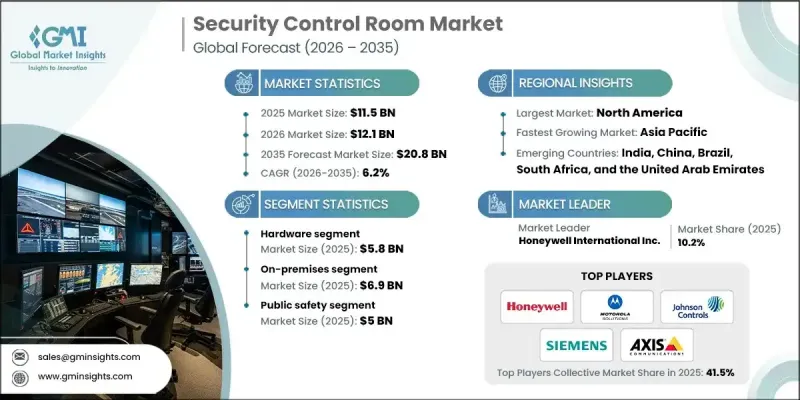
The Global Security Control Room Market was valued at USD 11.5 billion in 2025 and is estimated to grow at a CAGR of 6.2% to reach USD 20.8 billion by 2035.
Market development is driven by accelerating urban expansion, rising investments in smart city initiatives, heightened focus on public safety and national security, and the continued build-out of critical infrastructure and transportation networks. Organizations across both public and private sectors are increasingly prioritizing centralized security operations to improve monitoring, coordination, and response capabilities. Security control rooms are evolving into highly integrated operational environments that support real-time decision-making and unified oversight. Growing reliance on advanced command and control platforms is improving situational awareness while enabling faster incident management and operational continuity. As cities, enterprises, and infrastructure operators pursue resilience and risk mitigation, demand for sophisticated control room environments continues to rise. This momentum is reinforced by modernization efforts aimed at improving reliability, interoperability, and operational efficiency across security ecosystems.
| Market Scope | |
|---|---|
| Start Year | 2025 |
| Forecast Year | 2026-2035 |
| Start Value | $11.5 Billion |
| Forecast Value | $20.8 Billion |
| CAGR | 6.2% |
Rapid urban development is driving governments to upgrade infrastructure to manage population density, mobility, and safety more effectively. Centralized command facilities are becoming integral to urban management strategies by consolidating monitoring, coordination, and emergency response capabilities into single operational environments. These facilities support real-time visibility and faster reaction during incidents, strengthening public sector demand for advanced control room investments. Governments are also expanding security capabilities to address evolving threats that require improved coordination and data-driven awareness. Control rooms are increasingly serving as central hubs for continuous monitoring and response through integrated data streams from surveillance and communication systems.
The hardware segment generated USD 5.8 billion in 2025. Demand is being supported by increased deployment of advanced visualization systems, sensors, and display technologies designed to deliver reliable, real-time monitoring. Infrastructure upgrades across public services, transportation, and essential facilities are further accelerating the adoption of hardware-intensive control room solutions.
The on-premises segment reached USD 6.9 billion in 2025. Strong demand from government bodies and operators of critical assets continues to support this segment, as localized data control and system reliability remain top priorities. Ongoing modernization of urban and transport infrastructure is driving on-premises deployments due to their performance consistency and low-latency operation.
North America Security Control Room Market accounted for 34.6% share in 2025. Regional growth is supported by integration of control rooms with emergency communication systems, real-time analytics platforms, and coordinated response frameworks across multiple administrative levels. Investment priorities focus on improving interoperability, operational visibility, and coordinated response capabilities.
Key companies operating in the Global Security Control Room Market include Honeywell International Inc, Siemens AG, Motorola Solutions, Axis Communications AB, Genetec Inc., ABB Ltd., Johnson Controls International, Barco NV, Hexagon AB, Securitas Technology, Eizo Corporation, Tyler Technologies, Convergint Technologies LLC, Hangzhou Hikvision Digital Technology Co., Ltd., Kastle Systems, Milestone Systems A/S, RGB Spectrum, ATEN INTERNATIONAL Co., Ltd., Buren Systems International BV, Access Hardware, Inc., and AxxonSoft. Companies in the Global Security Control Room Market are reinforcing their competitive position through continuous innovation and expansion of integrated solutions. Many providers are investing in advanced software platforms that enhance real-time analytics, system interoperability, and centralized command capabilities. Strategic partnerships with governments, infrastructure operators, and technology firms are helping expand market reach and accelerate deployment. Firms are also focusing on modular and scalable designs to support diverse operational requirements.
Table of Contents
Chapter 1 Methodology and Scope
- 1.1 Market scope and definition
- 1.2 Research design
- 1.2.1 Research approach
- 1.2.2 Data collection methods
- 1.3 Data mining sources
- 1.3.1 Global
- 1.3.2 Regional/Country
- 1.4 Base estimates and calculations
- 1.4.1 Base year calculation
- 1.4.2 Key trends for market estimation
- 1.5 Primary research and validation
- 1.5.1 Primary sources
- 1.6 Forecast model
- 1.7 Research assumptions and limitations
Chapter 2 Executive Summary
- 2.1 Industry 3600 synopsis
- 2.2 Key market trends
- 2.2.1 Offering trends
- 2.2.2 Deployment mode trends
- 2.2.3 Application trends
- 2.2.4 End use trends
- 2.2.5 Regional trends
- 2.3 TAM Analysis, 2026-2035 (USD Million)
- 2.4 CXO perspectives: Strategic imperatives
- 2.4.1 Executive decision points
- 2.4.2 Critical success factors
- 2.5 Future outlook and strategic recommendations
Chapter 3 Industry Insights
- 3.1 Industry ecosystem analysis
- 3.1.1 Supplier landscape
- 3.1.2 Profit margin
- 3.1.3 Cost structure
- 3.1.4 Value addition at each stage
- 3.1.5 Factor affecting the value chain
- 3.1.6 Disruptions
- 3.2 Industry impact forces
- 3.2.1 Growth drivers
- 3.2.1.1 Rising urbanization and smart city investments
- 3.2.1.2 Increasing public safety and homeland security concerns
- 3.2.1.3 Expansion of critical infrastructure and transportation networks
- 3.2.1.4 Growing adoption of integrated command and control systems
- 3.2.1.5 Rising corporate demand for centralized security operations
- 3.2.2 Pitfalls and challenges
- 3.2.2.1 High initial capital and system integration costs
- 3.2.2.2 Cybersecurity risks and data privacy concerns
- 3.2.1 Growth drivers
- 3.3 Growth potential analysis
- 3.4 Regulatory landscape
- 3.4.1 North America
- 3.4.2 Europe
- 3.4.3 Asia Pacific
- 3.4.4 Latin America
- 3.4.5 Middle East & Africa
- 3.5 Porter's analysis
- 3.6 PESTEL analysis
- 3.7 Technology and Innovation landscape
- 3.7.1 Current technological trends
- 3.7.2 Emerging technologies
- 3.8 Emerging Business Models
- 3.9 Compliance Requirements
- 3.10 Sustainability Initiatives
- 3.11 Supply Chain Resilience
- 3.12 Geopolitical Analysis
- 3.13 Digital Transformation
Chapter 4 Competitive Landscape, 2025
- 4.1 Introduction
- 4.2 Company market share analysis
- 4.2.1 By region
- 4.2.1.1 North America
- 4.2.1.2 Europe
- 4.2.1.3 Asia Pacific
- 4.2.1.4 Latin America
- 4.2.1.5 Middle East & Africa
- 4.2.2 Market concentration analysis
- 4.2.1 By region
- 4.3 Competitive benchmarking of key players
- 4.3.1 Product portfolio comparison
- 4.3.1.1 Product range breadth
- 4.3.1.2 Technology
- 4.3.1.3 Innovation
- 4.3.2 Geographic presence comparison
- 4.3.2.1 Global footprint analysis
- 4.3.2.2 Service network coverage
- 4.3.2.3 Market penetration by region
- 4.3.3 Competitive positioning matrix
- 4.3.3.1 Leaders
- 4.3.3.2 Challengers
- 4.3.3.3 Followers
- 4.3.3.4 Niche players
- 4.3.4 Strategic outlook matrix
- 4.3.1 Product portfolio comparison
- 4.4 Key developments, 2022-2025
- 4.4.1 Mergers and acquisitions
- 4.4.2 Partnerships and collaborations
- 4.4.3 Technological advancements
- 4.4.4 Expansion and investment strategies
- 4.4.5 Sustainability initiatives
- 4.4.6 Digital transformation initiatives
- 4.5 Emerging/ startup competitors landscape
Chapter 5 Market Estimates and Forecast, By Offering, 2022 - 2035 (USD Million)
- 5.1 Key trends
- 5.2 Hardware
- 5.2.1 Display systems
- 5.2.2 Projectors
- 5.2.3 KVM switches & control equipment
- 5.2.4 Operator workstations & consoles
- 5.2.5 Network infrastructure equipment
- 5.2.6 Servers & storage systems
- 5.2.7 Others
- 5.3 Software
- 5.3.1 Video Management Systems (VMS)
- 5.3.2 Physical Security Information Management (PSIM)
- 5.3.3 Access control management software
- 5.3.4 Analytics & AI/ML platforms
- 5.3.5 Incident management systems
- 5.3.6 Command & control platforms
- 5.3.7 Visualization & dashboard software
- 5.3.8 Others
- 5.4 Services
- 5.4.1 System integration & installation services
- 5.4.2 Maintenance & technical support
- 5.4.3 Consulting & design services
- 5.4.4 Training & operator development
- 5.4.5 Others
Chapter 6 Market Estimates and Forecast, By Deployment Mode, 2022 - 2035 (USD Million)
- 6.1 Key trends
- 6.2 On-premises
- 6.3 Cloud-based
- 6.4 Hybrid
Chapter 7 Market Estimates and Forecast, By Application, 2022 - 2035 (USD Million)
- 7.1 Key trends
- 7.2 Public safety
- 7.3 Corporate safety
- 7.4 Industrial safety
Chapter 8 Market Estimates and Forecast, By End Use, 2022 - 2035 (USD Million)
- 8.1 Key trends
- 8.2 Government & defense
- 8.2.1 Law enforcement & police operations
- 8.2.2 Military & defense
- 8.2.3 Border security & immigration control
- 8.2.4 Intelligence & national security agencies
- 8.2.5 Others
- 8.3 Transportation
- 8.3.1 Airports & aviation security
- 8.3.2 Seaports & maritime security
- 8.3.3 Railways & mass transit systems
- 8.3.4 Logistics & distribution centers
- 8.3.5 Others
- 8.4 BFSI
- 8.4.1 Bank branches & atm networks
- 8.4.2 Data centers
- 8.4.3 Others
- 8.5 Manufacturing
- 8.5.1 Automotive
- 8.5.2 Electronics & semiconductor
- 8.5.3 Aerospace & defense
- 8.5.4 Chemicals & petrochemicals
- 8.5.5 Food & beverage
- 8.5.6 Others
- 8.6 Utilities
- 8.6.1 Power generation & distribution
- 8.6.2 Water & wastewater treatment
- 8.6.3 Oil & gas infrastructure
- 8.6.4 Others
- 8.7 Healthcare
- 8.7.1 Hospitals & medical centers
- 8.7.2 Pharmaceutical manufacturing
- 8.7.3 Patient safety & access control
- 8.7.4 Others
- 8.8 Retail & commercial real estate
- 8.8.1 Shopping malls & retail chains
- 8.8.2 Corporate office buildings
- 8.8.3 Commercial complexes
- 8.8.4 Others
- 8.9 Others
Chapter 9 Market Estimates and Forecast, By Region, 2022 - 2035 (USD Million)
- 9.1 Key trends
- 9.2 North America
- 9.2.1 U.S.
- 9.2.2 Canada
- 9.3 Europe
- 9.3.1 Germany
- 9.3.2 UK
- 9.3.3 France
- 9.3.4 Spain
- 9.3.5 Italy
- 9.3.6 Netherlands
- 9.4 Asia Pacific
- 9.4.1 China
- 9.4.2 India
- 9.4.3 Japan
- 9.4.4 Australia
- 9.4.5 South Korea
- 9.5 Latin America
- 9.5.1 Brazil
- 9.5.2 Mexico
- 9.5.3 Argentina
- 9.6 Middle East and Africa
- 9.6.1 Saudi Arabia
- 9.6.2 South Africa
- 9.6.3 UAE
Chapter 10 Company Profiles
- 10.1 Global Key Players
- 10.1.1 ABB Ltd.
- 10.1.2 Honeywell International Inc
- 10.1.3 Siemens AG
- 10.1.4 Johnson Controls International
- 10.1.5 Motorola Solutions
- 10.2 Regional Key Players
- 10.2.1 North America
- 10.2.1.1 Convergint Technologies LLC
- 10.2.1.2 Genetec Inc.
- 10.2.1.3 Tyler Technologies
- 10.2.1.4 Kastle Systems
- 10.2.1.5 Access Hardware, Inc.
- 10.2.2 Europe
- 10.2.2.1 Axis Communications AB
- 10.2.2.2 Barco NV
- 10.2.2.3 Milestone Systems A/S
- 10.2.2.4 Hexagon AB
- 10.2.2.5 Buren Systems International BV
- 10.2.3 Asia Pacific
- 10.2.3.1 Hangzhou Hikvision Digital Technology Co., Ltd.
- 10.2.3.2 Eizo Corporation
- 10.2.3.3 ATEN INTERNATIONAL Co., Ltd.
- 10.2.1 North America
- 10.3 Niche / Disruptors
- 10.3.1 RGB Spectrum
- 10.3.2 Securitas Technology
- 10.3.3 AxxonSoft