|
시장보고서
상품코드
1665250
지능형 교통 신호 시스템 시장 : 기회, 성장 촉진요인, 산업 동향 분석, 예측(2025-2034년)Intelligent Traffic Signal System Market Opportunity, Growth Drivers, Industry Trend Analysis, and Forecast 2025 - 2034 |
||||||

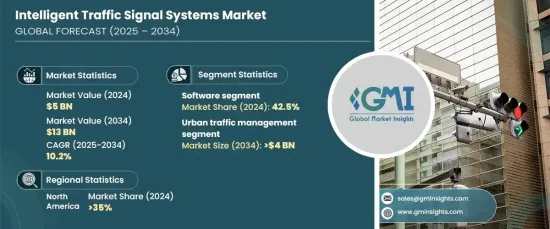
세계의 지능형 교통 신호 시스템 시장은 2024년 50억 달러로 평가되었으며, 2025-2034년까지 CAGR 10.2%로 강력한 성장을 이룰 것으로 예측되고 있습니다.
이 성장의 원동력이 되는 것은 교통 관리 시스템을 변화시켜 보다 효율적이고 적응성이 높은 최첨단 기술의 진보입니다. 인공지능(AI)과 머신러닝(ML)을 통합함으로써 지능형 교통 신호는 실시간 데이터를 분석하고 교통 패턴을 인식하며 현재 도로 상황에 따라 신호의 타이밍을 조정할 수 있습니다. 이러한 혁신은 교통 체증을 완화하고 지연을 최소화하며 전반적인 교통 흐름을 개선하는 데 필수적입니다.

도시화와 도로를 달리는 자동차 수 증가가 시장의 성장을 가속하는 주요 요인이 되고 있습니다. 도시가 계속 성장하고 도시 인구가 확대됨에 따라 교통량이 증가하여 교통 체증, 이동 시간 연장, 교통 통제 비효율화로 이어지고 있습니다. 도시계획자와 교통당국이 이러한 임박한 과제에 대처하는 방법을 모색하고 있기 때문에 보다 스마트하고 효과적인 교통관리 솔루션에 대한 수요는 과거 없을 정도로 높아지고 있습니다.
| 시장 범위 | |
|---|---|
| 시작 연도 | 2024년 |
| 예측 연도 | 2025-2034년 |
| 시작 금액 | 50억 달러 |
| 예측 금액 | 130억 달러 |
| CAGR | 10.2% |
시장은 대중교통 관리, 고속도로 교통관리, 도시 교통관리, 스마트시티 구상, 긴급차량관리 등 다양한 용도로 구분됩니다. 2024년에는 도시 교통관리가 시장 점유율의 31%를 차지했고, 2034년에는 40억 달러에 이를 것으로 예측됩니다. 이러한 성장은 도시 확대에 따른 과제와 도시를 원활하게 운영하기 위한 혁신적인 이동성 솔루션에 대한 필요성이 커지는 요인이 되고 있습니다.
구성 요소의 관점에서 지능형 교통 신호 시스템 시장은 하드웨어, 소프트웨어 및 서비스로 나뉩니다. 소프트웨어 부문은 2024년에 42.5% 시장 점유율을 차지했으며 교통 운행 최적화에서 중요한 역할을 반영합니다. 소프트웨어 솔루션은 실시간 교통 데이터를 처리하고 신호 타이밍을 동적으로 조정하며 교통 시스템의 성능을 모니터링하는 데 필수적입니다. 고정된 신호 타이밍에 의존하는 전통적인 시스템과는 달리, 지능형 시스템은 첨단 알고리즘을 이용하여 교통 흐름을 분석하고, 변화하는 상황에 적응하고, 신호 위상을 최적화함으로써 효율 향상과 정체 완화를 실현합니다.
북미는 세계 지능형 교통 신호 시스템 시장의 35%라는 큰 점유율을 차지하고 있습니다. 이는 주로 이 지역의 첨단 인프라, 스마트 시티 프로젝트에 대한 많은 투자, 최첨단 기술의 광범위한 채용으로 인한 것입니다. 북미 전역의 도시는 급속한 도시화의 결과로 심각한 교통 정체에 직면하고 있습니다. 지방정부와 교통은 교통관리를 최적화하고, 정체를 완화하고, 교통안전을 개선하기 위해 최첨단 솔루션에 대한 투자를 늘리고 있습니다. AI, ML, 실시간 데이터를 활용한 지능형 교통 신호 시스템의 활용은 교통 정체 지연을 줄이고 교통량이 많은 도로에서 차량의 흐름을 강화하는 데 매우 중요합니다.
목차
제1장 조사 방법과 조사 범위
- 조사 디자인
- 조사 접근
- 데이터 수집 방법
- 기본 추정과 계산
- 기준연도의 산출
- 시장 추정의 주요 동향
- 예측 모델
- 1차 조사와 검증
- 1차 정보
- 데이터 마이닝 소스
- 시장 정의
제2장 주요 요약
제3장 산업 인사이트
- 생태계 분석
- 공급자의 상황
- 하드웨어 제조업체
- 소프트웨어 개발 제조업체
- 기술 제공업체
- 시스템 통합자
- 최종 사용자
- 이익률 분석
- 기술 혁신의 상황
- 특허 상황
- 주요 뉴스와 이니셔티브
- 규제 상황
- 영향요인
- 성장 촉진요인
- 도시화와 교통 정체 증가
- 정부의 이니셔티브와 스마트 시티 프로젝트
- 교통 관리 기술의 진보
- 기타 교통 시스템과의 통합
- 실시간 교통 모니터링 및 데이터 분석 수요
- 산업의 잠재적 리스크 및 과제
- 통합의 과제와 복잡성
- 데이터 프라이버시 및 보안에 대한 우려
- 성장 촉진요인
- 성장 가능성 분석
- Porter's Five Forces 분석
- PESTEL 분석
제4장 경쟁 구도
- 소개
- 기업 점유율 분석
- 경쟁 포지셔닝 매트릭스
- 전략 전망 매트릭스
제5장 시장 추정·예측 : 기술별, 2021-2034년
- 주요 동향
- 정시 신호 시스템
- 차량 작동 신호 시스템
- 적응형 신호 제어 시스템
- 인공지능형 신호 시스템
- 커넥티드 차량형 신호 시스템
제6장 시장 추정·예측 : 컴포넌트별, 2021-2034년
- 주요 동향
- 하드웨어
- 교통 신호 컨트롤러
- 센서
- 통신 기기
- 전원 시스템
- 소프트웨어
- 교통 관리 소프트웨어
- 분석 플랫폼
- 클라우드 기반 솔루션
- 서비스
- 설치
- 유지보수
- 컨설팅
- 통합 서비스
제7장 시장 추정·예측 : 용도별, 2021-2034년
- 주요 동향
- 도시 교통 관리
- 고속도로 교통 관리
- 스마트 시티에 대한 대처
- 대중교통관리
- 긴급 차량 관리
제8장 시장 추정·예측 : 최종 용도별, 2021-2034년
- 주요 동향
- 정부 교통 부문
- 지방자치단체
- 고속도로 당국
- 공공 수송
- 스마트 시티 개발 기업
- 민간 인프라 회사
제9장 시장 추정·예측 : 지역별, 2021-2034년
- 주요 동향
- 북미
- 미국
- 캐나다
- 유럽
- 영국
- 독일
- 프랑스
- 스페인
- 이탈리아
- 러시아
- 북유럽
- 아시아태평양
- 중국
- 인도
- 일본
- 한국
- 뉴질랜드
- 동남아시아
- 라틴아메리카
- 브라질
- 멕시코
- 아르헨티나
- 중동 및 아프리카
- 아랍에미리트(UAE)
- 남아프리카
- 사우디아라비아
제10장 기업 프로파일
- AECOM
- Cubic
- Dynniq
- Econolite
- Intelligent Traffic Systems
- Iteris Inc
- Kapsch
- LG CNS
- LITE-ON Technology
- Parsons
- Q-Free
- Sensys Networks
- Serco Group
- Siemens
- Sumitomo
- Swarco
- Teledyne FLIR
- Traffic Technology Services
- TransCore
- Yangzhou Xintong Transport Equipment Group
The Global Intelligent Traffic Signal System Market was valued at USD 5 billion in 2024 and is projected to experience robust growth at a CAGR of 10.2% from 2025 to 2034. This growth is driven by cutting-edge advancements in technology that are transforming traffic management systems, making them more efficient and adaptable. By integrating artificial intelligence (AI) and machine learning (ML), intelligent traffic signals can analyze real-time data, recognize traffic patterns, and adjust signal timings according to current road conditions. These innovations are vital for reducing congestion, minimizing delays, and enhancing overall traffic flow.
Urbanization and the increasing number of vehicles on the road are key factors fueling the growth of the market. As cities continue to grow and urban populations expand, traffic volumes are rising, leading to congestion, longer travel times, and inefficiencies in traffic control. The demand for smarter, more effective traffic management solutions has never been greater as city planners and transportation authorities look for ways to address these pressing challenges.
| Market Scope | |
|---|---|
| Start Year | 2024 |
| Forecast Year | 2025-2034 |
| Start Value | $5 Billion |
| Forecast Value | $13 Billion |
| CAGR | 10.2% |
The market is segmented into various applications, including public transportation management, highway traffic management, urban traffic management, smart city initiatives, and emergency vehicle management. In 2024, urban traffic management accounted for 31% of the market share, and it is projected to reach USD 4 billion by 2034. This growth is largely driven by the mounting challenges associated with urban expansion and the increasing need for innovative mobility solutions to keep cities running smoothly.
From a component standpoint, the intelligent traffic signal system market is divided into hardware, software, and services. The software segment commanded a 42.5% market share in 2024, reflecting its critical role in optimizing traffic operations. Software solutions are essential for processing real-time traffic data, adjusting signal timings dynamically, and monitoring the performance of traffic systems. Unlike traditional systems that rely on fixed signal timings, intelligent systems make use of advanced algorithms to analyze traffic flow, adapt to evolving conditions, and optimize signal phases, resulting in improved efficiency and reduced congestion.
North America holds a significant 35% share of the global intelligent traffic signal system market. This is primarily due to the region's advanced infrastructure, substantial investments in smart city projects, and widespread adoption of cutting-edge technologies. Cities across North America are facing severe traffic congestion as a result of rapid urbanization. Local governments and transportation agencies are increasingly investing in state-of-the-art solutions to optimize traffic management, alleviate congestion, and improve road safety. The use of intelligent traffic signal systems powered by AI, ML, and real-time data is crucial in reducing traffic delays and enhancing the flow of vehicles on busy roads.
Table of Contents
Chapter 1 Methodology & Scope
- 1.1 Research design
- 1.1.1 Research approach
- 1.1.2 Data collection methods
- 1.2 Base estimates and calculations
- 1.2.1 Base year calculation
- 1.2.2 Key trends for market estimates
- 1.3 Forecast model
- 1.4 Primary research & validation
- 1.4.1 Primary sources
- 1.4.2 Data mining sources
- 1.5 Market definitions
Chapter 2 Executive Summary
- 2.1 Industry 3600 synopsis, 2021 - 2034
Chapter 3 Industry Insights
- 3.1 Industry ecosystem analysis
- 3.2 Supplier landscape
- 3.2.1 Hardware manufacturers
- 3.2.2 Software developers
- 3.2.3 Technology providers
- 3.2.4 System integrators
- 3.2.5 End users
- 3.3 Profit margin analysis
- 3.4 Technology & innovation landscape
- 3.5 Patent landscape
- 3.6 Key news & initiatives
- 3.7 Regulatory landscape
- 3.8 Impact forces
- 3.8.1 Growth drivers
- 3.8.1.1 Increasing urbanization and traffic congestion
- 3.8.1.2 Government initiatives and smart city projects
- 3.8.1.3 Technological advancements in traffic management
- 3.8.1.4 Integration with other transportation systems
- 3.8.1.5 Demand for real-time traffic monitoring and data analytics
- 3.8.2 Industry pitfalls & challenges
- 3.8.2.1 Integration challenges and complexity
- 3.8.2.2 Data privacy and security concerns
- 3.8.1 Growth drivers
- 3.9 Growth potential analysis
- 3.10 Porter’s analysis
- 3.11 PESTEL analysis
Chapter 4 Competitive Landscape, 2024
- 4.1 Introduction
- 4.2 Company market share analysis
- 4.3 Competitive positioning matrix
- 4.4 Strategic outlook matrix
Chapter 5 Market Estimates & Forecast, By Technology, 2021 - 2034 ($Bn)
- 5.1 Key trends
- 5.2 Fixed time signal system
- 5.3 Vehicle actuated signal system
- 5.4 Adaptive signal control system
- 5.5 Artificial intelligence-based signal system
- 5.6 Connected vehicle-based signal system
Chapter 6 Market Estimates & Forecast, By Component, 2021 - 2034 ($Bn)
- 6.1 Key trends
- 6.2 Hardware
- 6.2.1 Traffic signal controllers
- 6.2.2 Sensors
- 6.2.3 Communication devices
- 6.2.4 Power supply systems
- 6.3 Software
- 6.3.1 Traffic management software
- 6.3.2 Analytics platforms
- 6.3.3 Cloud-based solutions
- 6.4 Services
- 6.4.1 Installation
- 6.4.2 Maintenance
- 6.4.3 Consulting
- 6.4.4 Integration services
Chapter 7 Market Estimates & Forecast, By Application, 2021 - 2034 ($Bn)
- 7.1 Key trends
- 7.2 Urban traffic management
- 7.3 Highway traffic management
- 7.4 Smart city initiatives
- 7.5 Public transportation management
- 7.6 Emergency vehicle management
Chapter 8 Market Estimates & Forecast, By End Use, 2021 - 2034 ($Bn)
- 8.1 Key trends
- 8.2 Government transportation departments
- 8.3 Municipal corporations
- 8.4 Highway authorities
- 8.5 Public transit agencies
- 8.6 Smart city developers
- 8.7 Private infrastructure companies
Chapter 9 Market Estimates & Forecast, By Region, 2021 - 2034 ($Bn)
- 9.1 Key trends
- 9.2 North America
- 9.2.1 U.S.
- 9.2.2 Canada
- 9.3 Europe
- 9.3.1 UK
- 9.3.2 Germany
- 9.3.3 France
- 9.3.4 Spain
- 9.3.5 Italy
- 9.3.6 Russia
- 9.3.7 Nordics
- 9.4 Asia Pacific
- 9.4.1 China
- 9.4.2 India
- 9.4.3 Japan
- 9.4.4 South Korea
- 9.4.5 ANZ
- 9.4.6 Southeast Asia
- 9.5 Latin America
- 9.5.1 Brazil
- 9.5.2 Mexico
- 9.5.3 Argentina
- 9.6 MEA
- 9.6.1 UAE
- 9.6.2 South Africa
- 9.6.3 Saudi Arabia
Chapter 10 Company Profiles
- 10.1 AECOM
- 10.2 Cubic
- 10.3 Dynniq
- 10.4 Econolite
- 10.5 Intelligent Traffic Systems
- 10.6 Iteris Inc
- 10.7 Kapsch
- 10.8 LG CNS
- 10.9 LITE-ON Technology
- 10.10 Parsons
- 10.11 Q-Free
- 10.12 Sensys Networks
- 10.13 Serco Group
- 10.14 Siemens
- 10.15 Sumitomo
- 10.16 Swarco
- 10.17 Teledyne FLIR
- 10.18 Traffic Technology Services
- 10.19 TransCore
- 10.20 Yangzhou Xintong Transport Equipment Group