


|
시장보고서
상품코드
1665262
피부 치료 스파 시장 : 시장 기회, 성장 촉진요인, 산업 동향 분석, 예측(2025-2034년)Skin Treatment Spa Market Opportunity, Growth Drivers, Industry Trend Analysis, and Forecast 2025 - 2034 |
||||||

세계의 피부 치료 스파 시장은 2024년에 363억 달러에 달하였고, 2025년부터 2034년까지 10.3%라는 경이적인 CAGR로 성장할 것으로 예측되고 있습니다. 이 강력한 확대의 배경으로는 피부 건강에 대한 의식이 높아지고, 개발 도상 지역에서 가처분 소득 증가, 스킨 케어 기술의 급속한 진보, 웰니스 투어리즘 증가가 있습니다. 홀리스틱한 건강지향의 고조 및 노령화로 전문적인 피부 치료에 대한 수요가 더욱 높아지고 시장은 지속적인 성장을 이룰 것으로 예상됩니다.
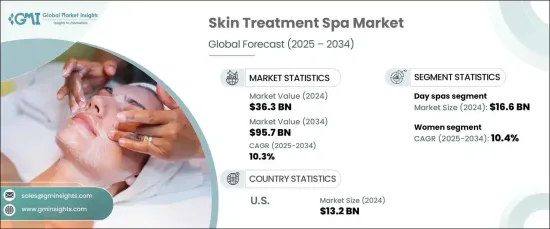
시장은 시설 유형별로 개인 클리닉, 데이 스파, 메디컬 스파, 리조트 및 호텔 스파, 데스티네이션 스파 등으로 구분됩니다. 그 중에서도 데이 스파는 2024년 수익이 166억 달러로 돌출했으며, 2034년 CAGR은 10.7%로 높은 성장이 예측되고 있습니다. 이러한 시설은 건강 지향 소비자를 끌어들이기 위해 명상과 스트레스 해소 요법 등 웰빙에 초점을 맞춘 서비스를 통합함으로써 점점 매력을 높이고 있습니다. 게다가 천연, 유기농, 지속가능한 스킨케어 제품에 대한 선호도 증가는 성분의 안전성과 환경의 지속가능성에 대한 소비자의 의식 증가를 반영하여 스파 제품의 진화를 형성하고 있습니다.
| 시장 범위 | |
|---|---|
| 시작 연도 | 2024년 |
| 예측 연도 | 2025-2034년 |
| 시작 금액 | 363억 달러 |
| 예측 금액 | 957억 달러 |
| CAGR | 10.3% |
소비자 그룹별로 보면 시장은 남성과 여성으로 나뉘며 2024년 시장 점유율은 여성이 78%로 압도적이었습니다. 이 부문은 2034년까지 연평균 복합 성장률(CAGR) 10.4%로 성장할 것으로 예상됩니다. 케미컬 필링, 레이저 치료, 피부 충전제 등의 안티 에이징 치료에 대한 수요가 높아짐에 따라 30-50세 여성이 주요 소비자가 되고 있습니다. 이러한 솔루션은 주름, 색소 침착, 전반적인 피부 회춘과 같은 일반적인 문제를 해결합니다. 게다가 스킨 케어의 유지보수에 대한 의식 증가와 비침습적인 치료의 인기는 이 층의 지속적인 성장에 기여하고 있습니다.
북미에서는 피부 치료 스파 시장이 2024년 132억 달러를 창출했으며, 미국이 이 지역의 성장 궤도를 이끌고 있습니다. 미국 시장은 비외과적 치료와 안티 에이징 솔루션의 인기가 높아짐에 따라 2034년까지 연평균 복합 성장률(CAGR) 10.3%로 확대될 것으로 예측됩니다. 소비자는 주름, 여드름, 색소 침착, 피부 전체의 건강을 다루는 스킨 케어 습관을 점점 더 우선시하고 있습니다. 보톡스, 피부 충전제, 미세박피술, 레이저 리서피싱 등의 비침습적 치료는 효능, 최소한의 회복 시간 및 사용하기 쉬워지고 있는 것으로 인해 여전히 높은 인기를 얻고 있습니다.
목차
제1장 조사 방법 및 조사 범위
- 시장 범위 및 정의
- 기본 추정 및 계산
- 예측 계산
- 데이터 소스
- 1차 데이터
- 2차 데이터
- 유료 정보원
- 공적 정보원
제2장 주요 요약
제3장 산업 인사이트
- 생태계 분석
- 밸류체인에 영향을 미치는 요인
- 이익률 분석
- 변혁
- 장래 전망
- 서비스 제공업체
- 이익률 분석
- 주요 뉴스 및 대처
- 규제 상황
- 영향 요인
- 성장 촉진요인
- 피부 건강에 대한 의식 고조
- 치료 기술의 진보
- 산업의 잠재적 리스크 및 과제
- 계절 수요
- 문화적 감수성 및 동향
- 성장 촉진요인
- 성장 가능성 분석
- Porter's Five Forces 분석
- PESTEL 분석
제4장 경쟁 구도
- 서문
- 기업 점유율 분석
- 경쟁 포지셔닝 매트릭스
- 전략 전망 매트릭스
제5장 시장 추정 및 예측 : 서비스 유형별(2021-2034년)
- 주요 동향
- 페이셜 치료
- 케미컬 필링
- 미세박피술
- 레이저 치료
- 주사 치료
- 기타(안티에이징 치료 등)
제6장 시장 추정 및 예측 : 피부 유형별(2021-2034년)
- 주요 동향
- 보통 피부
- 건조 피부
- 지성 피부
- 혼합 피부
- 기타(민감한 피부 등)
제7장 시장 추정 및 예측 : 시설 유형별(2021-2034년)
- 주요 동향
- 데이 스파
- 리조트 및 호텔 스파
- 메디컬 스파
- 데스티네이션 스파
- 프라이빗 클리닉
- 기타(웰니스 리트리트 등)
제8장 시장 추정 및 예측 : 가격별(2021-2034년)
- 주요 동향
- 예산
- 고가격
- 초고가격
제9장 시장 추정 및 예측 : 소비자 그룹별(2021-2034년)
- 주요 동향
- 남성
- 여성
제10장 시장 추정 및 예측 : 연령층별(2021-2034년)
- 주요 동향
- 18세 이하
- 19-35세
- 36-50세
- 50세 이상
제11장 시장 추정 및 예측 : 지역별(2021-2034년)
- 주요 동향
- 북미
- 미국
- 캐나다
- 유럽
- 영국
- 독일
- 프랑스
- 이탈리아
- 스페인
- 러시아
- 아시아태평양
- 중국
- 인도
- 일본
- 한국
- 호주
- 라틴아메리카
- 브라질
- 멕시코
- 중동 및 아프리카
- 아랍에미리트(UAE)
- 사우디아라비아
- 남아프리카
제12장 기업 프로파일
- Bamford Spa
- Bvlgari Hotel London
- Champneys
- Clarins
- COMO Shambhala
- Cowshed
- Elemis
- ESPA Life at Corinthia
- Harrods
- Lanesborough Club and Spa
- PURE Spa &Beauty
- Ragdale Hall Spa
- The Face Spa London
- The Greenwich Spa
- Titanic Spa
The Global Skin Treatment Spa Market reached USD 36.3 billion in 2024 and is projected to grow at an impressive compound annual growth rate (CAGR) of 10.3% from 2025 to 2034. This robust expansion is fueled by growing awareness of skin health, rising disposable incomes in developing regions, rapid advancements in skincare technologies, and an increase in wellness tourism. A heightened focus on holistic well-being and an aging population further amplify the demand for professional skin treatments, positioning the market for sustained growth.
The market is segmented by facility type into private clinics, day spas, medical spas, resort and hotel spas, destination spas, and others. Among these, day spas stood out with a revenue of USD 16.6 billion in 2024 and are forecasted to grow at a strong CAGR of 10.7% through 2034. These facilities are increasingly enhancing their appeal by integrating wellness-focused services, such as meditation and stress-relief therapies, to attract health-conscious consumers. Furthermore, the rising preference for natural, organic, and sustainable skincare products reflects growing consumer awareness of ingredient safety and environmental sustainability, which is shaping the evolution of spa offerings.
| Market Scope | |
|---|---|
| Start Year | 2024 |
| Forecast Year | 2025-2034 |
| Start Value | $36.3 Billion |
| Forecast Value | $95.7 Billion |
| CAGR | 10.3% |
By consumer group, the market is divided into men and women, with women dominating the landscape at a 78% market share in 2024. This segment is expected to grow at a CAGR of 10.4% through 2034. Women aged 30-50 are the primary consumers, driven by the increasing demand for anti-aging treatments such as chemical peels, laser therapies, and dermal fillers. These solutions address prevalent concerns like wrinkles, pigmentation, and overall skin rejuvenation. Additionally, rising awareness of skincare maintenance and the popularity of non-invasive procedures contribute to the sustained growth of this demographic.
In North America, the skin treatment spa market generated USD 13.2 billion in 2024, with the U.S. leading the region's growth trajectory. The U.S. market is projected to expand at a CAGR of 10.3% through 2034, driven by the growing popularity of non-surgical treatments and anti-aging solutions. Consumers are increasingly prioritizing skincare routines to address aging, acne, pigmentation, and overall skin health. Non-invasive treatments, including Botox, dermal fillers, microdermabrasion, and laser resurfacing, remain highly sought after due to their effectiveness, minimal recovery time, and growing accessibility.
Table of Contents
Chapter 1 Methodology & Scope
- 1.1 Market scope & definitions
- 1.2 Base estimates & calculations
- 1.3 Forecast calculations.
- 1.4 Data sources
- 1.4.1 Primary
- 1.4.2 Secondary
- 1.4.2.1 Paid sources
- 1.4.2.2 Public sources
Chapter 2 Executive Summary
- 2.1 Industry synopsis, 2021-2034
Chapter 3 Industry Insights
- 3.1 Industry ecosystem analysis
- 3.1.1 Factor affecting the value chain.
- 3.1.2 Profit margin analysis.
- 3.1.3 Disruptions
- 3.1.4 Future outlook
- 3.1.5 Service providers
- 3.2 Profit margin analysis.
- 3.3 Key news & initiatives
- 3.4 Regulatory landscape
- 3.5 Impact forces
- 3.5.1 Growth drivers
- 3.5.1.1 Increased awareness of skin health
- 3.5.1.2 Advancements in treatment technologies
- 3.5.2 Industry pitfalls & challenges
- 3.5.2.1 Seasonal demand
- 3.5.2.2 Cultural sensitivity and trends
- 3.5.1 Growth drivers
- 3.6 Growth potential analysis
- 3.7 Porter’s analysis
- 3.8 PESTEL analysis
Chapter 4 Competitive Landscape, 2024
- 4.1 Introduction
- 4.2 Company market share analysis
- 4.3 Competitive positioning matrix
- 4.4 Strategic outlook matrix
Chapter 5 Market Estimates & Forecast, By Service Type, 2021-2034 (USD Billion)
- 5.1 Key trends
- 5.2 Facial treatments
- 5.3 Chemical peels
- 5.4 Microdermabrasion
- 5.5 Laser treatments
- 5.6 Injectables
- 5.7 Others (anti-aging treatments etc.)
Chapter 6 Market Estimates & Forecast, By Skin Type, 2021-2034 (USD Billion)
- 6.1 Key trends
- 6.2 Normal skin
- 6.3 Dry skin
- 6.4 Oily skin
- 6.5 Combination skin
- 6.6 Others (sensitive skin etc.)
Chapter 7 Market Estimates & Forecast, By Facility Type, 2021-2034 (USD Billion)
- 7.1 Key trends
- 7.2 Day spas
- 7.3 Resort/hotel spas
- 7.4 Medical spas
- 7.5 Destination spas
- 7.6 Private clinics
- 7.7 Others (wellness retreats etc.)
Chapter 8 Market Estimates & Forecast, By Price, 2021-2034 (USD Billion)
- 8.1 Key trends
- 8.2 Budget
- 8.3 Premium
- 8.4 Luxury
Chapter 9 Market Estimates & Forecast, By Consumer Group, 2021-2034 (USD Billion)
- 9.1 Key trends
- 9.2 Men
- 9.3 Women
Chapter 10 Market Estimates & Forecast, By Age Group, 2021-2034 (USD Billion)
- 10.1 Key trends
- 10.2 Below 18
- 10.3 19 to 35
- 10.4 36 to 50
- 10.5 Above 50
Chapter 11 Market Estimates & Forecast, By Region, 2021-2034 (USD Billion)
- 11.1 Key trends
- 11.2 North America
- 11.2.1 U.S.
- 11.2.2 Canada
- 11.3 Europe
- 11.3.1 UK
- 11.3.2 Germany
- 11.3.3 France
- 11.3.4 Italy
- 11.3.5 Spain
- 11.3.6 Russia
- 11.4 Asia Pacific
- 11.4.1 China
- 11.4.2 India
- 11.4.3 Japan
- 11.4.4 South Korea
- 11.4.5 Australia
- 11.5 Latin America
- 11.5.1 Brazil
- 11.5.2 Mexico
- 11.6 MEA
- 11.6.1 UAE
- 11.6.2 Saudi Arabia
- 11.6.3 South Africa
Chapter 12 Company Profiles
- 12.1 Bamford Spa
- 12.2 Bvlgari Hotel London
- 12.3 Champneys
- 12.4 Clarins
- 12.5 COMO Shambhala
- 12.6 Cowshed
- 12.7 Elemis
- 12.8 ESPA Life at Corinthia
- 12.9 Harrods
- 12.10 Lanesborough Club and Spa
- 12.11 PURE Spa & Beauty
- 12.12 Ragdale Hall Spa
- 12.13 The Face Spa London
- 12.14 The Greenwich Spa
- 12.15 Titanic Spa


