|
시장보고서
상품코드
1666633
건축용 실란트 시장 기회, 성장 촉진요인, 업계 동향 분석 및 예측(2025-2034년)Construction Sealants Market Opportunity, Growth Drivers, Industry Trend Analysis, and Forecast 2025 - 2034 |
||||||

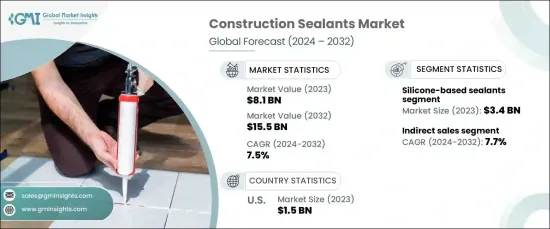
세계의 건축용 실란트 시장은 2024년에 81억 달러로 평가되었고 2025년부터 2034년에 걸쳐 CAGR 7.5%를 나타낼 것으로 예측됩니다.
이 성장의 주요 요인은 건설의 환경 친화적인 재료에 대한 수요 증가입니다.
지속가능성은 건설 업계에서 중요한 경쟁 요인이 되고 있으며, 각국 정부는 다양한 인센티브와 규제를 통해 이러한 변화를 지원하고 있습니다. 탄소 배출량 넷 제로의 달성을 향한 업계의 움직임에 따라, 에너지 효율이 높고 환경에 배려한 실링재 수요가 급증하고 있습니다. 소비자와 기업은 재료 조달과 제품 환경 영향에 대한 투명성을 강조합니다. 환경 제품 선언(EPD)과 ISO 준수와 같은 지속가능성이 인증된 실란트는 점점 더 희망되고 있습니다. 이러한 추세는 제품의 품질을 저하시키지 않으면서 환경에 대한 책임을 우선시하는 건설 산업의 보다 광범위한 움직임의 일부입니다.
| 시장 범위 | |
|---|---|
| 시작 연도 | 2024년 |
| 예측 연도 | 2025-2034년 |
| 시작 금액 | 81억 달러 |
| 예측 금액 | 155억 달러 |
| CAGR | 7.5% |
시장은 실리콘계, 우레탄계, 아크릴계, 폴리설파이드계 등 제품 유형별로 구분됩니다. 2024년에는 실리콘계 실란트가 시장을 선도하여 34억 달러를 창출했습니다. 이 부문은 2025년부터 2034년까지 7.7%의 강력한 성장률을 유지할 것으로 예상됩니다. 실리콘계 실링재는 뛰어난 내구성, 내후성, 유연성으로 널리 평가되고 있으며, 글레이징, 내후성, 구조 접합부의 씰 등, 건축에 있어서 다양한 용도에 이상적입니다. 또한, 저 VOC 제제는 그린 빌딩의 노력을 지원하고 그 보급에 더욱 기여하고 있습니다.
판매 채널 측면에서 간접 판매 부문은 건축용 실란트 시장을 독점했으며 2024년에는 67.4%의 점유율을 차지했습니다. 이 부문은 2025년부터 2034년에 걸쳐 CAGR 7.7%의 성장이 전망되고 있습니다. 간접판매는 도매업체, 소매업체, 온라인 플랫폼 등의 중개업자를 통해 제품을 유통시키는 것으로, 일반적으로 소량의 실란트를 구입하는 소규모 건설사, 개인 계약자, DIY 애호가 등 보다 폭넓은 고객에게 도달하는 데 도움이 됩니다.
미국의 건축용 실란트 시장은 2024년에는 15억 달러로 평가되었으며, 2025년부터 2034년까지 CAGR 7.7%의 안정된 속도로 성장할 것으로 예측됩니다. 이러한 성장은 인프라 개발, 도시화, 지속가능한 건축 관행에 대한 관심 증가 등 다양한 분야에서 수요 증가가 기여하고 있습니다. 낮은 VOC로 친환경 실란트를 채택하면 엄격한 환경 기준을 충족하는 데 도움이 되고 시장 확대를 더욱 촉진하고 있습니다.
목차
제1장 조사 방법과 조사 범위
- 시장 범위와 정의
- 기본 추정과 계산
- 예측 파라미터
- 데이터 소스
- 1차 데이터
- 2차 데이터
- 유료 소스
- 공개 소스
제2장 주요 요약
제3장 업계 인사이트
- 생태계 분석
- 밸류체인에 영향을 주는 요인
- 이익률 분석
- 방해
- 향후 전망
- 제조업체
- 유통업체
- 공급자의 상황
- 이익률 분석
- 주요 뉴스
- 규제 상황
- 영향요인
- 성장 촉진요인
- 친환경적이고 지속 가능한 건축자재에 대한 수요 증가
- 신흥국의 인프라 프로젝트 확대
- 실란트 배합 기술의 진보
- 업계의 잠재적 위험 및 과제
- 원재료 가격 변동
- 엄격한 규제 준수 및 환경 문제
- 성장 촉진요인
- 성장 가능성 분석
- Porter's Five Forces 분석
- PESTEL 분석
제4장 경쟁 구도
- 서론
- 기업 점유율 분석
- 경쟁 포지셔닝 매트릭스
- 전략 전망 매트릭스
제5장 시장 추계·예측 : 제품 유형별(2021-2032년), 10억 달러
- 주요 동향
- 실리콘 기반 실란트
- 우레탄 기반 실란트
- 아크릴 기반 실란트
- 폴리설파이드 기반 실란트
- 기타
제6장 시장 추계·예측 : 용도별(2021-2032년), 10억 달러
- 주요 동향
- 창문 및 문 실링
- 콘크리트 접합부 및 균열
- 욕실 및 주방 실링
- 파사드 및 커튼월
- 루핑
- 콘크리트 및 석조물 복원
- 기타
제7장 시장 추계·예측 : 최종 용도별(2021-2032년), 10억 달러
- 주요 동향
- 주택용
- 상업용
- 산업용
제8장 시장 추계·예측 : 유통 채널별(2021-2032년), 10억 달러
- 주요 동향
- 직접 판매
- 간접 판매
제9장 시장 추계·예측 : 지역별(2021-2032년), 10억 달러
- 주요 동향
- 북미
- 미국
- 캐나다
- 유럽
- 독일
- 영국
- 프랑스
- 이탈리아
- 스페인
- 러시아
- 아시아태평양
- 중국
- 인도
- 일본
- 한국
- 호주
- 라틴아메리카
- 브라질
- 멕시코
- 중동 및 아프리카
- 사우디아라비아
- UAE
- 남아프리카
제10장 기업 프로파일
- 3M Company
- Arkema SA
- Avery Dennison Corporation
- BASF SE
- Bostik
- Dow Inc.
- HB Fuller Company
- Henkel AG &Co. KGaA
- Huntsman Corporation
- ITW Polymers Sealants
- MAPEI SpA
- Momentive Performance Materials Inc.
- RPM International Inc.
- Sika AG
- Wacker Chemie AG
The Global Construction Sealants Market was valued at USD 8.1 billion in 2024 and is expected to grow at 7.5% CAGR from 2025 to 2034. This growth is primarily driven by the increasing demand for eco-friendly materials in construction.
Sustainability has become a significant competitive factor in the construction industry, with governments supporting this shift through various incentives and regulations. As the industry moves toward achieving net-zero carbon emissions, the demand for energy-efficient and environmentally conscious sealants has surged. Consumers and businesses are placing greater emphasis on transparency regarding material sourcing and the environmental impact of products. Sealants certified for sustainability, such as those with Environmental Product Declarations (EPDs) or ISO compliance, are becoming increasingly desirable. This trend is part of a broader movement within the construction sector to prioritize environmental responsibility without compromising product quality.
| Market Scope | |
|---|---|
| Start Year | 2024 |
| Forecast Year | 2025-2034 |
| Start Value | $8.1 Billion |
| Forecast Value | $15.5 Billion |
| CAGR | 7.5% |
The market is segmented based on product type, including silicone-based, urethane-based, acrylic-based, and polysulphide-based sealants, among others. In 2024, silicone-based sealants led the market, generating USD 3.4 billion. This segment is expected to maintain a strong growth rate of 7.7% during 2025-2034. Silicone sealants are widely regarded for their exceptional durability, weather resistance, and flexibility, making them ideal for various applications in construction, including glazing, weatherproofing, and sealing structural joints. Additionally, their low-VOC formulations support green building initiatives, further contributing to their widespread adoption.
In terms of distribution channels, the indirect sales segment dominated the construction sealants market, holding a 67.4% share in 2024. This segment is expected to grow at a CAGR of 7.7% during 2025-2034. Indirect sales involve the distribution of products through intermediaries such as wholesalers, retailers, and online platforms, which helps to reach a wider range of customers, including smaller construction firms, individual contractors, and DIY enthusiasts who typically purchase sealants in smaller quantities.
U.S. construction sealants market was valued at USD 1.5 billion in 2024 and is also projected to grow at a steady pace of 7.7% CAGR during 2025-2034. This growth is fueled by rising demand across various sectors, including infrastructure development, urbanization, and the increased focus on sustainable building practices. The adoption of low-VOC and eco-friendly sealants is helping to meet stringent environmental standards, further driving the market's expansion.
Table of Contents
Chapter 1 Methodology & Scope
- 1.1 Market scope & definition
- 1.2 Base estimates & calculations
- 1.3 Forecast parameters
- 1.4 Data sources
- 1.4.1 Primary
- 1.4.2 Secondary
- 1.4.2.1 Paid sources
- 1.4.2.2 Public sources
Chapter 2 Executive Summary
- 2.1 Industry synopsis, 2021 - 2032
Chapter 3 Industry Insights
- 3.1 Industry ecosystem analysis
- 3.1.1 Factors affecting the value chain
- 3.1.2 Profit margin analysis
- 3.1.3 Disruptions
- 3.1.4 Future outlook
- 3.1.5 Manufacturers
- 3.1.6 Distributors
- 3.2 Supplier landscape
- 3.3 Profit margin analysis
- 3.4 Key news & initiatives
- 3.5 Regulatory landscape
- 3.6 Impact forces
- 3.6.1 Growth drivers
- 3.6.1.1 Rising demand for green and sustainable construction materials
- 3.6.1.2 Expanding infrastructure projects in emerging economies
- 3.6.1.3 Technological advancements in sealant formulations
- 3.6.2 Industry pitfalls & challenges
- 3.6.2.1 Fluctuations in raw material prices
- 3.6.2.2 Stringent regulatory compliance and environmental concerns
- 3.6.1 Growth drivers
- 3.7 Growth potential analysis
- 3.8 Porter’s analysis
- 3.9 PESTEL analysis
Chapter 4 Competitive Landscape, 2023
- 4.1 Introduction
- 4.2 Company market share analysis
- 4.3 Competitive positioning matrix
- 4.4 Strategic outlook matrix
Chapter 5 Market Estimates & Forecast, By Product Type, 2021 – 2032, (USD Billion) (Million Units)
- 5.1 Key trends
- 5.2 Silicone based sealants
- 5.3 Urethane based sealants
- 5.4 Acrylic based sealants
- 5.5 Polysulphide based sealants
- 5.6 Others
Chapter 6 Market Estimates & Forecast, By Application, 2021 – 2032, (USD Billion) (Million Units)
- 6.1 Key trends
- 6.2 Window & door sealing
- 6.3 Concrete joints and cracks
- 6.4 Bathroom and kitchen sealing
- 6.5 Facades and curtain walls
- 6.6 Roofing
- 6.7 Concrete and masonry restoration
- 6.8 Others
Chapter 7 Market Estimates & Forecast, By End Use, 2021 – 2032, (USD Billion) (Million Units)
- 7.1 Key trends
- 7.2 Residential
- 7.3 Commercial
- 7.4 Industrial
Chapter 8 Market Estimates & Forecast, By Distribution Channel, 2021 – 2032, (USD Billion) (Million Units)
- 8.1 Key trends
- 8.2 Direct sales
- 8.3 Indirect sales
Chapter 9 Market Estimates & Forecast, By Region, 2021 – 2032, (USD Billion) (Million Units)
- 9.1 Key trends
- 9.2 North America
- 9.2.1 U.S.
- 9.2.2 Canada
- 9.3 Europe
- 9.3.1 Germany
- 9.3.2 UK
- 9.3.3 France
- 9.3.4 Italy
- 9.3.5 Spain
- 9.3.6 Russia
- 9.4 Asia Pacific
- 9.4.1 China
- 9.4.2 India
- 9.4.3 Japan
- 9.4.4 South Korea
- 9.4.5 Australia
- 9.5 Latin America
- 9.5.1 Brazil
- 9.5.2 Mexico
- 9.6 MEA
- 9.6.1 Saudi Arabia
- 9.6.2 UAE
- 9.6.3 South Africa
Chapter 10 Company Profiles
- 10.1 3M Company
- 10.2 Arkema S.A.
- 10.3 Avery Dennison Corporation
- 10.4 BASF SE
- 10.5 Bostik
- 10.6 Dow Inc.
- 10.7 H.B. Fuller Company
- 10.8 Henkel AG & Co. KGaA
- 10.9 Huntsman Corporation
- 10.10 ITW Polymers Sealants
- 10.11 MAPEI S.p.A.
- 10.12 Momentive Performance Materials Inc.
- 10.13 RPM International Inc.
- 10.14 Sika AG
- 10.15 Wacker Chemie AG