|
시장보고서
상품코드
1708223
창고 자동화 시장 기회, 성장 촉진요인, 산업 동향 분석, 예측(2025-2034년)Warehouse Automation Market Opportunity, Growth Drivers, Industry Trend Analysis, and Forecast 2025 - 2034 |
||||||

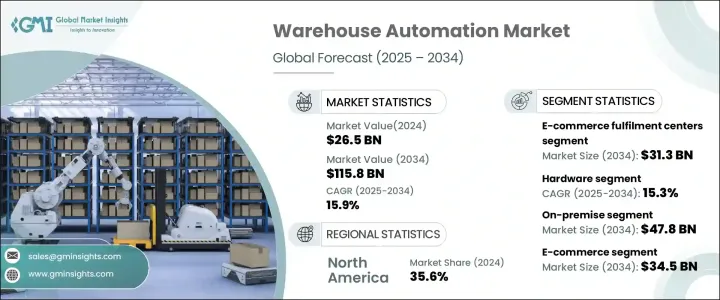
세계의 창고 자동화 시장의 2024년 시장 규모는 265억 달러로, 창고 시설 전체의 합리화된 비용 효율이 높은 오퍼레이션에 대한 요구의 증가에 의해 2025-2034년에 CAGR 15.9%로 성장할 것으로 예측됩니다.
기업이 노동력 부족과 E-Commerce 수요 급증에 대응하기 위해 많은 기업이 자율 이동 로봇(AMR), 자동 보관 및 검색 시스템(AS/RS) 등 자동화 기술에 눈을 돌리며 일상적인 프로세스를 최적화하고 있습니다. 이러한 기술은 업무 효율성을 높일 뿐만 아니라 인건비를 절감하고 인적 오류를 줄임으로써 신속한 주문 처리와 재고 관리 개선으로 이어집니다.
배송 시간 단축과 완벽한 운영에 대한 기대치가 높아짐에 따라 시장은 자동화를 향한 큰 변화를 목격하고 있습니다. 또한 클라우드 기반 창고 관리 시스템(WMS)과 예측 분석의 도입이 확대됨에 따라 기업은 데이터베이스 의사결정을 통해 물류 프로세스를 더욱 개선할 수 있게 되었습니다. 도시 지역에서는 당일 또는 익일 배송에 대한 급증하는 수요에 대응하기 위해 설계된 마이크로 풀필먼트 센터가 점점 더 눈에 띄게 증가하고 있는 것도 창고 자동화 시장의 성장을 가속화하는 데 기여하고 있습니다.
| 시장 범위 | |
|---|---|
| 시작연도 | 2024년 |
| 예측연도 | 2025-2034년 |
| 시작 금액 | 265억 달러 |
| 예상 금액 | 1,158억 달러 |
| CAGR | 15.9% |
로봇공학과 인공지능(AI)의 발전은 주문 처리 속도와 작업 정확도를 향상시킴으로써 창고 운영을 변화시키고 있습니다. 기업은 재고를 보다 효과적으로 관리하고, 피킹 및 분류 정확도를 높이고, 작업 오류를 줄이기 위해 AI 기반 솔루션에 많은 투자를 하고 있으며, AI 및 센서 기반 시스템을 창고 자동화에 통합하여 로봇 비전 시스템, 고속 컨베이어 등의 혁신이 자재 취급 효율을 높이는 데 중요한 역할을 하고 있습니다. 혁신이 중요한 역할을 하고 있으며, 자재 취급의 효율성이 향상되고 있습니다. 점점 더 많은 기업이 사물인터넷(IoT)과 AI 기술을 통합하여 예지보전을 가능하게 하고, 다양한 창고 구성 요소 간의 원활한 연계를 보장하며, 그 결과 확장성과 혁신성을 높이고 있습니다.
시장은 하드웨어, 소프트웨어, 서비스의 세 가지 핵심 요소로 구분됩니다. 로봇 공학, 컨베이어 시스템, 자동 저장 솔루션을 포함한 하드웨어 부문은 2034년까지 15.3%의 연평균 복합 성장률(CAGR)을 보일 것으로 예측되며, AI를 활용한 로봇 공학 및 센서가 탑재된 시스템의 중요성이 부각되면서 자재 취급에 혁명을 일으키고 프로세스를 효율화하며 자재 취급에 혁명을 가져오고, 프로세스를 효율화하며, 다운타임을 최소화합니다. 기업이 창고 공간 활용도를 극대화하고 업무 처리 능력을 향상시키는 데 집중하면서 AI 기반 하드웨어 솔루션에 대한 수요는 계속 증가하고 있습니다.
창고 유형도 시장 확대에 매우 중요한 역할을 하고 있으며, E-Commerce 주문 처리 분야는 온라인 쇼핑의 급격한 성장과 더 빠르고 정확한 주문 처리에 대한 필요성에 힘입어 2034년까지 313억 달러에 달할 것으로 예상되고 있습니다. 도달할 것으로 예측됩니다. 이 부문의 주요 동향은 공간 효율성이 높은 보관 시스템의 도입과 당일 또는 익일 배송에 대한 소비자의 기대치가 높아짐에 따라 도시 지역에 마이크로 풀필먼트 센터를 설립하는 것입니다. 자동화 시스템은 피킹, 분류, 포장 프로세스를 간소화하는 데 널리 사용되고 있으며, AI 기반 오케스트레이션 시스템은 워크플로우를 더욱 강화하여 재고 정확도를 높이고 공급망 관리를 개선하는 데 도움을 주고 있습니다. 재고 정확도를 높이고 공급망 관리를 개선할 수 있습니다.
북미 창고 자동화 시장은 2024년 35.6%의 점유율을 차지할 것으로 예상되며, 이 지역에서는 창고 효율성을 개선하기 위해 로봇 공학 및 AI를 활용한 솔루션 도입이 급증하고 있습니다. 이 지역의 기업은 보관, 피킹, 자재 취급 프로세스를 강화하고 수작업에 대한 의존도를 낮추는 자율 시스템을 도입하는 데 주력하고 있습니다. 기업은 빠르게 변화하는 E-Commerce 환경에서 경쟁력을 유지하기 위해 노력하고 있으며, 첨단 창고 자동화 솔루션의 채택이 증가하면서 전체 시장의 성장과 기술 발전에 기여하고 있습니다.
목차
제1장 조사 방법과 조사 범위
제2장 개요
제3장 업계 인사이트
- 에코시스템 분석
- 업계에 대한 영향요인
- 촉진요인
- E-Commerce의 성장과 옴니채널 소매의 확대
- 업무 효율화와 비용 삭감의 필요성
- 콜드체인 및 신선품의 자동화가 진행되는 식품 및 음료 업계
- 창고 효율 향상을 위한 로봇 및 AI에 대한 투자의 증가
- 보관과 컴플라이언스 강화를 위한 의약품·헬스케어 업계
- 업계의 잠재적 리스크 & 과제
- 고액의 초기 투자와 도입 비용
- 사이버 보안 리스크와 데이터 프라이버시에 대한 우려
- 촉진요인
- 잠재 성장력의 분석
- 규제 상황
- 기술 동향
- 향후 시장 동향
- 갭 분석
- Porter의 산업 분석
- PESTEL 분석
제4장 경쟁 구도
- 서론
- 기업 점유율 분석
- 주요 시장 기업의 경쟁 분석
- 경쟁 포지셔닝 매트릭스
- 전략 대시보드
제5장 시장 추산·예측 : 컴포넌트별, 2021-2034년
- 주요 동향
- 하드웨어
- 소프트웨어
- 서비스
제6장 시장 추산·예측 : 창고 유형별, 2021-2034년
- 주요 동향
- E-Commerce 풀필먼트 센터
- 소매 유통 센터
- 냉장 창고
- 제조 창고
- 서드파티-·물류(3PL) 창고
제7장 시장 추산·예측 : 배포 모드별, 2021-2034년
- 주요 동향
- 온프레미스
- 클라우드 기반
- 하이브리드
제8장 시장 추산·예측 : 기술별, 2021-2034년
- 주요 동향
- 자동 보관·검색 시스템(AS/RS)
- 자율 이동 로봇(AMR)
- 무인운반차(AGV)
- 컨베이어·분류 시스템
- 로봇 피킹 & 핸들링 시스템
- 창고 관리·시행 소프트웨어
제9장 시장 추산·예측 : 용도별, 2021-2034년
- 주요 동향
- 오더 풀필먼트 자동화
- 재고 추적·관리
- GTP(Goods-to-person) 솔루션
- 팔레타이징과 디팔레타이징
- 자동 포장 & 라벨링
- 리버스 물류와 반품 처리
제10장 시장 추산·예측 : 최종 용도 산업별, 2021-2034년
- 주요 동향
- E-Commerce
- 식품 및 음료
- 소매·소비재
- 헬스케어
- 자동차
- 산업
- 기타
제11장 시장 추산·예측 : 지역별, 2021-2034년
- 주요 동향
- 북미
- 미국
- 캐나다
- 유럽
- 독일
- 영국
- 프랑스
- 스페인
- 이탈리아
- 네덜란드
- 아시아태평양
- 중국
- 인도
- 일본
- 호주
- 한국
- 라틴아메리카
- 브라질
- 멕시코
- 아르헨티나
- 중동 및 아프리카
- 사우디아라비아
- 남아프리카공화국
- 아랍에미리트
제12장 기업 개요
- 6 River Systems
- AutoStore
- Bastian Solutions
- Daifuku
- Dematic
- Element Logic
- Fives
- Fortna
- Gebhardt Intralogistics
- Honeywell
- Kardex
- Knapp
- Korber
- Locus Robotics
- Murata Machinery
- Savoye
- SSI Schaefer
- Stow Robotics
- Swisslog
- Symbotic
- System Logistics
- Vanderlande
- Witron
The Global Warehouse Automation Market was valued at USD 26.5 billion in 2024 and is anticipated to grow at a CAGR of 15.9% from 2025 to 2034, driven by the increasing need for streamlined, cost-effective operations across warehouse facilities. As businesses grapple with rising labor shortages and surging e-commerce demand, many are turning to automation technologies such as autonomous mobile robots (AMRs) and automatic storage and retrieval systems (AS/RS) to optimize routine processes. These technologies not only enhance operational efficiency but also reduce labor costs and mitigate human errors, leading to faster order fulfillment and improved inventory management.
The market is witnessing a substantial shift toward automation as businesses seek to address the rising expectations for shorter delivery times and flawless operations. Additionally, the growing adoption of cloud-based warehouse management systems (WMS) and predictive analytics is enabling organizations to make data-driven decisions that further refine their logistics processes. The increasing prominence of micro-fulfillment centers in urban areas, designed to meet the surging demand for same-day or next-day deliveries, is also contributing to the accelerated growth of the warehouse automation market.
| Market Scope | |
|---|---|
| Start Year | 2024 |
| Forecast Year | 2025-2034 |
| Start Value | $26.5 Billion |
| Forecast Value | $115.8 Billion |
| CAGR | 15.9% |
Advancements in robotics and artificial intelligence (AI) are transforming warehouse operations by driving improvements in order fulfillment speed and operational precision. Companies are investing heavily in AI-driven solutions to manage inventory more effectively, boost picking and sorting accuracy, and reduce operational errors. The integration of AI and sensor-powered systems into warehouse automation is enhancing material handling efficiency, with innovations such as robotic vision systems and high-speed conveyors playing a critical role. Businesses are increasingly incorporating the Internet of Things (IoT) and AI technologies to enable predictive maintenance and ensure seamless coordination between various warehouse components, resulting in greater scalability and innovation.
The market is segmented into three core components: hardware, software, and services. The hardware segment, which includes robotics, conveyor systems, and automated storage solutions, is projected to grow at a CAGR of 15.3% by 2034. A growing emphasis on AI-driven robotics and sensor-equipped systems is revolutionizing material handling, making processes more efficient, and minimizing downtime. As companies focus on maximizing warehouse space utilization and improving operational throughput, the demand for AI-powered hardware solutions continues to rise.
Warehouse types are also playing a pivotal role in the market's expansion, with e-commerce fulfillment leading the way. The e-commerce fulfillment segment is expected to reach USD 31.3 billion by 2034, fueled by the rapid growth of online shopping and the need for faster, more accurate order processing. A key trend within this segment is the implementation of space-efficient storage systems and the establishment of micro-fulfillment centers in urban locations to meet rising consumer expectations for same-day or next-day delivery. Automated systems are being widely used to streamline picking, sorting, and packaging processes, enabling fulfillment centers to handle large-scale operations with minimal errors. AI-driven orchestration systems are further enhancing workflows, allowing for better inventory accuracy and improved supply chain management.
North America Warehouse Automation Market accounted for a 35.6% share in 2024, with the region experiencing a surge in the adoption of robotics and AI-powered solutions to improve warehouse efficiency. Businesses across the region are focusing on implementing autonomous systems to enhance storage, picking, and material handling processes, reducing the reliance on manual labor. With companies striving to stay competitive in the fast-paced e-commerce landscape, the increased adoption of cutting-edge warehouse automation solutions is contributing to the overall growth and technological advancement of the market.
Table of Contents
Chapter 1 Methodology and Scope
- 1.1 Market scope and definitions
- 1.2 Research design
- 1.2.1 Research approach
- 1.2.2 Data collection methods
- 1.3 Base estimates and calculations
- 1.3.1 Base year calculation
- 1.3.2 Key trends for market estimation
- 1.4 Forecast model
- 1.5 Primary research and validation
- 1.5.1 Primary sources
- 1.5.2 Data mining sources
Chapter 2 Executive Summary
- 2.1 Industry 360° synopsis
Chapter 3 Industry Insights
- 3.1 Industry ecosystem analysis
- 3.2 Industry impact forces
- 3.2.1 Growth drivers
- 3.2.1.1 Expansion of e-commerce growth and omnichannel retailing
- 3.2.1.2 Need for operational efficiency and cost reduction
- 3.2.1.3 Food & beverage industry increasing automation for cold chain and perishable goods
- 3.2.1.4 Rising investments in robotics and AI to enhance warehouse efficiency
- 3.2.1.5 Pharmaceutical & healthcare sectors enhancing storage and compliance
- 3.2.2 Industry pitfalls and challenges
- 3.2.2.1 High initial investment and implementation costs
- 3.2.2.2 Cybersecurity risks and data privacy concerns
- 3.2.1 Growth drivers
- 3.3 Growth potential analysis
- 3.4 Regulatory landscape
- 3.5 Technology landscape
- 3.6 Future market trends
- 3.7 Gap analysis
- 3.8 Porter's analysis
- 3.9 PESTEL analysis
Chapter 4 Competitive Landscape, 2024
- 4.1 Introduction
- 4.2 Company market share analysis
- 4.3 Competitive analysis of major market players
- 4.4 Competitive positioning matrix
- 4.5 Strategy dashboard
Chapter 5 Market Estimates & Forecast, By Component, 2021-2034 (USD Billion)
- 5.1 Key trends
- 5.2 Hardware
- 5.3 Software
- 5.4 Services
Chapter 6 Market Estimates & Forecast, By Warehouse Type, 2021-2034 (USD Billion)
- 6.1 Key trends
- 6.2 E-commerce fulfillment centers
- 6.3 Retail distribution centers
- 6.4 Cold storage warehouses
- 6.5 Manufacturing warehouses
- 6.6 Third-party logistics (3PL) warehouses
Chapter 7 Market Estimates & Forecast, By Deployment Mode, 2021-2034 (USD Billion)
- 7.1 Key trends
- 7.2 On-premise
- 7.3 Cloud-based
- 7.4 Hybrid
Chapter 8 Market Estimates & Forecast, By Technology, 2021-2034 (USD Billion)
- 8.1 Key trends
- 8.2 Automated storage and retrieval systems (AS/RS)
- 8.3 Autonomous mobile robots (AMRs)
- 8.4 Automated guided vehicles (AGVs)
- 8.5 Conveyor & sortation systems
- 8.6 Robotic picking & handling systems
- 8.7 Warehouse management & execution software
Chapter 9 Market Estimates & Forecast, By Application, 2021-2034 (USD Billion)
- 9.1 Key trends
- 9.2 Order fulfillment automation
- 9.3 Inventory tracking & management
- 9.4 Goods-to-person (GTP) solutions
- 9.5 Palletizing & depalletizing
- 9.6 Automated packaging & labeling
- 9.7 Reverse logistics & returns handling
Chapter 10 Market Estimates & Forecast, By End Use Industry, 2021-2034 (USD Billion)
- 10.1 Key trends
- 10.2 E-commerce
- 10.3 Food & beverage
- 10.4 Retail & consumer goods
- 10.5 Healthcare
- 10.6 Automotive
- 10.7 Industrial
- 10.8 Others
Chapter 11 Market Estimates and Forecast, By Region, 2021 – 2034 (USD Billion)
- 11.1 Key trends
- 11.2 North America
- 11.2.1 U.S.
- 11.2.2 Canada
- 11.3 Europe
- 11.3.1 Germany
- 11.3.2 UK
- 11.3.3 France
- 11.3.4 Spain
- 11.3.5 Italy
- 11.3.6 Netherlands
- 11.4 Asia Pacific
- 11.4.1 China
- 11.4.2 India
- 11.4.3 Japan
- 11.4.4 Australia
- 11.4.5 South Korea
- 11.5 Latin America
- 11.5.1 Brazil
- 11.5.2 Mexico
- 11.5.3 Argentina
- 11.6 Middle East and Africa
- 11.6.1 Saudi Arabia
- 11.6.2 South Africa
- 11.6.3 UAE
Chapter 12 Company Profiles
- 12.1 6 River Systems
- 12.2 AutoStore
- 12.3 Bastian Solutions
- 12.4 Daifuku
- 12.5 Dematic
- 12.6 Element Logic
- 12.7 Fives
- 12.8 Fortna
- 12.9 Gebhardt Intralogistics
- 12.10 Honeywell
- 12.11 Kardex
- 12.12 Knapp
- 12.13 Korber
- 12.14 Locus Robotics
- 12.15 Murata Machinery
- 12.16 Savoye
- 12.17 SSI Schaefer
- 12.18 Stow Robotics
- 12.19 Swisslog
- 12.20 Symbotic
- 12.21 System Logistics
- 12.22 Vanderlande
- 12.23 Witron