|
시장보고서
상품코드
1716646
항공 연료 시장 기회, 성장 촉진요인, 산업 동향 분석 및 예측(2025-2034년)Aviation Fuel Market Opportunity, Growth Drivers, Industry Trend Analysis, and Forecast 2025 - 2034 |
||||||

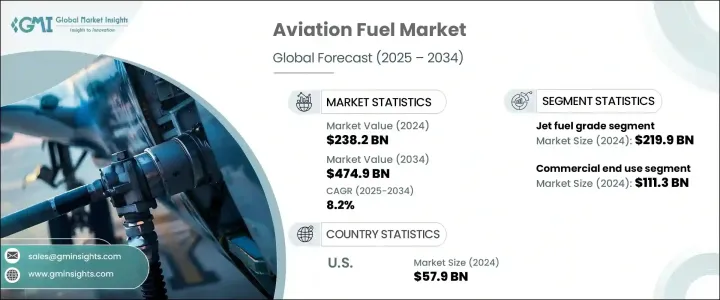
세계의 항공 연료 시장은 2024년 2,382억 달러에 달했고 2025년부터 2034년까지 연평균 복합 성장률(CAGR) 8.2%를 나타낼 것으로 예측됩니다.
이 확대는 항공 수요 증가, 화물운송 증가, 공급체인의 효율을 높이는 전략적 제휴에 의해 초래됩니다. 물류를 합리화하고 효율적인 연료공급과 비용 최적화를 도모하기 위해 전략적 파트너십과 합작사업을 형성하고 있습니다.
항공 연료 공급업체는 저탄소 배출과 환경을 배려한 솔루션의 추진 등 진화하는 업계 동향에 따른 기술 혁신에 주력하고 있습니다. 최첨단 제조 방법을 도입하고 있습니다. 저렴한 항공사의 대두, 공항 인프라 개척의 진전, E-Commerce 주도의 항공화물 운송의 급증은 더욱 시장 확대에 기여하고 있습니다. 여행 붐이 대유행 전의 수준으로 회복되고 있기 때문에 항공 각사는 항공기의 증편과 연비 효율이 높은 항공기의 업그레이드를 가속시키고 있어 항공 연료 수요를 밀어 올리고 있습니다.
| 시장 범위 | |
|---|---|
| 시작 연도 | 2024년 |
| 예측 연도 | 2025-2034년 |
| 시작 금액 | 2,382억 달러 |
| 예측 금액 | 4,749억 달러 |
| CAGR | 8.2% |
항공 연료 시장 최대 제트연료 부문은 2024년 시장 규모가 2,199억 달러였고 2025년부터 2034년까지 연평균 복합 성장률(CAGR) 7.6%를 나타낼 것으로 예상되고 있습니다. 비즈니스 활동의 활성화와 화물 운송의 확대에 의한 세계의 항공 여행 증가가 이 성장을 뒷받침하는 주요 요인입니다. 추가로 소비자의 구매력이 강화되고, 국경을 넘어선 무역이 확대됨에 따라 항공사는 제트 연료 소비의 급증을 목격하고 있습니다.
항공 연료 시장의 상업용 최종 용도 부문은 2024년에 1,113억 달러로 평가되어 시장 점유율 46.7%를 차지했습니다. 2025년부터 2034년까지 CAGR 7.6%을 나타낼 것으로 예상되는 이 부문은 경제 간의 연결성 증가에 힘입어 성장하고 있습니다. 대응하기 위해 장비를 확대하고 노선망을 강화함에 따라 연료소비량은 증가의 길을 따라가고 있습니다.
북미의 항공 연료 시장은 2024년에는 579억 달러에 달했고, 2034년까지의 CAGR 성장률은 5.6%를 나타낼 것으로 예측되고 있습니다. 항공 수요가 급증하고 연료효율 혁신이 진행됨에 따라 항공 연료 소비량이 현저히 증가할 것으로 예상됩니다.
목차
제1장 조사 방법과 조사 범위
제2장 주요 요약
제3장 업계 인사이트
- 생태계 분석
- 밸류체인에 영향을 주는 요인
- 이익률 분석
- 파괴적 혁신
- 향후 전망
- 제조업체
- 유통업체
- 공급자의 상황
- 이익률 분석
- 주요 뉴스와 대처
- 규제 상황
- 영향요인
- 성장 촉진요인
- 항공 수요 증가
- 연료 효율화 기술의 진보
- 지속가능한 항공 연료(SAF)의 채용
- 규제 압력과 환경 정책
- 업계의 잠재적 위험 및 과제
- 불안정한 연료 가격
- SAF 생산을 위한 인프라 제약
- 성장 촉진요인
- 성장 가능성 분석
- Porter's Five Forces 분석
- PESTEL 분석
제4장 경쟁 구도
- 서론
- 기업 점유율 분석
- 경쟁 포지셔닝 매트릭스
- 전략 전망 매트릭스
제5장 시장 추계·예측 : 그레이드별(2021-2034년)
- 주요 동향
- 제트 연료
- 항공 휘발유
- 바이오 등유
제6장 시장 추계·예측 : 최종 용도별(2021-2034년)
- 주요 동향
- 상업용
- 내로우 바디
- 와이드 바디
- 지역
- 비즈니스
- 헬리콥터
- 군사
제7장 시장 추계·예측 : 지역별(2021-2034년)
- 주요 동향
- 북미
- 미국
- 캐나다
- 유럽
- 영국
- 독일
- 프랑스
- 이탈리아
- 스페인
- 러시아
- 아시아태평양
- 중국
- 인도
- 일본
- 한국
- 호주
- 라틴아메리카
- 브라질
- 멕시코
- 중동 및 아프리카
- 남아프리카
- 사우디아라비아
- 아랍에미리트(UAE)
제8장 기업 프로파일
- Bharat Petroleum Corporation Limited(BPCL)
- British Petroleum PLC
- Chevron
- China Aviation Oil
- ExxonMobil
- Gazprom
- HPCL
- Indian Oil Corporation Limited
- Mercury Air Group
- Reliance Petroleum
- Shell
- Total
- Virent, Inc.
- Vitol
- World Fuel Services
The Global Aviation Fuel Market was valued at USD 238.2 billion in 2024 and is projected to grow at a CAGR of 8.2% between 2025 and 2034. This expansion is driven by rising air travel demand, increasing freight transportation, and strategic collaborations that enhance supply chain efficiencies. The resurgence of international and domestic air traffic, coupled with economic globalization, is fueling demand for aviation fuel at an unprecedented rate. Airlines and fuel suppliers are forming strategic partnerships and joint ventures to streamline logistics, ensuring efficient fuel distribution and cost optimization. Additionally, the growing emphasis on sustainable aviation fuels (SAFs) and advancements in fuel production technologies are expected to further accelerate market growth.
Aviation fuel suppliers are focusing on innovations that align with evolving industry trends, including the push for lower carbon emissions and environmentally responsible solutions. As governments impose stringent emission regulations and encourage sustainable fuel alternatives, investments in biofuels and synthetic fuel technologies are increasing. Market players are also strengthening their refining capacities and adopting cutting-edge production methods to meet the evolving fuel consumption needs of airlines globally. The rise of budget airlines, increased airport infrastructure development, and the surge in e-commerce-driven air cargo transport further contribute to market expansion. With global travel bouncing back to pre-pandemic levels, airlines are ramping up fleet expansion and upgrading fuel-efficient aircraft, driving aviation fuel demand higher.
| Market Scope | |
|---|---|
| Start Year | 2024 |
| Forecast Year | 2025-2034 |
| Start Value | $238.2 Billion |
| Forecast Value | $474.9 Billion |
| CAGR | 8.2% |
The jet fuel segment, the largest in the aviation fuel market, was valued at USD 219.9 billion in 2024 and is expected to grow at a CAGR of 7.6% between 2025 and 2034. Increased global air travel, fueled by heightened business activities and expanding cargo transport, is the primary factor propelling this growth. The recovery from the pandemic, alongside rising globalization and urbanization, has led to a significant increase in passenger and freight movements. As consumer purchasing power strengthens and cross-border trade expands, airlines are witnessing a surge in jet fuel consumption. Additionally, technological advancements in fuel efficiency and alternative aviation fuel solutions are shaping the future of this segment.
The commercial end-use segment of the aviation fuel market was valued at USD 111.3 billion in 2024, accounting for a 46.7% market share. Expected to grow at a CAGR of 7.6% between 2025 and 2034, this segment is benefiting from the rising connectivity between economies. The booming tourism industry, expanding international business activities, and economic growth are key factors increasing the demand for aviation fuel. As airlines expand their fleets and enhance route networks to accommodate growing travel demand, fuel consumption continues to rise. However, environmental concerns surrounding carbon emissions remain a challenge, underscoring the need for sustainable aviation fuel adoption.
North America aviation fuel market was valued at USD 57.9 billion in 2024, with a projected growth rate of 5.6% CAGR through 2034. The region benefits from a well-established aviation sector, strong international and domestic flight networks, and economic stability driven by business and tourism. The United States is expected to witness a notable rise in aviation fuel consumption as air travel demand soars and fuel efficiency innovations continue to advance. However, sustainability concerns remain central to the industry's growth trajectory, prompting efforts to integrate greener fuel solutions without compromising operational efficiency.
Table of Contents
Chapter 1 Methodology & Scope
- 1.1 Market scope & definitions
- 1.2 Base estimates & calculations
- 1.3 Forecast calculations
- 1.4 Data sources
- 1.4.1 Primary
- 1.4.2 Secondary
- 1.4.2.1 Paid sources
- 1.4.2.2 Public sources
Chapter 2 Executive Summary
- 2.1 Industry synopsis, 2021-2034
Chapter 3 Industry Insights
- 3.1 Industry ecosystem analysis
- 3.1.1 Factor affecting the value chain
- 3.1.2 Profit margin analysis
- 3.1.3 Disruptions
- 3.1.4 Future outlook
- 3.1.5 Manufacturers
- 3.1.6 Distributors
- 3.2 Supplier landscape
- 3.3 Profit margin analysis
- 3.4 Key news & initiatives
- 3.5 Regulatory landscape
- 3.6 Impact forces
- 3.6.1 Growth drivers
- 3.6.1.1 Increasing air travel demand
- 3.6.1.2 Advancements in fuel efficiency technologies
- 3.6.1.3 Adoption of sustainable aviation fuel (SAF)
- 3.6.1.4 Regulatory pressures and environmental policies
- 3.6.2 Industry pitfalls & challenges
- 3.6.2.1 Volatile fuel prices
- 3.6.2.2 Infrastructure limitations for SAF production
- 3.6.1 Growth drivers
- 3.7 Growth potential analysis
- 3.8 Porter's analysis
- 3.9 PESTEL analysis
Chapter 4 Competitive Landscape, 2024
- 4.1 Introduction
- 4.2 Company market share analysis
- 4.3 Competitive positioning matrix
- 4.4 Strategic outlook matrix
Chapter 5 Market Estimates & Forecast, By Grade, 2021 - 2034 (USD Billion) (Kilo Tons)
- 5.1 Key trends
- 5.2 Jet fuel
- 5.3 Aviation gasoline
- 5.4 Biokerosene
Chapter 6 Market Estimates & Forecast, By End Use, 2021 - 2034 (USD Billion) (Kilo Tons)
- 6.1 Key trends
- 6.2 Commercial
- 6.2.1 Narrow body
- 6.2.2 Wide body
- 6.3 Regional
- 6.4 Business
- 6.5 Helicopter
- 6.6 Military
Chapter 7 Market Estimates & Forecast, By Region, 2021 - 2034 (USD Billion) (Kilo Tons)
- 7.1 Key trends
- 7.2 North America
- 7.2.1 U.S.
- 7.2.2 Canada
- 7.3 Europe
- 7.3.1 UK
- 7.3.2 Germany
- 7.3.3 France
- 7.3.4 Italy
- 7.3.5 Spain
- 7.3.6 Russia
- 7.4 Asia Pacific
- 7.4.1 China
- 7.4.2 India
- 7.4.3 Japan
- 7.4.4 South Korea
- 7.4.5 Australia
- 7.5 Latin America
- 7.5.1 Brazil
- 7.5.2 Mexico
- 7.6 MEA
- 7.6.1 South Africa
- 7.6.2 Saudi Arabia
- 7.6.3 UAE
Chapter 8 Company Profiles
- 8.1 Bharat Petroleum Corporation Limited (BPCL)
- 8.2 British Petroleum PLC
- 8.3 Chevron
- 8.4 China Aviation Oil
- 8.5 ExxonMobil
- 8.6 Gazprom
- 8.7 HPCL
- 8.8 Indian Oil Corporation Limited
- 8.9 Mercury Air Group
- 8.10 Reliance Petroleum
- 8.11 Shell
- 8.12 Total
- 8.13 Virent, Inc.
- 8.14 Vitol
- 8.15 World Fuel Services