|
시장보고서
상품코드
1721455
마이크로 CT 시장 기회, 성장 촉진요인, 산업 동향 분석 및 예측(2025-2034년)Micro Computed Tomography Market Opportunity, Growth Drivers, Industry Trend Analysis, and Forecast 2025 - 2034 |
||||||

세계의 마이크로 CT 시장은 2024년에 2억 7,690만 달러로 평가되었고, CAGR 8.2%를 나타내 2034년까지는 6억 480만 달러에 이를 것으로 예측되고 있습니다.
마이크로 CT는 내부 구조의 초고해상도 3D 이미지를 제공하는 강력한 이미징 기술로, 타의 추종을 불허하는 정확성과 세부사항을 가능하게 합니다.

마이크로 CT 시스템은 비파괴 검사 기능을 제공하며 항공우주, 자동차, 전자기기 등 고도의 품질보증을 필요로 하는 산업에서 특히 유용합니다. 중요한 연구개발 활동을 지원할 뿐만 아니라 신소재와 신제품의 상업화에 있어서도 매우 중요한 역할을 하고 있습니다.
| 시장 범위 | |
|---|---|
| 시작 연도 | 2024년 |
| 예측 연도 | 2025-2034년 |
| 시작 금액 | 2억 7,690만 달러 |
| 예측 금액 | 6억 480만 달러 |
| CAGR | 8.2% |
처음에는 바이오메디컬 헬스케어 이미징용으로 개발된 마이크로 CT는 연월을 거치면서 그 응용 범위를 크게 넓혀 왔습니다. 제조 환경 전체에 걸쳐 정밀 공학과 품질 관리가 중시되게 됨으로써 마이크로 CT 시스템 수요가 세계에서 높아지고 있습니다.
시장은 제품 유형별로 in vivo와 ex vivo의 마이크로 CT로 구분됩니다. Ex vivo 시스템은 추출된 샘플을 매우 선명하게 스캔할 수 있기 때문에 재료 과학, 생물학, 헬스 케어 이미징에 널리 이용되고 있습니다.
마이크로CT는 생명과학, 치과학, 뼈연구, 식물·식품분석, 재료과학, 지질학·석유 및 가스 등 몇 가지 주요 용도로 이용되고 있습니다. 마이크로CT는 조직과 장기를 상세하고 비침습적으로 3D로 시각화할 수 있기 때문에 종양학, 심장병학, 신경학 등의 분야에서 매우 중요합니다.
미국의 마이크로 CT 시장은 2023년에 9,750만 달러를 창출했고 2034년까지는 2억 2,770만 달러에 이를 것으로 예측되고 있습니다.
경쟁 구도를 형성하는 주요 기업은 Bruker, PerkinElmer, Zeiss, TESCAN, Shimadzu, Micro Photonics, Rigaku, North Star Imaging, Delta Electronics, NeoScan, SCANCO Medical, Sanying Precision Instruments 등이 있습니다. 이들 기업은 연구개발에 많은 투자를 하고 뛰어난 해상도, 보다 빠른 스캔 속도, 사용자 친화적인 기능을 갖춘 시스템을 포함한 제품 포트폴리오를 확대하고 있습니다.
목차
제1장 조사 방법과 범위
제2장 주요 요약
제3장 업계 인사이트
- 업계 생태계 분석
- 업계에 미치는 영향요인
- 성장 촉진요인
- 마이크로컴퓨터 단층촬영(마이크로CT)에 있어서 기술의 진보
- 다양한 산업에의 응용 확대
- R&D 투자 증가
- 업계의 잠재적 리스크 및 과제
- 훈련을 받은 전문가의 부족
- 높은 설비비
- 성장 촉진요인
- 성장 가능성 분석
- 규제 상황
- 기술적 상황
- 장래 시장 동향
- 갭 분석
- Porter's Five Forces 분석
- PESTEL 분석
제4장 경쟁 구도
- 서론
- 기업의 시장 점유율 분석
- 기업 매트릭스 분석
- 주요 시장 기업의 경쟁 분석
- 경쟁 포지셔닝 매트릭스
- 전략 대시보드
제5장 시장 추계·예측 : 제품 유형별(2021-2034년)
- 주요 동향
- In vivo 마이크로 CT
- Ex vivo 마이크로 CT
제6장 시장 추계·예측 : 용도별(2021-2034년)
- 주요 동향
- 생명 과학
- 뼈
- 치과
- 식물과 식품
- 재료 과학
- 지질학/석유 및 가스 지질학
제7장 시장 추계·예측 : 최종 용도별(2021-2034년)
- 주요 동향
- 산업
- 연구기관
- 진단 영상 검사실
- 기타 최종 용도
제8장 시장 추계·예측 : 지역별(2021-2034년)
- 주요 동향
- 북미
- 미국
- 캐나다
- 유럽
- 독일
- 영국
- 프랑스
- 스페인
- 이탈리아
- 네덜란드
- 아시아태평양
- 중국
- 인도
- 일본
- 호주
- 한국
- 라틴아메리카
- 브라질
- 멕시코
- 아르헨티나
- 중동 및 아프리카
- 사우디아라비아
- 남아프리카
- 아랍에미리트(UAE)
제9장 기업 프로파일
- Bruker
- PerkinElmer
- Delta Electronics
- Zeiss
- NeoScan
- Sanying Precision Instruments
- North Star Imaging
- SCANCO Medical
- TESCAN
- Micro Photonics
- Shimadzu
- Rigaku
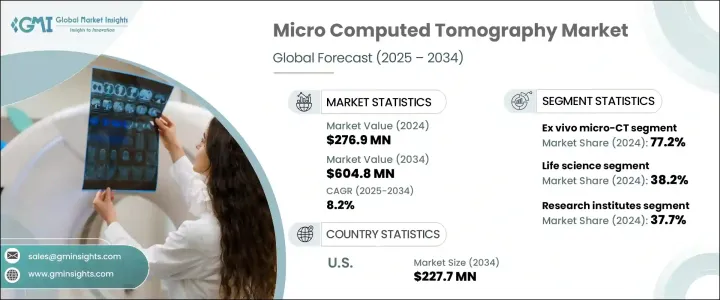
The Global Micro Computed Tomography Market was valued at USD 276.9 million in 2024 and is estimated to grow at a CAGR of 8.2% to reach USD 604.8 million by 2034. Micro computed tomography (micro-CT) is a powerful imaging technology that delivers ultra-high-resolution 3D images of internal structures, enabling unmatched accuracy and detail. The increasing demand for advanced imaging solutions across both industrial and scientific applications is driving substantial growth in this market.
Micro-CT systems offer non-destructive testing capabilities that are especially valuable in industries requiring high levels of quality assurance, such as aerospace, automotive, and electronics. With ongoing technological advancements, including faster scan times, improved resolution, and more compact systems, micro-CT is evolving into a highly versatile tool. It not only supports critical R&D activities but also plays a pivotal role in the commercialization of new materials and products. The integration of AI and machine learning for automated image analysis is further enhancing the efficiency and accuracy of micro-CT systems, making them even more indispensable across diverse sectors.
| Market Scope | |
|---|---|
| Start Year | 2024 |
| Forecast Year | 2025-2034 |
| Start Value | $276.9 Million |
| Forecast Value | $604.8 Million |
| CAGR | 8.2% |
Initially developed for biomedical and healthcare imaging, micro-CT has significantly broadened its reach over the years. The ability to visualize microstructures in 3D without damaging the object makes it ideal for use in material science, biology, electronics, and geological research. The growing emphasis on precision engineering and quality control across manufacturing environments is amplifying the demand for micro-CT systems worldwide. Moreover, the surge in pharmaceutical and biotech research, especially in preclinical studies and drug development, has fueled widespread adoption in life sciences.
The market is segmented by product type into in vivo and ex vivo micro-CT. In 2024, the ex vivo micro-CT segment accounted for a dominant 77.2% share. Ex vivo systems are widely used in material science, biology, and healthcare imaging for their ability to scan extracted samples with extreme clarity. These systems are particularly beneficial for researchers who need detailed internal imaging of biological specimens or structural materials without altering or destroying them. The ultra-high-resolution imaging they offer is critical in exploring microscopic details in various applications.
Micro-CT serves several key applications, including life science, dentistry, bone research, plant and food analysis, material science, and geology or oil and gas. In 2024, the life science segment led the market with a 38.2% share. The ability of micro-CT to offer detailed, non-invasive 3D visualization of tissues and organs makes it crucial in fields like oncology, cardiology, and neurology. It supports the entire research lifecycle from hypothesis testing to validation in drug development and disease modeling.
The U.S. Micro Computed Tomography Market generated USD 97.5 million in 2023 and is anticipated to reach USD 227.7 million by 2034. Robust R&D investments, adoption of advanced diagnostic tools, and growing industrial applications continue to drive market expansion in the country.
Key players shaping the competitive landscape include Bruker, PerkinElmer, Zeiss, TESCAN, Shimadzu, Micro Photonics, Rigaku, North Star Imaging, Delta Electronics, NeoScan, SCANCO Medical, and Sanying Precision Instruments. These companies are investing heavily in R&D and expanding their product portfolios to include systems with superior resolution, faster scanning speeds, and user-friendly features. Strategic partnerships with academic institutions and industry stakeholders are also playing a central role in extending their global footprint and enhancing innovation.
Table of Contents
Chapter 1 Methodology and Scope
- 1.1 Market scope and definitions
- 1.2 Research design
- 1.2.1 Research approach
- 1.2.2 Data collection methods
- 1.3 Base estimates and calculations
- 1.3.1 Base year calculation
- 1.3.2 Key trends for market estimation
- 1.4 Forecast model
- 1.5 Primary research and validation
- 1.5.1 Primary sources
- 1.5.2 Data mining sources
Chapter 2 Executive Summary
- 2.1 Industry 3600 synopsis
Chapter 3 Industry Insights
- 3.1 Industry ecosystem analysis
- 3.2 Industry impact forces
- 3.2.1 Growth drivers
- 3.2.1.1 Technological advancements in micro computed tomography
- 3.2.1.2 Expanding applications across different industries
- 3.2.1.3 Increasing R&D investments
- 3.2.2 Industry pitfalls and challenges
- 3.2.2.1 Lack of trained professionals
- 3.2.2.2 High cost of equipment
- 3.2.1 Growth drivers
- 3.3 Growth potential analysis
- 3.4 Regulatory landscape
- 3.5 Technological landscape
- 3.6 Future market trends
- 3.7 Gap analysis
- 3.8 Porter’s analysis
- 3.9 PESTEL analysis
Chapter 4 Competitive Landscape, 2024
- 4.1 Introduction
- 4.2 Company market share analysis
- 4.3 Company matrix analysis
- 4.4 Competitive analysis of major market players
- 4.5 Competitive positioning matrix
- 4.6 Strategy dashboard
Chapter 5 Market Estimates and Forecast, By Product Type, 2021 – 2034 ($ Mn)
- 5.1 Key trends
- 5.2 In vivo micro-CT
- 5.3 Ex vivo micro-CT
Chapter 6 Market Estimates and Forecast, By Application, 2021 – 2034 ($ Mn)
- 6.1 Key trends
- 6.2 Life science
- 6.3 Bones
- 6.4 Dentistry
- 6.5 Plant and food
- 6.6 Material science
- 6.7 Geology/oil and gas geology
Chapter 7 Market Estimates and Forecast, By End Use, 2021 – 2034 ($ Mn)
- 7.1 Key trends
- 7.2 Industries
- 7.3 Research institutes
- 7.4 Diagnostic imaging labs
- 7.5 Other end use
Chapter 8 Market Estimates and Forecast, By Region, 2021 – 2034 ($ Mn)
- 8.1 Key trends
- 8.2 North America
- 8.2.1 U.S.
- 8.2.2 Canada
- 8.3 Europe
- 8.3.1 Germany
- 8.3.2 UK
- 8.3.3 France
- 8.3.4 Spain
- 8.3.5 Italy
- 8.3.6 Netherlands
- 8.4 Asia Pacific
- 8.4.1 China
- 8.4.2 India
- 8.4.3 Japan
- 8.4.4 Australia
- 8.4.5 South Korea
- 8.5 Latin America
- 8.5.1 Brazil
- 8.5.2 Mexico
- 8.5.3 Argentina
- 8.6 Middle East and Africa
- 8.6.1 Saudi Arabia
- 8.6.2 South Africa
- 8.6.3 UAE
Chapter 9 Company Profiles
- 9.1 Bruker
- 9.2 PerkinElmer
- 9.3 Delta Electronics
- 9.4 Zeiss
- 9.5 NeoScan
- 9.6 Sanying Precision Instruments
- 9.7 North Star Imaging
- 9.8 SCANCO Medical
- 9.9 TESCAN
- 9.10 Micro Photonics
- 9.11 Shimadzu
- 9.12 Rigaku