|
시장보고서
상품코드
1721614
특수 상용차 시장 기회, 성장 촉진요인, 산업 동향 분석 및 예측(2025-2034년)Specialty Commercial Vehicle Market Opportunity, Growth Drivers, Industry Trend Analysis, and Forecast 2025 - 2034 |
||||||

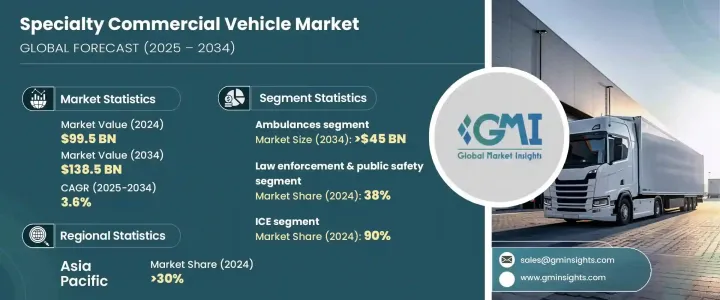
세계의 특수 상용차 시장 규모는 2024년 995억 달러로 평가되었고, CAGR 3.6%를 나타내 2034년에는 1,385억 달러에 이를 것으로 예측됩니다. 빠르고 건강 관리 시스템이 진화함에 따라 필요한 필수 서비스를 지역 사회에 직접 전달할 수있는 이동 장치에 대한 신뢰가 높아지고 있습니다. 만성 질환의 부담 증가, 고령화 인구 증가, 예방 의료의 중시의 고조가, 스마트 헬스케어 기능을 갖춘 차량에 대한 투자를 당국에 촉구하고 있습니다. 최첨단 의료 기준에 적합한 특수 차량에 대한 수요가 더욱 높아지고 있습니다.

차세대 구급차나 이동식 헬스케어 유닛 등 선진적인 긴급 대응 시스템에 투자가 집중되는 가운데 특수 차량 수요는 계속 높아지고 있습니다. 감염 관리 프로토콜과 원격 의료 툴의 채용 확대가, 세계 시장 전체에서 최신의 특수 차량에 대한 수요를 한층 더 가속시키고 있습니다.
| 시장 범위 | |
|---|---|
| 시작 연도 | 2024년 |
| 예측 연도 | 2025-2034년 |
| 시작 금액 | 995억 달러 |
| 예측 금액 | 1,385억 달러 |
| CAGR | 3.6% |
구급차는 2024년 세계 시장의 40%를 차지했고 2034년에는 450억 달러 시장 규모에 이를 것으로 예측되고 있습니다. 이러한 기술 혁신에 의해 반송중의 원활한 병원 제휴와 환자의 결과 개선이 가능하게 됩니다.
2024년 시장 점유율은 법 집행 기관 및 공안 차량이 38%를 차지했고 이동식 진단 실험실에서 원격지에서의 치료 유닛까지 다양한 역할을 수행합니다. 이러한 차량은 재택치료의 제공을 서포트해, 불우한 지역에서의 액세스를 향상시키기 위해, 특수 차량의 설계에 새로운 혁신의 파도가 밀려오고 있습니다.
아시아태평양은 2024년 세계 시장의 30%를 차지했으며 중국의 급속한 인프라 개발과 스마트 모빌리티에 대한 투자가 견인하고 있습니다.
Farber Specialty Vehicles, Mercedes-Benz, Volvo, Isuzu, Traton, Pierce, REV, LDV, Oshkosh Corporation, NFI 등의 주요 기업은 전동화, 모듈 설계, AI를 탑재한 진단에 의해 한계를 밀고 있습니다. 지자체나 의료 제공자와의 전략적 제휴는 이들 기업이 지역의 발자취를 강화해, 지역 전체 수요 증가에 대응하는 데 도움이 되고 있습니다.
목차
제1장 조사 방법과 범위
제2장 주요 요약
제3장 업계 인사이트
- 생태계 분석
- 공급자의 상황
- 원재료 공급자
- 부품 공급자
- 제조업체
- 서비스 제공업체
- 유통업체
- 최종 용도
- 트럼프 정권에 의한 관세에 대한 영향
- 무역량의 혼란
- 보복 조치
- 업계에 미치는 영향
- 공급측의 영향
- 수요측의 영향
- 이익률 분석
- 기술 및 혁신 전망
- 특허 분석
- 주요 뉴스와 대처
- 규제 상황
- 가격 동향
- 코스트 내역 분석
- 영향요인
- 성장 촉진요인
- 세계적으로 높아지는 응급 의료 서비스 수요
- 재해 대응에 대한 정부 투자 증가
- 원격지에서의 산업활동 확대
- 레저 여행의 급증
- 업계의 잠재적 위험 및 과제
- 높은 초기 비용과 긴 생산 리드 타임
- 엄격한 규제 및 인증 요건
- 성장 촉진요인
- 성장 가능성 분석
- Porter's Five Forces 분석
- PESTEL 분석
제4장 경쟁 구도
- 서론
- 기업의 시장 점유율 분석
- 경쟁 포지셔닝 매트릭스
- 전략적 전망 매트릭스
제5장 시장 추계·예측 : 차량별(2021-2034년)
- 주요 동향
- 구급차
- 소화차
- 이동식 연료 운반 유조선
- 기타
제6장 시장 추계·예측 : 추진력별(2021-2034년)
- 주요 동향
- ICE
- 전기
- BEV
- HEV
- PHEV
제7장 시장 추계·예측 : 용도별(2021-2034년)
- 주요 동향
- 의료 및 헬스케어
- 법 집행 기관 및 공공 안전
- 레크리에이션 차량
- 시정 서비스
- 기타
제8장 시장 추계·예측 : 지역별(2021-2034년)
- 주요 동향
- 북미
- 미국
- 캐나다
- 유럽
- 영국
- 독일
- 프랑스
- 스페인
- 이탈리아
- 러시아
- 북유럽 국가
- 아시아태평양
- 중국
- 인도
- 일본
- 한국
- 호주 및 뉴질랜드
- 동남아시아
- 라틴아메리카
- 브라질
- 멕시코
- 아르헨티나
- 중동 및 아프리카
- 아랍에미리트(UAE)
- 남아프리카
- 사우디아라비아
제9장 기업 프로파일
- Arctic Cat
- Cargotec
- Case New Holland
- Demers Ambulances
- Eicher
- Emergency One
- Farber Specialty Vehicles
- Hino Motors
- Isuzu
- LDV
- Matthews Specialty Vehicles
- Mercedes-Benz
- NFI
- Oshkosh Corporation
- Pierce
- REV
- Rosenbauer International
- Specialty Vehicles
- Traton
- Volvo
The Global Specialty Commercial Vehicle Market was valued at USD 99.5 billion in 2024 and is estimated to grow at a CAGR of 3.6% to reach USD 138.5 billion by 2034. The growth trajectory of this market is being driven by rising demand for specialized transportation solutions tailored to emergency response, healthcare delivery, and public safety. As urbanization accelerates and healthcare systems evolve, there is a growing reliance on mobile units that can bring essential services directly to communities. Governments and private organizations are expanding their fleets to enhance accessibility and responsiveness, particularly in underserved and remote regions. The growing burden of chronic illnesses, a rising aging population, and the increasing emphasis on preventive care are pushing authorities to invest in vehicles equipped with smart healthcare capabilities. Moreover, in the post-pandemic landscape, infection control and remote diagnostics have become core considerations, further fueling demand for specialty vehicles that align with modern healthcare standards. From high-tech ambulances to mobile clinics and fire-rescue units, the global market is witnessing a transformation driven by innovation, technology integration, and a broader shift toward decentralized care and public safety operations.
The demand for specialized vehicles continues to rise as investments pour into advanced emergency response systems, including next-generation ambulances and mobile healthcare units. Heightened awareness around public health, combined with a renewed push to deliver medical services to rural and hard-to-reach areas, is propelling the deployment of mobile ICU vans and paramedic vehicles. Infection control protocols and the growing adoption of telemedicine tools are further accelerating the demand for modern specialty vehicles across global markets. In parallel, the increasing frequency of natural disasters and climate-induced emergencies is driving nations to bolster their firefighting fleets and public safety vehicle infrastructure.
| Market Scope | |
|---|---|
| Start Year | 2024 |
| Forecast Year | 2025-2034 |
| Start Value | $99.5 Billion |
| Forecast Value | $138.5 Billion |
| CAGR | 3.6% |
Ambulances accounted for a 40% share of the global market in 2024 and are projected to generate USD 45 billion by 2034. Governments and private healthcare operators are prioritizing shorter emergency response times and are outfitting vehicles with state-of-the-art communication systems, 5G connectivity, and real-time patient monitoring solutions. These innovations enable seamless hospital coordination and better patient outcomes during transport. As digital healthcare continues to evolve, smart ambulance technology is expected to play a critical role in next-gen emergency response strategies.
Law enforcement and public safety vehicles captured a 38% market share in 2024, fulfilling diverse roles from mobile diagnostic labs to treatment units in remote zones. As the healthcare delivery model becomes more decentralized, there is strong momentum behind mobile services offering diagnostics, outpatient care, and dialysis. These vehicles support home-based care delivery and enhance access in under-resourced areas, driving a new wave of innovation in specialty vehicle design.
Asia Pacific represented 30% of the global market in 2024, led by China's rapid infrastructure development and investment in smart mobility. Rising demand for ambulances, fire trucks, and utility vans in the region is backed by government incentives favoring clean, sustainable vehicle fleets.
Major players such as Farber Specialty Vehicles, Mercedes-Benz, Volvo, Isuzu, Traton, Pierce, REV, LDV, Oshkosh Corporation, and NFI are pushing the envelope through electrification, modular designs, and AI-powered diagnostics. Strategic collaborations with municipalities and healthcare providers are helping these companies strengthen local footprints and meet rising demand across regions.
Table of Contents
Chapter 1 Methodology & Scope
- 1.1 Research design
- 1.1.1 Research approach
- 1.1.2 Data collection methods
- 1.2 Base estimates and calculations
- 1.2.1 Base year calculation
- 1.2.2 Key trends for market estimates
- 1.3 Forecast model
- 1.4 Primary research & validation
- 1.4.1 Primary sources
- 1.4.2 Data mining sources
- 1.5 Market definitions
Chapter 2 Executive Summary
- 2.1 Industry 3600 synopsis, 2021 - 2034
Chapter 3 Industry Insights
- 3.1 Industry ecosystem analysis
- 3.2 Supplier landscape
- 3.2.1 Raw material suppliers
- 3.2.2 Component suppliers
- 3.2.3 Manufacturers
- 3.2.4 Service providers
- 3.2.5 Distributors
- 3.2.6 End use
- 3.3 Impact of Trump administration tariffs
- 3.3.1 Trade volume disruptions
- 3.3.2 Retaliatory measures
- 3.3.3 Impact on the industry
- 3.3.4 Supply-side impact
- 3.3.5 Demand-side impact
- 3.4 Profit margin analysis
- 3.5 Technology & innovation landscape
- 3.6 Patent analysis
- 3.7 Key news & initiatives
- 3.8 Regulatory landscape
- 3.9 Price trends
- 3.10 Cost breakdown analysis
- 3.11 Impact forces
- 3.11.1 Growth drivers
- 3.11.1.1 Rising demand for emergency medical services across the globe
- 3.11.1.2 Increasing government investments in disaster response
- 3.11.1.3 Growing remote industrial activities
- 3.11.1.4 Surge in recreational travel
- 3.11.2 Industry pitfalls & challenges
- 3.11.2.1 High initial cost and long production lead times
- 3.11.2.2 Stringent regulatory and certification requirements
- 3.11.1 Growth drivers
- 3.12 Growth potential analysis
- 3.13 Porter’s analysis
- 3.14 PESTEL analysis
Chapter 4 Competitive Landscape, 2024
- 4.1 Introduction
- 4.2 Company market share analysis
- 4.3 Competitive positioning matrix
- 4.4 Strategic outlook matrix
Chapter 5 Market Estimates & Forecast, By Vehicle, 2021 - 2034 ($Bn, Units)
- 5.1 Key trends
- 5.2 Ambulances
- 5.3 Fire extinguishing trucks
- 5.4 Mobile fuel carrying tankers
- 5.5 Others
Chapter 6 Market Estimates & Forecast, By Propulsion, 2021 - 2034 ($Bn, Units)
- 6.1 Key trends
- 6.2 ICE
- 6.3 Electric
- 6.3.1 BEV
- 6.3.2 HEV
- 6.3.3 PHEV
Chapter 7 Market Estimates & Forecast, By Application, 2021 - 2034 ($Bn, Units)
- 7.1 Key trends
- 7.2 Medical & healthcare
- 7.3 Law enforcement & public safety
- 7.4 Recreational vehicles
- 7.5 Municipal services
- 7.6 Others
Chapter 8 Market Estimates & Forecast, By Region, 2021 - 2034 ($Bn, Units)
- 8.1 Key trends
- 8.2 North America
- 8.2.1 U.S.
- 8.2.2 Canada
- 8.3 Europe
- 8.3.1 UK
- 8.3.2 Germany
- 8.3.3 France
- 8.3.4 Spain
- 8.3.5 Italy
- 8.3.6 Russia
- 8.3.7 Nordics
- 8.4 Asia Pacific
- 8.4.1 China
- 8.4.2 India
- 8.4.3 Japan
- 8.4.4 South Korea
- 8.4.5 ANZ
- 8.4.6 Southeast Asia
- 8.5 Latin America
- 8.5.1 Brazil
- 8.5.2 Mexico
- 8.5.3 Argentina
- 8.6 MEA
- 8.6.1 UAE
- 8.6.2 South Africa
- 8.6.3 Saudi Arabia
Chapter 9 Company Profiles
- 9.1 Arctic Cat
- 9.2 Cargotec
- 9.3 Case New Holland
- 9.4 Demers Ambulances
- 9.5 Eicher
- 9.6 Emergency One
- 9.7 Farber Specialty Vehicles
- 9.8 Hino Motors
- 9.9 Isuzu
- 9.10 LDV
- 9.11 Matthews Specialty Vehicles
- 9.12 Mercedes-Benz
- 9.13 NFI
- 9.14 Oshkosh Corporation
- 9.15 Pierce
- 9.16 REV
- 9.17 Rosenbauer International
- 9.18 Specialty Vehicles
- 9.19 Traton
- 9.20 Volvo