|
시장보고서
상품코드
1740788
외장 페인트 소매 시장 : 기회, 성장 촉진요인, 산업 동향 분석, 예측(2025-2034년)Exterior Paint Retail Market Opportunity, Growth Drivers, Industry Trend Analysis, and Forecast 2025 - 2034 |
||||||

세계 외장 페인트 소매 시장은 2024년 355억 달러로 평가되었으며 CAGR 8.2%로 확대되어 2034년까지 783억 달러에 이를 것으로 추정됩니다.
이 성장은 특히 신흥 경제 국가에서 건설 활동의 활성화와 주택 개축 및 리폼 프로젝트 증가에 의해 크게 뒷받침되고 있습니다. 건축 미관을 커스터마이징하는 경향 증가도 외장 페인트 소비의 일관된 증가에 기여하고 있습니다. 상업 건축과 주택 건축 양 분야에서 내구성과 내후성이 뛰어난 도료의 대규모 사용을 필요로 하는 인프라 개발에 대한 주목이 높아지고 있어, 이 급성장에 적극적으로 공헌하고 있습니다.
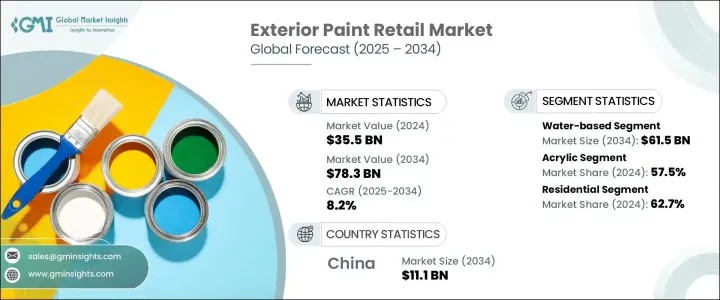
지속가능성과 환경에 배려한 건축 관행을 중시하는 지역에서는 외장용 페인트의 판매는 호조를 유지하고 있습니다. 동시에, 도시 개발이 급속히 진행되고 있는 국가에서는 정부 주도의 건설 이니셔티브와 주택 존의 확대가 성장의 원동력이 되고 있습니다. 건강과 환경의 안전성을 중시하는 시장에서는 유해 화합물의 함유량이 적은 도료로 이행이 가속되고 있으며, 제품의 기호에 큰 변화가 일어나고 있습니다.
| 시장 범위 | |
|---|---|
| 시작 연도 | 2024년 |
| 예측 연도 | 2025-2034년 |
| 시작 금액 | 355억 달러 |
| 예측 금액 | 783억 달러 |
| CAGR | 8.2% |
수성 페인트는 외장 페인트 소매 시장을 독점하며 총 점유율의 약 77.7%를 차지합니다. 이 제제가 널리 채용되고 있는 것은 환경에 부드럽고, 냄새가 적고, 속건성이 있어, 뒷정리가 간단하기 때문입니다. 그 결과, 수성 페인트는 주택용과 상업용으로 모두 선택되고 있습니다.
건설 부문에서의 녹색 인증에 대한 주목은 이 시프트에 기세를 주고, 세계의 환경 기준에 따른 차세대 도료의 개발을 촉구하고 있습니다.
수지 유형별로는 아크릴계 도료가 2024년에 57.5%의 점유율로 시장을 선도했습니다. 이러한 특징으로 아크릴계 도료는 특히 폭넓은 기후나 용도에 적합합니다. 환경에 대한 관심이 높아지는 가운데, 아크릴 수성은 VOC의 함유량을 최소한으로 억제해 지속가능성을 배려하고 있기 때문에 더욱 바람직한 것이 되고 있습니다.
최종 용도별로는 2024년에는 주택 분야가 시장 점유율 전체의 약 62.7%를 차지해, 압도적인 강도를 보였습니다. 도시화가 진행되는 나라에서는 중산 계급이 증가해, 저렴한 가격이면서 내구성이 있는 외벽 도료를 요구하게 되어, 주택 분야 수요를 한층 더 밀어 올리고 있습니다. 디자인의 개성화나 환경에 배려한 제품에 대한 관심의 고조 등, 소비자
중국 외장 페인트 소매 시장은 2024년 49억 달러에 달했으며 CAGR 8.5%로 성장했으며 2034년에는 111억 달러에 달할 것으로 예측됩니다. 소비자는, 특히 급성장하는 도심부에서, 낮은 VOC로 내후성이 높은 도료에 관심을 기울이고 있습니다.
목차
제1장 조사 방법과 범위
제2장 주요 요약
제3장 업계 인사이트
- 생태계 분석
- 밸류체인에 영향을 주는 요인
- 이익률 분석
- 혁신
- 미래의 전망
- 제조업자
- 리셀러
- 트럼프 정권의 관세 영향 - 구조화된 개요
- 무역에 미치는 영향
- 무역량의 혼란
- 보복 조치
- 업계에 미치는 영향
- 공급측의 영향(원재료)
- 주요 원재료의 가격 변동
- 공급망 재구성
- 생산 비용에 미치는 영향
- 수요측의 영향(판매가격)
- 최종 시장에의 가격 전달
- 시장 점유율 동향
- 소비자의 반응 패턴
- 공급측의 영향(원재료)
- 영향을 받는 주요 기업
- 전략적인 업계 대응
- 공급망 재구성
- 가격 설정 및 제품 전략
- 정책관여
- 전망과 향후 검토 사항
- 무역에 미치는 영향
- 무역 통계(HS코드)
- 주요 수출국
- 주요 수입국
- 공급자의 상황
- 이익률 분석
- 주요 뉴스와 대처
- 규제 상황
- 영향요인
- 성장 촉진요인
- 세계의 주택 및 인프라 개발의 급증
- 친환경 도료 배합의 기술적 진보
- 소매 및 전자상거래 유통 채널 확대
- 업계의 잠재적 위험 및 과제
- 원재료비의 변동
- 엄격한 환경 규제와 VOC 규제
- 성장 촉진요인
- 성장 가능성 분석
- Porter's Five Forces 분석
- PESTEL 분석
제4장 경쟁 구도
- 소개
- 기업의 시장 점유율 분석
- 경쟁 포지셔닝 매트릭스
- 전략적 전망 매트릭스
제5장 시장 추계 및 예측 : 제품 유형별, 2021-2034년
- 주요 동향
- 수성
- 유성
제6장 시장 추계 및 예측 : 수지 유형별, 2021-2034년
- 주요 동향
- 아크릴
- 폴리우레탄
- 에폭시
- 규산염
- 기타
제7장 시장 추계 및 예측 : 최종 용도별, 2021-2034년
- 주요 동향
- 주택용
- 상업용
- 산업
제8장 시장 추계 및 예측 : 지역별, 2021-2034년
- 주요 동향
- 북미
- 미국
- 캐나다
- 유럽
- 독일
- 영국
- 프랑스
- 스페인
- 이탈리아
- 네덜란드
- 아시아태평양
- 중국
- 인도
- 일본
- 호주
- 한국
- 라틴아메리카
- 브라질
- 멕시코
- 아르헨티나
- 중동 및 아프리카
- 사우디아라비아
- 남아프리카
- 아랍에미리트(UAE)
제9장 기업 프로파일
- AkzoNobel
- Asian Paints
- Axalta Coating Systems
- BASF Coatings
- Benjamin Moore &Co.
- Berger Paints
- DAW SE
- Hempel
- Jotun
- Kansai Paint
- Masco Corporation
- Nippon Paint Holdings
- PPG Industries
- RPM International
- Sherwin-Williams
The Global Exterior Paint Retail Market was valued at USD 35.5 billion in 2024 and is estimated to expand at a CAGR of 8.2% to reach USD 78.3 billion by 2034. This growth is largely fueled by rising construction activity, especially in developing economies, along with an increasing number of home renovation and remodeling projects. Consumers are becoming more willing to invest in their properties, especially in enhancing the visual appeal of exteriors. As a result, the demand for high-performance paints that offer both aesthetic and protective benefits is increasing significantly. Urban expansion, government housing initiatives, and the growing trend of customized architectural aesthetics are also contributing to the consistent rise in exterior paint consumption. Additionally, rural housing developments in emerging regions are creating more opportunities for product adoption, driving further growth. Both commercial and residential construction segments are actively contributing to the surge, with an increased focus on infrastructure developments that require large-scale use of durable and weather-resistant paints.
In regions that emphasize sustainability and eco-conscious building practices, exterior paint sales remain strong. North America and Europe continue to lead due to their established repaint cycles, preference for premium products, and strong regulatory frameworks surrounding low-VOC materials. These regions have maintained consistent demand due to awareness of environmental concerns and a steady pace of real estate maintenance activities. Simultaneously, countries experiencing rapid urban development are seeing growth driven by government-led construction initiatives and expanding residential zones. Markets that emphasize health and environmental safety are accelerating the transition to paints that contain fewer harmful compounds, thus giving rise to a significant shift in product preferences.
| Market Scope | |
|---|---|
| Start Year | 2024 |
| Forecast Year | 2025-2034 |
| Start Value | $35.5 Billion |
| Forecast Value | $78.3 Billion |
| CAGR | 8.2% |
Water-based paints dominate the exterior paint retail market, capturing around 77.7% of the total share. These formulations generated USD 27.6 billion in revenue in 2024 and are forecasted to reach USD 61.5 billion by 2034, expanding at a CAGR of 8.4%. Their widespread adoption is due to the combination of eco-friendliness, low odor, quick drying properties, and easy cleanup. Consumers and regulators alike are pushing for solutions that meet sustainability targets without compromising performance. As a result, water-based paints have become the go-to choice across both residential and commercial applications. Manufacturers are also investing in technologies that enhance these products with improved weather resistance, UV stability, and longer lifespans.
The focus on green certifications in the construction sector has added momentum to this shift, encouraging the development of next-generation paint formulations that align with global environmental standards. Innovations such as advanced acrylic emulsions with enhanced durability, along with other weatherproof features, are shaping premium product lines in the global market.
By resin type, acrylic-based paints led the market in 2024 with a 57.5% share. Their popularity stems from their outstanding durability, flexibility, and resistance to ultraviolet radiation. These features make acrylic paints especially suitable for a wide range of climates and applications. When combined with water-based systems, they provide a versatile solution that appeals to both budget-conscious and premium consumers. With environmental concerns taking center stage, acrylic water-based formulations have become even more desirable due to their minimal VOC content and adherence to sustainability practices. Enhanced features such as self-cleaning surfaces and elastomeric flexibility are becoming increasingly popular in modern paint lines, adding value to both consumers and property developers.
In terms of end use, the residential segment emerged as the dominant force in 2024, accounting for approximately 62.7% of total market share. This is driven by steady volumes of new housing projects and cyclical repainting practices in more mature markets. In regions with a growing culture of DIY renovation and design, consumers are opting for high-quality paints that offer long-lasting finishes and ease of application. Additionally, the rising middle class in urbanizing nations is seeking affordable yet durable exterior paint options, further driving demand in the residential space. Shifts in consumer behavior, including a stronger focus on design personalization and environmentally conscious products, are influencing purchasing decisions across this segment.
China exterior paint retail market reached USD 4.9 billion in 2024 and is expected to grow at a CAGR of 8.5%, hitting USD 11.1 billion by 2034. The growth is largely backed by large-scale investments in housing and infrastructure, driven by the government's strategic urbanization initiatives. Consumers are leaning toward low-VOC and weather-resistant coatings, particularly in fast-growing urban centers. Domestic manufacturers are adapting to these trends by offering certified sustainable products, reflecting evolving building codes and environmental objectives.
Table of Contents
Chapter 1 Methodology & Scope
- 1.1 Market scope & definition
- 1.2 Base estimates & calculations
- 1.3 Forecast calculation
- 1.4 Data sources
- 1.4.1 Primary
- 1.4.2 Secondary
- 1.4.2.1 Paid sources
- 1.4.2.2 Public sources
Chapter 2 Executive Summary
- 2.1 Industry synopsis, 2021-2034
Chapter 3 Industry Insights
- 3.1 Industry ecosystem analysis
- 3.1.1 Factor affecting the value chain
- 3.1.2 Profit margin analysis
- 3.1.3 Disruptions
- 3.1.4 Future outlook
- 3.1.5 Manufacturers
- 3.1.6 Distributors
- 3.2 Impact of trump administration tariffs – structured overview
- 3.2.1 Impact on trade
- 3.2.1.1 Trade volume disruptions
- 3.2.1.2 Retaliatory measures
- 3.2.2 Impact on the industry
- 3.2.2.1 Supply-side impact (raw materials)
- 3.2.2.1.1 Price volatility in key materials
- 3.2.2.1.2 Supply chain restructuring
- 3.2.2.1.3 Production cost implications
- 3.2.2.2 Demand-side impact (selling price)
- 3.2.2.2.1 Price transmission to end markets
- 3.2.2.2.2 Market share dynamics
- 3.2.2.2.3 Consumer response patterns
- 3.2.2.1 Supply-side impact (raw materials)
- 3.2.3 Key companies impacted
- 3.2.4 Strategic industry responses
- 3.2.4.1 Supply chain reconfiguration
- 3.2.4.2 Pricing and product strategies
- 3.2.4.3 Policy engagement
- 3.2.5 Outlook and future considerations
- 3.2.1 Impact on trade
- 3.3 Trade statistics (HS code)
- 3.3.1 Major exporting countries
- 3.3.2 Major importing countries
- 3.4 Supplier landscape
- 3.5 Profit margin analysis
- 3.6 Key news & initiatives
- 3.7 Regulatory landscape
- 3.8 Impact forces
- 3.8.1 Growth drivers
- 3.8.1.1 Surge in global residential and infrastructure development
- 3.8.1.2 Technological advancements in eco-friendly paint formulations
- 3.8.1.3 Expansion of retail and e-commerce distribution channels
- 3.8.2 Industry pitfalls & challenges
- 3.8.2.1 Volatility in raw material costs
- 3.8.2.2 Stringent environmental and VOC regulations
- 3.8.1 Growth drivers
- 3.9 Growth potential analysis
- 3.10 Porter's analysis
- 3.11 PESTEL analysis
Chapter 4 Competitive Landscape, 2024
- 4.1 Introduction
- 4.2 Company market share analysis
- 4.3 Competitive positioning matrix
- 4.4 Strategic outlook matrix
Chapter 5 Market Estimates and Forecast, By Product Type, 2021 – 2034 (USD Billion) (Tons)
- 5.1 Key trends
- 5.2 Water-based
- 5.3 Oil-based
Chapter 6 Market Estimates and Forecast, By Resin Type, 2021 – 2034 (USD Billion) (Tons)
- 6.1 Key trends
- 6.2 Acrylic
- 6.3 Polyurethane
- 6.4 Epoxy
- 6.5 Silicate
- 6.6 Others
Chapter 7 Market Estimates and Forecast, By End use, 2021 – 2034 (USD Billion) (Tons)
- 7.1 Key trends
- 7.2 Residential
- 7.3 Commercial
- 7.4 Industrial
Chapter 8 Market Estimates and Forecast, By Region, 2021 – 2034 (USD Billion) (Tons)
- 8.1 Key trends
- 8.2 North America
- 8.2.1 U.S.
- 8.2.2 Canada
- 8.3 Europe
- 8.3.1 Germany
- 8.3.2 UK
- 8.3.3 France
- 8.3.4 Spain
- 8.3.5 Italy
- 8.3.6 Netherlands
- 8.4 Asia Pacific
- 8.4.1 China
- 8.4.2 India
- 8.4.3 Japan
- 8.4.4 Australia
- 8.4.5 South Korea
- 8.5 Latin America
- 8.5.1 Brazil
- 8.5.2 Mexico
- 8.5.3 Argentina
- 8.6 Middle East and Africa
- 8.6.1 Saudi Arabia
- 8.6.2 South Africa
- 8.6.3 UAE
Chapter 9 Company Profiles
- 9.1 AkzoNobel
- 9.2 Asian Paints
- 9.3 Axalta Coating Systems
- 9.4 BASF Coatings
- 9.5 Benjamin Moore & Co.
- 9.6 Berger Paints
- 9.7 DAW SE
- 9.8 Hempel
- 9.9 Jotun
- 9.10 Kansai Paint
- 9.11 Masco Corporation
- 9.12 Nippon Paint Holdings
- 9.13 PPG Industries
- 9.14 RPM International
- 9.15 Sherwin-Williams