


|
시장보고서
상품코드
1740815
퇴비화 가능 포장기기 시장 : 기회, 성장 촉진요인, 산업 동향 분석, 예측(2025-2034년)Compostable Packaging Equipment Market Opportunity, Growth Drivers, Industry Trend Analysis, and Forecast 2025 - 2034 |
||||||

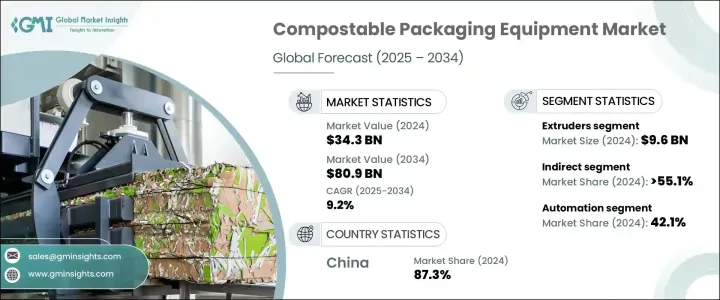
세계의 퇴비화 가능 포장 장비 시장은 2024년 343억 달러로 평가되었으며 CAGR 9.2%로 성장해 2034년까지 809억 달러에 이를 것으로 예측됩니다.
세계 각국의 정부가 지속가능성에 대한 규제를 강화하고 환경 친화적인 대체품을 채용하도록 업계에 일하고 있습니다.
업데이트된 환경 정책을 준수하기 위해 기업은 생분해성 재료를 도입하고 그린 테크놀러지에 투자하고 사용한 포장 솔루션을 재평가해야 합니다. 이를 받고, 제조업체는 기술 혁신을 가속시켜, 식물 유래의 투입물의 사용을 확대해, 지속 가능한 설계 원칙을 기계나 제품 개발에 짜넣어, 컴플라이언스 목표와 소비자의 기대의 양쪽을 채우려고 하고 있습니다.
| 시장 범위 | |
|---|---|
| 시작 연도 | 2024년 |
| 예측 연도 | 2025-2034년 |
| 시작 금액 | 343억 달러 |
| 예측 금액 | 809억 달러 |
| CAGR | 9.2% |
다양한 장비 유형 중에서 압출기 부문은 2024년에 96억 달러를 생산하고, 2025년과 2034년 사이에 CAGR 9.6%를 보일 것으로 예측됩니다. 이 기계는 바이오 폴리머를 필름, 시트 및 성형 포장 부품과 같은 사용 가능한 재료로 변환하는 데 필수적입니다.
유통 관점에서 간접 채널은 2024년에 55.1%의 점유율을 차지하고 2034년까지 연평균 복합 성장률(CAGR) 9.4%를 보일 것으로 예측됩니다. 이 모델은 타사 딜러, 대행사 또는 유통업체에게 장비를 판매하게 되며, 비용 효율성과 지역 접근성 향상을 제공합니다. 신속한 침투와 확장성을 가능하게 합니다. 이러한 유통 파트너는 지역의 선호, 조달 사이클, 규제 요건에 대해 깊은 지식을 가지고 있는 경우가 많아, 세계 제조업체가 사업 확대 전략을 성공시키는데 있어서 빼놓을 수 없는 존재가 되고 있습니다.
중국 퇴비화 가능 포장기기 2024년 시장 규모는 85억 달러로, 그린테크놀로지를 지지하는 지역정책과 소비자의식의 고조가 시장의 추가 확대에 박차를 가하고 있습니다. 자동차를 걸고 있습니다.환경 의식이 높은 소비자의 대두와 생분해성 대체품을 추진하는 정부의 이니셔티브가 함께 이 지역 전체의 기술 혁신이 촉진되고 있습니다.
세계 퇴비화 가능 포장 장비 시장의 주요 기업은 Braskem, Tetra Pak, BASF, Placon, EcoEnclose, Amcor, Smurfit Kappa, Ball, BioBag, Corbion, WestRock, Biome Bioplastics, Berry Global, Mondi, International Paper 등입니다.시장에서의 존재감을 높이기 위해, 주요 기업은 기술 혁신, 지속가능성, 전략적 파트너십에 투자하고 있습니다. 운영 비용을 절감하고 에너지 효율을 높이기 위해 제조를 합리화하는 것도 중요한 전략입니다.
목차
제1장 조사 방법과 범위
제2장 주요 요약
제3장 업계 인사이트
- 생태계 분석
- 밸류체인에 영향을 주는 요인
- 이익률 분석
- 혁신
- 미래의 전망
- 제조업자
- 리셀러
- 트럼프 정권의 관세 분석
- 무역에 미치는 영향
- 무역량의 혼란
- 보복 조치
- 업계에 미치는 영향
- 공급측의 영향(원재료)
- 주요 원재료의 가격 변동
- 공급망 재구성
- 생산 비용에 미치는 영향
- 수요측의 영향(판매가격)
- 최종 시장에의 가격 전달
- 시장 점유율 동향
- 소비자의 반응 패턴
- 영향을 받는 주요 기업
- 전략적인 업계 대응
- 공급망 재구성
- 가격 설정 및 제품 전략
- 정책관여
- 전망과 향후 검토 사항
- 무역에 미치는 영향
- 영향요인
- 성장 촉진요인
- 엄격한 환경 규제
- 친환경 제품에 대한 소비자의 취향
- 전자상거래와 패키지 상품의 성장
- 업계의 잠재적 위험 및 과제
- 높은 초기 자본 투자액
- 퇴비화 가능한 원재료의 입수가 한정되어 있다
- 성장 촉진요인
- 성장 가능성 분석
- Porter's Five Forces 분석
- PESTEL 분석
제4장 경쟁 구도
- 소개
- 기업의 시장 점유율 분석
- 경쟁 포지셔닝 매트릭스
- 전략적 전망 매트릭스
제5장 시장 추계 및 예측 : 기기 종류별, 2021-2034년
- 주요 동향
- 압출기
- 필름 블로우 기계
- 인쇄기
- 절단기
- 씰링 머신
- 기타
제6장 시장 추계 및 예측 : 재질별, 2021-2034년
- 주요 동향
- 식물 유래 섬유
- 종이 및 골판지
- 옥수수 전분
- 대나무
- 기타
제7장 시장 추계 및 예측 : 포장 형태별, 2021-2034년
- 주요 동향
- 연질 포장
- 경질 포장
- 칼집 및 액세서리
- 종이 기반 포장
제8장 시장 추계 및 예측 : 자동화 그레이드별, 2021-2034년
- 주요 동향
- 자동
- 반자동
- 수동
제9장 시장 추계 및 예측 : 전원별, 2021-2034년
- 주요 동향
- 전동기기
- 가스동력기기
- 디젤
- 하이브리드
제10장 시장 추계 및 예측 : 최종 용도별, 2021-2034년
- 주요 동향
- 식품 및 음료 포장
- 소매 및 소비재
- 헬스케어 및 퍼스널케어
- 전자상거래 및 배송
- 농업 및 원예
- 기타
제11장 시장 추계 및 예측 : 유통 채널별, 2021-2034년
- 주요 동향
- 직접
- 간접
제12장 시장 추계 및 예측 : 지역별, 2021-2034년
- 주요 동향
- 북미
- 미국
- 캐나다
- 유럽
- 영국
- 독일
- 프랑스
- 이탈리아
- 스페인
- 러시아
- 북유럽 국가
- 아시아태평양
- 중국
- 인도
- 일본
- 호주
- 한국
- 동남아시아
- 라틴아메리카
- 브라질
- 멕시코
- 아르헨티나
- 중동 및 아프리카
- 아랍에미리트(UAE)
- 남아프리카
- 사우디아라비아
제13장 기업 프로파일
- Amcor
- Ball
- BASF
- Berry Global
- Biome Bioplastics
- BioBag
- Braskem
- Corbion
- EcoEnclose
- International Paper
- Mondi
- Placon
- Smurfit Kappa
- Tetra Pak
- WestRock
The Global Compostable Packaging Equipment Market was valued at USD 34.3 billion in 2024 and is estimated to grow at a CAGR of 9.2% to reach USD 80.9 billion by 2034, driven largely by increasing environmental concerns and tightening regulations aimed at reducing single-use plastics and packaging-related emissions. Governments worldwide enforce stricter sustainability mandates, encouraging industries to adopt eco-friendly alternatives. As a result, manufacturers are rapidly adopting compostable solutions to align with these standards. These regulatory changes are not only pushing companies to reduce their environmental footprint but are also reshaping supply chains and production practices across various sectors.
Compliance with updated environmental policies requires businesses to incorporate biodegradable materials, invest in green technologies, and re-evaluate end-of-life packaging solutions. This growing pressure from regulatory bodies creates competitive advantages for early adopters, positioning them as leaders in the shift toward sustainable packaging. In response, manufacturers are accelerating innovation, scaling up the use of plant-based inputs, and integrating sustainable design principles into machinery and product development to meet both compliance goals and consumer expectations. Accelerated urbanization and booming e-commerce sectors have intensified the demand for sustainable packaging technologies.
| Market Scope | |
|---|---|
| Start Year | 2024 |
| Forecast Year | 2025-2034 |
| Start Value | $34.3 billion |
| Forecast Value | $80.9 billion |
| CAGR | 9.2% |
Among the various equipment types, the extruders segment generated USD 9.6 billion in 2024 and is forecast to grow at a CAGR of 9.6% during 2025-2034. These machines are essential for transforming biopolymers into usable materials like films, sheets, or molded packaging components. Their versatility and effectiveness in handling compostable raw materials make them highly favored across industries. Other machinery such as film-blowing units, cutting and sealing equipment, and printing presses witness increased demand, but extruders remain central to the conversion process.
From a distribution perspective, the indirect channel held a 55.1% share in 2024 and is projected to grow at a 9.4% CAGR through 2034. This model relies on third-party dealers, agents, or distributors to sell equipment, offering cost efficiency and better regional access. Manufacturers benefit from the local expertise and established customer networks of these intermediaries. This approach also helps navigate regulatory landscapes more efficiently, enabling quicker market penetration and scalability. These distribution partners often possess deep knowledge of regional preferences, procurement cycles, and regulatory requirements, making them critical to successful expansion strategies for global manufacturers. By leveraging these networks, companies can reduce operational complexity and focus on core activities like product innovation and customization.
China Compostable Packaging Equipment Market generated USD 8.5 billion in 2024. Regional policies favoring green technology, coupled with increased consumer awareness, are fueling further market expansion. Regional policies favoring green technology, coupled with increased consumer awareness, are fueling further market expansion. The rise of eco-conscious consumers, combined with government-backed initiatives promoting biodegradable alternatives, drives innovation across the region. This growing momentum positions APAC as a global hub for compostable packaging production and machinery development.
Key players in the Global Compostable Packaging Equipment Market include Braskem, Tetra Pak, BASF, Placon, EcoEnclose, Amcor, Smurfit Kappa, Ball, BioBag, Corbion, WestRock, Biome Bioplastics, Berry Global, Mondi, and International Paper. To strengthen their market presence, leading companies invest in innovation, sustainability, and strategic partnerships. Many firms are enhancing their R&D capabilities to develop advanced machines that process next-generation biodegradable materials. They are also expanding their global footprints through joint ventures and acquisitions, targeting emerging markets with high growth potential. Streamlining manufacturing to reduce operational costs and improve energy efficiency remains another vital tactic. Additionally, businesses are increasingly participating in eco-certification programs and forming alliances with regulatory bodies to ensure compliance and enhance credibility in the sustainable packaging ecosystem.
Table of Contents
Chapter 1 Methodology & Scope
- 1.1 Research design
- 1.1.1 Research Approach
- 1.1.2 Data collection methods
- 1.2 Base estimates and calculations
- 1.2.1 Base year calculation
- 1.2.2 Key trends for market estimates
- 1.3 Forecast model
- 1.4 Primary research & validation
- 1.4.1 Primary sources
- 1.4.2 Data mining sources
- 1.5 Market definitions
Chapter 2 Executive Summary
- 2.1 Industry synopsis, 2021 - 2034
Chapter 3 Industry Insights
- 3.1 Industry ecosystem analysis
- 3.1.1 Factor affecting the value chain
- 3.1.2 Profit margin analysis
- 3.1.3 Disruptions
- 3.1.4 Future outlook
- 3.1.5 Manufacturers
- 3.1.6 Distributors
- 3.2 Trump administration tariffs analysis
- 3.2.1 Impact on trade
- 3.2.1.1 Trade volume disruptions
- 3.2.1.2 Retaliatory measures
- 3.2.2 Impact on the industry
- 3.2.2.1 Supply-Side impact (Raw Materials)
- 3.2.2.2 Price volatility in key materials
- 3.2.2.3 Supply chain restructuring
- 3.2.2.4 Production cost implications
- 3.2.2.5 Demand-Side impact (Selling Price)
- 3.2.2.6 Price transmission to end markets
- 3.2.2.7 Market share dynamics
- 3.2.2.8 Consumer response patterns
- 3.2.3 Key companies impacted
- 3.2.4 Strategic industry responses
- 3.2.4.1 Supply chain reconfiguration
- 3.2.4.2 Pricing and product strategies
- 3.2.4.3 Policy engagement
- 3.2.5 Outlook and future considerations
- 3.2.1 Impact on trade
- 3.3 Impact forces
- 3.3.1 Growth drivers
- 3.3.1.1 Stringent environmental regulations
- 3.3.1.2 Consumer preference for eco-friendly products
- 3.3.1.3 Growth in e-commerce and packaged goods
- 3.3.2 Industry pitfalls & challenges
- 3.3.2.1 High initial capital investment
- 3.3.2.2 Limited availability of compostable raw materials
- 3.3.1 Growth drivers
- 3.4 Growth potential analysis
- 3.5 Porter's analysis
- 3.6 PESTEL analysis
Chapter 4 Competitive Landscape, 2024
- 4.1 Introduction
- 4.2 Company market share analysis
- 4.3 Competitive positioning matrix
- 4.4 Strategic outlook matrix
Chapter 5 Market Estimates & Forecast, By Equipment Type, 2021 - 2034 ($Bn) (Thousand Units)
- 5.1 Key trends
- 5.2 Extruders
- 5.3 Film blowing machines
- 5.4 Printing presses
- 5.5 Cutting machines
- 5.6 Sealing machines
- 5.7 Others
Chapter 6 Market Estimates & Forecast, By Materials, 2021 - 2034 ($Bn) (Thousand Units)
- 6.1 Key trends
- 6.2 Plant-Based fibers
- 6.3 Paper & cardboard
- 6.4 Cornstarch
- 6.5 Bamboo
- 6.6 Others
Chapter 7 Market Estimates & Forecast, By Packaging Type, 2021 - 2034 ($Bn) (Thousand Units)
- 7.1 Key trends
- 7.2 Flexible packaging
- 7.3 Rigid packaging
- 7.4 Cutlery & accessories
- 7.5 Paper-based packaging
Chapter 8 Market Estimates & Forecast, By Automation Grade, 2021 - 2034 ($Bn) (Thousand Units)
- 8.1 Key trends
- 8.2 Automatic
- 8.3 Semi-automatic
- 8.4 Manual
Chapter 9 Market Estimates & Forecast, By Power Source, 2021 - 2034 ($Bn) (Thousand Units)
- 9.1 Key trends
- 9.2 Electric-powered equipment
- 9.3 Gas-powered equipment
- 9.4 Diesel
- 9.5 Hybrid
Chapter 10 Market Estimates & Forecast, By End Use, 2021 - 2034 ($Bn) (Thousand Units)
- 10.1 Key trends
- 10.2 Food & beverage packaging
- 10.3 Retail & consumer goods
- 10.4 Healthcare & personal care
- 10.5 E-commerce & shipping
- 10.6 Agriculture & horticulture
- 10.7 Others
Chapter 11 Market Estimates & Forecast, By Distribution Channel, 2021 - 2034 ($Bn) (Thousand Units)
- 11.1 Key trends
- 11.2 Direct
- 11.3 Indirect
Chapter 12 Market Estimates & Forecast, By Region, 2021 - 2034 ($Bn) (Thousand Units)
- 12.1 Key trends
- 12.2 North America
- 12.2.1 U.S.
- 12.2.2 Canada
- 12.3 Europe
- 12.3.1 UK
- 12.3.2 Germany
- 12.3.3 France
- 12.3.4 Italy
- 12.3.5 Spain
- 12.3.6 Russia
- 12.3.7 Nordics
- 12.4 Asia Pacific
- 12.4.1 China
- 12.4.2 India
- 12.4.3 Japan
- 12.4.4 Australia
- 12.4.5 South Korea
- 12.4.6 Southeast Asia
- 12.5 Latin America
- 12.5.1 Brazil
- 12.5.2 Mexico
- 12.5.3 Argentina
- 12.6 MEA
- 12.6.1 UAE
- 12.6.2 South Africa
- 12.6.3 Saudi Arabia
Chapter 13 Company Profiles
- 13.1 Amcor
- 13.2 Ball
- 13.3 BASF
- 13.4 Berry Global
- 13.5 Biome Bioplastics
- 13.6 BioBag
- 13.7 Braskem
- 13.8 Corbion
- 13.9 EcoEnclose
- 13.10 International Paper
- 13.11 Mondi
- 13.12 Placon
- 13.13 Smurfit Kappa
- 13.14 Tetra Pak
- 13.15 WestRock


