|
시장보고서
상품코드
1740937
가축용 백신 시장 : 기회, 성장 촉진요인, 산업 동향 분석 및 예측(2025-2034년)Livestock Vaccines Market Opportunity, Growth Drivers, Industry Trend Analysis, and Forecast 2025 - 2034 |
||||||

세계의 가축용 백신 시장은 2024년에는 64억 달러로 평가되었고 동물 건강에 대한 인식 증가, 산업 농업의 확대, 백신 기술의 발전을 배경으로 2034년에는 126억 달러에 이를 것으로 추정되며, CAGR 7.1%로 성장할 전망입니다.
이러한 증가 추세는 농부들 사이에서 질병 예방에 대한 관심이 높아지고 예방 접종과 관련된 경제적 이점에 대한 이해가 높아졌기 때문입니다. 축산업이 산업화됨에 따라 종합적인 질병 관리 전략의 필요성이 더욱 커지고 있습니다. 기술 혁신으로 인해 매우 효과적인 백신 개발이 가능해졌고, 동물 보건 성과를 강화하고 농장의 생산성을 향상시킬 수 있게 되었습니다. 전 세계적으로 질병이 빈번하게 발생함에 따라 특히 가금류는 여전히 매우 취약한 축종으로 남아 있어 예방 조치에 대한 시급성이 더욱 커지고 있습니다. 전 세계 식량 안보가 가축 생산성에 점점 더 의존하고 있는 상황에서 동물 건강은 농업의 지속 가능성을 위한 중요한 요소입니다. 또한 질병과 폐사로 인한 손실 감소는 특히 고밀도 생산 환경에서 농업 운영의 경제적 생존 가능성을 직접적으로 뒷받침합니다. 이 시장은 우호적인 정부 정책, 업계 협력, 동물 의료 인프라에 대한 투자 증가로 인해 지속적으로 성장하고 있습니다.
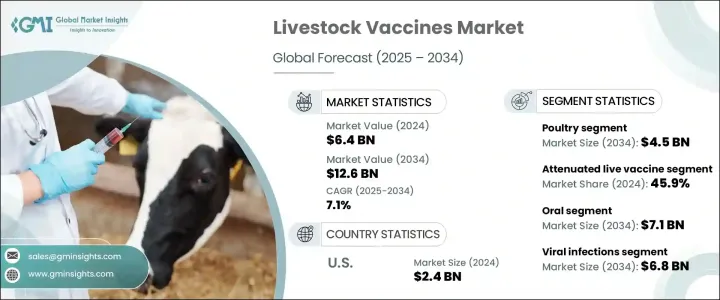
소, 돼지, 가금류, 양식어종, 양과 염소와 같은 가축은 식량 생산, 섬유, 노동력 등 다양한 목적을 제공하는 농업 경제의 중심축입니다. 백신 접종은 동물의 건강을 보호하고 전염병의 경제적 영향을 줄이기 위한 필수적인 수단으로 널리 알려져 있습니다. 2024년 가금류 부문은 24억 달러의 매출을 기록하며 가장 큰 시장 점유율을 차지했으며, 2034년에는 6.5%의 연평균 성장률로 45억 달러에 달할 것으로 예상됩니다. 가금류는 다른 가축에 비해 생산 비용이 낮고 회전율이 빠르기 때문에 전 세계적으로 여전히 주요 식재료로 사용되고 있습니다. 특히 빠르게 발전하는 지역에서 가금류 제품에 대한 수요가 증가하면서 대량 백신 접종 관행의 채택이 가속화되고 있습니다. 업계는 바이러스 및 박테리아 발생으로 인한 지속적인 위협에 직면해 있으며, 이로 인해 강력한 백신 프로그램의 중요성이 강조되고 있습니다.
| 시장 범위 | |
|---|---|
| 시작 연도 | 2024년 |
| 예측 연도 | 2025-2034년 |
| 시작 금액 | 64억 달러 |
| 예측 금액 | 126억 달러 |
| CAGR | 7.1% |
백신 유형 중 약독화 생백신이 2024년 45.9%의 점유율을 차지하며 시장을 지배하고 있습니다. 이 부문은 2034년까지 6.7%의 연평균 성장률로 선두 자리를 유지할 것으로 예상됩니다. 이러한 백신은 자연 감염을 모방하여 적은 접종으로 강력하고 오래 지속되는 면역력을 제공하기 때문에 매우 효과적입니다. 백신은 심각한 가축 질병을 해결하는 데 일반적으로 사용되기 때문에 대규모 동물 건강 관리에 선호되는 솔루션입니다. 이 백신은 또한 질병이 빠르게 확산될 수 있는 집약적인 축산 환경에서 필수적인 요소인 빠른 면역 반응을 제공하는 것으로도 알려져 있습니다.
투여 경로와 관련하여 경구용 백신은 대규모 작업에서 편리하고 효과적이기 때문에 상당한 주목을 받고 있습니다. 2034년까지 71억 달러의 가치가 있는 이 부문은 6.8%의 연평균 성장률로 성장할 것으로 예상됩니다. 경구용 백신은 특히 가금류, 돼지, 소 분야에서 스트레스 없이 동물에게 면역을 제공할 수 있는 방법입니다. 사료나 물을 통해 투여할 수 있기 때문에 취급이 간편하여 부상 위험을 최소화하고 가축의 순응도를 높일 수 있습니다. 백신 제형의 기술 발전으로 경구 백신의 안정성과 효율성이 향상되어 경구 백신의 광범위한 사용에 점점 더 적합해지고 있습니다.
용도별로는 바이러스 감염 백신은 2034년까지 7.2%의 연평균 성장률로 68억 달러에 달할 것으로 예상되는 시장에서 상당한 점유율을 차지하고 있습니다. 반복되는 바이러스 발생은 동물 건강과 경제적 영향 측면에서 축산업에 계속해서 큰 도전이 되고 있습니다. 이러한 질병은 생산량을 크게 감소시켜 농부들이 효과적인 예방 솔루션을 도입하도록 강요합니다. 백신 제조업체의 지속적인 연구 개발 투자는 바이러스 백신의 효능과 접근성을 개선하여 이 부문의 혁신을 주도할 것으로 예상됩니다.
유통과 관련하여 동물병원 약국은 2024년 33억 달러로 가장 큰 매출 비중을 차지했으며, 2034년에는 64억 달러로 6.9%의 연평균 성장률을 기록할 것으로 예측됩니다. 이러한 시설은 진단, 상담, 즉각적인 백신 투여 등 종합적인 치료 서비스를 제공하기 때문에 선호되고 있습니다. 특히 신흥 시장에서 동물병원 네트워크의 확장은 동물 의료 서비스에 대한 접근성을 높이는 데 기여하고 있습니다. 동물병원의 체계적인 전달 시스템은 적시에 백신을 접종할 수 있도록 보장하여 백신 접종 기회를 놓치는 경우를 줄이고 전반적인 효과를 높입니다.
미국은 북미 가축 백신 시장을 선도하며 2024년에 24억 달러의 가치를 달성할 것으로 예상됩니다. 이러한 리더십은 선진화된 동물 의료 체계, 높은 수의학 지출, 예방적 가축 관리에 대한 정부의 지속적인 지원으로 뒷받침되고 있습니다. 질병의 확산은 백신에 대한 수요를 지속적으로 증가시키며 시장을 발전시키고 있습니다.
Zoetis, Merck Animal Health, Boehringer Ingelheim, Elanco 및 Ceva와 같은 주요 기업은 전 세계 시장의 약 45%를 차지하고 있습니다. 이들의 우위는 광범위한 제품 라인, 강력한 글로벌 유통망, 차세대 백신 개발에 대한 전략적 투자에 기인합니다. 가축 백신 산업은 적당히 통합된 상태로 유지되고 있으며, 이러한 리더들이 동물 건강 솔루션의 혁신, 효율성 및 지속 가능성을 위한 속도를 높이고 있습니다.
목차
제1장 조사 방법과 범위
제2장 주요 요약
제3장 업계 인사이트
- 생태계 분석
- 업계에 미치는 영향요인
- 성장 촉진요인
- 가축 질병의 유병률 증가
- 백신 접종의 이점에 대한 농부들의 인식 증가
- 동물 건강 및 식량 안보를 지원하는 정부 대처 및 정책
- 보다 효과적인 백신 개발로 이어지는 기술 발전
- 업계의 잠재적 위험 및 과제
- 백신 개발 및 유통과 관련된 높은 비용
- 제품 승인 및 시장 진입을 지연시킬 수 있는 규제 장애물
- 성장 촉진요인
- 성장 가능성 분석
- 규제 상황
- 트럼프 정권에 의한 관세에 대한 영향
- 무역에 미치는 영향
- 무역량의 혼란
- 보복 조치
- 업계에 미치는 영향
- 공급측의 영향(원자재)
- 주요 원자재의 가격 변동
- 공급망 재구성
- 생산 비용에 미치는 영향
- 수요측의 영향(판매가격)
- 최종 시장에의 가격 전달
- 시장 점유율 동향
- 소비자의 반응 패턴
- 공급측의 영향(원자재)
- 영향을 받는 주요 기업
- 전략적인 업계 대응
- 공급망 재구성
- 가격 설정 및 제품 전략
- 정책관여
- 전망과 향후 검토 사항
- 무역에 미치는 영향
- 파이프라인 분석
- Porter's Five Forces 분석
- PESTEL 분석
제4장 경쟁 구도
- 소개
- 기업 매트릭스 분석
- 주요 시장 기업의 경쟁 분석
- 경쟁 포지셔닝 매트릭스
- 전략 대시보드
제5장 시장 추계 및 예측 : 동물 유형별(2021-2034년)
- 주요 동향
- 가금류
- 소
- 돼지
- 양식어종
- 양 및 염소
제6장 시장 추계 및 예측 : 백신 유형별(2021-2034년)
- 주요 동향
- 약독화 생백신
- 결합 백신
- 불활성화 백신
- 재조합 백신
- 기타 백신의 유형
제7장 시장 추계 및 예측 : 투여 경로별(2021-2034년)
- 주요 동향
- 경구
- 부모
- 기타 투여 경로
제8장 시장 추계 및 예측 : 용도별(2021-2034년)
- 주요 동향
- 박테리아 감염
- 바이러스 감염
- 기생충 감염
- 기타 용도
제9장 시장 추계 및 예측 : 유통 채널별(2021-2034년)
- 주요 동향
- 동물병원 약국
- 소매 약국
- 전자상거래
제10장 시장 추계 및 예측 : 지역별(2021-2034년)
- 주요 동향
- 북미
- 미국
- 캐나다
- 유럽
- 독일
- 영국
- 프랑스
- 스페인
- 이탈리아
- 네덜란드
- 아시아태평양
- 중국
- 인도
- 일본
- 호주
- 한국
- 라틴아메리카
- 브라질
- 멕시코
- 아르헨티나
- 중동 및 아프리카
- 남아프리카
- 사우디아라비아
- 아랍에미리트(UAE)
제11장 기업 프로파일
- Biogenesis Bago
- Bioveta
- Boehringer Ingelheim
- Ceva
- Elanco
- HIPRA
- Indian Immunologicals
- Merck Animal Health
- Neogen
- Phibro Animal Health
- SAN VET
- Vaxxinova
- Venkys
- Virbac
- Zoetis
The Global Livestock Vaccines Market was valued at USD 6.4 billion in 2024 and is estimated to grow at a CAGR of 7.1% to reach USD 12.6 billion by 2034, driven by increased awareness of animal health, the expansion of industrial farming, and advancements in vaccine technology. This rising trend is largely attributed to the heightened focus on disease prevention among farmers and a growing understanding of the economic advantages linked to immunization. As livestock farming becomes more industrialized, the need for comprehensive disease management strategies grows stronger. Technological innovation has further enabled the development of highly effective vaccines, strengthening animal health outcomes and improving productivity across farms. The emergence of frequent disease outbreaks globally has led to increased urgency around preventive measures, especially for poultry, which remains a highly vulnerable category. Global food security is increasingly reliant on livestock productivity, making animal health a critical aspect of agricultural sustainability. Moreover, the reduction in losses due to illness and mortality directly supports the economic viability of farming operations, especially in high-density production settings. The market continues to benefit from favorable government policies, industry collaborations, and increased investments in animal healthcare infrastructure.
Livestock animals such as cattle, swine, poultry, aquaculture species, and sheep and goats are central to the agricultural economy, serving various purposes including food production, fiber, and labor. Vaccination is widely recognized as an essential tool for safeguarding animal health and reducing the economic impact of infectious diseases. In 2024, the poultry segment held the largest market share, generating USD 2.4 billion in revenue, and is projected to reach USD 4.5 billion by 2034, growing at a CAGR of 6.5%. Poultry remains a global dietary staple, largely due to its lower production costs and faster turnover compared to other livestock. Increased demand for poultry products, particularly in rapidly developing regions, has accelerated the adoption of mass vaccination practices. The industry faces ongoing threats from viral and bacterial outbreaks, which have emphasized the importance of robust vaccination programs.
| Market Scope | |
|---|---|
| Start Year | 2024 |
| Forecast Year | 2025-2034 |
| Start Value | $6.4 Billion |
| Forecast Value | $12.6 Billion |
| CAGR | 7.1% |
Among vaccine types, attenuated live vaccines dominate the market, holding a 45.9% share in 2024. This segment is expected to maintain its leading position through 2034 with a CAGR of 6.7%. These vaccines are highly effective because they mimic natural infections, providing strong and long-lasting immunity with fewer doses. Their use is common in addressing serious livestock diseases, making them a preferred solution for large-scale animal health management. These vaccines are also known for providing quicker immune responses, an essential factor in intensive farming setups where disease can spread rapidly.
Regarding administration routes, the oral segment is gaining significant traction due to its convenience and effectiveness in large-scale operations. Valued at USD 7.1 billion by 2034, this segment is projected to grow at a CAGR of 6.8%. Oral vaccines offer a stress-free way to immunize animals, especially in poultry, swine, and cattle sectors. Their ability to be administered through feed or water reduces handling, thereby minimizing injury risks and ensuring higher compliance across herds. Technological progress in vaccine formulation has improved the stability and efficiency of oral vaccines, making them increasingly suitable for widespread use.
In terms of applications, viral infection vaccines hold a substantial share of the market, anticipated to reach USD 6.8 billion by 2034, with a CAGR of 7.2%. Recurring viral outbreaks continue to pose major challenges to the livestock industry, both in terms of animal health and economic impact. These diseases significantly reduce production yields, compelling farmers to adopt effective preventive solutions. The ongoing investment in research and development by vaccine manufacturers is expected to drive innovation in this segment, improving the efficacy and accessibility of viral vaccines.
When it comes to distribution, veterinary hospital pharmacies accounted for the largest revenue share of USD 3.3 billion in 2024 and are forecasted to hit USD 6.4 billion by 2034, growing at a CAGR of 6.9%. These facilities are preferred for their comprehensive care offerings, including diagnostics, consultations, and immediate vaccine administration. The expansion of veterinary care networks, especially in emerging markets, is contributing to better access to animal healthcare. The structured delivery system in veterinary hospitals ensures timely vaccination, reducing missed opportunities and increasing overall effectiveness.
The United States leads the North American livestock vaccines market, achieving a valuation of USD 2.4 billion in 2024. This leadership is supported by an advanced animal healthcare framework, high veterinary expenditure, and consistent government support for preventive livestock care. Disease prevalence continues to drive demand for vaccination, pushing the market forward.
Key players such as Zoetis, Merck Animal Health, Boehringer Ingelheim, Elanco, and Ceva collectively hold around 45% of the global market. Their dominance is attributed to broad product lines, strong global distribution networks, and strategic investments in next-generation vaccine development. The livestock vaccines industry remains moderately consolidated, with these leaders setting the pace for innovation, efficiency, and sustainability in animal health solutions.
Table of Contents
Chapter 1 Methodology and Scope
- 1.1 Market scope and definition
- 1.2 Research design
- 1.2.1 Research approach
- 1.2.2 Data collection methods
- 1.3 Base estimates and calculations
- 1.3.1 Base year calculation
- 1.3.2 Key trends for market estimation
- 1.4 Forecast model
- 1.5 Primary research and validation
- 1.5.1 Primary sources
- 1.5.2 Data mining sources
Chapter 2 Executive Summary
- 2.1 Industry 3600 synopsis
Chapter 3 Industry Insights
- 3.1 Industry ecosystem analysis
- 3.2 Industry impact forces
- 3.2.1 Growth drivers
- 3.2.1.1 Rising prevalence of livestock diseases
- 3.2.1.2 Growing awareness among farmers about the benefits of vaccination.
- 3.2.1.3 Government initiatives and policies supporting animal health and food security.
- 3.2.1.4 Technological advancements leading to the development of more effective vaccines
- 3.2.2 Industry pitfalls and challenges
- 3.2.2.1 High costs associated with vaccine development and distribution
- 3.2.2.2 Regulatory hurdles that can delay product approvals and market entry.
- 3.2.1 Growth drivers
- 3.3 Growth potential analysis
- 3.4 Regulatory landscape
- 3.5 Trump administration tariffs
- 3.5.1 Impact on trade
- 3.5.1.1 Trade volume disruptions
- 3.5.1.2 Retaliatory measures
- 3.5.2 Impact on the industry
- 3.5.2.1 Supply-side impact (raw materials)
- 3.5.2.1.1 Price volatility in key materials
- 3.5.2.1.2 Supply chain restructuring
- 3.5.2.1.3 Production cost implications
- 3.5.2.2 Demand-side impact (selling price)
- 3.5.2.2.1 Price transmission to end markets
- 3.5.2.2.2 Market share dynamics
- 3.5.2.2.3 Consumer response patterns
- 3.5.2.1 Supply-side impact (raw materials)
- 3.5.3 Key companies impacted
- 3.5.4 Strategic industry responses
- 3.5.4.1 Supply chain reconfiguration
- 3.5.4.2 Pricing and product strategies
- 3.5.4.3 Policy engagement
- 3.5.5 Outlook and future considerations
- 3.5.1 Impact on trade
- 3.6 Pipeline analysis
- 3.7 Porter's analysis
- 3.8 PESTEL analysis
Chapter 4 Competitive Landscape, 2024
- 4.1 Introduction
- 4.2 Company matrix analysis
- 4.3 Competitive analysis of major market players
- 4.4 Competitive positioning matrix
- 4.5 Strategy dashboard
Chapter 5 Market Estimates and Forecast, By Animal Type, 2021 - 2034 ($ Mn)
- 5.1 Key trends
- 5.2 Poultry
- 5.3 Cattle
- 5.4 Swine
- 5.5 Aquaculture
- 5.6 Sheep and goats
Chapter 6 Market Estimates and Forecast, By Vaccine Type, 2021 - 2034 ($ Mn)
- 6.1 Key trends
- 6.2 Attenuated live vaccine
- 6.3 Conjugate vaccine
- 6.4 Inactivated vaccine
- 6.5 Recombinant vaccine
- 6.6 Other vaccine types
Chapter 7 Market Estimates and Forecast, By Route of Administration, 2021 - 2034 ($ Mn)
- 7.1 Key trends
- 7.2 Oral
- 7.3 Parentral
- 7.4 Other routes of administration
Chapter 8 Market Estimates and Forecast, By Application, 2021 - 2034 ($ Mn)
- 8.1 Key trends
- 8.2 Bacterial infections
- 8.3 Viral infections
- 8.4 Parasitic infections
- 8.5 Other applications
Chapter 9 Market Estimates and Forecast, By Distribution Channel, 2021 - 2034 ($ Mn)
- 9.1 Key trends
- 9.2 Veterinary hospital pharmacies
- 9.3 Retail pharmacies
- 9.4 E-commerce
Chapter 10 Market Estimates and Forecast, By Region, 2021 - 2034 ($ Mn)
- 10.1 Key trends
- 10.2 North America
- 10.2.1 U.S.
- 10.2.2 Canada
- 10.3 Europe
- 10.3.1 Germany
- 10.3.2 UK
- 10.3.3 France
- 10.3.4 Spain
- 10.3.5 Italy
- 10.3.6 Netherlands
- 10.4 Asia Pacific
- 10.4.1 China
- 10.4.2 India
- 10.4.3 Japan
- 10.4.4 Australia
- 10.4.5 South Korea
- 10.5 Latin America
- 10.5.1 Brazil
- 10.5.2 Mexico
- 10.5.3 Argentina
- 10.6 Middle East and Africa
- 10.6.1 South Africa
- 10.6.2 Saudi Arabia
- 10.6.3 UAE
Chapter 11 Company Profiles
- 11.1 Biogenesis Bago
- 11.2 Bioveta
- 11.3 Boehringer Ingelheim
- 11.4 Ceva
- 11.5 Elanco
- 11.6 HIPRA
- 11.7 Indian Immunologicals
- 11.8 Merck Animal Health
- 11.9 Neogen
- 11.10 Phibro Animal Health
- 11.11 SAN VET
- 11.12 Vaxxinova
- 11.13 Venkys
- 11.14 Virbac
- 11.15 Zoetis