|
시장보고서
상품코드
1740944
자동차 멀티모달 인터랙션 개발 시장 : 시장 기회, 성장 촉진요인, 산업 동향 분석 및 예측(2025-2034년)Automotive Multimodal Interaction Development Market Opportunity, Growth Drivers, Industry Trend Analysis, and Forecast 2025 - 2034 |
||||||

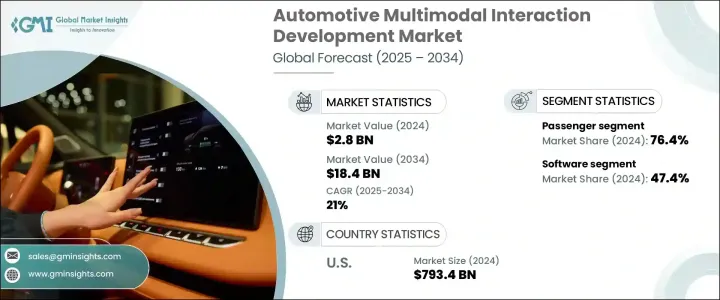
세계의 자동차 멀티모달 인터랙션 개발 시장 규모는 2024년 28억 달러로 평가되었고, 차세대 자동차의 지능형 사용자 인터페이스 수요 급증과 커넥티드 모빌리티 솔루션의 보급으로 2034년에는 184억 달러에 달할 것으로 예측되며, CAGR 21%로 성장할 전망입니다.
자동차 혁신이 가속화됨에 따라 인간과 기계 간의 원활한 커뮤니케이션이 모빌리티의 미래를 정의하는 차량 내 기술의 중심이 되는 멀티모달 상호 작용이 중요해지고 있습니다. 개인화, 향상된 안전성, 직관적인 제어에 대한 요구가 증가함에 따라 운전자가 차량과 상호작용하는 방식이 재편되고 있습니다. 인공 지능, 첨단 센서 통합, 실시간 데이터 처리가 모두 융합되어 고도로 적응적인 차량 내 환경을 조성하고 있습니다. 자율 주행, 스마트 시티 에코시스템, 디지털 연결로 전환하면서 자동차 제조업체들은 자연스럽고 반응이 빠른 사용자 경험을 제공하는 시스템을 탑재하기 위해 경쟁하고 있습니다. 전 세계의 자동차 제조업체와 기술 제공업체는 인간과 기계의 시너지를 개선하기 위해 R&D에 막대한 투자를 하고 있으며, 차량이 정확하게 반응할 뿐만 아니라 운전자의 요구를 예측할 수 있도록 보장합니다. 음성, 터치, 제스처, 감정 감지를 아우르는 멀티모달 상호 작용은 운전의 편의성과 안전성을 대규모로 재정의할 준비가 되어 있습니다.
전 세계적으로 모빌리티 노력과 디지털 혁신 프로그램은 운전의 복잡성을 줄이기 위한 스마트 교통 인프라에 대한 투자를 촉진하고 있습니다. 각국 정부는 교통 관리, 안전, 운전자 만족도를 높이기 위해 인간-기계 인터페이스(HMI) 기술의 발전을 지지하고 있습니다. 음성 명령, 제스처 인식, 안면 인증 등 비접촉식 시스템으로의 전환이 증가하면서 차량 내 경험이 변화하고 있습니다. 자동차 제조업체들은 운전자의 행동, 환경, 감정을 이해하는 적응형 시스템을 빠르게 도입하여 자율주행 및 반자율 플랫폼에 멀티모달 기술을 통합하고 있습니다. 아시아는 확장하는 시장에 차세대 대화형 모빌리티 솔루션을 배포하기 위한 규제 인센티브와 정책 지원을 제공하면서 강력한 촉매제로 자리매김하고 있습니다.
| 시장 범위 | |
|---|---|
| 시작 연도 | 2024년 |
| 예측 연도 | 2025-2034년 |
| 시작 금액 | 28억 달러 |
| 예측 금액 | 184억 달러 |
| CAGR | 21% |
컴포넌트별로 소프트웨어 플랫폼 부문은 2024년에 47.4%의 점유율을 차지했으며 2034년까지 21.8%의 연평균 성장률로 성장할 것으로 예상됩니다. AI 기반 기능의 복잡성이 증가함에 따라 고급 알고리즘, 음성 인식 도구, 상황 인식 인터페이스에 대한 수요가 증가하고 있습니다. 소프트웨어 플랫폼은 멀티모달 시스템의 두뇌 역할을 하며, 채널 간 통신을 가능하게 하고, 무선 업데이트를 제공하며, 고도로 맞춤화된 주행 환경을 지원합니다. 도시 지역과 커넥티드 모빌리티 생태계는 확장 가능한 지능형 상호 작용 프레임워크를 구축하기 위한 투자가 급증하고 있습니다.
차량 유형별로, 승용차가 2024년 76.4%의 점유율로 시장을 장악했으며, 이는 생산률 증가, HMI 시스템의 강력한 통합, 정교한 기술 중심의 주행 경험에 대한 소비자 수요 증가에 힘입은 결과입니다. 전기자동차의 붐과 첨단 운전자 지원 시스템(ADAS)의 채택으로 인해 OEM은 편안함, 안전, 직관적인 제어를 향상시키는 멀티모달 솔루션을 통합하고 있습니다.
미국의 자동차 멀티모달 인터랙션 개발 시장은 2024년에 63%의 점유율을 차지해 7억 9,340만 달러로 성장했습니다. 이러한 성장은 미국의 첨단 자동차 R&D 생태계, 자율주행차 대응에 대한 강력한 투자, 기술 기업과 자동차 제조업체 간의 긴밀한 협력에서 비롯된 것입니다. 미국 전역의 도시들은 연방 노력과 민간 자금의 지원을 받아 최첨단 HMI 기술의 실제 테스트 베드 역할을 활발히 수행하고 있습니다.
시장을 선도하는 주요 기업은 Huawei, Horizon Robotics, Desay SV, Cerence, PATEO, Baidu, Tencent, Aptiv, iFlytek, Continental 등이 있습니다. 기업들은 전략적 파트너십, AI 개발자와의 합작 투자, R&D 노력 확대, 독점적인 AI 플랫폼 개발 등을 통해 시장 입지를 강화하고 있습니다. 지역 확장, 사용자 경험의 현지화, 클라우드 기반 인텔리전스의 통합에 중점을 두면서 업계 전반의 혁신을 주도하고 있습니다.
목차
제1장 조사 방법과 범위
제2장 주요 요약
제3장 업계 인사이트
- 생태계 분석
- 공급자의 상황
- 부품 제조업체
- 기술 공급자
- 소프트웨어 개발자
- 최종 용도
- 트럼프 정권에 의한 관세에 대한 영향
- 무역에 미치는 영향
- 무역량의 혼란
- 보복 조치
- 업계에 미치는 영향
- 공급측의 영향(원자재)
- 주요 원자재의 가격 변동
- 공급망 재구성
- 생산 비용에 미치는 영향
- 수요측의 영향(고객에 대한 비용)
- 최종 시장에의 가격 전달
- 시장 점유율 동향
- 소비자의 반응 패턴
- 공급측의 영향(원자재)
- 영향을 받는 주요 기업
- 전략적인 업계 대응
- 공급망 재구성
- 가격 설정 및 제품 전략
- 정책관여
- 전망과 향후 검토 사항
- 무역에 미치는 영향
- 이익률 분석
- 기술과 혁신의 상황
- 특허 분석
- 주요 뉴스와 대처
- 규제 상황
- 영향요인
- 성장 촉진요인
- 자율주행 및 반자율 주행 차량의 부상
- 차량 내 안전(DMS, ADAS)에 대한 관심 증가
- 지능형 콕핏 시스템에 대한 OEM 및 티어1 투자
- 지속적인 기술 발전
- 업계의 잠재적 위험 및 과제
- 높은 개발 및 통합 비용
- 사용자 경험 설계의 복잡성
- 성장 촉진요인
- 성장 가능성 분석
- Porter's Five Forces 분석
- PESTEL 분석
제4장 경쟁 구도
- 소개
- 기업의 시장 점유율 분석
- 경쟁 포지셔닝 매트릭스
- 전략적 전망 매트릭스
제5장 시장 추계 및 예측 : 컴포넌트별(2021-2034년)
- 주요 동향
- 하드웨어
- 소프트웨어
- 서비스
제6장 시장 추계 및 예측 : 차량 유형별(2021-2034년)
- 주요 동향
- 승용차
- 해치백
- 세단
- SUV
- 상업용
제7장 시장 추계 및 예측 : 인터랙션별(2021-2034년)
- 주요 동향
- 음성 명령
- 제스처 인식
- 안면 인증
- 터치 기반 인터페이스
- 기타
제8장 시장 추계 및 예측 : 지역별(2021-2034년)
- 주요 동향
- 북미
- 미국
- 캐나다
- 유럽
- 영국
- 독일
- 프랑스
- 이탈리아
- 스페인
- 러시아
- 북유럽 국가
- 아시아태평양
- 중국
- 인도
- 일본
- 한국
- 호주 및 뉴질랜드
- 동남아시아
- 라틴아메리카
- 브라질
- 멕시코
- 아르헨티나
- 중동 및 아프리카
- 아랍에미리트(UAE)
- 사우디아라비아
- 남아프리카
제9장 기업 프로파일
- ADAYO
- AISpeech
- Aptiv
- ArcSoft Technology
- Baidu
- Banma Network
- Cerence
- Cipia Vision
- Continental
- Desay SV
- Hikvision
- Horizon Robotics
- Huawei
- iFlytek
- Joyson Electronics
- Shenzhen Minieye Intelligent Technology(MINIEYE)
- Shanghai PATEO Electronic Equipment Manufacturing
- SenseTime
- Tencent
- ThunderSoft
The Global Automotive Multimodal Interaction Development Market was valued at USD 2.8 billion in 2024 and is estimated to grow at a CAGR of 21% to reach USD 18.4 billion by 2034, driven by the surging demand for intelligent user interfaces in next-gen vehicles and the widespread adoption of connected mobility solutions. As automotive innovation accelerates, multimodal interaction is becoming the centerpiece of in-vehicle technology, where seamless communication between humans and machines defines the future of mobility. The growing need for personalization, enhanced safety, and intuitive control is reshaping how drivers interact with vehicles. Artificial intelligence, advanced sensor integration, and real-time data processing are all converging to create highly adaptive in-vehicle environments. With the shift toward autonomous driving, smart city ecosystems, and digital connectivity, automakers are racing to embed systems that deliver a natural, responsive user experience. Around the globe, automotive manufacturers and tech providers are investing heavily in R&D to refine human-machine synergy, ensuring vehicles not only respond accurately but also anticipate driver needs. Multimodal interaction-spanning voice, touch, gesture, and emotion detection-is poised to redefine driving convenience and safety at scale.
Globally, mobility initiatives and digital transformation programs are pushing investments in smart transport infrastructure aimed at reducing driving complexities. Governments are endorsing advancements in human-machine interface (HMI) technologies to boost traffic management, safety, and driver satisfaction. The growing transition toward touchless systems, including voice commands, gesture recognition, and facial authentication, is transforming in-vehicle experiences. Automakers are rapidly embracing adaptive systems that understand driver behavior, environment, and emotions, integrating multimodal technologies into both autonomous and semi-autonomous platforms. Asia is positioning itself as a strong catalyst, offering regulatory incentives and policy support for deploying next-generation interactive mobility solutions across expanding markets.
| Market Scope | |
|---|---|
| Start Year | 2024 |
| Forecast Year | 2025-2034 |
| Start Value | $2.8 Billion |
| Forecast Value | $18.4 Billion |
| CAGR | 21% |
Based on components, the software platforms segment held a 47.4% share in 2024 and is anticipated to grow at a CAGR of 21.8% through 2034. The rising complexity of AI-powered features is fueling the demand for advanced algorithms, speech recognition tools, and context-aware interfaces. Software platforms serve as the brain of multimodal systems, enabling cross-channel communication, delivering over-the-air updates, and supporting highly customized driving environments. Urban areas and connected mobility ecosystems are seeing a surge in investments aimed at building scalable, intelligent interaction frameworks.
By vehicle type, passenger vehicles dominated the market in 2024 with a 76.4% share, propelled by rising production rates, strong integration of HMI systems, and escalating consumer demand for sophisticated, tech-driven driving experiences. The boom in electric vehicles and the adoption of advanced driver-assistance systems (ADAS) are driving OEMs to integrate multimodal solutions that enhance comfort, safety, and intuitive control.
The United States Automotive Multimodal Interaction Development Market held a 63% share in 2024, contributing USD 793.4 million. This growth stems from the country's advanced automotive R&D ecosystem, robust investments in autonomous vehicle initiatives, and deep collaboration between tech firms and automakers. Cities across the U.S. are actively serving as real-world test beds for cutting-edge HMI technologies backed by federal initiatives and private funding.
Key players leading the market include Huawei, Horizon Robotics, Desay SV, Cerence, PATEO, Baidu, Tencent, Aptiv, iFlytek, and Continental. Companies are strengthening their market presence through strategic partnerships, joint ventures with AI developers, expanded R&D efforts, and proprietary AI platform developments. Emphasis on regional expansion, localization of user experiences, and integration of cloud-based intelligence continues to drive innovation across the space.
Table of Contents
Chapter 1 Methodology & Scope
- 1.1 Research design
- 1.1.1 Research approach
- 1.1.2 Data collection methods
- 1.2 Base estimates and calculations
- 1.2.1 Base year calculation
- 1.2.2 Key trends for market estimates
- 1.3 Forecast model
- 1.4 Primary research & validation
- 1.4.1 Primary sources
- 1.4.2 Data mining sources
- 1.5 Market definitions
Chapter 2 Executive Summary
- 2.1 Industry 3600 synopsis, 2021 - 2034
Chapter 3 Industry Insights
- 3.1 Industry ecosystem analysis
- 3.2 Supplier landscape
- 3.2.1 Component manufacturers
- 3.2.2 Technology providers
- 3.2.3 Software developers
- 3.2.4 End use
- 3.3 Impact of Trump administration tariffs
- 3.3.1 Trade impact
- 3.3.1.1 Trade volume disruptions
- 3.3.1.2 Retaliatory measures
- 3.3.2 Impact on industry
- 3.3.2.1 Supply-side impact (raw materials)
- 3.3.2.1.1 Price volatility in key materials
- 3.3.2.1.2 Supply chain restructuring
- 3.3.2.1.3 Production cost implications
- 3.3.2.2 Demand-side impact (Cost to customers)
- 3.3.2.2.1 Price transmission to end markets
- 3.3.2.2.2 Market share dynamics
- 3.3.2.2.3 Consumer response patterns
- 3.3.2.1 Supply-side impact (raw materials)
- 3.3.3 Key companies impacted
- 3.3.4 Strategic industry responses
- 3.3.4.1 Supply chain reconfiguration
- 3.3.4.2 Pricing and product strategies
- 3.3.4.3 Policy engagement
- 3.3.5 Outlook & future considerations
- 3.3.1 Trade impact
- 3.4 Profit margin analysis
- 3.5 Technology & innovation landscape
- 3.6 Patent analysis
- 3.7 Key news & initiatives
- 3.8 Regulatory landscape
- 3.9 Impact forces
- 3.9.1 Growth drivers
- 3.9.1.1 Rise of autonomous and semi-autonomous vehicles
- 3.9.1.2 Increasing focus on in-vehicle safety (DMS, ADAS)
- 3.9.1.3 OEM and Tier-1 investment in intelligent cockpit systems
- 3.9.1.4 Ongoing technological advancements
- 3.9.2 Industry pitfalls & challenges
- 3.9.2.1 High development & integration cost
- 3.9.2.2 Complexity in user experience design
- 3.9.1 Growth drivers
- 3.10 Growth potential analysis
- 3.11 Porter's analysis
- 3.12 PESTEL analysis
Chapter 4 Competitive Landscape, 2024
- 4.1 Introduction
- 4.2 Company market share analysis
- 4.3 Competitive positioning matrix
- 4.4 Strategic outlook matrix
Chapter 5 Market Estimates & Forecast, By Component, 2021 - 2034 ($Bn)
- 5.1 Key trends
- 5.2 Hardware
- 5.3 Software
- 5.4 Services
Chapter 6 Market Estimates & Forecast, By Vehicle, 2021 - 2034 ($Bn)
- 6.1 Key trends
- 6.2 Passenger cars
- 6.2.1 Hatchback
- 6.2.2 Sedan
- 6.2.3 SUV
- 6.3 Commercial
Chapter 7 Market Estimates & Forecast, By Interaction, 2021 - 2034 ($Bn)
- 7.1 Key trends
- 7.2 Speech recognition
- 7.3 Gesture recognition
- 7.4 Facial recognition
- 7.5 Touch-based interfaces
- 7.6 Others
Chapter 8 Market Estimates & Forecast, By Region, 2021 - 2034 ($Bn)
- 8.1 Key trends
- 8.2 North America
- 8.2.1 U.S.
- 8.2.2 Canada
- 8.3 Europe
- 8.3.1 UK
- 8.3.2 Germany
- 8.3.3 France
- 8.3.4 Italy
- 8.3.5 Spain
- 8.3.6 Russia
- 8.3.7 Nordics
- 8.4 Asia Pacific
- 8.4.1 China
- 8.4.2 India
- 8.4.3 Japan
- 8.4.4 South Korea
- 8.4.5 ANZ
- 8.4.6 Southeast Asia
- 8.5 Latin America
- 8.5.1 Brazil
- 8.5.2 Mexico
- 8.5.3 Argentina
- 8.6 MEA
- 8.6.1 UAE
- 8.6.2 Saudi Arabia
- 8.6.3 South Africa
Chapter 9 Company Profiles
- 9.1 ADAYO
- 9.2 AISpeech
- 9.3 Aptiv
- 9.4 ArcSoft Technology
- 9.5 Baidu
- 9.6 Banma Network
- 9.7 Cerence
- 9.8 Cipia Vision
- 9.9 Continental
- 9.10 Desay SV
- 9.11 Hikvision
- 9.12 Horizon Robotics
- 9.13 Huawei
- 9.14 iFlytek
- 9.15 Joyson Electronics
- 9.16 Shenzhen Minieye Intelligent Technology (MINIEYE)
- 9.17 Shanghai PATEO Electronic Equipment Manufacturing
- 9.18 SenseTime
- 9.19 Tencent
- 9.20 ThunderSoft