|
시장보고서
상품코드
1750274
적응형 미채 재료 시장 : 시장 기회, 성장 촉진요인, 산업 동향 분석, 예측(2025-2034년)Adaptive Camouflage Materials Market Opportunity, Growth Drivers, Industry Trend Analysis, and Forecast 2025 - 2034 |
||||||

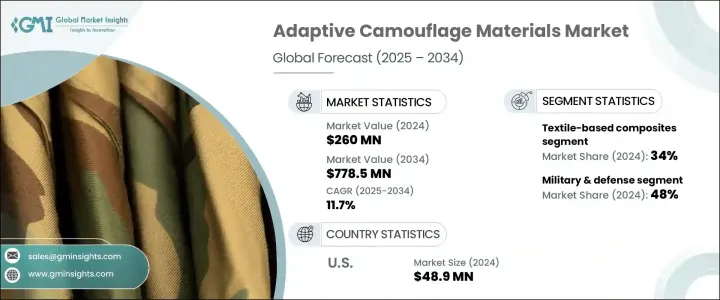
세계의 적응형 미채 재료 시장은 2024년에는 2억 6,000만 달러로 평가되었고 스텔스성과 은폐성이 전술 작전 성공에 필수적인 방위 및 항공우주 분야로부터 수요 증가에 의해 CAGR 11.7%로 성장하여 2034년에는 7억 7,850만 달러에 이를 것으로 예측됩니다. 다양한 작전 환경용으로 설계된 스마트·텍스타일과 적응 시스템에 대한 투자 증가가 이 성장을 지지하고 있습니다. 군 및 상업 기업이 범용성 높은 고성능 소재를 요구하는 것에 따라, 시각, 적외선, 레이더 등 복수 스펙트럼에 걸쳐 기능하는 적응형 미채 수요가 가속하고 있습니다. 이러한 진화하는 요구는 국내 방위 능력 강화와 기술 혁신에 초점을 맞춘 정부 이니셔티브에 의해 유지되고 있습니다.
나노기술과 재료과학의 지속적인 발전은 적응형 위장 기술의 변화를 주도하고 있습니다. 나노구조 폴리머, 메타물질, 액정 등 스마트 소재의 획기적인 개발로 변화하는 주변 환경에 실시간으로 적응할 수 있는 표면을 개발할 수 있게 되었습니다. 이러한 혁신은 시스템의 유연성, 에너지 효율성, 경량화 및 성능 향상을 촉진하며, 이는 모두 현대의 전투 및 전술 환경에서 필수적인 요소입니다. 항공우주 및 방위군은 다양한 조건에서 신뢰할 수 있는 은폐가 필요한 장비, 차량 및 기타 플랫폼의 장비에 이러한 소재를 많이 사용하고 있습니다.
| 시장 범위 | |
|---|---|
| 개시 연도 | 2024년 |
| 예측 기간 | 2025-2034년 |
| 당초 시장 규모 | 2억 6,000만 달러 |
| 시장 규모 예측 | 7억 7,850만 달러 |
| CAGR | 11.7% |
섬유 기반 부문은 2024년 34%의 점유율을 차지할 것으로 예상되는데, 이는 주로 경량 구조, 내구성, 통기성, 군용 웨어러블 및 장비에 매우 적합한 통기성 때문으로 분석됩니다. 이러한 첨단 직물은 환경 자극에 노출되면 적극적으로 외관을 변화시키는 반응성 안료와 미세 구조를 통합하고 있습니다. 이러한 형상 변화 능력은 시각, 적외선, 레이더 등 다양한 스펙트럼에 걸쳐 실시간으로 적응할 수 있어 예측할 수 없는 환경이나 적대적인 환경에서 활동하는 요원에게 필수적인 전술적 우위를 제공합니다.
군사 및 방위 분야는 2024년 48%의 점유율을 차지했습니다. 현대 전투에서 복잡한 작전 영역에서 스텔스성이 점점 더 요구됨에 따라 전 세계 군는 다중 스펙트럼 은폐 기술을 중요시하고 있습니다. 적응형 위장의 응용은 개인 장비뿐만 아니라 차량, 장비 보호소, 감시 시스템 등에도 적용되고 있습니다. 높은 국방 예산 배분과 국제 안보 전략은 현재 더 높은 생존성과 작전 성공을 보장하는 스마트 소재를 우선시하고 있습니다.
미국 적응형 위장 재료 시장은 국방 기술에 대한 연방 정부의 막대한 투자, 첨단 연구 기관의 지속적인 기술 혁신, 탄탄한 군수 공급업체 생태계로 인해 2024년 4,890만 달러 규모에 달할 것으로 예측됩니다. 미국의 국방 이니셔티브는 병사 시스템, 차량 및 무인 플랫폼에 다중 스펙트럼 위장을 통합하는 데 중점을 두고 있습니다. 이러한 노력은 전술적 기동성을 강화하고, 감지 능력을 낮추며, 다양한 지형과 조건에서 미래에도 전투 능력을 유지한다는 보다 광범위한 목표에 부합하는 것입니다.
Rheinmetall AG, HyperStealth Biotechnology, Folium Optics, Saab AB, Ashwin-Ushas와 같은 주요 시장 기업들은 업계 입지를 강화하기 위해 핵심 전략을 실행하고 있습니다. 여기에는 재료 혁신에 대한 투자, 전략적 방위 파트너십 형성, 스마트 섬유 및 다중 스펙트럼 적응형 시스템 생산 확대 등이 포함됩니다. 또한, 각 회사는 군사 인프라에 쉽게 통합할 수 있는 가볍고 반응성이 뛰어난 소재 개발에 주력하는 한편, 정부 계약 및 방위 기관과의 협력을 통해 세계 사업 범위를 확장하고 있습니다.
목차
제1장 분석 방법과 범위
제2장 주요 요약
제3장 업계 인사이트
- 생태계 분석
- 밸류체인에 영향을 미치는 요인
- 이익률 분석
- 파괴적 변화
- 향후 전망
- 제조업체
- 유통업체
- 트럼프 정권 관세 영향 : 구조 개요
- 무역에 대한 영향
- 무역량 혼란
- 보복 조치
- 업계에 대한 영향
- 공급측 영향(원재료)
- 주요 원재료의 가격 변동
- 공급망 재구축
- 생산비용에 대한 영향
- 수요측 영향(판매 가격)
- 최종 시장에의 가격 전달
- 시장 점유율 동향
- 소비자 반응 패턴
- 영향을 받는 주요 기업
- 전략적인 업계 대응
- 공급망 재구성
- 가격 결정과 제품 전략
- 정책 관여
- 전망과 향후 검토사항
- 무역에 대한 영향
- 무역 통계(HS코드)
- 주요 수출국
- 주요 수입국
- 규제 상황
- 영향요인
- 성장 촉진요인
- 업계의 잠재적 리스크&과제
- 성장 가능성 분석
- Porter's Five Forces 분석
- PESTEL 분석
제4장 경쟁 구도
- 서론
- 기업의 시장 점유율 분석
- 경쟁 포지셔닝 매트릭스
- 전략적 전망 매트릭스
제5장 시장 추산·예측 : 재질별(2021-2034년)
- 주요 동향
- 섬유 기반 복합재료
- 스마트 폴리머
- LCD 재료
- 금속 산화물
- 기타
제6장 시장 추산·예측 : 용도별(2021-2034년)
- 주요 동향
- 군 및 방위
- 항공우주
- 자동차
- 의료
- 기타
제7장 시장 추산·예측 : 지역별(2021-2034년)
- 주요 동향
- 북미
- 미국
- 캐나다
- 유럽
- 독일
- 영국
- 프랑스
- 스페인
- 이탈리아
- 기타 유럽
- 아시아태평양
- 중국
- 인도
- 일본
- 호주
- 한국
- 기타 아시아태평양
- 라틴아메리카
- 브라질
- 멕시코
- 아르헨티나
- 기타 라틴아메리카
- 중동 및 아프리카
- 사우디아라비아
- 남아프리카공화국
- 아랍에미리트(UAE)
- 기타 중동 및 아프리카
제8장 기업 개요
- Ashwin-Ushas
- BAE Systems.
- Folium Optics
- HyperStealth Biotechnology
- Miranda Spolka z o.o..
- Rheinmetall AG
- Saab AB
- Shaoxing Maigurui Textile
- Vollebak
- Wuhan Jinteng Manufacturing &Trading
The Global Adaptive Camouflage Materials Market was valued at USD 260 million in 2024 and is estimated to grow at a CAGR of 11.7% to reach USD 778.5 million by 2034 due to escalating demand from the defense and aerospace sectors, where stealth and concealment are vital to success in tactical operations. Heightened investment in smart textiles and adaptive systems designed for various operational environments pushes this growth forward. As military and commercial players seek versatile, high-performance materials, the demand for adaptive camouflage capable of functioning across multiple spectrums-visual, infrared, and radar-is accelerating. These evolving needs are supported by government initiatives focused on strengthening domestic defense capabilities and technological innovation.
Ongoing advancements in nanotechnology and material sciences are powering the transformation of adaptive camouflage technologies. Breakthroughs in smart materials such as nanostructured polymers, metamaterials, and liquid crystals have enabled the development of surfaces that can adjust to changing surroundings in real time. These innovations drive improvements in system flexibility, energy efficiency, and lightweight performance, all essential in modern combat and tactical environments. Aerospace and defense forces rely heavily on these materials to outfit gear, vehicles, and other platforms that demand reliable concealment across varied conditions.
| Market Scope | |
|---|---|
| Start Year | 2024 |
| Forecast Year | 2025-2034 |
| Start Value | $260 Million |
| Forecast Value | $778.5 Million |
| CAGR | 11.7% |
Textile-based segment accounted for 34% share in 2024, largely due to lightweight structure, durability, and breathability, which make highly suitable for military wearables and gear. These advanced fabrics incorporate responsive pigments and microstructures that actively change appearance when exposed to environmental stimuli. This shape-shifting capability enables real-time adaptation across multiple spectrums, including visual, infrared, and radar, offering an essential tactical advantage for personnel operating in unpredictable or hostile environments.
The military and defense segment held a 48% share in 2024. Global armed forces emphasize multispectral concealment technologies as modern combat increasingly demands stealth across complex operational theaters. The application of adaptive camouflage extends beyond personal gear to include vehicles, equipment shelters, and surveillance systems. High-budget defense allocations and international security strategies are now prioritizing smart materials that ensure greater survivability and operational success.
United States Adaptive Camouflage Materials Market reached USD 48.9 million in 2024 driven by significant federal investment in defense technologies, continuous innovation through advanced research institutions, and a robust ecosystem of military suppliers. U.S. defense initiatives focus on integrating multispectral camouflage into soldier systems, vehicles, and unmanned platforms. These efforts align with broader goals to enhance tactical mobility, reduce detectability, and future-proof combat capabilities in varying terrains and conditions.
Key market players including Rheinmetall AG, HyperStealth Biotechnology, Folium Optics, Saab AB, and Ashwin-Ushas are implementing core strategies to reinforce their industry positions. These include investing in material innovation, forming strategic defense partnerships, and scaling up production of smart textiles and multispectral adaptive systems. Additionally, companies are focused on developing lightweight, responsive materials that integrate easily into military infrastructure, while expanding their global reach through government contracts and collaborations with defense agencies.
Table of Contents
Chapter 1 Methodology & Scope
- 1.1 Market scope & definition
- 1.2 Base estimates & calculations
- 1.3 Forecast calculation
- 1.4 Data sources
- 1.4.1 Primary
- 1.4.2 Secondary
- 1.4.2.1 Paid sources
- 1.4.2.2 Public sources
- 1.5 Primary research and validation
- 1.5.1 Primary sources
- 1.5.2 Data mining sources
Chapter 2 Executive Summary
- 2.1 Industry synopsis, 2021 - 2034
Chapter 3 Industry Insights
- 3.1 Industry ecosystem analysis
- 3.1.1 Factor affecting the value chain
- 3.1.2 Profit margin analysis
- 3.1.3 Disruptions
- 3.1.4 Future outlook
- 3.1.5 Manufacturers
- 3.1.6 Distributors
- 3.2 Impact of trump administration tariffs - structured overview
- 3.2.1 Impact on trade
- 3.2.1.1 Trade volume disruptions
- 3.2.1.2 Retaliatory measures
- 3.2.2 Impact on the industry
- 3.2.2.1.1 Supply-side impact (raw materials)
- 3.2.2.1.2 Price volatility in key materials
- 3.2.2.1.3 Supply chain restructuring
- 3.2.2.1.4 Production cost implications
- 3.2.2.2 Demand-side impact (selling price)
- 3.2.2.2.1 Price transmission to end markets
- 3.2.2.2.2 Market share dynamics
- 3.2.2.2.3 Consumer response patterns
- 3.2.3 Key companies impacted
- 3.2.4 Strategic industry responses
- 3.2.4.1 Supply chain reconfiguration
- 3.2.4.2 Pricing and product strategies
- 3.2.4.3 Policy engagement
- 3.2.5 Outlook and future considerations
- 3.2.1 Impact on trade
- 3.3 Trade statistics (hs code)
- 3.3.1 Major exporting countries
- 3.3.2 Major importing countries
- 3.4 Regulatory landscape
- 3.5 Impact forces
- 3.5.1 Growth drivers
- 3.5.1.1 Advancements in material science and nanotechnology
- 3.5.1.2 Growing demand for stealth technologies
- 3.5.1.3 Increasing demand for stealth and concealment technologies
- 3.5.1.4 Government initiatives for indigenous defense manufacturing
- 3.5.2 Industry pitfalls & challenges
- 3.5.2.1 High development and production costs
- 3.5.2.2 Supply chain constraints for advanced materials
- 3.5.1 Growth drivers
- 3.6 Growth potential analysis
- 3.7 Porter's analysis
- 3.8 Pestel analysis
Chapter 4 Competitive Landscape, 2024
- 4.1 Introduction
- 4.2 Company market share analysis
- 4.3 Competitive positioning matrix
- 4.4 Strategic outlook matrix
Chapter 5 Market Estimates and Forecast, By Material Type, 2021 - 2034 (USD Million) (Kilo Tons)
- 5.1 Key trends
- 5.2 Textile-based composites
- 5.3 Smart polymers
- 5.4 Liquid crystal materials
- 5.5 Metal oxides
- 5.6 Others
Chapter 6 Market Estimates and Forecast, By Application, 2021 - 2034 (USD Million) (Kilo Tons)
- 6.1 Key trends
- 6.2 Military & defense
- 6.3 Aerospace
- 6.4 Automotives
- 6.5 Healthcare
- 6.6 Others
Chapter 7 Market Estimates and Forecast, By Region, 2021 - 2034 (USD Million) (Kilo Tons)
- 7.1 Key trends
- 7.2 North America
- 7.2.1 U.S.
- 7.2.2 Canada
- 7.3 Europe
- 7.3.1 Germany
- 7.3.2 UK
- 7.3.3 France
- 7.3.4 Spain
- 7.3.5 Italy
- 7.3.6 Rest of Europe
- 7.4 Asia Pacific
- 7.4.1 China
- 7.4.2 India
- 7.4.3 Japan
- 7.4.4 Australia
- 7.4.5 South Korea
- 7.4.6 Rest of Asia Pacific
- 7.5 Latin America
- 7.5.1 Brazil
- 7.5.2 Mexico
- 7.5.3 Argentina
- 7.5.4 Rest of Latin America
- 7.6 Middle East and Africa
- 7.6.1 Saudi Arabia
- 7.6.2 South Africa
- 7.6.3 UAE
- 7.6.4 Rest of Middle East and Africa
Chapter 8 Company Profiles
- 8.1 Ashwin-Ushas
- 8.2 BAE Systems.
- 8.3 Folium Optics
- 8.4 HyperStealth Biotechnology
- 8.5 Miranda Spolka z o.o..
- 8.6 Rheinmetall AG
- 8.7 Saab AB
- 8.8 Shaoxing Maigurui Textile
- 8.9 Vollebak
- 8.10 Wuhan Jinteng Manufacturing & Trading