|
시장보고서
상품코드
1750280
로봇 방사선 치료 시장 : 기회, 성장 촉진요인, 산업 동향 분석, 예측(2025-2034년)Robotic Radiotherapy Market Opportunity, Growth Drivers, Industry Trend Analysis, and Forecast 2025 - 2034 |
||||||

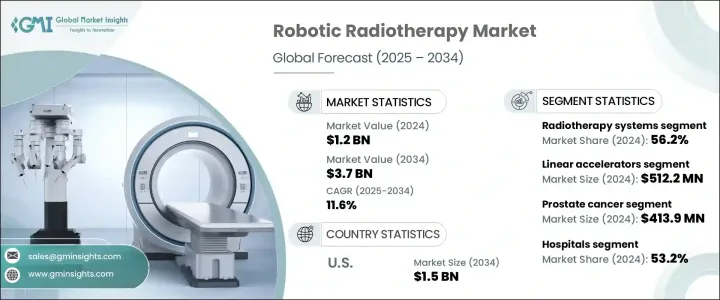
세계의 로봇 방사선 치료 시장은 2024년 12억 달러로 평가되었고, 다양한 종양과 암에 대한 정밀 주도의 방사선 치료에 대한 의존이 높아지고 있는 것을 배경으로 CAGR 11.6%로 성장해 2034년까지 37억 달러에 달할 것으로 예측되고 있습니다.
로봇 방사선 치료는 타겟팅 정밀도를 향상시켜 치료 성적을 향상시키고 치료 횟수를 줄일 수 있습니다. 비침습적인 외래암 치료에 대한 수요가 높아지는 가운데, 로봇 시스템은 수술이나 입원의 필요 없이 고선량 방사선을 조사할 수 있기 때문에 지지를 모으고 있습니다. 이것은 가치관에 근거한 치료로의 폭넓은 시프트와 암 치료 경로에서의 회복 기간의 단축을 반영하고 있습니다.
실시간 영상 처리, 움직임 보정, AI를 탑재한 계획 소프트웨어의 최첨단 진보는 로봇 방사선 치료 기술의 채용에 더욱 박차를 가하고 있습니다. 이러한 시스템은 환자 고유의 움직임과 종양의 움직임에 맞게 방사선 조사를 자동으로 적응시켜 일관되고 정확한 조사를 가능하게 합니다. 시설은 섬세한 해부학 적 영역의 종양을 가까운 건강한 조직을 손상시키지 않고 치료하기 위해 로봇 장비를 선호합니다. 또한, 하이포프랙션법으로 알려진 치료 횟수의 삭감 추진도 이러한 시스템의 보급에 기여하고 있습니다. 그 결과, 건강 관리 제공업체와 환자 모두 실시간 모니터링, 빔 변조, 스마트 이미지 유도 치료를 결합한 로봇 플랫폼을 선택하게 되었습니다.
| 시장 범위 | |
|---|---|
| 시작 연도 | 2024년 |
| 예측 연도 | 2025-2034년 |
| 시작 금액 | 12억 달러 |
| 예측 금액 | 37억 달러 |
| CAGR | 11.6% |
2024년 로봇 방사선 치료 시장의 방사선 치료 시스템 부문은 56.2%의 점유율을 차지했습니다. 주위의 건강한 조직에 대한 방사선 피폭을 대폭 줄임으로써 이러한 시스템은 임상의가 복잡한 암 증례를 관리하는 방법을 일변시켰습니다.
한편, 리니악(LINACs) 부문은 2024년에 5억 1,220만 달러를 창출했습니다. 이러한 로봇 대응 기기는 영상 유도 및 강도조절 방사선 치료를 서포트해, 다이나믹한 종양 위치에 맞추어 고도로 컨포멀한 선량을 공급합니다. 그 적응 계획 기능은 호흡이나 소화에 의해 자주 위치가 이동하는 폐나 간 등의 이동성 장기의 종양에 특히 유용합니다. 또한, 리니악은 외래암 치료로의 이용이 증가하고 있어, 입원 기간을 최소한으로 억제해, 환자의 쾌적성을 최대한으로 높이는 보다 짧고 편리한 치료 세션을 가능하게 하고 있습니다.
미국의 로봇 방사선 치료 시장은 2024년에 5억 830만 달러를 창출해 2034년에는 15억 달러로 성장할 것으로 예측되고 있습니다. 병원이나 암 센터는 회복 시간의 단축과 합병증이 적은 비침습적인 치료를 제공하기 위해 로봇 플랫폼에 대한 투자를 확대하고 있습니다.
로봇 방사선 치료 세계 시장의 주요 기업은 기술 혁신, 전략적 제휴, 지리적 확대를 우선, 시장에서의 지위를 굳히고 있습니다. RefleXion과 ViewRay는 실시간 종양 추적을 활용하여 차별화를 도모하고 있습니다. United Imaging과 ZAP는 세계 수요 증가에 대응하기 위해 생산 규모를 확대하고, Mitsubishi Electric과 Mevion은 중견 의료 분야를 개척하기 위해 저렴한 가격과 컴팩트한 시스템 설계에 주력하고 있습니다.
목차
제1장 조사 방법과 범위
제2장 주요 요약
제3장 업계 인사이트
- 생태계 분석
- 업계에 미치는 영향요인
- 성장 촉진요인
- 세계 암 이환율이 증가
- 비침습적 및 외래 치료법에 대한 호의 상승
- 화상 처리와 모션 트래킹의 기술 진보
- 종양학 케어 인프라에 대한 건강 관리 투자와 정부 자금 증가
- 업계의 잠재적 위험 및 과제
- 로봇 방사선 치료 시스템과 유지 보수에 필요한 높은 비용
- 고급 로봇 시스템을 조작하는 숙련된 전문가의 부족
- 성장 촉진요인
- 성장 가능성 분석
- 트럼프 정권에 의한 관세에 대한 영향
- 무역에 미치는 영향
- 무역량의 혼란
- 보복 조치
- 업계에 미치는 영향
- 공급측의 영향(원재료)
- 주요 원재료의 가격 변동
- 공급망 재구성
- 생산 비용에 미치는 영향
- 수요측의 영향(판매가격)
- 최종 시장에의 가격 전달
- 시장 점유율 동향
- 소비자의 반응 패턴
- 공급측의 영향(원재료)
- 영향을 받는 주요 기업
- 전략적인 업계 대응
- 공급망 재구성
- 가격 설정 및 제품 전략
- 정책관여
- 전망과 향후 검토 사항
- 무역에 미치는 영향
- 기술의 상황
- 장래 시장 동향
- 규제 상황
- 특허 분석
- 갭 분석
- Porter's Five Forces 분석
- PESTEL 분석
제4장 경쟁 구도
- 소개
- 경쟁 시장 점유율 분석
- 기업 매트릭스 분석
- 주요 시장 기업의 경쟁 분석
- 경쟁 포지셔닝 매트릭스
- 전략적 전망 매트릭스
제5장 시장 추계 및 예측 : 제품별, 2021-2034년
- 주요 동향
- 방사선 치료 시스템
- 3D 카메라
- 소프트웨어
- 기타 제품
제6장 시장 추계 및 예측 : 기술별, 2021-2034년
- 주요 동향
- 선형 가속기
- 정위 방사선 치료 시스템
- 사이버나이프
- 감마 나이프
- 입자선 치료
- 양자선 치료
- 중립자선 치료
제7장 시장 추계 및 예측 : 용도별, 2021-2034년
- 주요 동향
- 전립선암
- 유방암
- 폐암
- 두경부암
- 대장암
- 기타 용도
제8장 시장 추계 및 예측 : 최종 용도별, 2021-2034년
- 주요 동향
- 병원
- 암 치료 센터
- 학술연구기관
- 전문 클리닉
제9장 시장 추계 및 예측 : 지역별, 2021-2034년
- 주요 동향
- 북미
- 미국
- 캐나다
- 유럽
- 독일
- 영국
- 프랑스
- 이탈리아
- 스페인
- 네덜란드
- 아시아태평양
- 일본
- 중국
- 인도
- 호주
- 한국
- 라틴아메리카
- 멕시코
- 브라질
- 아르헨티나
- 중동 및 아프리카
- 남아프리카
- 사우디아라비아
- 아랍에미리트(UAE)
제10장 기업 프로파일
- Accuray
- Brainlab
- Elekta
- GE Healthcare
- Hitachi
- Ion Beam Applications
- Mevion
- Mitsubishi Electric
- RefleXion
- Shinva
- Siemens Healthineers
- United Imaging
- Varian
- ViewRay
- ZAP
The Global Robotic Radiotherapy Market was valued at USD 1.2 billion in 2024 and is estimated to grow at a CAGR of 11.6% to reach USD 3.7 billion by 2024, driven by the increasing reliance on precision-driven radiation therapies for various tumors and cancers. Robotic radiotherapy enables enhanced targeting accuracy, leading to better treatment outcomes and reduced therapy sessions. As demand for non-invasive and outpatient cancer treatments grows, robotic systems are gaining favor for their ability to deliver high-dose radiation without the need for surgery or hospitalization. This reflects a broader shift toward value-based care and shorter recovery periods in oncology treatment pathways.
Cutting-edge advances in real-time imaging, motion compensation, and AI-powered planning software are further fueling the adoption of robotic radiotherapy technologies. These systems automatically adapt radiation delivery to patient-specific movement or tumor shifts, enabling consistent, accurate dosing. Facilities prefer robotic equipment to treat tumors in delicate anatomical regions without harming nearby healthy tissue. The push for fewer treatment sessions, known as hypofractionation, is also contributing to the popularity of these systems. As a result, both healthcare providers and patients are increasingly opting for robotic platforms that combine real-time monitoring, beam modulation, and smart image-guided therapy.
| Market Scope | |
|---|---|
| Start Year | 2024 |
| Forecast Year | 2025-2034 |
| Start Value | $1.2 Billion |
| Forecast Value | $3.7 Billion |
| CAGR | 11.6% |
In 2024, the radiotherapy systems segment in the robotic radiotherapy market held a 56.2% share. Their advanced targeting capabilities, offering sub-millimeter precision, have become indispensable in treating tumors located near vital organs or in hard-to-reach areas. By significantly reducing radiation exposure to surrounding healthy tissue, these systems have transformed the way clinicians manage complex cancer cases. Their integration into oncology practices has elevated patient outcomes and safety profiles, solidifying their role as a standard in next-generation cancer treatment.
Meanwhile, linear accelerators (LINACs) segment generated USD 512.2 million in 2024. These robotic-enabled devices support image-guided and intensity-modulated radiotherapy, delivering highly conformal doses tailored to dynamic tumor positions. Their adaptive planning features are especially valuable for tumors in mobile organs such as the lungs or liver, where breathing or digestion introduces frequent positional shifts. Additionally, LINACs are increasingly utilized in outpatient cancer care, allowing for shorter, more convenient treatment sessions that minimize hospital stays and maximize patient comfort.
U.S. Robotic Radiotherapy Market generated USD 508.3 million in 2024 and is projected to grow to USD 1.5 billion by 2034. Rising cancer prevalence-especially in an aging population-has intensified the need for precise, efficient treatment solutions. Hospitals and cancer centers are expanding investments in robotic platforms to offer non-invasive therapies with reduced recovery times and fewer complications. This patient-centric shift, favoring customized and targeted radiation approaches, continues to fuel technology adoption worldwide.
Key players in the Global Robotic Radiotherapy Market prioritize innovation, strategic collaborations, and geographic expansion to solidify their market standing. Accuray and Elekta are investing heavily in AI-based treatment planning and adaptive therapy systems. Siemens Healthineers and GE Healthcare are advancing integrated imaging and robotic platforms to boost precision. RefleXion and ViewRay are leveraging real-time tumor tracking to differentiate their offerings. Varian, Brainlab, and Hitachi continue to enhance software-driven functionalities and secure regulatory approvals in emerging markets. United Imaging and ZAP are scaling up production to meet growing demand globally, Mitsubishi Electric and Mevion focus on affordability and compact system design to tap mid-tier healthcare segments.
Table of Contents
Chapter 1 Methodology and Scope
- 1.1 Market scope and definitions
- 1.2 Research design
- 1.2.1 Research approach
- 1.2.2 Data collection methods
- 1.3 Base estimates and calculations
- 1.3.1 Base year calculation
- 1.3.2 Key trends for market estimation
- 1.4 Forecast model
- 1.5 Primary research and validation
- 1.5.1 Primary sources
- 1.5.2 Data mining sources
Chapter 2 Executive Summary
- 2.1 Industry 3600 synopsis
Chapter 3 Industry Insights
- 3.1 Industry ecosystem analysis
- 3.2 Industry impact forces
- 3.2.1 Growth drivers
- 3.2.1.1 Increasing prevalence of cancer worldwide
- 3.2.1.2 Growing preference for non-invasive and outpatient treatment methods
- 3.2.1.3 Technological advancements in imaging and motion tracking
- 3.2.1.4 Rising healthcare investments and government funding in oncology care infrastructure
- 3.2.2 Industry pitfalls and challenges
- 3.2.2.1 High cost of robotic radiotherapy systems and maintenance
- 3.2.2.2 Lack of skilled professionals to operate advanced robotic systems
- 3.2.1 Growth drivers
- 3.3 Growth potential analysis
- 3.4 Trump administration tariffs
- 3.4.1 Impact on trade
- 3.4.1.1 Trade volume disruptions
- 3.4.1.2 Retaliatory measures
- 3.4.2 Impact on the Industry
- 3.4.2.1 Supply-side impact (raw materials)
- 3.4.2.1.1 Price volatility in key materials
- 3.4.2.1.2 Supply chain restructuring
- 3.4.2.1.3 Production cost implications
- 3.4.2.2 Demand-side impact (selling price)
- 3.4.2.2.1 Price transmission to end markets
- 3.4.2.2.2 Market share dynamics
- 3.4.2.2.3 Consumer response patterns
- 3.4.2.1 Supply-side impact (raw materials)
- 3.4.3 Key companies impacted
- 3.4.4 Strategic industry responses
- 3.4.4.1 Supply chain reconfiguration
- 3.4.4.2 Pricing and product strategies
- 3.4.4.3 Policy engagement
- 3.4.5 Outlook and future considerations
- 3.4.1 Impact on trade
- 3.5 Technology landscape
- 3.6 Future market trends
- 3.7 Regulatory landscape
- 3.8 Patent analysis
- 3.9 Gap analysis
- 3.10 Porter's analysis
- 3.11 PESTEL analysis
Chapter 4 Competitive Landscape, 2024
- 4.1 Introduction
- 4.2 Competitive market share analysis
- 4.3 Company matrix analysis
- 4.4 Competitive analysis of major market players
- 4.5 Competitive positioning matrix
- 4.6 Strategic outlook matrix
Chapter 5 Market Estimates and Forecast, By Product, 2021 – 2034 ($ Mn)
- 5.1 Key trends
- 5.2 Radiotherapy systems
- 5.3 3D cameras
- 5.4 Software
- 5.5 Other products
Chapter 6 Market Estimates and Forecast, By Technology, 2021 – 2034 ($ Mn)
- 6.1 Key trends
- 6.2 Linear accelerators
- 6.3 Stereotactic radiation therapy systems
- 6.4 Cyberknife
- 6.5 Gamma knife
- 6.6 Particle therapy
- 6.7 Proton beam therapy
- 6.8 Heavy ion beam therapy
Chapter 7 Market Estimates and Forecast, By Application, 2021 – 2034 ($ Mn)
- 7.1 Key trends
- 7.2 Prostate cancer
- 7.3 Breast cancer
- 7.4 Lung cancer
- 7.5 Head and neck cancer
- 7.6 Colorectal cancer
- 7.7 Other applications
Chapter 8 Market Estimates and Forecast, By End Use, 2021 – 2034 ($ Mn)
- 8.1 Key trends
- 8.2 Hospitals
- 8.3 Cancer treatment centers
- 8.4 Academic and research institutions
- 8.5 Specialty clinics
Chapter 9 Market Estimates and Forecast, By Region, 2021 – 2034 ($ Mn)
- 9.1 Key trends
- 9.2 North America
- 9.2.1 U.S.
- 9.2.2 Canada
- 9.3 Europe
- 9.3.1 Germany
- 9.3.2 UK
- 9.3.3 France
- 9.3.4 Italy
- 9.3.5 Spain
- 9.3.6 Netherlands
- 9.4 Asia Pacific
- 9.4.1 Japan
- 9.4.2 China
- 9.4.3 India
- 9.4.4 Australia
- 9.4.5 South Korea
- 9.5 Latin America
- 9.5.1 Mexico
- 9.5.2 Brazil
- 9.5.3 Argentina
- 9.6 Middle East and Africa
- 9.6.1 South Africa
- 9.6.2 Saudi Arabia
- 9.6.3 UAE
Chapter 10 Company Profiles
- 10.1 Accuray
- 10.2 Brainlab
- 10.3 Elekta
- 10.4 GE Healthcare
- 10.5 Hitachi
- 10.6 Ion Beam Applications
- 10.7 Mevion
- 10.8 Mitsubishi Electric
- 10.9 RefleXion
- 10.10 Shinva
- 10.11 Siemens Healthineers
- 10.12 United Imaging
- 10.13 Varian
- 10.14 ViewRay
- 10.15 ZAP