

|
시장보고서
상품코드
1750342
항산화 음료 시장 : 시장 기회, 성장 촉진요인, 산업 동향 분석, 예측(2025-2034년)Antioxidant Drinks Market Opportunity, Growth Drivers, Industry Trend Analysis, and Forecast 2025 - 2034 |
||||||

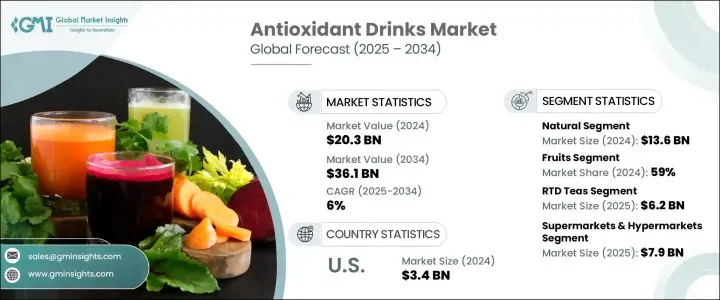
세계의 항산화 음료 시장은 2024년에 203억 달러로 평가되었고, CAGR 6%로 성장할 전망이며, 2034년에는 361억 달러에 이를 것으로 추정되고 있습니다.
이 증가 추세는 주로 건강과 웰빙에 대한 관심 증가에 따른 것으로, 소비자는 기능적 이점을 제공하는 음료를 점점 선호하고 있습니다. 면역체계를 개선해 노화를 늦추고 체내 독소 축적을 줄이는 것을 목표로 하는 사람이 늘면서 항산화 물질이 풍부한 음료가 기세를 올리고 있습니다. 현대의 소비자는 고도의 정보통이며, 예방적인 건강을 서포트하는 제품을 적극적으로 요구하고 있으며, 이러한 행동이 음료의 전망을 재구축하고 있습니다.
산화 스트레스의 유해한 영향과 만성 질환과 노화와의 관련성에 대한 인식이 높아져 이러한 영향에 대항하는 음료 수요가 급증하고 있습니다.건강 지향의 바이어는 현재, 맛이 좋을 뿐만 아니라, 투명성이나 천연 성분을 선호하는 클린 라벨의 동향에 따른 음료를 찾고 있습니다. 시장에서는 저칼로리, 무설탕, 식물 유래의 선택지로의 현저한 시프트를 볼 수 있어 기능성 음료의 주류화를 뒷받침하고 있습니다. 게다가 슈퍼마켓, 전문점, 편의점, 온라인 플랫폼등의 소매 채널에서 항산화 음료를 입수하기 쉬워짐으로써, 소비자가 좋아하는 제품을 입수하기 쉬워져 시장의 확대에 박차를 가하고 있습니다.
| 시장 범위 | |
|---|---|
| 시작 연도 | 2024년 |
| 예측 연도 | 2025-2034년 |
| 시작 금액 | 203억 달러 |
| 예측 금액 | 361억 달러 |
| CAGR | 6% |
시장 실적은 지역에 따라 다르며 북미와 유럽은 제품의 보급이 현저합니다. 한편, 아시아태평양은 전통적인 웰빙 음료의 인기가 재점화되면서 급성장하고 있습니다.모든 층에서, 온라인 소매가 점점 선호되고 있고, 특히 편리성과 소비자로부터의 직접 액세스를 중시하는 젊은 구매층 사이에서 인기가 높아지고 있습니다. 이러한 소매 역동성의 변화는 브랜드에게 개인화된 혁신적인 상품으로 고객을 사로잡을 새로운 기회를 창출하고 있습니다.
혁신은 이 시장을 특징으로 하며, 각 회사는 기능적이고 건강을 증진하는 음료에 대한 수요 증가에 대응하기 위해 새로운 배합을 개발하고 있습니다. 웰니스가 소비자 라이프 스타일의 필수적인 일부가 됨에 따라 제조사는 경쟁력을 유지하기 위해 새로운 성분과 기술을 시험할 것으로 기대됩니다. 소비자들이 합성첨가물보다 건강상의 이점을 계속 우선시하는 가운데 천연의 기능성 성분, 특히 홀리스틱 웰니스와 관련된 성분의 사용은 지지를 모을 것으로 보입니다.
제품 유형별로 보면, 항산화 음료 시장은 천연 소재와 강화 소재로 나뉘어져 있습니다. 천연 항산화 음료는 큰 시장 점유율을 획득해 2024년에는 136억 달러의 시장 규모를 기록했습니다. 이러한 음료는 최소한의 가공으로 제조되어 전 원료를 사용하고 있으며, 클린 라벨로 영양 밀도가 높은 선택지를 원하는 소비자들이 선호하고 있습니다. 천연 제품은 면역 기능과 전체적인 건강을 지원하는 필수 항산화 물질을 제공하여 보다 안전하고 건강한 것으로 인식되고 있습니다.
공급원의 관점에서 시장 부문에는 과일, 야채, 허브와 식물 등이 포함됩니다. 과일 베이스의 음료는 2024년에 59%의 점유율로 부문을 선도하였고, 예측 기간 동안 CAGR 5.8%로 성장할 것으로 예측됩니다.
제품 카테고리별로 분류하면, 시장은 RTD 티, 과일 및 채소의 블렌드, 강화수, 에너지 스포츠 드링크, 콤부차 및 발효 음료, 기능성 커피와 코코아 기반의 음료, 기타로 구성됩니다. 이 중 RTD 티는 2025년에 62억 달러에 달하였으며, CAGR 6.2%로 성장할 것으로 예측됩니다. 이러한 음료는 대사 촉진 효과와 스트레스 완화 효과가 평가되며, 소비자는 그 편리성과 인식되는 건강 효과에 끌리고 있습니다.
유통 채널로는 슈퍼마켓 및 하이퍼마켓, 편의점, 전문점, 온라인 소매, 외식 등이 있습니다. 슈퍼마켓과 하이퍼마켓은 2025년에 79억 달러의 예측치를 차지하며 예측 기간 CAGR은 5.5%로 추정됩니다. 이러한 점포는, 액세스가 넓고, 소비자의 방문이 많고, 가치 지향의 쇼핑객 및 고급 지향의 쇼핑객 모두에게 어필하는 다양한 상품을 제공하고 있기 때문에, 유력한 유통 수단으로 계속 되고 있습니다.
미국은 항산화 음료 시장에서 지배적인 기업이며 2024년 매출은 34억 달러에 달했습니다. 기능성 음료에 대한 관심의 고조 및 건강 효과에 대한 의식의 고조가 수요 급증의 주된 요인입니다. 미국 소비자들은 투명성 있는 표시와 건강 효과가 입증된 제품에 끌리고 있습니다. 이러한 변화는 제조사들이 보다 건강 지향적인 소비자에 대응하기 위해 제품 포트폴리오를 혁신하고 확대하는 것을 뒷받침하고 있습니다.
경쟁 구도를 형성하는 주요 기업으로는 코카콜라, 다논, 네슬레, 산토리 홀딩스, 타타 소비자 제품 등이 있습니다. 이러한 기업은, 포괄적인 제품 포트폴리오와 강고한 생산 및 유통 인프라를 갖춘 강력한 세계적 존재를 유지하고 있어, 다양한 시장에서 높아지는 수요에 효율적이고 일관되게 대응하는 것을 가능하게 하고 있습니다.
목차
제1장 조사 방법 및 범위
제2장 주요 요약
제3장 업계 인사이트
- 시장 서문
- 업계 밸류체인 분석
- 원재료 조달 및 조달
- 가공 및 제조
- 포장 및 배송
- 소매 및 소비자에 대한 액세스
- 기술의 상황
- 가공 기술
- 보존 방법
- 패키징의 혁신
- 신흥기술
- 시장 역학
- 시장 성장 촉진요인
- 건강 의식의 고조
- 만성질환의 유병률 증가
- 기능성 음료 수요 증가
- 달콤한 음료에서 건강한 대체품으로 전환
- 시장 성장 억제요인
- 높은 생산 비용
- 엄격한 규제 틀
- 개발 도상 지역에서 낮은 소비자의 인지도
- 미각 및 맛의 과제
- 시장 기회
- 제품의 혁신 및 개발
- 신흥 시장으로 확대
- 전자상거래 성장
- 클린 라벨 및 천연 성분의 트렌드
- 시장의 과제
- 항산화 물질의 생물학적 이용능력 유지
- 공급망의 혼란
- 경쟁가격압력
- 건강에 관한 주장의 입증
- 시장 성장 촉진요인
- PESTEL 분석
- Porter's Five Forces 분석
- 규제 프레임워크과 기준
- 세계의 규제
- 지역의 규제 상황
- 건강 강조 표시 규제
- 라벨 요건
- 규제가 시장 성장에 미치는 영향
- COVID-19의 영향 분석
- 소비자 행동 분석
- 소비자의 인구통계
- 구입 패턴
- 선호 요인
- 건강에 관한 인식 및 의식
- 지속가능성과 환경 측면
- 지속 가능한 조달 관행
- 친환경 포장에 대한 노력
- 폐기물 삭감 전략
- 카본 풋 프린트의 고려
- 트럼프 정권의 관세 분석
- 무역에 미치는 영향
- 무역량의 혼란
- 보복 조치
- 업계에 미치는 영향
- 공급측의 영향(원재료)
- 주요 원재료의 가격 변동
- 공급망 재구성
- 생산 비용에 미치는 영향
- 수요측의 영향(판매가격)
- 최종 시장에 대한 가격 전달
- 시장 점유율 동향
- 소비자의 반응 패턴
- 영향을 받는 주요 기업
- 전략적인 업계 대응
- 공급망 재구성
- 가격 설정 및 제품 전략
- 정책관여
- 무역 통계(HS코드)
- 주요 수출국(2021-2024년)
- 미국
- 일본
- 한국
- 주요 수입국(2021-2024년)
- 인도
- 러시아
- 미국
- 주요 수출국(2021-2024년)
- 공급측의 영향(원재료)
- 무역에 미치는 영향
참고 : 위의 무역 통계는 주요 국가에 대해서만 제공됩니다.
제4장 경쟁 구도
- 서문
- 시장 점유율 분석
- 주요 기업이 채용한 주요 전략
- 합병 및 인수
- 파트너십 및 협업
- 제품 발매 및 혁신
- 확대의 대처
- 경쟁 벤치마킹
- 전략적 포지셔닝 매트릭스
- 경쟁 대시보드
- 신흥 기업의 분석
- 투자 분석 및 자금 조달 시나리오
제5장 시장 추계 및 예측 : 제품 유형별(2021-2034년)
- 주요 동향
- 천연
- 강화
제6장 시장 추계 및 예측 : 원료별(2021-2034년)
- 주요 동향
- 과일
- 베리류(블루베리, 크랜베리, 딸기)
- 감귤류
- 석류
- 기타 과일
- 야채
- 비트 루트
- 당근
- 기타 야채
- 허브와 식물
- 녹차
- 마테차
- 심황
- 기타 허브 및 식물
- 기타
제7장 시장 추계 및 예측 : 상품 카테고리별(2021-2034년)
- 주요 동향
- RTD티
- 과일 및 채소
- 강화수
- 에너지 음료와 스포츠 음료
- 기능성 커피 및 코코아 음료
- 콤부차 및 발효음료
- 기타
제8장 시장 추계 및 예측 : 유통 채널별(2021-2034년)
- 주요 동향
- 슈퍼마켓 및 하이퍼마켓
- 편의점
- 전문점
- 온라인 소매
- 푸드서비스
- 기타
제9장 시장 추계 및 예측 : 지역별(2021-2034년)
- 주요 동향
- 북미
- 미국
- 캐나다
- 유럽
- 독일
- 영국
- 프랑스
- 스페인
- 이탈리아
- 러시아
- 아시아태평양
- 중국
- 인도
- 일본
- 호주
- 한국
- 라틴아메리카
- 브라질
- 멕시코
- 아르헨티나
- 중동 및 아프리카
- 사우디아라비아
- 남아프리카
- 아랍에미리트(UAE)
제10장 기업 프로파일
- Bai Brands LLC(Dr Pepper Snapple Group)
- Danone SA
- GT's Living Foods
- Hint, Inc.
- ITO EN, Ltd.
- Karma Culture LLC
- Keurig Dr Pepper Inc.
- Lemon Perfect
- Monster Beverage Corporation
- Nestle SA
- Ocean Spray Cranberries, Inc.
- PepsiCo, Inc.
- POM Wonderful LLC
- Red Bull GmbH
- Suntory Holdings Limited
- Tata Consumer Products Limited
- The Coca-Cola Company
- Unilever PLC
- Vita Coco
The Global Antioxidant Drinks Market was valued at USD 20.3 billion in 2024 and is estimated to grow at a CAGR of 6% to reach USD 36.1 billion by 2034. This upward trend is driven primarily by the rising focus on health and wellness, with consumers increasingly favoring beverages that offer functional benefits. Antioxidant-rich drinks are gaining momentum as more people aim to improve their immune systems, delay aging, and reduce toxin buildup in the body. The modern consumer is highly informed and actively seeks products that support preventive health, and this behavior is reshaping the beverage landscape.
Greater awareness of the harmful effects of oxidative stress and its links to chronic diseases and aging has led to an upsurge in demand for drinks that counteract these effects. Health-conscious buyers now look for beverages that not only taste good but also align with clean-label trends, favoring transparency and natural ingredients. The market has seen a marked shift toward low-calorie, sugar-free, and plant-based options, helping functional drinks become mainstream. Additionally, improved availability of antioxidant beverages across retail channels such as supermarkets, specialty stores, convenience outlets, and online platforms is making it easier for consumers to access their preferred products, thereby fueling market expansion.
| Market Scope | |
|---|---|
| Start Year | 2024 |
| Forecast Year | 2025-2034 |
| Start Value | $20.3 Billion |
| Forecast Value | $36.1 Billion |
| CAGR | 6% |
Market performance varies by region, with North America and Europe demonstrating strong product penetration. Meanwhile, the Asia-Pacific region is witnessing rapid growth as traditional wellness drinks gain renewed popularity. Across all demographics, online retail is increasingly preferred, especially among younger buyers who value convenience and direct-to-consumer accessibility. This changing retail dynamic is creating new opportunities for brands to engage customers with personalized and innovative offerings.
Innovation is a defining trait of this market, with companies developing new formulations to meet the growing demand for functional, health-enhancing beverages. As wellness becomes an integral part of consumer lifestyles, manufacturers are expected to experiment with new ingredients and technologies to stay competitive. The use of naturally functional ingredients, particularly those associated with holistic wellness, is likely to gain traction as consumers continue to prioritize health benefits over synthetic additives.
By product type, the antioxidant drinks market is divided into natural and fortified categories. Natural antioxidant drinks captured a significant market share, recording a value of USD 13.6 billion in 2024. These beverages, which are made with minimal processing and sourced from whole ingredients, are preferred by consumers seeking clean-label, nutrient-dense options. Natural products are perceived as safer and healthier, offering essential antioxidants that support immune function and overall wellness.
In terms of sources, the market segments include fruits, vegetables, herbs and botanicals, and others. Fruit-based beverages led the segment with a 59% share in 2024 and are expected to grow at a CAGR of 5.8% through the forecast period. Fruit sources remain central to antioxidant beverages due to their high nutrient content and favorable consumer perception, making them a dominant force in the market.
When categorized by product category, the market comprises RTD teas, fruit and vegetable blends, enhanced waters, energy and sports drinks, kombucha and fermented drinks, functional coffee and cocoa-based beverages, and others. Among these, RTD teas are projected to reach USD 6.2 billion in 2025 and are anticipated to grow at a CAGR of 6.2%. These beverages are valued for their metabolic benefits and stress-relief properties, with consumers gravitating toward their convenience and perceived health benefits.
In terms of distribution channels, the market includes supermarkets and hypermarkets, convenience stores, specialty outlets, online retail, food service, and others. Supermarkets and hypermarkets accounted for a projected value of USD 7.9 billion in 2025, with an estimated CAGR of 5.5% over the forecast period. These outlets remain a leading distribution method due to their widespread accessibility, large consumer footfall, and diverse product offerings that appeal to both value-conscious and premium shoppers.
The United States is the dominant player in the antioxidant drinks market, contributing USD 3.4 billion in revenue in 2024. Growing interest in functional beverages and increasing awareness of health benefits are key factors driving the surge in demand. Consumers in the U.S. are gravitating toward products with transparent labeling and proven wellness benefits. This shift has encouraged manufacturers to innovate and expand their portfolios to cater to a more health-focused audience.
Major companies shaping the competitive landscape include The Coca-Cola Company, Danone S.A., Nestle S.A., Suntory Holdings, and Tata Consumer Products. These firms maintain a strong global presence with comprehensive product portfolios and robust production and distribution infrastructure, allowing them to meet rising demand efficiently and consistently across diverse markets.
Table of Contents
Chapter 1 Methodology and Scope
- 1.1 Market scope and definition
- 1.2 Base estimates and calculations
- 1.3 Forecast calculation
- 1.4 Data sources
- 1.4.1 Primary
- 1.4.2 Secondary
- 1.4.2.1 Paid sources
- 1.4.2.2 Public sources
- 1.5 Primary research and validation
- 1.5.1 Primary sources
- 1.5.2 Data mining sources
Chapter 2 Executive Summary
- 2.1 Market snapshot
- 2.2 Global antioxidant drinks market overview
- 2.3 Key industry highlights
- 2.4 Regional insights
- 2.5 Investment scenario
- 2.6 Competitive landscape overview
- 2.7 Future market outlook
Chapter 3 Industry Insights
- 3.1 Market introduction
- 3.2 Industry value chain analysis
- 3.2.1 Raw material sourcing and procurement
- 3.2.2 Processing and manufacturing
- 3.2.3 Packaging and distribution
- 3.2.4 Retail and consumer access
- 3.3 Technology landscape
- 3.3.1 Processing technologies
- 3.3.2 Preservation methods
- 3.3.3 Packaging innovations
- 3.3.4 Emerging technologies
- 3.4 Market dynamics
- 3.4.1 Market drivers
- 3.4.1.1 Rising health consciousness
- 3.4.1.2 Increasing prevalence of chronic diseases
- 3.4.1.3 Growing demand for functional beverages
- 3.4.1.4 Shift from sugary drinks to healthier alternatives
- 3.4.2 Market restraints
- 3.4.2.1 High production costs
- 3.4.2.2 Stringent regulatory framework
- 3.4.2.3 Limited consumer awareness in developing regions
- 3.4.2.4 Taste and flavor challenges
- 3.4.3 Market opportunities
- 3.4.3.1 Product innovation and development
- 3.4.3.2 Expansion in emerging markets
- 3.4.3.3 E-commerce growth
- 3.4.3.4 Clean label and natural ingredients trend
- 3.4.4 Market challenges
- 3.4.4.1 Maintaining bioavailability of antioxidants
- 3.4.4.2 Supply chain disruptions
- 3.4.4.3 Competitive pricing pressure
- 3.4.4.4 Substantiating health claims
- 3.4.1 Market drivers
- 3.5 Pestle analysis
- 3.6 Porter's five forces analysis
- 3.7 Regulatory framework and standards
- 3.7.1 Global regulations
- 3.7.2 Regional regulatory landscape
- 3.7.3 Health claim regulations
- 3.7.4 Labeling requirements
- 3.7.5 Impact of regulations on market growth
- 3.8 Covid-19 impact analysis
- 3.9 Consumer behavior analysis
- 3.9.1 Consumer demographics
- 3.9.2 Purchase patterns
- 3.9.3 Preference factors
- 3.9.4 Health perception and awareness
- 3.10 Sustainability and environmental aspects
- 3.10.1 Sustainable sourcing practices
- 3.10.2 Eco-friendly packaging initiatives
- 3.10.3 Waste reduction strategies
- 3.10.4 Carbon footprint considerations
- 3.11 Trump administration tariff analysis
- 3.11.1 Impact on trade
- 3.11.1.1 Trade volume disruptions
- 3.11.1.2 Retaliatory measures
- 3.11.2 Impact on the industry
- 3.11.2.1 Supply-side impact (raw materials)
- 3.11.2.1.1 Price volatility in key materials
- 3.11.2.1.2 Supply chain restructuring
- 3.11.2.1.3 Production cost implications
- 3.11.2.2 Demand-side impact (selling price)
- 3.11.2.2.1 Price transmission to end markets
- 3.11.2.2.2 Market share dynamics
- 3.11.2.2.3 Consumer response patterns
- 3.11.2.3 Key companies impacted
- 3.11.2.4 Strategic industry responses
- 3.11.2.5 Supply chain reconfiguration
- 3.11.2.6 Pricing and product strategies
- 3.11.2.7 Policy engagement
- 3.11.2.8 Trade Statistics (HS Code)
- 3.11.2.8.1 Major Exporting Countries, 2021-2024 (USD Bn)
- 3.11.2.8.1.1 U.S.
- 3.11.2.8.1.2 Japan
- 3.11.2.8.1.3 South Korea
- 3.11.2.8.2 Major Importing Countries, 2021-2024 (USD Bn)
- 3.11.2.8.2.1 India
- 3.11.2.8.2.2 Russia
- 3.11.2.8.2.3 U.S.
- 3.11.2.8.1 Major Exporting Countries, 2021-2024 (USD Bn)
- 3.11.2.1 Supply-side impact (raw materials)
- 3.11.1 Impact on trade
Note: the above trade statistics will be provided for key countries only.
Chapter 4 Competitive Landscape, 2024
- 4.1 Introduction
- 4.2 Market share analysis
- 4.3 Key strategies adopted by major players
- 4.3.1 Mergers and acquisitions
- 4.3.2 Partnerships and collaborations
- 4.3.3 Product launches and innovations
- 4.3.4 Expansion initiatives
- 4.4 Competitive benchmarking
- 4.5 Strategic positioning matrix
- 4.6 Competitive dashboard
- 4.7 Emerging players analysis
- 4.8 Investment analysis and funding scenario
Chapter 5 Market Estimates and Forecast, By Product Type, 2021 - 2034 (USD Billion) (Kilo Tons)
- 5.1 Key trends
- 5.2 Natural
- 5.3 Fortified
Chapter 6 Market Estimates and Forecast, By Source 2021 - 2034 (USD Billion) (Kilo Tons)
- 6.1 Key trends
- 6.2 Fruits
- 6.2.1 Berries (blueberry, cranberry, strawberry)
- 6.2.2 Citrus fruits
- 6.2.3 Pomegranate
- 6.2.4 Other fruits
- 6.3 Vegetable
- 6.3.1 Beetroot
- 6.3.2 Carrot
- 6.3.3 Other vegetables
- 6.4 Herbs & botanicals
- 6.4.1 Green tea
- 6.4.2 Yerba mate
- 6.4.3 Turmeric
- 6.4.4 Other herbs & botanicals
- 6.5 Others
Chapter 7 Market Estimates and Forecast, By Product category, 2021 - 2034 (USD Billion) (Kilo Tons)
- 7.1 Key trends
- 7.2 RTD teas
- 7.3 Fruits & vegetables
- 7.4 Enhanced water
- 7.5 Energy and sports drinks
- 7.6 Functional coffee and cocoa beverages
- 7.7 Kombucha and fermented drinks
- 7.8 Others
Chapter 8 Market Estimates and Forecast, By Distribution Channel, 2021 - 2034 (USD Billion) (Kilo Tons)
- 8.1 Key trends
- 8.2 Supermarkets & hypermarkets
- 8.3 Convenience stores
- 8.4 Speciality stores
- 8.5 Online retail
- 8.6 Food service
- 8.7 Others
Chapter 9 Market Estimates and Forecast, By Region, 2021 - 2034 (USD Billion) (Kilo Tons)
- 9.1 Key trends
- 9.2 North America
- 9.2.1 U.S.
- 9.2.2 Canada
- 9.3 Europe
- 9.3.1 Germany
- 9.3.2 UK
- 9.3.3 France
- 9.3.4 Spain
- 9.3.5 Italy
- 9.3.6 Russia
- 9.4 Asia Pacific
- 9.4.1 China
- 9.4.2 India
- 9.4.3 Japan
- 9.4.4 Australia
- 9.4.5 South Korea
- 9.5 Latin America
- 9.5.1 Brazil
- 9.5.2 Mexico
- 9.5.3 Argentina
- 9.6 Middle East and Africa
- 9.6.1 Saudi Arabia
- 9.6.2 South Africa
- 9.6.3 UAE
Chapter 10 Company Profiles
- 10.1 Bai Brands LLC (Dr Pepper Snapple Group)
- 10.2 Danone S.A.
- 10.3 GT's Living Foods
- 10.4 Hint, Inc.
- 10.5 ITO EN, Ltd.
- 10.6 Karma Culture LLC
- 10.7 Keurig Dr Pepper Inc.
- 10.8 Lemon Perfect
- 10.9 Monster Beverage Corporation
- 10.10 Nestle S.A.
- 10.11 Ocean Spray Cranberries, Inc.
- 10.12 PepsiCo, Inc.
- 10.13 POM Wonderful LLC
- 10.14 Red Bull GmbH
- 10.15 Suntory Holdings Limited
- 10.16 Tata Consumer Products Limited
- 10.17 The Coca-Cola Company
- 10.18 Unilever PLC
- 10.19 Vita Coco


