|
시장보고서
상품코드
1750616
풍력 터빈 단조 시장 : 기회, 성장 촉진요인, 산업 동향 분석 및 예측(2025-2034년)Wind Turbine Forging Market Opportunity, Growth Drivers, Industry Trend Analysis, and Forecast 2025 - 2034 |
||||||

세계의 풍력 터빈 단조 시장은 2024년에 96억 달러로 평가되었고 2034년에는 192억 8,000만 달러에 달할 것으로 예측되며, CAGR 7.3%로 성장할 전망입니다.
전 세계 풍력 에너지 설치량의 증가가 터빈에 사용되는 단조 부품에 대한 수요를 직접적으로 영향을 미치고 있습니다. 이 수요는 지속적인 사용과 환경적 스트레스에 견딜 수 있는 내구성과 고성능 부품을 필요로 하기 때문입니다. 지속 가능성 목표 달성을 위해 재생 에너지로 전환하는 국가와 기업이 증가함에 따라 풍력 에너지에 대한 관심이 높아지고 있습니다. 이는 풍력 터빈 인프라에 대한 대규모 투자를 촉진하며, 주축, 플랜지, 기어 블랭크, 베어링 하우징 등 단조 부품의 수요를 증가시키고 있습니다. 이러한 부품은 육상 및 해상 터빈 응용 분야에서 필수적입니다. 북미, 유럽, 아시아태평양 등 전 세계적으로 풍력 발전 용량이 증가함에 따라 정밀 단조된 고강도 부품에 대한 수요도 계속 증가할 것입니다. 개방형 및 무접합 압연 링 단조와 같은 단조 기술은 최적의 기계적 특성과 구조적 무결성을 갖춘 부품을 생산할 수 있기 때문에 널리 사용되고 있습니다. 이러한 방법은 현대의 풍력 에너지 시스템의 엄격한 요구 사항을 충족하는 강력하고 신뢰할 수 있는 부품을 생산하기 때문에 단조는 재생 가능 에너지 공급망에서 중요한 부문을 차지하고 있습니다.
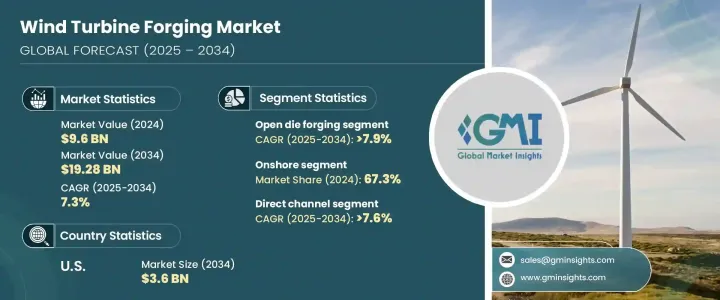
유형별로 시장은 개방형 단조, 무접합 압연 링 단조, 폐쇄형 단조로 분류됩니다. 이 중 개방형 단조는 2024년 시장 점유율 44%로 가장 큰 비중을 차지했으며, 예측 기간 동안 연평균 성장률(CAGR) 7.9% 이상으로 성장할 것으로 예상됩니다. 이 단조 방법은 풍력 터빈 건설에 필수적인 대형 및 견고한 부품 제작에 적합하기 때문에 선호됩니다. 이 과정은 금속을 평평하거나 특수 모양의 다이 사이에 변형시키는 것으로, 곡류 흐름을 최적화하고 재료 강도를 향상시킵니다. 이러한 정밀도는 터빈 응용 분야에서 높은 토크, 피로, 기계적 스트레스에 노출되는 허브, 샤프트, 플랜지 등 부품 제조에 필수적입니다.
| 시장 범위 | |
|---|---|
| 시작 연도 | 2024년 |
| 예측 연도 | 2025-2034년 |
| 시작금액 | 96억 달러 |
| 예측 금액 | 192억 8,000만 달러 |
| CAGR | 7.3% |
응용 분야에 따라 풍력 터빈 단조 시장은 육상 및 해상 부문으로 분류됩니다. 2024년에는 육상 부문이 67.3%의 시장 점유율을 차지하며 우위를 차지할 것으로 예상되며, 2025년부터 2034년까지 연평균 7.6% 이상의 CAGR을 기록할 것으로 예상됩니다. 육상 풍력 프로젝트는 일반적으로 해상 개발에 비해 물류가 용이하고 설치 비용이 저렴하며 인프라가 간단하다는 장점이 있습니다. 이러한 장점들은 주요 지역에서 널리 채택되는 것을 촉진하고 있습니다. 이러한 설치에는 표준 크기의 터빈이 자주 사용되어 플랜지 및 기어 블랭크와 같은 단조 부품의 대량 생산을 단순화하고 보다 효율적인 공급망 관리를 가능하게 합니다.
유통 채널별로 분석할 때, 시장은 직접 채널과 간접 채널로 나뉩니다. 2024년 기준 직접 채널이 더 큰 비중을 차지했으며, 2034년까지 연평균 성장률(CAGR) 7.6%를 초과해 성장할 것으로 예상됩니다. 직접 구매는 제조업체가 품질, 납기, 기술 사양에 대한 더 나은 통제권을 제공합니다. 대형 풍력 터빈 OEM 기업들은 기어 링, 프로젝션, 메인 샤프트 등 엄격한 준수 및 일관된 품질이 요구되는 부품의 성능 기준 유지와 제품 추적 가능성을 확보하기 위해 단조 업체와 직접 협력하는 것을 선호합니다.
지역별로는 2024년 북미 지역에서 미국이 약 87%의 시장 점유율을 차지했습니다. 해당 국가의 풍력 터빈 단조 산업은 2034년까지 USD 36억 달러의 매출을 달성할 것으로 추정됩니다. 강력한 정부 지원, 유리한 세제 정책, 풍력 에너지 프로젝트에 대한 투자 증가가 단조 부품 수요를 촉진하고 있습니다. 내륙과 해안 지역에 위치한 풍력 발전 단지가 고성능, 고강도 터빈 부품의 수요를 증가시키고 있습니다. 특히 해상 풍력 발전의 발전은 더 크고 내구성이 뛰어난 단조 부품에 대한 요구를 촉진하고 있습니다.
시장의 주요 기업은 시장 점유율을 얻기 위해 다양한 경쟁 접근법을 제공하는 전통적인 기업을 포함합니다. 이러한 기업들은 터빈 효율성, 현지 제조 전략, 맞춤형 공학 솔루션, 비용 효율적인 생산 방법 등에 초점을 맞추고 있습니다. 디자인 혁신, 신흥 시장 진출, 전략적 협력은 경쟁력을 강화하기 위해 자주 활용되는 전략입니다. 경험이 풍부한 제조업체의 존재는 현대 풍력 에너지 인프라의 엄격한 요구사항을 충족하는 고품질 단조 부품의 안정적인 공급을 보장함으로써 풍력 터빈 단조 시장 전체의 발전을 지원합니다.
목차
제1장 조사 방법과 범위
제2장 주요 요약
제3장 산업 고찰
- 생태계 분석
- 공급자의 상황
- 제조업자
- 원료 공급업체
- 유통 채널
- 트럼프 정권에 의한 관세에 대한 영향
- 무역에 미치는 영향
- 무역량의 혼란
- 보복 조치
- 산업에 미치는 영향
- 공급측의 영향(원료)
- 주요 원료의 가격 변동
- 공급망 재구성
- 생산 비용에 미치는 영향
- 수요측의 영향(고객에 대한 비용)
- 최종 시장에의 가격 전달
- 시장 점유율 동향
- 소비자의 반응 패턴
- 공급측의 영향(원료)
- 영향을 받는 주요 기업
- 전략적인 산업 대응
- 공급망 재구성
- 가격 설정 및 제품 전략
- 시책관여
- 전망과 향후 검토 사항
- 무역에 미치는 영향
- 이익률 분석
- 기술과 혁신의 상황
- 주요 뉴스와 대처
- 규제 상황
- 영향요인
- 성장 촉진요인
- 풍력 발전 설비의 급증
- 정부 인센티브와 넷 제로 목표
- 해상 풍력 프로젝트 성장
- 산업의 잠재적 리스크 및 과제
- 원자재 가격 변동성
- 높은 초기 투자 및 자본 지출
- 성장 촉진요인
- 성장 가능성 분석
- Porter's Five Forces 분석
- PESTEL 분석
제4장 경쟁 구도
- 소개
- 산업 구조와 집중
- 경쟁 강도 평가
- 기업의 시장 점유율 분석
- 경쟁 포지셔닝 매트릭스
- 제품의 위치 지정
- 가격 성능비 포지셔닝
- 지리적 존재
- 혁신 능력
- 전략적 대시보드
- 경쟁 벤치마킹
- 제조능력
- 제품 포트폴리오의 강도
- 유통 네트워크
- R&D 투자
- 전략적 노력의 평가
- 주요 진입기업의 SWOT 분석
- 미래의 경쟁 전망
제5장 시장 추정 및 예측 : 유형별(2021-2034년)
- 주요 동향
- 개방형 단조
- 무접합 압연 링 단조
- 폐쇄형 단조
제6장 시장 추정 및 예측 : 부품별(2021-2034년)
- 주요 동향
- 플랜지
- 기어
- 샤프트
- 블레이드
- 베어링
- 기타
제7장 시장 추정 및 예측 : 재료별(2021-2034년)
- 주요 동향
- 강철 합금
- 알루미늄 합금
- 복합 재료
- 기타
제8장 시장 추정 및 예측 : 용도별(2021-2034년)
- 주요 동향
- 육상
- 해상
제9장 시장 추정 및 예측 : 유통 채널별(2021-2034년)
- 주요 동향
- 직접 채널
- 간접 채널
제10장 시장 추정 및 예측 : 지역별(2021-2034년)
- 주요 동향
- 북미
- 미국
- 캐나다
- 유럽
- 영국
- 독일
- 프랑스
- 이탈리아
- 스페인
- 러시아
- 아시아태평양
- 중국
- 인도
- 일본
- 한국
- 라틴아메리카
- 브라질
- 멕시코
- 중동 및 아프리카
- 아랍에미리트(UAE)
- 사우디아라비아
- 남아프리카
제11장 기업 프로파일
- Bharat Forge
- Bruck
- China First Heavy Industries
- Dongfeng Forging
- Ellwood Group
- Fountaintown Forge
- Forgital Group
- Iraeta Energy Equipment
- Jiangsu Pacific Precision Forging
- Larsen & Toubro
- Samuel, Son & Co.
- Scot Forge
- Thyssenkrupp
- VDM Metals
- VIC Forgings
The Global Wind Turbine Forging Market was valued at USD 9.6 billion in 2024 and is estimated to grow at a CAGR of 7.3% to reach USD 19.28 billion by 2034. The growth in wind energy installations globally is directly influencing the demand for forged components used in turbines. This demand stems from the need for durable, high-performance parts that can endure continuous use and environmental stress. With an increasing number of countries and corporations turning to renewable sources to achieve sustainability goals, the focus on wind energy is intensifying. This is encouraging significant investment in wind turbine infrastructure, thus boosting the requirement for forged parts such as main shafts, flanges, gear blanks, and bearing housings. These components are essential in both onshore and offshore turbine applications. As global wind capacity increases, especially across regions like North America, Europe, and Asia-Pacific, the demand for precision-forged, high-strength components will continue to rise. Forging techniques like open die and seamless rolled ring forging are widely adopted because of their ability to deliver parts with optimal mechanical properties and structural integrity. These methods produce strong and reliable components that meet the exacting requirements of modern wind energy systems, making forging a critical segment within the renewable energy supply chain.
In terms of type, the market is categorized into open die forging, seamless rolled ring forging, and closed die forging. Among these, open die forging led the market in 2024 with a 44% share and is projected to grow at a CAGR of over 7.9% during the forecast timeline. This forging method is favored for its capacity to create large, robust components essential for wind turbine construction. The process involves deforming metal between flat or specially shaped dies, which helps optimize the grain flow and improves material strength. Such precision is critical for manufacturing parts like hubs, shafts, and flanges, all of which endure high levels of torque, fatigue, and mechanical stress in turbine applications.
| Market Scope | |
|---|---|
| Start Year | 2024 |
| Forecast Year | 2025-2034 |
| Start Value | $9.6 billion |
| Forecast Value | $19.28 billion |
| CAGR | 7.3% |
Based on application, the wind turbine forging market is categorized into onshore and offshore categories. In 2024, the onshore segment dominated with a 67.3% market share and is expected to register a CAGR of more than 7.6% from 2025 to 2034. Onshore wind projects typically benefit from easier logistics, lower installation costs, and simpler infrastructure compared to offshore developments. These advantages are driving widespread adoption across major regions. Standard-sized turbines are frequently used for these installations, simplifying mass production of forged components like flanges and gear blanks and enabling more efficient supply chain management.
When analyzed by distribution channel, the market is divided into direct and indirect channels. In 2024, the direct channel accounted for the larger share and is forecasted to grow at a CAGR exceeding 7.6% through 2034. Direct procurement offers manufacturers better control over quality, lead times, and technical specifications. Large wind turbine OEMs prefer working directly with forging companies to maintain performance standards and ensure product traceability, particularly for components like gear rings, projections, and main shafts that demand strict compliance and consistent quality.
Regionally, the United States held the largest share in North America in 2024, commanding about 87% of the regional market. The country's wind turbine forging sector is estimated to reach a revenue of USD 3.6 billion by 2034. Strong government support, favorable tax policies, and growing investment in wind energy projects are fueling demand for forged parts. Wind farms located both inland and along the coasts are increasing the need for high-performance, heavy-duty turbine components. In particular, advancements in offshore wind development are pushing the requirements for larger, more resilient forged pieces.
Leading market players include well-established companies that offer different competitive approaches to capture market share. These organizations focus on areas such as turbine efficiency, local manufacturing strategies, tailored engineering solutions, and cost-effective production methods. Innovation in design, expansion into emerging markets, and strategic collaborations are common tactics employed to enhance competitiveness. The presence of experienced manufacturers further supports the overall development of the wind turbine forging market by ensuring a consistent supply of high-quality forged components that meet the rigorous demands of modern wind energy infrastructure.
Table of Contents
Chapter 1 Methodology & Scope
- 1.1 Research design
- 1.1.1 Research approach
- 1.1.2 Data collection methods
- 1.2 Base estimates and calculations
- 1.2.1 Base year calculation
- 1.2.2 Key trends for market estimates
- 1.3 Forecast model.
- 1.4 Primary research & validation
- 1.4.1 Primary sources
- 1.4.2 Data mining sources
- 1.5 Market definitions
Chapter 2 Executive Summary
- 2.1 Industry 3600 synopsis, 2021 - 2034
Chapter 3 Industry Insights
- 3.1 Industry ecosystem analysis
- 3.2 Supplier landscape
- 3.2.1 Manufacturers
- 3.2.2 Raw material suppliers
- 3.2.3 Distribution channel
- 3.3 Impact of Trump administration tariffs
- 3.3.1 Trade impact
- 3.3.1.1 Trade volume disruptions
- 3.3.1.2 Retaliatory measures
- 3.3.2 Impact on industry
- 3.3.2.1 Supply-side impact (raw materials)
- 3.3.2.1.1 Price volatility in key materials
- 3.3.2.1.2 Supply chain restructuring.
- 3.3.2.1.3 Production cost implications
- 3.3.2.2 Demand-side impact (Cost to customers)
- 3.3.2.2.1 Price transmission to end markets.
- 3.3.2.2.2 Market share dynamics
- 3.3.2.2.3 Consumer response patterns
- 3.3.2.1 Supply-side impact (raw materials)
- 3.3.3 Key companies impacted.
- 3.3.4 Strategic industry responses
- 3.3.4.1 Supply chain reconfiguration.
- 3.3.4.2 Pricing and product strategies
- 3.3.4.3 Policy engagement
- 3.3.5 Outlook & future considerations
- 3.3.1 Trade impact
- 3.4 Profit margin analysis.
- 3.5 Technology & innovation landscape
- 3.6 Key news & initiatives
- 3.7 Regulatory landscape
- 3.8 Impact on forces
- 3.8.1 Growth drivers
- 3.8.1.1 Surge in wind power installations
- 3.8.1.2 Government incentives and net-zero targets
- 3.8.1.3 Growth in offshore wind projects
- 3.8.2 Industry pitfalls & challenges
- 3.8.2.1 Raw material price volatility
- 3.8.2.2 High initial investment and capex
- 3.8.1 Growth drivers
- 3.9 Growth potential analysis
- 3.10 Porter's analysis
- 3.11 PESTEL analysis
Chapter 4 Competitive Landscape, 2024
- 4.1 Introduction
- 4.2 Industry structure and concentration
- 4.2.1 Competitive intensity assessment
- 4.2.2 Company market share analysis
- 4.2.3 Competitive positioning matrix
- 4.3 Product positioning
- 4.3.1 Price-performance positioning
- 4.3.2 Geographic presence
- 4.3.3 Innovation capabilities
- 4.4 Strategic dashboard
- 4.5 Competitive benchmarking
- 4.5.1 Manufacturing capabilities
- 4.5.2 Product portfolio strength
- 4.5.3 Distribution network
- 4.5.4 R&D investments
- 4.6 Strategic initiatives assessment
- 4.7 SWOT analysis of key players
- 4.8 Future competitive outlook
Chapter 5 Market Estimates & Forecast, By Type, 2021 - 2034 ($Bn, Units)
- 5.1 Key trends
- 5.2 Open die forging
- 5.3 Seamless rolled ring
- 5.4 Closed die forging
Chapter 6 Market Estimates & Forecast, By Component, 2021 - 2034 ($Bn, Units)
- 6.1 Key trends
- 6.2 Flanges
- 6.3 Gears
- 6.4 Shafts
- 6.5 Blades
- 6.6 Bearings
- 6.7 Others
Chapter 7 Market Estimates & Forecast, By Material, 2021 - 2034 ($Bn, Units)
- 7.1 Key trends
- 7.2 Steel alloys
- 7.3 Aluminium alloys
- 7.4 Composite materials
- 7.5 Other materials
Chapter 8 Market Estimates & Forecast, By Application, 2021 - 2034 ($Bn, Units)
- 8.1 Key trends
- 8.2 Onshore installation
- 8.3 Offshore installation
Chapter 9 Market Estimates & Forecast, By Distribution Channel, 2021 - 2034 ($Bn, Units)
- 9.1 Key trends
- 9.2 Direct channel
- 9.3 Indirect channel
Chapter 10 Market Estimates & Forecast, By Region, 2021 - 2034 ($Bn, Units)
- 10.1 Key trends
- 10.2 North America
- 10.2.1 U.S.
- 10.2.2 Canada
- 10.3 Europe
- 10.3.1 UK
- 10.3.2 Germany
- 10.3.3 France
- 10.3.4 Italy
- 10.3.5 Spain
- 10.3.6 Russia
- 10.4 Asia Pacific
- 10.4.1 China
- 10.4.2 India
- 10.4.3 Japan
- 10.4.4 South Korea
- 10.5 Latin America
- 10.5.1 Brazil
- 10.5.2 Mexico
- 10.6 MEA
- 10.6.1 UAE
- 10.6.2 Saudi Arabia
- 10.6.3 South Africa
Chapter 11 Company Profiles
- 11.1 Bharat Forge
- 11.2 Bruck
- 11.3 China First Heavy Industries
- 11.4 Dongfeng Forging
- 11.5 Ellwood Group
- 11.6 Fountaintown Forge
- 11.7 Forgital Group
- 11.8 Iraeta Energy Equipment
- 11.9 Jiangsu Pacific Precision Forging
- 11.10 Larsen & Toubro
- 11.11 Samuel, Son & Co.
- 11.12 Scot Forge
- 11.13 Thyssenkrupp
- 11.14 VDM Metals
- 11.15 VIC Forgings