|
시장보고서
상품코드
1755232
침엽수 단판 및 합판 시장 기회, 성장 촉진요인, 산업 동향 분석 및 예측(2025-2034년)Softwood Veneer and Plywood Market Opportunity, Growth Drivers, Industry Trend Analysis, and Forecast 2025 - 2034 |
||||||

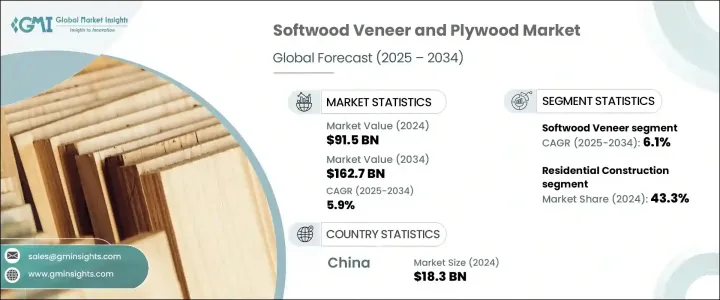
세계의 침엽수 단판 및 합판 시장은 2024년에 915억 달러로 평가되었고 건설 활동 증가, 지속 가능한 건축재료로의 시프트, 범용성과 비용효과에 의한 침엽수 제품에 대한 기호의 고조 등을 배경으로 CAGR 5.9%를 나타내 2034년에는 1,627억 달러에 달할 전망입니다.
침엽수 합판은 경량성과 취급 용이성으로 지붕재, 바닥재, 벽 기초재 등의 구조 용도에서는 활엽수 합판보다 지지되고 있습니다. 환경 친화적인 인증을받은 목재 제품에 대한 수요가 증가하고 있으며 제조업체는 지속 가능한 관행을 채택하고 세계 환경 기준을 충족하도록 요구되고 있습니다.
단판 프레스나 접착제 도포 기술의 진보에 의해 침엽수 합판의 구조적 완전성, 내습성, 전체적인 성능이 대폭 향상되었습니다. 이러한 기술 혁신으로 침엽수 합판은 휨, 층간 박리, 마모에 강해져 실내외에서의 사용 가능성이 넓어졌습니다. 강화된 접착 방법은 안정적인 품질과 내하중성을 확보하고 침엽수 합판은 바닥재, 거푸집 공사, 지붕재, 구조용 하지재 등의 요구가 엄격한 용도에 신뢰할 수 있는 옵션이 되고 있습니다. 그 결과 건축가와 건설업자들은 조립식 주택과 지속가능한 인프라와 같은 성능과 비용 효율성이 동일하게 우선되는 현대적인 건축 설계에 침엽수 합판을 통합하는 경우가 늘고 있습니다.
| 시장 범위 | |
|---|---|
| 시작 연도 | 2024년 |
| 예측 연도 | 2025-2034년 |
| 시작 금액 | 915억 달러 |
| 예측 금액 | 1,627억 달러 |
| CAGR | 5.9% |
침엽수 단판 부문은 2024년에 417억 달러를 기록했고, 2034년에는 754억 달러에 이르며 CAGR 6.1%를 나타낼 것으로 예상됩니다. 침엽수 합판은 강도, 비용 효율성, 사용 편의성에 따라 구조용도로 사용되는 주요 제품으로 지속되고 있습니다.
2024년에는 주택건설분야가 43.3%의 주요 점유율을 차지했습니다. 적당한 가격으로 범용성이 있기 때문에 구조용 골조, 바닥재, 내장 용도에 선호되고 있습니다.신흥국 시장은 단독 주택이나 중고층 주택에 있어서의 왕성한 보수·개축 문화를 통해, 시장에 크게 공헌하고 있습니다.
2024년 중국의 침엽수 단판 및 합판 시장 규모는 183억 달러로 평가되었고, 2034년에는 326억 달러에 이르며 CAGR 5.9%를 나타낼 것으로 예측됩니다.
침엽수 단판 및 합판 시장 주요 기업으로는 Weyerhaeuser Company, UPM-Kymmene Oyj, Georgia-Pacific LLC, Boise Cascade Company, Egger Group 등이 있습니다. 이러한 기업들은 시장 포지션을 강화하기 위해 제품 포트폴리오 확대, 생산 능력 강화, 지속 가능한 관행 도입에 주력하고 있습니다. 침엽수 단판 및 합판 시장의 기업은 시장에서 존재감을 높이기 위해 몇 가지 전략을 채택하고 있습니다. 연구개발에 투자함으로써 내습합판이나 내화합판 등 진화하는 소비자 수요에 부응하는 혁신적인 제품을 만들 수 있습니다. 환경 친화적인 접착제 및 FSC와 같은 인증 프로그램과 같은 지속 가능한 조달 방법은 친환경 제품에 대한 선호도 증가와 일치합니다. 자동화 및 프레스 기술의 향상과 같은 제조 기술의 진보는 제품의 품질과 생산 효율을 높입니다. 게다가 유통망의 확대와 신흥 시장의 개척으로 기업은 보다 광범위한 고객층을 획득하고 새로운 성장 기회를 활용할 수 있습니다.
목차
제1장 조사 방법과 범위
제2장 주요 요약
제3장 업계 인사이트
- 생태계 분석
- 밸류체인에 영향을 주는 요인
- 이익률 분석
- 파괴적 혁신
- 향후 전망
- 제조업체
- 유통업체
- 트럼프 정권의 관세 영향 - 구조화된 개요
- 무역에 미치는 영향
- 무역량의 혼란
- 보복 조치
- 업계에 미치는 영향
- 공급측의 영향(원재료)
- 주요 원재료의 가격 변동
- 공급망 재구성
- 생산 비용에 미치는 영향
- 수요측의 영향(판매가격)
- 최종 시장에의 가격 전달
- 시장 점유율 동향
- 소비자의 반응 패턴
- 공급측의 영향(원재료)
- 영향을 받는 주요 기업
- 전략적인 업계 대응
- 공급망 재구성
- 가격 설정 및 제품 전략
- 정책관여
- 전망과 향후 검토 사항
- 무역에 미치는 영향
- 무역 통계
- 제품 개요
- 침엽수 단판와 합판의 제조 공정
- 목재의 수종 특성과 성질
- 그레이딩 시스템과 품질 기준
- 성능 특성 및 용도
- 시장 역학
- 시장 성장 촉진요인
- 시장 성장 억제요인
- 시장 기회
- 시장의 과제
- 업계에 미치는 영향요인
- 성장 가능성 분석
- 업계의 잠재적 위험 및 과제
- 규제 프레임워크과 기준
- 제품 품질 및 안전 기준
- 건축 기준법 및 건설 기준
- 임업규제 및 인증 프로그램
- 환경규제
- 무역정책과 관세
- 제조 공정 분석
- 통나무 준비 및 박리
- 단판 건조 및 그레이딩
- 접착 및 패널 조립
- 프레싱 및 마감 처리
- 품질 관리 프로세스
- 원재료 분석 및 조달 전략
- 가격 분석
- 지속가능성과 환경영향 평가
- PESTEL 분석
- Porter's Five Forces 분석
제4장 경쟁 구도
- 서론
- 시장 점유율 분석
- 전략 틀
- 합병과 인수
- 합작투자와 콜라보레이션
- 신제품 개발
- 확대 전략
- 경쟁 벤치마킹
- 공급업체 상황
- 경쟁 포지셔닝 매트릭스
- 전략적 대시보드
- 생산 능력 분석
- 신규 참가자 시장 진출 전략
- 배전망 분석
제5장 시장 추계·예측 : 제품 유형별(2021-2034년)
- 주요 동향
- 침엽수 단판
- 로터리 컷 단판
- 슬라이스 단판
- 소목 단판
- 침엽수 합판
- 구조용 합판
- 장식용 합판
- 선박용 합판
- 항공기용 합판
- 오버레이 합판
- 기타 합판 유형
- 적층 단판재(LVL)
- 기타 제품 유형
제6장 시장 추계·예측 : 수목 유형별(2021-2034년)
- 주요 동향
- 소나무
- 남부 노란 소나무
- 라디아 타 소나무
- 로지 폴 소나무
- 기타 소나무
- 스프루스
- 더글라스 전나무
- 낙엽송
- 헴록
- 삼나무
- 혼합종
- 기타 침엽수종
제7장 시장 추계·예측 : 그레이드별(2021-2034년)
- 주요 동향
- A그레이드(프리미엄)
- B급(양호)
- C급(표준)
- D급(유틸리티)
- 특수 등급
- 마린 등급
- 외장 등급
- 구조 등급
- 기타 특수 등급
제8장 시장 추계·예측 : 용도별(2021-2034년)
- 주요 동향
- 건설
- 바닥재
- 루핑
- 벽 외장
- 콘크리트 거푸집
- 기타 건설용도
- 가구 제조
- 주거용 가구
- 상업용 가구
- 기타 가구 용도
- 포장
- 상자
- 팔레트
- 기타 포장 용도
- 수송
- 자동차
- 해양
- 항공
- 기타 운송 용도
- 기타 용도
제9장 시장 추계·예측 : 최종 이용 산업별(2021-2034년)
- 주요 동향
- 주택건설
- 신축
- 개수 및 리폼
- 상업건설
- 오피스 빌딩
- 소매점
- 접객
- 기타 상업 빌딩
- 산업건설
- 가구업계
- 포장업계
- 조선업계
- 기타 최종 이용 산업
제10장 시장 추계·예측 : 유통 채널별(2021-2034년)
- 주요 동향
- 직접 판매
- 유통업체 및 도매업체
- 건축자재 소매 업체
- 대형 소매점
- 전문점
- 철물점
- 온라인 소매
- 기타 유통 채널
제11장 시장 추계·예측 : 지역별(2021-2034년)
- 주요 동향
- 북미
- 미국
- 캐나다
- 유럽
- 독일
- 영국
- 프랑스
- 스페인
- 이탈리아
- 기타 유럽
- 아시아태평양
- 중국
- 인도
- 일본
- 호주
- 한국
- 기타 아시아태평양
- 라틴아메리카
- 브라질
- 멕시코
- 아르헨티나
- 기타 라틴아메리카
- 중동 및 아프리카
- 사우디아라비아
- 남아프리카
- 아랍에미리트(UAE)
- 기타 중동 및 아프리카
제12장 기업 프로파일
- ARAUCO
- Austral Plywoods Pty Ltd.
- Boise Cascade Company
- Canfor Corporation
- Carter Holt Harvey Ltd.
- Century Plyboards(India) Ltd.
- CMPC
- Coastal Plywood Company
- Columbia Forest Products
- Freres Lumber Co. Inc.
- Georgia-Pacific LLC
- Greenply Industries Limited
- Hardel Mutual Plywood Corporation
- Hood Industries, Inc.
- Interfor Corporation
- Louisiana-Pacific Corporation
- Metsa Wood
- Murphy Company
- Nordic Structures
- Pacific Veneer Products Ltd.
- Potlatch Deltic Corporation
- Roseburg Forest Products
- Sierra Pacific Industries
- Stora Enso Oyj
- SVEZA Group
- Swanson Group Manufacturing
- Timber Products Company
- UPM-Kymmene Corporation
- West Fraser Timber Co. Ltd.
- Weyerhaeuser Company
The Global Softwood Veneer and Plywood Market was valued at USD 91.5 billion in 2024 and is estimated to grow at a CAGR of 5.9% to reach USD 162.7 billion by 2034, driven by increased construction activities, a shift toward sustainable building materials, and the growing preference for softwood products due to their versatility and cost-effectiveness. Softwood plywood is favored over hardwood alternatives for structural applications such as roofing, flooring, and wall sheathing, owing to its lightweight nature and ease of handling. The demand for eco-friendly and certified wood products is also rising, prompting manufacturers to adopt sustainable practices and meet global environmental standards.
Technological advancements in veneer pressing and adhesive application techniques have significantly improved the structural integrity, moisture resistance, and overall performance of softwood plywood. These innovations have made the material more resilient to warping, delamination, and wear, extending its usability in indoor and outdoor environments. Enhanced bonding methods ensure consistent quality and increased load-bearing capacity, making softwood plywood a reliable choice for demanding applications such as flooring systems, formwork, roofing, and structural sheathing. As a result, architects and builders are increasingly integrating softwood plywood into modern construction designs, including prefab housing and sustainable infrastructure, where performance and cost efficiency are equally prioritized.
| Market Scope | |
|---|---|
| Start Year | 2024 |
| Forecast Year | 2025-2034 |
| Start Value | $91.5 Billion |
| Forecast Value | $162.7 Billion |
| CAGR | 5.9% |
The softwood veneer segment generated USD 41.7 billion in 2024 and is expected to reach USD 75.4 billion by 2034, growing at a CAGR of 6.1%. Softwood plywood remains the dominant product used in structural applications due to its strength, cost-efficiency, and ease of use. The trend toward sustainable construction drives the demand for eco-certified plywood products, with modern construction techniques like prefabrication further bolstering its use.
In 2024, the residential construction segment held a major share of 43.3%. The demand for affordable housing, coupled with urbanization and population growth, is fueling the need for softwood plywood in residential buildings. Its affordability and versatility make it a preferred choice for structural framing, flooring, and interior applications. Developed regions contribute significantly to the market through a robust repair and renovation culture in single-family houses and mid-rise residential buildings.
China Softwood Veneer and Plywood Market generated USD 18.3 billion in 2024 and is projected to reach USD 32.6 billion by 2034, growing at a CAGR of 5.9%. The country's strong manufacturing infrastructure and skilled labor force enable it to produce a significant share of global softwood veneer and plywood. Advancements in automation and adherence to emission control policies have enhanced production efficiency and environmental compliance. However, trade policies in regions like the U.S. and Europe have redirected China's exports to Africa and Southeast Asia.
Key players in the Softwood Veneer and Plywood Market include Weyerhaeuser Company, UPM-Kymmene Oyj, Georgia-Pacific LLC, Boise Cascade Company, and Egger Group. These companies focus on expanding their product portfolios, enhancing production capabilities, and adopting sustainable practices to strengthen their market positions. Companies in the softwood veneer and plywood market are adopting several strategies to foster their market presence. Investing in research and development allows for innovative products that meet evolving consumer demands, such as moisture-resistant and fireproof plywood. Sustainable sourcing practices, including eco-friendly adhesives and certification programs like FSC, align with the growing preference for environmentally responsible products. Advancements in manufacturing technologies, such as automation and improved pressing techniques, enhance product quality and production efficiency. Additionally, expanding distribution networks and exploring emerging markets enable companies to reach a broader customer base and capitalize on new growth opportunities.
Table of Contents
Chapter 1 Methodology & Scope
- 1.1 Research methodology
- 1.2 Research scope & assumptions
- 1.3 List of data sources
- 1.4 Market estimation technique
- 1.5 Market segmentation & breakdown
- 1.6 Research limitations
Chapter 2 Executive Summary
- 2.1 Market snapshot
- 2.2 Segment highlights
- 2.3 Competitive landscape snapshot
- 2.4 Regional market outlook
- 2.5 Key market trends
- 2.6 Future market outlook
Chapter 3 Industry Insights
- 3.1 Industry ecosystem analysis
- 3.1.1 Factor affecting the value chain
- 3.1.2 Profit margin analysis
- 3.1.3 Disruptions
- 3.1.4 Future outlook
- 3.1.5 Manufacturers
- 3.1.6 Distributors
- 3.2 Impact of trump administration tariffs - structured overview
- 3.2.1 Impact on trade
- 3.2.1.1 Trade volume disruptions
- 3.2.1.2 Retaliatory measures
- 3.2.2 Impact on the industry
- 3.2.2.1 Supply-side impact (raw materials)
- 3.2.2.1.1 Price volatility in key materials
- 3.2.2.1.2 Supply chain restructuring
- 3.2.2.1.3 Production cost implications
- 3.2.2.2 Demand-side impact (selling price)
- 3.2.2.2.1 Price transmission to end markets
- 3.2.2.2.2 Market share dynamics
- 3.2.2.2.3 Consumer response patterns
- 3.2.2.1 Supply-side impact (raw materials)
- 3.2.3 Key companies impacted
- 3.2.4 Strategic industry responses
- 3.2.4.1 Supply chain reconfiguration
- 3.2.4.2 Pricing and product strategies
- 3.2.4.3 Policy engagement
- 3.2.5 Outlook and future considerations
- 3.2.1 Impact on trade
- 3.3 Trade statistics
- 3.4 Product overview
- 3.4.1 Softwood veneer & plywood manufacturing process
- 3.4.2 Wood species characteristics & properties
- 3.4.3 Grading systems & quality standards
- 3.4.4 Performance characteristics & applications
- 3.5 Market dynamics
- 3.5.1 Market drivers
- 3.5.2 Market restraints
- 3.5.3 Market opportunities
- 3.5.4 Market challenges
- 3.6 Industry impact forces
- 3.6.1 Growth potential analysis
- 3.6.2 Industry pitfalls & challenges
- 3.7 Regulatory framework & standards
- 3.7.1 Product quality & safety standards
- 3.7.2 Building codes & construction standards
- 3.7.3 Forestry regulations & certification programs
- 3.7.4 Environmental regulations
- 3.7.5 Trade policies & tariffs
- 3.8 Manufacturing process analysis
- 3.8.1 Log preparation & peeling
- 3.8.2 Veneer drying & grading
- 3.8.3 Gluing & panel assembly
- 3.8.4 Pressing & finishing
- 3.8.5 Quality control processes
- 3.9 Raw material analysis & procurement strategies
- 3.10 Pricing analysis
- 3.11 Sustainability & environmental impact assessment
- 3.12 Pestle analysis
- 3.13 Porter's five forces analysis
Chapter 4 Competitive Landscape, 2024
- 4.1 Introduction
- 4.2 Market share analysis
- 4.3 Strategic framework
- 4.3.1 Mergers & acquisitions
- 4.3.2 Joint ventures & collaborations
- 4.3.3 New product developments
- 4.3.4 Expansion strategies
- 4.4 Competitive benchmarking
- 4.5 Vendor landscape
- 4.6 Competitive positioning matrix
- 4.7 Strategic dashboard
- 4.8 Production capacity analysis
- 4.9 Market entry strategies for new players
- 4.10 Distribution network analysis
Chapter 5 Market Estimates and Forecast, By Product Type, 2021 - 2034 (USD Billion) (Tons)
- 5.1 Key trends
- 5.2 Softwood veneer
- 5.2.1 Rotary cut veneer
- 5.2.2 Sliced veneer
- 5.2.3 Sawn veneer
- 5.3 Softwood plywood
- 5.3.1 Structural plywood
- 5.3.2 Decorative plywood
- 5.3.3 Marine plywood
- 5.3.4 Aircraft plywood
- 5.3.5 Overlaid plywood
- 5.3.6 Other plywood types
- 5.4 Laminated veneer lumber (lvl)
- 5.5 Other product types
Chapter 6 Market Estimates and Forecast, By Wood Species, 2021 - 2034 (USD Billion) (Tons)
- 6.1 Key trends
- 6.2 Pine
- 6.2.1 Southern yellow pine
- 6.2.2 Radiata pine
- 6.2.3 Lodgepole pine
- 6.2.4 Other pine species
- 6.3 Spruce
- 6.4 Douglas fir
- 6.5 Larch
- 6.6 Hemlock
- 6.7 Cedar
- 6.8 Mixed species
- 6.9 Other softwood species
Chapter 7 Market Estimates and Forecast, By Grade, 2021 - 2034 (USD Billion) (Tons)
- 7.1 Key trends
- 7.2 A grade (premium)
- 7.3 B grade (good)
- 7.4 C grade (standard)
- 7.5 D grade (utility)
- 7.6 Specialty grades
- 7.6.1 Marine grade
- 7.6.2 Exterior grade
- 7.6.3 Structural grade
- 7.6.4 Other specialty grades
Chapter 8 Market Estimates and Forecast, By Application, 2021 - 2034 (USD Billion) (Tons)
- 8.1 Key trends
- 8.2 Construction
- 8.2.1 Flooring
- 8.2.2 Roofing
- 8.2.3 Wall sheathing
- 8.2.4 Concrete formwork
- 8.2.5 Other construction applications
- 8.3 Furniture manufacturing
- 8.3.1 Residential furniture
- 8.3.2 Commercial furniture
- 8.3.3 Other furniture applications
- 8.4 Packaging
- 8.4.1 Crates & boxes
- 8.4.2 Pallets
- 8.4.3 Other packaging applications
- 8.5 Transportation
- 8.5.1 Automotive
- 8.5.2 Marine
- 8.5.3 Aviation
- 8.5.4 Other transportation applications
- 8.6 Other applications
Chapter 9 Market Estimates and Forecast, By End Use Industry, 2021 - 2034 (USD Billion) (Tons)
- 9.1 Key trends
- 9.2 Residential construction
- 9.2.1 New construction
- 9.2.2 Renovation & remodeling
- 9.3 Commercial construction
- 9.3.1 Office buildings
- 9.3.2 Retail spaces
- 9.3.3 Hospitality
- 9.3.4 Other commercial buildings
- 9.4 Industrial construction
- 9.5 Furniture industry
- 9.6 Packaging industry
- 9.7 Shipbuilding industry
- 9.8 Other end use industries
Chapter 10 Market Estimates and Forecast, By Distribution Channel, 2021 - 2034 (USD Billion) (Tons)
- 10.1 Key trends
- 10.2 Direct sales
- 10.3 Distributors & wholesalers
- 10.4 Building material retailers
- 10.4.1 Big box retailers
- 10.4.2 Specialty stores
- 10.4.3 Hardware stores
- 10.5 Online retail
- 10.6 Other distribution channels
Chapter 11 Market Estimates and Forecast, By Region, 2021 - 2034 (USD Billion) (Tons)
- 11.1 Key trends
- 11.2 North America
- 11.2.1 U.S.
- 11.2.2 Canada
- 11.3 Europe
- 11.3.1 Germany
- 11.3.2 UK
- 11.3.3 France
- 11.3.4 Spain
- 11.3.5 Italy
- 11.3.6 Rest of Europe
- 11.4 Asia Pacific
- 11.4.1 China
- 11.4.2 India
- 11.4.3 Japan
- 11.4.4 Australia
- 11.4.5 South Korea
- 11.4.6 Rest of Asia Pacific
- 11.5 Latin America
- 11.5.1 Brazil
- 11.5.2 Mexico
- 11.5.3 Argentina
- 11.5.4 Rest of Latin America
- 11.6 Middle East and Africa
- 11.6.1 Saudi Arabia
- 11.6.2 South Africa
- 11.6.3 UAE
- 11.6.4 Rest of MEA
Chapter 12 Company Profiles
- 12.1 ARAUCO
- 12.2 Austral Plywoods Pty Ltd.
- 12.3 Boise Cascade Company
- 12.4 Canfor Corporation
- 12.5 Carter Holt Harvey Ltd.
- 12.6 Century Plyboards (India) Ltd.
- 12.7 CMPC
- 12.8 Coastal Plywood Company
- 12.9 Columbia Forest Products
- 12.10 Freres Lumber Co., Inc.
- 12.11 Georgia-Pacific LLC
- 12.12 Greenply Industries Limited
- 12.13 Hardel Mutual Plywood Corporation
- 12.14 Hood Industries, Inc.
- 12.15 Interfor Corporation
- 12.16 Louisiana-Pacific Corporation
- 12.17 Metsa Wood
- 12.18 Murphy Company
- 12.19 Nordic Structures
- 12.20 Pacific Veneer Products Ltd.
- 12.21 Potlatch Deltic Corporation
- 12.22 Roseburg Forest Products
- 12.23 Sierra Pacific Industries
- 12.24 Stora Enso Oyj
- 12.25 SVEZA Group
- 12.26 Swanson Group Manufacturing
- 12.27 Timber Products Company
- 12.28 UPM-Kymmene Corporation
- 12.29 West Fraser Timber Co. Ltd.
- 12.30 Weyerhaeuser Company