|
시장보고서
상품코드
1755240
콘크리트 공기 혼화제 시장 : 기회, 성장 촉진요인, 산업 동향 분석 및 예측(2025-2034년)Concrete Air-entraining Agents Market Opportunity, Growth Drivers, Industry Trend Analysis, and Forecast 2025 - 2034 |
||||||

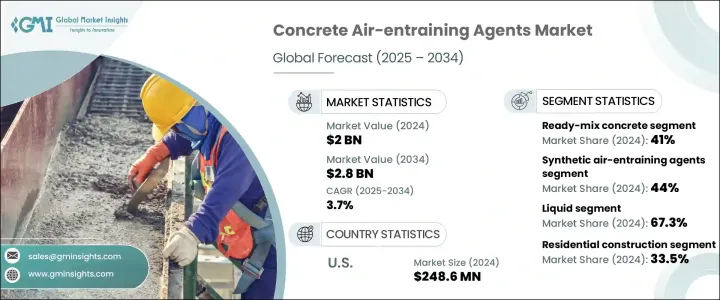
세계의 콘크리트 공기 혼화제 시장은 2024년 20억 달러로 평가되었고 2034년에는 28억 달러에 이를 것으로 예측되며, CAGR 3.7%로 성장할 전망입니다. 이 시장은 극한 기상 현상이 발생하는 지역에서 내구성이 뛰어나고 수명이 긴 건축 자재에 대한 수요가 증가함에 따라 촉진되고 있습니다. 추운 기후에서 반복되는 동결-해동 사이클은 콘크리트 내부의 물이 얼어 팽창하여 균열과 구조적 손상을 일으킬 수 있습니다. 공기 혼화제는 콘크리트 혼합물에 미세한 공기 구멍을 도입하여 물이 안전하게 팽창할 수 있는 공간을 제공함으로써 이 문제를 해결합니다. 이 과정은 극한 기후에서 콘크리트의 내구성을 크게 향상시킵니다.
신흥 경제국에서의 도시화 및 인프라 투자 증가로 인해 날씨에 강하고 서비스 수명을 연장하는 콘크리트에 대한 수요는 그 어느 때보다 높습니다. 현대 건축이 유지보수 감소와 성능 향상을 강조함에 따라 이러한 첨가제의 사용은 도로, 다리, 교통 시스템 등에서 점점 더 일반화되고 있습니다. 이러한 발전은 환경 스트레스에 견디며 더 오래 지속되도록 설계된 성능 중심 건축 자재에 대한 시장의 관심이 증가하고 있음을 반영합니다.
| 시장 범위 | |
|---|---|
| 시작 연도 | 2024년 |
| 예측 연도 | 2025-2034년 |
| 시작 금액 | 20억 달러 |
| 예측 금액 | 28억 달러 |
| CAGR | 3.7% |
2024년에는 합성 공기 혼화제 부문이 44%의 점유율을 차지합니다. 알킬 설페이트 및 설포네이트와 같은 화학 물질을 포함한 이러한 합성 제제는 정확한 공기 함량 제어, 비용 효율성 및 다양한 시멘트 구성에 대한 호환성을 제공하기 때문에 널리 사용되고 있습니다. 신뢰할 수 있는 성능으로 인프라 및 레미콘 생산과 같은 대규모 응용 분야에서 가장 많이 사용되는 제품이 되었습니다. 한편, 합성 및 천연 계면 활성제를 결합한 혼합 제형은 지속 가능하면서도 효과적인 대안으로 주목을 받고 있습니다. 이러한 하이브리드 제제는 성능을 저하시키지 않고 친환경적인 건설 솔루션을 찾는 시장에 적합합니다.
콘크리트 공기 혼화제 시장에서 레미콘 부문은 2024년에 41%의 점유율을 차지했습니다. 이 우위는 인프라부터 상업용 개발까지 다양한 건설 활동에 널리 사용되기 때문입니다. 레디믹스 공장 내 통제된 환경은 액체 공기 혼화제의 정확한 투여와 최적의 혼합을 가능하게 합니다. 이러한 첨가제는 내구성과 동결-해동 보호 측면에서 일관된 성능을 보장하며, 장기적인 내구성을 요구하는 현대 건설 기준과 일치합니다.
미국의 콘크리트 공기 혼화제 시장은 85%의 점유율을 차지했으며, 2024년에는 2억 4,860만 달러를 창출했습니다. 이 지역의 성장은 신규 주거용 건설 활동과 노후 인프라 개선 프로젝트의 증가에 힘입고 있습니다. 여러 주에 걸쳐 혹독한 겨울과 다양한 기후 조건은 환경적 스트레스에 견딜 수 있는 공기 함유 콘크리트의 사용을 필수적으로 만들고 있습니다. 건설 업계의 주요 기관들이 제정한 규제 기준은 공공 및 민간 부문 프로젝트에 이러한 제제의 사용을 의무화하여 제제의 채택을 강화하고 시장 수요를 더욱 확대하고 있습니다.
세계의 콘크리트 공기 혼화제 시장에서 사업을 전개하고 있는 주요 기업은 GCP Applied Technologies Inc., Mapei SpA, BASF SE, RPM International Inc., Sika AG 등이 있습니다. 이 시장의 주요 업체들은 지속 가능성과 성능이 개선된 차세대 공기 혼화제 개발을 위한 R&D에 주력하고 있습니다. 이들은 특정 지역의 기후 조건과 변화하는 규제 요건을 충족하기 위해 제형을 개선하고 있습니다. 또한 유통망을 강화하고 지역 건축 자재 공급업체들과 파트너십을 맺어 전 세계로 사업을 확장하고 있습니다. 콘크리트 공장을 위한 자동 주입 기술과 디지털 추적 시스템에 대한 투자를 통해 제조업체들은 부가가치 솔루션을 제공할 수 있게 되었습니다.
목차
제1장 조사 방법과 범위
제2장 주요 요약
제3장 산업 고찰
- 생태계 분석
- 공급자의 상황
- 이익률
- 각 단계에서의 부가가치
- 밸류체인에 영향을 주는 요인
- 혁신
- 산업에 미치는 영향요인
- 성장 촉진요인
- 추운 지역에서의 건설 활동 증가
- 내구성이 뛰어난 콘크리트 구조물에 대한 수요 증가
- 인프라 개발 프로젝트 증가
- 엄격한 건축 규정 및 기준
- 콘크리트 성능 요구사항 강화
- 산업의 잠재적 리스크 및 과제
- 적절한 공기 함량 유지의 어려움
- 공기 함량과 콘크리트 강도 균형 조정
- 원자재 가격 변동
- 대체 기술과의 경쟁
- 시장 기회
- 바이오 기반 공기 혼화제 개발
- 신흥 시장으로 확대
- 혼화 기술의 진보
- 고성능 콘크리트 수요 증가
- 성장 촉진요인
- 성장 가능성 분석
- 규제 상황
- 북미
- 유럽
- 아시아태평양
- 라틴아메리카
- 중동 및 아프리카
- Porter's Five Forces 분석
- PESTEL 분석
- 가격 동향
- 지역별
- 제품별
- 장래 시장 동향
- 기술과 혁신의 상황
- 현재의 기술 동향
- 신흥기술
- 특허 상황
- 무역 통계(HS코드)(참고 : 무역 통계는 주요 국가에서만 제공됨)
- 주요 수입국
- 주요 수출국
- 지속가능성과 환경 측면
- 지속 가능한 실습
- 폐기물 삭감 전략
- 생산에 있어서의 에너지 효율
- 친환경 활동
- 탄소 발자국 프린트의 고려
제4장 경쟁 구도
- 소개
- 기업의 시장 점유율 분석
- 지역별
- 북미
- 유럽
- 아시아태평양
- 라틴아메리카 항공
- 중동 및 아프리카
- 지역별
- 기업 매트릭스 분석
- 주요 시장 기업의 경쟁 분석
- 경쟁 포지셔닝 매트릭스
- 합병과 인수
- 파트너십 및 협업
- 신제품 발매
- 확대 계획
제5장 시장 추정 및 예측 : 유형별(2021-2034년)
- 주요 동향
- 천연
- 빈솔 수지
- 우드로진
- 톨오일
- 기타
- 합성
- 알킬아릴설포네이트
- 알킬설페이트
- 올레핀설포네이트
- 기타
- 혼합 공기 혼화제
제6장 시장 추정 및 예측 : 형태별(2021-2034년)
- 주요 동향
- 액체
- 분말
제7장 시장 추정 및 예측 : 용도별(2021-2034년)
- 주요 동향
- 레미콘
- 프리캐스트 콘크리트
- 콘크리트 포장
- 콘크리트 블록과 벽돌
- 분출 콘크리트
- 기타
제8장 시장 추정 및 예측 : 최종 이용 산업별(2021-2034년)
- 주요 동향
- 주거용
- 상업용
- 인프라 개발
- 도로 및 고속도로
- 교량 및 댐
- 공항 및 항구
- 기타
- 산업건설
- 기타
제9장 시장 추정 및 예측 : 지역별(2021-2034년)
- 주요 동향
- 북미
- 미국
- 캐나다
- 유럽
- 독일
- 영국
- 프랑스
- 스페인
- 이탈리아
- 기타 유럽
- 아시아태평양
- 중국
- 인도
- 일본
- 호주
- 한국
- 기타 아시아태평양
- 라틴아메리카
- 브라질
- 멕시코
- 아르헨티나
- 기타 라틴아메리카
- 중동 및 아프리카
- 사우디아라비아
- 남아프리카
- 아랍에미리트(UAE)
- 기타 중동 및 아프리카
제10장 기업 프로파일
- BASF SE
- Cementaid International Ltd.
- Cemex SAB de CV
- Chryso Group
- Concrete Additives and Chemicals Pvt. Ltd.
- Euclid Chemical Company
- Fosroc, Inc.
- Fritz-Pak Corporation
- GCP Applied Technologies Inc.
- Kao Corporation
- Kryton International Inc.
- Mapei SpA
- Master Builders Solutions
- Oscrete Construction Products
- Pidilite Industries Ltd.
- Rhein Chemotechnik GmbH
- RPM International Inc.
- Shandong Wanshan Chemical Co., Ltd.
- Sika AG
- WR Grace & Co.
The Global Concrete Air-Entraining Agents Market was valued at USD 2 billion in 2024 and is estimated to grow at a CAGR of 3.7% to reach USD 2.8 billion by 2034. This market is driven by the increasing demand for durable and long-lasting construction materials in regions that experience extreme weather patterns. In cold climates, repeated freeze-thaw cycles can cause internal water within the concrete to freeze and expand, leading to cracking and structural damage. Air-entraining agents help solve this issue by introducing microscopic air voids into the concrete mix, allowing space for water to expand safely. This process significantly improves concrete's resilience in severe climates.
With growing urbanization and infrastructure investments in emerging economies, the need for concrete that resists weathering and extends service life is stronger than ever. As modern construction emphasizes reduced maintenance and greater performance, the use of these agents has become increasingly common in roads, bridges, and transit systems. These developments reflect the market's growing focus on performance-based building materials that are designed to last longer and withstand environmental stress.
| Market Scope | |
|---|---|
| Start Year | 2024 |
| Forecast Year | 2025-2034 |
| Start Value | $2 Billion |
| Forecast Value | $2.8 Billion |
| CAGR | 3.7% |
In 2024, the synthetic air-entraining agents segment held a 44% share. These synthetic agents, including chemical compounds such as alkyl sulfates and sulfonates, are widely used due to their ability to offer precise air content control, cost-effectiveness, and compatibility across diverse cement compositions. Their dependable performance has made them the go-to choice in large-scale applications such as infrastructure and ready-mix concrete production. Meanwhile, blended formulations that combine synthetic and natural surfactants are gaining attention for providing a sustainable yet effective alternative. These hybrid agents cater to markets seeking greener construction solutions without compromising on performance.
Ready-mix concrete segment in the concrete air-entraining agents market held a 41% share in 2024. This dominance is largely due to its use in a wide range of construction activities, from infrastructure to commercial development. Controlled environments at ready-mix plants allow for precise dosing and optimal blending of liquid air-entraining agents. These agents help ensure consistent performance, especially in terms of durability and freeze-thaw protection, aligning with modern construction standards that demand long-lasting materials.
U.S. Concrete Air-entraining Agents Market held an 85% share and generated USD 248.6 million in 2024. Growth in this region is being supported by increased activity in both new residential construction and upgrades to aging infrastructure. Harsh winters and varied climates across several states necessitate the use of air-entrained concrete to withstand environmental stresses. Regulatory standards established by key institutions in the construction industry enforce the use of these agents in both public and private sector projects, reinforcing their adoption and further expanding market demand.
Leading companies operating in the Global Concrete Air-entraining Agents Market include GCP Applied Technologies Inc., Mapei S.p.A., BASF SE, RPM International Inc., and Sika AG. Key players in this market are focusing on R&D initiatives to develop next-generation air-entraining agents with improved sustainability and performance. They are enhancing formulations to meet specific regional climatic requirements and shifting regulatory expectations. Companies are also expanding their global reach by strengthening distribution networks and forming partnerships with regional construction material suppliers. Investing in automated dosing technologies for concrete plants and digital tracking systems has helped manufacturers offer value-added solutions.
Table of Contents
Chapter 1 Methodology & Scope
- 1.1 Market scope and definition
- 1.2 Research design
- 1.2.1 Research approach
- 1.2.2 Data collection methods
- 1.3 Data mining sources
- 1.3.1 Global
- 1.3.2 Regional/Country
- 1.4 Base estimates and calculations
- 1.4.1 Base year calculation
- 1.4.2 Key trends for market estimation
- 1.5 Primary research and validation
- 1.5.1 Primary sources
- 1.6 Forecast model
- 1.7 Research assumptions and limitations
Chapter 2 Executive Summary
- 2.1 Industry 3600 synopsis
- 2.2 Key market trends
- 2.2.1 Regional
- 2.2.2 Type
- 2.2.3 Form
- 2.2.4 Application
- 2.2.5 End use Industry
- 2.3 TAM Analysis, 2025-2034
- 2.4 CXO perspectives: Strategic imperatives
- 2.4.1 Executive decision points
- 2.4.2 Critical success factors
- 2.5 Future Outlook and Strategic Recommendations
Chapter 3 Industry Insights
- 3.1 Industry ecosystem analysis
- 3.1.1 Supplier Landscape
- 3.1.2 Profit Margin
- 3.1.3 Value addition at each stage
- 3.1.4 Factor affecting the value chain
- 3.1.5 Disruptions
- 3.2 Industry impact forces
- 3.2.1 Growth drivers
- 3.2.1.1 Growing construction activities in cold regions
- 3.2.1.2 Increasing demand for durable concrete structures
- 3.2.1.3 Rising infrastructure development projects
- 3.2.1.4 Stringent building codes and standards
- 3.2.1.5 Enhanced concrete performance requirements
- 3.2.2 Industry pitfalls and challenges
- 3.2.2.1 Challenges in maintaining proper air content
- 3.2.2.2 Balancing air content and concrete strength
- 3.2.2.3 Fluctuating raw material prices
- 3.2.2.4 Competition from alternative technologies
- 3.2.3 Market opportunities
- 3.2.3.1 Development of bio-based air-entraining agents
- 3.2.3.2 Expansion in emerging markets
- 3.2.3.3 Advancements in admixture technology
- 3.2.3.4 Growing demand for high-performance concrete
- 3.2.1 Growth drivers
- 3.3 Growth potential analysis
- 3.4 Regulatory landscape
- 3.4.1 North America
- 3.4.2 Europe
- 3.4.3 Asia Pacific
- 3.4.4 Latin America
- 3.4.5 Middle East & Africa
- 3.5 Porter's analysis
- 3.6 PESTEL analysis
- 3.6.1 Technology and Innovation Landscape
- 3.6.2 Current technological trends
- 3.6.3 Emerging technologies
- 3.7 Price trends
- 3.7.1 By region
- 3.7.2 By product
- 3.8 Future market trends
- 3.9 Technology and Innovation Landscape
- 3.9.1 Current technological trends
- 3.9.2 Emerging technologies
- 3.10 Patent Landscape
- 3.11 Trade statistics (HS code) (Note: the trade statistics will be provided for key countries only)
- 3.11.1 Major importing countries
- 3.11.2 Major exporting countries
- 3.12 Sustainability and Environmental Aspects
- 3.12.1 Sustainable Practices
- 3.12.2 Waste Reduction Strategies
- 3.12.3 Energy Efficiency in Production
- 3.12.4 Eco-friendly Initiatives
- 3.13 Carbon Footprint Considerations
Chapter 4 Competitive Landscape, 2024
- 4.1 Introduction
- 4.2 Company market share analysis
- 4.2.1 By region
- 4.2.1.1 North America
- 4.2.1.2 Europe
- 4.2.1.3 Asia Pacific
- 4.2.1.4 LATAM
- 4.2.1.5 MEA
- 4.2.1 By region
- 4.3 Company matrix analysis
- 4.4 Competitive analysis of major market players
- 4.5 Competitive positioning matrix
- 4.6 Key developments
- 4.6.1 Mergers & acquisitions
- 4.6.2 Partnerships & collaborations
- 4.6.3 New Product Launches
- 4.6.4 Expansion Plans
Chapter 5 Market Estimates and Forecast, By Type, 2021 – 2034 (USD Billion) (Kilo Tons)
- 5.1 Key trends
- 5.2 Natural-based air-entraining agents
- 5.2.1 Vinsol resin
- 5.2.2 Wood rosin
- 5.2.3 Tall oil
- 5.2.4 Others
- 5.3 Synthetic air-entraining agents
- 5.3.1 Alkyl aryl sulfonates
- 5.3.2 Alkyl sulfates
- 5.3.3 Olefin sulfonates
- 5.3.4 Others
- 5.4 Blended air-entraining agents
Chapter 6 Market Estimates and Forecast, By Form, 2021 – 2034 (USD Billion) (Kilo Tons)
- 6.1 Key trends
- 6.2 Liquid
- 6.3 Powder
Chapter 7 Market Estimates and Forecast, By Application, 2021 – 2034 (USD Billion) (Kilo Tons)
- 7.1 Key trends
- 7.2 Ready-mix concrete
- 7.3 Precast concrete
- 7.4 Concrete pavements
- 7.5 Concrete blocks & bricks
- 7.6 Shotcrete
- 7.7 Others
Chapter 8 Market Estimates and Forecast, By End Use Industry, 2021 – 2034 (USD Billion) (Kilo Tons)
- 8.1 Key trends
- 8.2 Residential construction
- 8.3 Commercial construction
- 8.4 Infrastructure development
- 8.4.1 Roads & highways
- 8.4.2 Bridges & dams
- 8.4.3 Airports & ports
- 8.4.4 Others
- 8.5 Industrial construction
- 8.6 Others
Chapter 9 Market Estimates and Forecast, By Region, 2021 – 2034 (USD Billion) (Kilo Tons)
- 9.1 Key trends
- 9.2 North America
- 9.2.1 U.S.
- 9.2.2 Canada
- 9.3 Europe
- 9.3.1 Germany
- 9.3.2 UK
- 9.3.3 France
- 9.3.4 Spain
- 9.3.5 Italy
- 9.3.6 Rest of Europe
- 9.4 Asia Pacific
- 9.4.1 China
- 9.4.2 India
- 9.4.3 Japan
- 9.4.4 Australia
- 9.4.5 South Korea
- 9.4.6 Rest of Asia Pacific
- 9.5 Latin America
- 9.5.1 Brazil
- 9.5.2 Mexico
- 9.5.3 Argentina
- 9.5.4 Rest of Latin America
- 9.6 Middle East and Africa
- 9.6.1 Saudi Arabia
- 9.6.2 South Africa
- 9.6.3 UAE
- 9.6.4 Rest of Middle East and Africa
Chapter 10 Company Profiles
- 10.1 BASF SE
- 10.2 Cementaid International Ltd.
- 10.3 Cemex S.A.B. de C.V.
- 10.4 Chryso Group
- 10.5 Concrete Additives and Chemicals Pvt. Ltd.
- 10.6 Euclid Chemical Company
- 10.7 Fosroc, Inc.
- 10.8 Fritz-Pak Corporation
- 10.9 GCP Applied Technologies Inc.
- 10.10 Kao Corporation
- 10.11 Kryton International Inc.
- 10.12 Mapei S.p.A.
- 10.13 Master Builders Solutions
- 10.14 Oscrete Construction Products
- 10.15 Pidilite Industries Ltd.
- 10.16 Rhein Chemotechnik GmbH
- 10.17 RPM International Inc.
- 10.18 Shandong Wanshan Chemical Co., Ltd.
- 10.19 Sika AG
- 10.20 W. R. Grace & Co.