


|
시장보고서
상품코드
1766325
산업 수요 관리 시장(2025-2034년) : 기회, 성장 촉진요인, 산업 동향 분석, 예측Industrial Demand Side Management Market Opportunity, Growth Drivers, Industry Trend Analysis, and Forecast 2025 - 2034 |
||||||

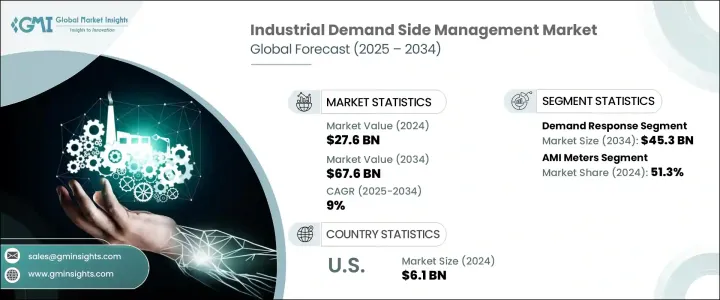
세계의 산업 수요 관리 시장 규모는 2024년에는 276억 달러에 달하였고, CAGR 9%로 성장하여 2034년에는 676억 달러에 이를 것으로 예측되고 있습니다.
인텔리전트 에너지 솔루션의 채용이 확대되고 있으며, 산업계가 전력 소비를 관리하는 방법에 변화를 가져오고 있습니다. 이를 통해 정밀한 부하 예측과 역동적인 가격 전략의 도입이 가능해집니다.
산업 인프라에 디지털 기술을 통합함으로써 에너지 제어는 점점 더 예측 가능해지고 적응성이 향상되고 있습니다. 맞춤형 DSM 솔루션은 시설이 에너지 운용을 보다 적절하게 관리할 수 있는 기능을 제공하고 있습니다. 송전망이 현대화되고 스마트 시스템이 보급됨에 따라 신속하고 자동화되어 있으며 반응성이 높은 에너지 관리 솔루션에 대한 수요는 계속 급증하고 있고, DSM은 저탄소 시대에 탄탄한 산업 기반을 위해서는 필수 요소입니다.
| 시장 범위 | |
|---|---|
| 시작 연도 | 2024년 |
| 예측 연도 | 2025-2034년 |
| 시작 금액 | 276억 달러 |
| 예측 금액 | 676억 달러 |
| CAGR | 9% |
수요 반응 부문은 2034년까지 453억 달러에 이를 것으로 예측됩니다. 수요 반응은 전반적인 신뢰성을 향상시키면서 에너지 가격 변동에 노출되는 기회를 줄일 수 있습니다.
2024년 AMI 미터 부문의 점유율은 51.3%를 차지하였으며, 2034년까지 안정적인 성장을 유지할 것으로 예측됩니다. AMI 미터는 양방향 통신을 지원하고 사용 시간대 가격 설정이나 시스템 상태에 근거한 자동 조정을 가능하게 합니다.
2024년 미국 산업 수요 관리 시장 규모는 61억 달러로, 에너지 가격의 상승과 강력한 규제 인센티브 및 재생에너지의 통합으로 스마트 기술과 에너지 효율이 높은 프로그램의 전개가 가속화되고 있습니다. 정부는 디지털 인프라 투자에 박차를 가해 산업계가 보다 반응성이 높은 저배출 에너지 전략으로 이행하도록 지원하고 있습니다.
세계의 산업 수요 관리 시장과 관련된 주요 기업은 Rockwell Automation, Siemens, IBM, eSight Energy, Eaton, Telkonet, General Electric, Honeywell International, SkyFoundry, Schneider Electric, Johnson Controls, Emerson Electric, Optimum Energy, C3ai. 등이 있습니다. 산업용 DSM 시장의 대기업은 에너지 제어 및 시스템 인텔리전스를 강화하기 위해 최첨단 기술의 활용에 주력하고 있습니다.
많은 기업들이 AI와 머신러닝을 DSM 플랫폼에 통합하여 예측 분석과 실시간 에너지 최적화를 제공합니다. 에너지 공급기업과 산업계 고객과의 전략적 파트너십을 통해 각 회사는 가시적인 효율성 향상을 위한 수요 반응 프로그램을 공동 개발할 수 있습니다.
목차
제1장 조사 방법과 범위
제2장 주요 요약
제3장 업계 인사이트
- 생태계 분석
- 규제 상황
- 업계에 미치는 영향요인
- 성장 촉진요인
- 업계의 잠재적 위험 및 과제
- 성장 가능성 분석
- Porter's Five Forces 분석
- PESTEL 분석
제4장 경쟁 구도
- 소개
- 전략적 대시보드
- 기업의 시장 점유율 분석
- 전략적 노력
- 기업 벤치마킹
- 혁신과 기술의 상황
제5장 시장 규모와 예측 : 서비스별(2021-2034년)
- 주요 동향
- 수요 반응
- 에너지 효율
- 부하 관리
제6장 시장 규모와 예측 : 기술 솔루션별(2021-2034년)
- 주요 동향
- 스마트 온도계
- AMI 미터
- EMS
제7장 시장 규모와 예측 : 지역별(2021-2034년)
- 주요 동향
- 북미
- 미국
- 캐나다
- 유럽
- 독일
- 프랑스
- 영국
- 스페인
- 이탈리아
- 아시아태평양
- 중국
- 일본
- 한국
- 호주
- 인도
- 중동 및 아프리카
- 사우디아라비아
- 아랍에미리트(UAE)
- 남아프리카
- 라틴아메리카
- 브라질
- 아르헨티나
제8장 기업 프로파일
- C3.ai
- Dexma Sensors
- Eaton
- Emerson Electric
- eSight Energy
- General Electric
- Honeywell International
- IBM
- Johnson Controls
- Optimum Energy
- Rockwell Automation
- Schneider Electric
- Siemens
- SkyFoundry
- Telkonet
The Global Industrial Demand Side Management Market was valued at USD 27.6 billion in 2024 and is estimated to grow at a CAGR of 9% to reach USD 67.6 billion by 2034. The growing adoption of intelligent energy solutions is transforming how industries manage power consumption. The emergence of IIoT-based sensors enables real-time tracking of energy usage, allowing for more accurate load forecasting and the ability to implement dynamic pricing strategies. As energy optimization becomes a priority, advanced analytics powered by AI are refining consumption behavior, thereby boosting the performance of DSM initiatives.
With the integration of digital technologies into industrial infrastructure, energy control is becoming increasingly predictive and adaptive. Rising energy costs, coupled with the global shift toward sustainable operations, are driving companies to adopt DSM systems that help reduce peak demand, optimize usage, and support grid reliability. Across key industries such as manufacturing and data processing, custom-designed DSM solutions are helping facilities gain better control over their energy operations. As grids modernize and smart systems become more prevalent, the demand for agile, automated, and responsive energy management solutions continues to surge, making DSM a critical component in the push toward a low-carbon, resilient industrial landscape.
| Market Scope | |
|---|---|
| Start Year | 2024 |
| Forecast Year | 2025-2034 |
| Start Value | $27.6 Billion |
| Forecast Value | $67.6 Billion |
| CAGR | 9% |
The demand response segment is anticipated to reach USD 45.3 billion by 2034. As one of the most vital elements of industrial DSM, demand response enables facilities to scale back or shift electricity usage during high-demand periods in exchange for cost-based incentives or pricing advantages. This helps reduce exposure to energy price fluctuations while improving overall grid reliability. By participating in demand response programs, industrial players gain financial benefits and operational flexibility, further enhancing their ability to align energy use with real-time grid conditions.
In 2024, the AMI meters segment held 51.3% share and is expected to maintain steady growth through 2034. AMI technology plays a key role in modern DSM frameworks by delivering continuous, real-time energy consumption data. These advanced metering systems support two-way communication between utilities and industrial facilities, allowing for automated adjustments based on time-of-use pricing or system conditions. AMI meters provide deeper insights into usage trends, help uncover inefficiencies and ensure compliance with energy policies. Their capacity for rapid data exchange and precise tracking makes them essential to smarter, more sustainable energy operations across industrial sectors.
U.S. Industrial Demand Side Management Market was valued at USD 6.1 billion in 2024. Rising energy prices, combined with strong regulatory incentives and renewable energy integration, are accelerating the deployment of smart technologies and energy-efficient programs. Recent legislation has spurred investment in digital infrastructure for energy management, helping industries transition to more responsive and low-emission energy strategies. Commitments from major corporations to achieve ESG goals are also encouraging the adoption of DSM systems across critical sectors, including logistics, manufacturing, and data infrastructure.
Key companies involved in the Global Industrial Demand Side Management Market include Rockwell Automation, Siemens, IBM, eSight Energy, Eaton, Telkonet, General Electric, Honeywell International, SkyFoundry, Schneider Electric, Johnson Controls, Emerson Electric, Optimum Energy, C3.ai, and Dexma Sensors. Leading firms in the industrial DSM market are focused on leveraging cutting-edge technologies to enhance energy control and system intelligence.
Many companies are integrating AI and machine learning into DSM platforms to offer predictive analytics and real-time energy optimization. A core strategy involves expanding their software and IoT portfolios to provide customizable, scalable solutions across different industrial environments. Strategic partnerships with energy providers and industrial clients allow companies to co-develop demand response programs that deliver measurable efficiency gains. Additionally, investments in cloud-based platforms and data analytics tools are helping streamline monitoring and automation.
Table of Contents
Chapter 1 Methodology & Scope
- 1.1 Market definitions
- 1.2 Base estimates & calculations
- 1.3 Forecast calculation
- 1.4 Data sources
- 1.4.1 Primary
- 1.4.2 Secondary
- 1.4.2.1 Paid
- 1.4.2.2 Public
Chapter 2 Executive Summary
- 2.1 Industry synopsis, 2021 - 2034
Chapter 3 Industry Insights
- 3.1 Industry ecosystem analysis
- 3.2 Regulatory landscape
- 3.3 Industry impact forces
- 3.3.1 Growth drivers
- 3.3.2 Industry pitfalls & challenges
- 3.4 Growth potential analysis
- 3.5 Porter's analysis
- 3.5.1 Bargaining power of suppliers
- 3.5.2 Bargaining power of buyers
- 3.5.3 Threat of new entrants
- 3.5.4 Threat of substitutes
- 3.6 PESTEL analysis
Chapter 4 Competitive Landscape, 2025
- 4.1 Introduction
- 4.2 Strategic dashboard
- 4.3 Company market share analysis, 2024
- 4.4 Strategic initiatives
- 4.5 Company benchmarking
- 4.6 Innovation & technology landscape
Chapter 5 Market Size and Forecast, By Service, 2021 - 2034, (USD Million)
- 5.1 Key trends
- 5.2 Demand response
- 5.3 Energy efficiency
- 5.4 Load management
Chapter 6 Market Size and Forecast, By Technology Solutions, 2021 - 2034, (USD Million)
- 6.1 Key trends
- 6.2 Smart thermostats
- 6.3 AMI meters
- 6.4 EMS
Chapter 7 Market Size and Forecast, By Region, 2021 - 2034, (USD Million)
- 7.1 Key trends
- 7.2 North America
- 7.2.1 U.S.
- 7.2.2 Canada
- 7.3 Europe
- 7.3.1 Germany
- 7.3.2 France
- 7.3.3 UK
- 7.3.4 Spain
- 7.3.5 Italy
- 7.4 Asia Pacific
- 7.4.1 China
- 7.4.2 Japan
- 7.4.3 South Korea
- 7.4.4 Australia
- 7.4.5 India
- 7.5 Middle East & Africa
- 7.5.1 Saudi Arabia
- 7.5.2 UAE
- 7.5.3 South Africa
- 7.6 Latin America
- 7.6.1 Brazil
- 7.6.2 Argentina
Chapter 8 Company Profiles
- 8.1 C3.ai
- 8.2 Dexma Sensors
- 8.3 Eaton
- 8.4 Emerson Electric
- 8.5 eSight Energy
- 8.6 General Electric
- 8.7 Honeywell International
- 8.8 IBM
- 8.9 Johnson Controls
- 8.10 Optimum Energy
- 8.11 Rockwell Automation
- 8.12 Schneider Electric
- 8.13 Siemens
- 8.14 SkyFoundry
- 8.15 Telkonet


