|
시장보고서
상품코드
1773322
펩티드 기반 나노재료 시장 기회, 성장 촉진요인, 산업 동향 분석 및 예측(2025-2034년)Peptide-Based Nanomaterials Market Opportunity, Growth Drivers, Industry Trend Analysis, and Forecast 2025 - 2034 |
||||||

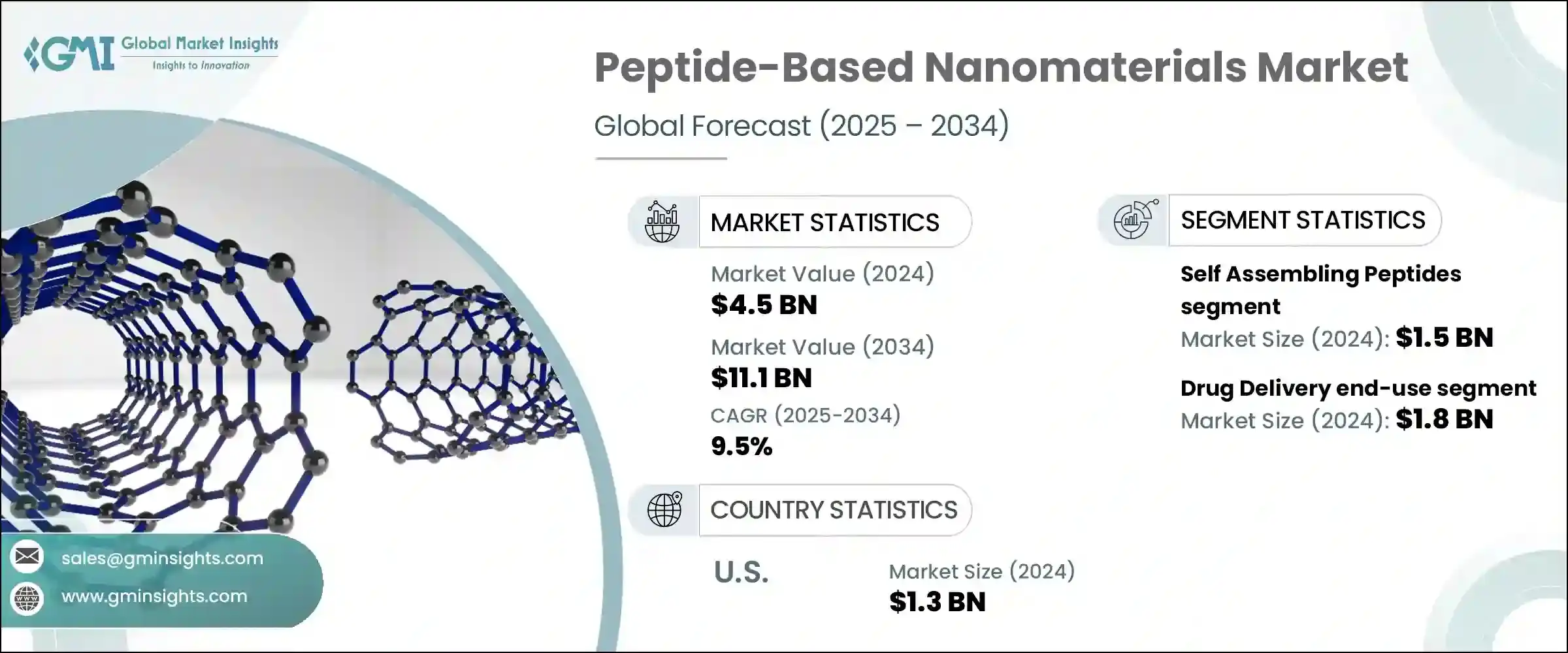
세계의 펩티드 기반 나노재료 시장 규모는 2024년에 45억 달러로 평가되었고, CAGR 9.5%를 나타내 2034년에는 111억 달러에 이를 것으로 예측되고 있습니다.
이 시장은 의료 산업이 정밀의료 및 표적 치료로 이동함에 따라 기세를 늘리고 있습니다. 성인 약물 캐리어로서 기능하고 첨단 치료 플랫폼을 지원하는 능력으로 기존의 치료법을 대체하는 매력적인 선택이 되고 있습니다.

헬스케어 시스템은 세계적으로 진화하고 있으며, 고급 의료 툴, 생물학적으로 반응하는 재료, 부작용이 적고 효능이 향상되는 나노스케일의 치료제에 다시 중점을 두고 있습니다. 또한, 투자자나 공적 헬스 케어 기관의 바이오 의약품 혁신에 대한 관심의 고조가, 분자 레벨에서의 질환 치료 방법의 변화를 목표로 한 특수한 검출 시스템, 인텔리전트인 약제 제제법, 모듈식 나노 구조를 만들어 냅니다.
| 시장 범위 | |
|---|---|
| 시작 연도 | 2024년 |
| 예측 연도 | 2025-2034년 |
| 시작 금액 | 45억 달러 |
| 예측 금액 | 111억 달러 |
| CAGR | 9.5% |
자기조립 펩티드 분야는 2024년에 15억 달러를 창출했고 2034년까지 연평균 복합 성장률(CAGR) 8.7%를 나타낼 것으로 예측됩니다. 이 분야의 인기는 방출 제어와 부위 특이적인 전달 시스템에 대한 수요 증가가 원동력이 되고 있습니다. 개발자는 보다 안전한 약물 수송을 가능하게 하는 생체 적합성과 생분해성을 갖춘 펩티드 나노 구조의 조제에 주력하고 있습니다.
2024년 약물전달 용도 분야 시장 규모는 18억 달러로 점유율은 39.3%였으며, 2034년까지 연평균 복합 성장률(CAGR)은 6.1%를 나타낼 전망입니다. 기업의 약 60%는 초기 연구 단계에서 이미 펩티드 기반의 시스템을 도입하고 있습니다.
2024년 미국의 펩티드 기반 나노재료 시장 규모는 13억 달러로 평가되었고, CAGR 9.1%를 나타내 2034년까지 29.3%를 차지할 것으로 예측되고 있습니다. 관련 특허의 35% 이상이 미국발이며, 연구 집약도와 기술력의 높음을 나타내고 있습니다.
펩티드 기반 나노재료 시장을 형성하는 주요 기업은 Genscript Biotech Corporation, PolyPeptide Group, Anika Therapeutics, Inc. PeptiDream Inc. Bachem Holding AG 등이 있습니다. 펩티드 기반 나노재료 시장의 각사는 경쟁력을 유지하기 위해, 치료의 범용성과 규제 준수에 중점을 두고, 확장성이 있는 연구개발에 대한 투자를 우선하고 있습니다. 선진적인 펩티드 합성 기술로 생산 능력을 강화하고 있는 기업도 많습니다. 지적 재산의 보호는 각사가 신규 나노재료의 특허 포트폴리오를 강화하고 있기 때문에 중요한 초점이 되고 있습니다.
목차
제1장 조사 방법
- 시장의 범위와 정의
- 조사 디자인
- 조사 접근
- 데이터 수집 방법
- 데이터 마이닝 소스
- 세계
- 지역/국가
- 기본 추정과 계산
- 기준연도 계산
- 시장 예측의 주요 동향
- 1차 조사와 검증
- 1차 정보
- 예측 모델
- 조사의 전제와 한계
제2장 주요 요약
제3장 업계 인사이트
- 생태계 분석
- 공급자의 상황
- 이익률
- 각 단계에서의 부가가치
- 밸류체인에 영향을 주는 요인
- 파괴적 혁신
- 업계에 미치는 영향요인
- 성장 촉진요인
- 업계의 잠재적 위험 및 과제
- 시장 기회
- 성장 가능성 분석
- 규제 상황
- 북미
- 유럽
- 아시아태평양
- 라틴아메리카
- 중동 및 아프리카
- Porter's Five Forces 분석
- PESTEL 분석
- 가격 동향
- 지역별
- 제품별
- 향후 시장 동향
- 기술과 혁신의 상황
- 현재의 기술 동향
- 신흥기술
- 특허 상황
- 무역 통계(HS코드)(참고 : 무역 통계는 주요 국가에서만 제공됨)
- 주요 수입국
- 주요 수출국
- 지속가능성과 환경 측면
- 지속가능한 관행
- 폐기물 감축 전략
- 생산에 있어서의 에너지 효율
- 환경 친화적인 노력
- 탄소발자국의 고려
제4장 경쟁 구도
- 서론
- 기업의 시장 점유율 분석
- 지역별
- 북미
- 유럽
- 아시아태평양
- 라틴아메리카
- 중동 및 아프리카
- 지역별
- 기업 매트릭스 분석
- 주요 시장 기업의 경쟁 분석
- 경쟁 포지셔닝 매트릭스
- 주요 발전
- 합병과 인수
- 파트너십 및 협업
- 신제품 발매
- 확장 계획
제5장 시장 추계·예측 : 유형별(2021-2034년)
- 주요 동향
- 자가 조립 펩티드
- 펩티드 양친매성
- 펩티드 폴리머 접합체
- 펩티드 나노입자 하이브리드
- 순환 펩티드 나노구조
- 기타
제6장 시장 추계·예측 : 나노구조 형태학별(2021-2034년)
- 주요 동향
- 나노섬유 및 나노튜브
- 나노스피어 및 소포
- 하이드로겔 및 스캐폴드
- 나노입자
- 2D 나노시트 및 필름
- 기타
제7장 시장 추계·예측 : 용도별(2021-2034년)
- 주요 동향
- 약물전달
- 표적암 치료제
- 유전자 및 핵산 전달
- 기타 약물전달 용도
- 조직 공학 및 재생 의료
- 바이오센싱 및 진단
- 항균 용도
- 바이오 이미징 및 테라노스틱스
- 기타 용도
제8장 시장 추계·예측 : 최종 이용 산업별(2021-2034년)
- 주요 동향
- 제약 및 생명공학
- 헬스케어 및 의료기기
- 연구 및 학술 기관
- 화장품 및 퍼스널케어
- 식품 및 농업
- 기타
제9장 시장 추계·예측 : 지역별(2021-2034년)
- 주요 동향
- 북미
- 미국
- 캐나다
- 유럽
- 독일
- 영국
- 프랑스
- 이탈리아
- 스페인
- 기타 유럽
- 아시아태평양
- 중국
- 인도
- 일본
- 호주
- 한국
- 기타 아시아태평양
- 라틴아메리카
- 브라질
- 멕시코
- 아르헨티나
- 기타 라틴아메리카
- 중동 및 아프리카
- 사우디아라비아
- 남아프리카
- 아랍에미리트(UAE)
- 기타 중동 및 아프리카
제10장 기업 프로파일
- Ferring Pharmaceuticals
- 3D Matrix Medical Technology
- Nanovesicular(NVS) Technologies
- CellMark Medical
- Nanomatrix Therapeutics
- Anika Therapeutics, Inc.
- Nanoviricides, Inc.
- Peptron, Inc.
- Ambiopharm, Inc.
- Bachem Holding AG
- PolyPeptide Group
- Nanosphere Health Sciences, Inc.
- Peptide Solutions, LLC
- PeptiDream Inc.
- Genscript Biotech Corporation
- Peptisyntha(Solvay Group)
- Pepscan
- Nanopartz Inc.
- CPC Scientific Inc.
- Advanced Peptides
The Global Peptide-Based Nanomaterials Market was valued at USD 4.5 billion in 2024 and is estimated to grow at a CAGR of 9.5% to reach USD 11.1 billion by 2034. This market is gaining momentum as the medical industry shifts towards precision medicine and targeted therapy. Peptide-based nanomaterials are gaining attention due to their multifunctional capabilities in drug delivery, imaging, transdermal therapeutics, and tissue engineering. Their ability to act as biocompatible drug carriers and support advanced treatment platforms has made them an attractive alternative to traditional therapies. Increasing private investments and government funding are accelerating the pace of innovation in nanomedicine.
Healthcare systems globally are evolving with a renewed emphasis on advanced medical tools, biologically responsive materials, and nanoscale therapeutics that offer improved efficacy with fewer side effects. The rising demand for smart drug systems, particularly those that can localize and minimize exposure to healthy tissue, is contributing significantly to the adoption of these technologies. In addition, increased interest from investors and public healthcare agencies in biopharmaceutical innovation is giving rise to specialized detection systems, intelligent drug formulation methods, and modular nanostructures aimed at revolutionizing how diseases are treated at the molecular level.
| Market Scope | |
|---|---|
| Start Year | 2024 |
| Forecast Year | 2025-2034 |
| Start Value | $4.5 billion |
| Forecast Value | $11.1 billion |
| CAGR | 9.5% |
The self-assembling peptides segment generated USD 1.5 billion in 2024 and is forecast to grow at a CAGR of 8.7% through 2034. The popularity of this segment is driven by the growing demand for controlled-release and site-specific delivery systems. With more than 300 peptide-based carriers in either preclinical or clinical stages, targeted therapeutics-especially for cancer and gene therapy-are key growth areas. Developers are focusing on formulating peptide nanostructures that are biocompatible and biodegradable, allowing for safer drug transport. Innovations are now spilling over into adjacent fields such as diagnostics and molecular imaging, which are seeing interest from both researchers and regulatory stakeholders.
In 2024, the drug delivery application segment held a market value of USD 1.8 billion, representing a 39.3% share and growing at a CAGR of 6.1% through 2034. The pharmaceutical and biotech sectors are the major end-users, heavily investing in developing safe, personalized delivery platforms. Around 60% of biotechnology firms have already incorporated peptide-based systems during early research phases. Beyond pharma, uptake is also growing among healthcare equipment manufacturers and research institutes due to favorable regulatory developments. The cosmetics and food industries are also exploring bioactive peptides, creating opportunities for market expansion among newer entrants.
United States Peptide-Based Nanomaterials Market generated USD 1.3 billion in 2024 and is projected to grow at a CAGR of 9.1%, accounting for 29.3% by 2034. With significant R&D expenditure and a well-established biopharma ecosystem, the US stands as a leader in peptide-based nanomaterials development. More than 35% of nanomedicine-related patents originate from the US, indicating high research intensity and technological capability. Domestic manufacturing is robust, backed by FDA-approved clinical trials and strong initiatives around personalized medicine, reducing reliance on imported solutions.
Key players shaping the Peptide-Based Nanomaterials Market include Genscript Biotech Corporation, PolyPeptide Group, Anika Therapeutics, Inc., PeptiDream Inc., and Bachem Holding AG. To maintain competitiveness, companies in the peptide-based nanomaterials market are prioritizing investments in scalable R&D, focusing on therapeutic versatility and regulatory compliance. Strategic collaborations with pharmaceutical firms, academic institutions, and clinical research organizations help accelerate product development pipelines. Many are also enhancing their production capabilities with advanced peptide synthesis technologies to meet rising global demand. Intellectual property protection is a key focus, as companies strengthen their patent portfolios for novel nanomaterials. Further, market players are expanding their application reach beyond drug delivery into diagnostics, regenerative medicine, and cosmeceuticals.
Table of Contents
Chapter 1 Methodology
- 1.1 Market scope and definition
- 1.2 Research design
- 1.2.1 Research approach
- 1.2.2 Data collection methods
- 1.3 Data mining sources
- 1.3.1 Global
- 1.3.2 Regional/Country
- 1.4 Base estimates and calculations
- 1.4.1 Base year calculation
- 1.4.2 Key trends for market estimation
- 1.5 Primary research and validation
- 1.5.1 Primary sources
- 1.6 Forecast model
- 1.7 Research assumptions and limitations
Chapter 2 Executive Summary
- 2.1 Industry 3600 synopsis
- 2.2 Key market trends
- 2.2.1 Regional
- 2.2.2 Type
- 2.2.3 Application
- 2.2.4 End Use
- 2.3 TAM Analysis, 2025-2034
- 2.4 CXO Perspectives: Strategic imperatives
- 2.4.1 Executive decision points
- 2.4.2 Critical success factors
- 2.5 Future Outlook and Strategic Recommendations
Chapter 3 Industry Insights
- 3.1 Industry ecosystem analysis
- 3.1.1 Supplier Landscape
- 3.1.2 Profit Margin
- 3.1.3 Value addition at each stage
- 3.1.4 Factor affecting the value chain
- 3.1.5 Disruptions
- 3.2 Industry impact forces
- 3.2.1 Growth drivers
- 3.2.2 Industry pitfalls and challenges
- 3.2.3 Market opportunities
- 3.3 Growth potential analysis
- 3.4 Regulatory landscape
- 3.4.1 North America
- 3.4.2 Europe
- 3.4.3 Asia Pacific
- 3.4.4 Latin America
- 3.4.5 Middle East & Africa
- 3.5 Porter's analysis
- 3.6 PESTEL analysis
- 3.6.1 Technology and Innovation landscape
- 3.6.2 Current technological trends
- 3.6.3 Emerging technologies
- 3.7 Price trends
- 3.7.1 By region
- 3.7.2 By product
- 3.8 Future market trends
- 3.9 Technology and Innovation landscape
- 3.9.1 Current technological trends
- 3.9.2 Emerging technologies
- 3.10 Patent Landscape
- 3.11 Trade statistics (HS code) (Note: the trade statistics will be provided for key countries only)
- 3.11.1 Major importing countries
- 3.11.2 Major exporting countries
- 3.12 Sustainability and environmental aspects
- 3.12.1 Sustainable practices
- 3.12.2 Waste reduction strategies
- 3.12.3 Energy efficiency in production
- 3.12.4 Eco-friendly initiatives
- 3.13 Carbon footprint considerations
Chapter 4 Competitive Landscape, 2024
- 4.1 Introduction
- 4.2 Company market share analysis
- 4.2.1 By region
- 4.2.1.1 North America
- 4.2.1.2 Europe
- 4.2.1.3 Asia Pacific
- 4.2.1.4 LATAM
- 4.2.1.5 MEA
- 4.2.1 By region
- 4.3 Company matrix analysis
- 4.4 Competitive analysis of major market players
- 4.5 Competitive positioning matrix
- 4.6 Key developments
- 4.6.1 Mergers & acquisitions
- 4.6.2 Partnerships & collaborations
- 4.6.3 New Product Launches
- 4.6.4 Expansion Plans
Chapter 5 Market Estimates & Forecast, By Type, 2021-2034 (USD Million) (Kilo Tons)
- 5.1 Key trends
- 5.2 Self assembling peptides
- 5.3 Peptide amphiphiles
- 5.4 Peptide polymer conjugates
- 5.5 Peptide nanoparticle hybrids
- 5.6 Cyclic peptide nanostructures
- 5.7 Others
Chapter 6 Market Estimates & Forecast, By Nanostructure Morphology, 2021-2034 (USD Million) (Kilo Tons)
- 6.1 Key trends
- 6.2 Nanofibers & nanotubes
- 6.3 Nanospheres & vesicles
- 6.4 Hydrogels & scaffolds
- 6.5 Nanoparticles
- 6.6 2d nanosheets & films
- 6.7 Others
Chapter 7 Market Estimates & Forecast, By Application, 2021-2034 (USD Million) (Kilo Tons)
- 7.1 Key trends
- 7.2 Drug delivery
- 7.2.1 targeted cancer therapeutics
- 7.2.2 gene & nucleic acid delivery
- 7.2.3 other drug delivery applications
- 7.3 Tissue engineering & regenerative medicine
- 7.4 Biosensing & diagnostics
- 7.5 Antimicrobial applications
- 7.6 Bioimaging & theranostics
- 7.7 Other applications
Chapter 8 Market Estimates & Forecast, By End Use Industry, 2021-2034 (USD Million) (Kilo Tons)
- 8.1 Key trends
- 8.2 Pharmaceutical & biotechnology
- 8.3 Healthcare & medical devices
- 8.4 Research & academic institutions
- 8.5 Cosmetics & personal care
- 8.6 Food & agriculture
- 8.7 Others
Chapter 9 Market Estimates & Forecast, By Region, 2021-2034 (USD Million) (Kilo Tons)
- 9.1 Key trends
- 9.2 North America
- 9.2.1 U.S.
- 9.2.2 Canada
- 9.3 Europe
- 9.3.1 Germany
- 9.3.2 UK
- 9.3.3 France
- 9.3.4 Italy
- 9.3.5 Spain
- 9.3.6 Rest of Europe
- 9.4 Asia Pacific
- 9.4.1 China
- 9.4.2 India
- 9.4.3 Japan
- 9.4.4 Australia
- 9.4.5 South Korea
- 9.4.6 Rest of Asia Pacific
- 9.5 Latin America
- 9.5.1 Brazil
- 9.5.2 Mexico
- 9.5.3 Argentina
- 9.5.4 Rest of Latin America
- 9.6 Middle East & Africa
- 9.6.1 Saudi Arabia
- 9.6.2 South Africa
- 9.6.3 UAE
- 9.6.4 Rest of Middle East & Africa
Chapter 10 Company Profiles
- 10.1 Ferring Pharmaceuticals
- 10.2 3D Matrix Medical Technology
- 10.3 Nanovesicular (NVS) Technologies
- 10.4 CellMark Medical
- 10.5 Nanomatrix Therapeutics
- 10.6 Anika Therapeutics, Inc.
- 10.7 Nanoviricides, Inc.
- 10.8 Peptron, Inc.
- 10.9 Ambiopharm, Inc.
- 10.10 Bachem Holding AG
- 10.11 PolyPeptide Group
- 10.12 Nanosphere Health Sciences, Inc.
- 10.13 Peptide Solutions, LLC
- 10.14 PeptiDream Inc.
- 10.15 Genscript Biotech Corporation
- 10.16 Peptisyntha (Solvay Group)
- 10.17 Pepscan
- 10.18 Nanopartz Inc.
- 10.19 CPC Scientific Inc.
- 10.20 Advanced Peptides