|
시장보고서
상품코드
1858835
곡물 작물 시장 : 시장 기회 및 성장 촉진요인, 산업 동향 분석, 예측(2025-2034년)Cereal Crops Market Opportunity, Growth Drivers, Industry Trend Analysis, and Forecast 2025 - 2034 |
||||||

세계의 곡물 작물 시장은 2024년에는 1조 3,000억 달러로 평가되었고, CAGR 3.4%로 성장할 전망이며, 2034년에는 1조 8,200억 달러에 이를 것으로 추정됩니다.

이 분야의 성장을 크게 지원하고 있는 것은 세계 인구 증가, 단백질이 풍부한 식사에 대한 수요 증가, 산업 분야에서의 곡물 이용의 확대입니다. 기술의 발전은 생산성과 지속가능성 모두를 크게 향상시키고 있습니다. 설문조사에 따르면 곡물 수율은 최대 20%까지 증가할 수 있으며, 물과 비료와 같은 투입 재료는 최대 30%까지 줄일 수 있습니다. 작물 센서 및 토양 센서의 사용, 관리된 교통 경작을 위한 스마트 기계, AI 주도 데이터 플랫폼 등 정밀 농업 혁신은 생산량을 최적화하는 동시에 운영 비용을 절감하는 데 도움이 됩니다. 셀룰로오스계 에탄올의 생산에 곡물 잔사가 이용되는 등, 바이오연료 개발의 역할도 높아지고 있습니다. 신재생 에너지 정책에 대한 정부의 지원은 이러한 변화를 더욱 강화하고 있습니다. 또한, 곡물 유래의 투입물은 식품 가공, 영양, 바이오의 산업 자재의 각 분야에서 점점 더 사용되고 있습니다. 클린 라벨의 트렌드와 식물 유래의 대체물로의 이동은 또한 여러 산업에 걸쳐 곡물의 용도의 다양화에 기여합니다.
| 시장 범위 | |
|---|---|
| 시작 연도 | 2024년 |
| 예측 연도 | 2025-2034년 |
| 시장 규모 | 1조 3,000억 달러 |
| 예측 금액 | 1조 8,200억 달러 |
| CAGR | 3.4% |
옥수수 부문은 2024년에 5,218억 달러를 창출해, 40%의 점유율을 차지했습니다. 이 지도력은 발달한 물류 및 고급 종자 유전학에 의해 지원되는 식품, 사료 및 산업 용도 분야에 걸친 옥수수의 적응성에 의해 만들어졌습니다. 옥수수의 광범위한 유용성으로 옥수수는 주요 세계적인 주식이 되고 있으며, 쌀과 밀은 다양한 지역에서 1차 출처로서 중요한 역할을 계속하고 있습니다. 보리 및 기타 곡물은 음료 및 특수 사료와 같은 특정 수요를 가진 틈새 시장에 해당합니다.
기존의 생산 시스템 분야는 2024년에 9,132억 달러를 창출했으며, 2034년까지 연평균 복합 성장률(CAGR) 3%로 성장할 것으로 예측됩니다. 이 시스템은 합성 비료 및 작물 보호 화학 물질을 포함한 일관된 투입 재료의 사용에 지원되는 신뢰할 수있는 수율을 제공하며 곡물 산업의 기초입니다. 성장이 완만함에도 불구하고 대규모 인프라와 효율성은 필수적입니다. 환경 문제에 대한 대응으로서, 보다 지속 가능한 대체 모델로 서서히 이행하고 있는 지역도 있습니다.
아시아태평양의 곡물 작물 2024년 시장 점유율은 47%로, 높은 국내 생산과 소비가 견인하고 있습니다. 중국의 곡물 생산량은 6억 5,229만 톤으로 인도는 여전히 쌀과 밀의 최고 생산국입니다. 이 지역의 이점은 인구가 많고, 식량 수요가 증가하고, 사료용 곡물 수요를 높이는 축산 부문의 확대에 기인합니다. 국내 소비가 여전히 중심이지만, 수출 능력은 국가와 작물의 유형에 따라 크게 다릅니다.
세계의 곡물 작물 시장을 형성하는 톱 기업으로는 Bunge Limited, Nestle, Cargill Inc, COFCO Corporation, Buhler, Agrovita Foods, Archer Daniels Midland Company, Vers Verdesian Life Sciences, Lidea, Avani Seeds Ltd, Louis Dreyfus Company 등이 있습니다. 곡물 작물 시장의 선도 기업들은 통합 전략을 활용하여 세계적인 존재를 확고히 하고 있습니다. 여기에는 작물 수율을 높이고 투입 자재 낭비를 없애기 위한 정밀 농업 기술에 대한 투자와 디지털 농장 관리 솔루션을 위한 아그리텍 기업과의 제휴가 포함됩니다. 각 회사는 기후 변화 하에서 작물의 성능을 보장하기 위해 가뭄에 강하고 높은 수율의 종자 품종의 연구 개발을 확대하고 있습니다. 많은 기업들은 바이오연료 및 산업용 곡물 유도체 등 제품 포트폴리오를 다양화하고 새로운 수익원을 개척하고 있습니다.
자주 묻는 질문
목차
제1장 조사 방법 및 범위
제2장 주요 요약
제3장 업계 인사이트
- 생태계 분석
- 공급자의 상황
- 이익률
- 각 단계에서의 부가가치
- 밸류체인에 영향을 주는 요인
- 혁신
- 업계에 미치는 영향요인
- 성장 촉진요인
- 세계 인구 증가 및 식량 안보에 대한 수요
- 동물 사료 산업에서의 수요 증가
- 확대하는 바이오연료 및 산업 용도
- 업계의 잠재적 위험 및 과제
- 기후 변화 및 수확량 변동의 과제
- 투입 비용(비료, 종자, 에너지)의 상승
- 엄격한 식품 안전 및 품질 규제
- 시장 기회
- 기능성 및 영양 강화 시리얼에 대한 진출
- 기후 스마트 농업 및 디지털 농업 툴의 채용
- 성장 촉진요인
- 성장 가능성 분석
- 규제 상황
- 북미
- 유럽
- 아시아태평양
- 라틴아메리카
- 중동 및 아프리카
- Porter's Five Forces 분석
- PESTEL 분석
- 가격 동향
- 지역별
- 제품별
- 향후 시장 동향
- 특허 상황
- 무역 통계(HS코드)(주 : 주요 국가만의 무역 통계가 됩니다)
- 주요 수입국
- 주요 수출국
- 지속가능성 및 환경 측면
- 지속가능한 실천
- 폐기물 감축 전략
- 생산에서의 에너지 효율
- 환경 친화적인 노력
- 탄소발자국에 관한 인사이트
제4장 경쟁 구도
- 서문
- 기업의 시장 점유율 분석
- 지역별
- 북미
- 유럽
- 아시아태평양
- 라틴아메리카
- 중동 및 아프리카
- 지역별
- 기업 매트릭스 분석
- 주요 시장 기업의 경쟁 분석
- 경쟁 포지셔닝 매트릭스
- 주요 발전
- 합병 및 인수
- 파트너십
- 신제품 발표
- 확장 계획
제5장 시장 추계 및 예측 : 제품 유형별(2021-2034년)
- 주요 동향
- 밀 및 메슬린
- 옥수수
- 쌀
- 보리
- 기타 거친 곡물
제6장 시장 추계 및 예측 : 생산 시스템별(2021-2034년)
- 주요 동향
- 관행 생산 시스템
- 유기 인증 생산
- 유전자 변형 품종
- 정밀 농업 시스템
- 식별 보존 시스템
제7장 시장 추계 및 예측 : 용도별(2021-2034년)
- 주요 동향
- 인간의 식품 소비
- 동물 사료
- 산업 가공
- 바이오연료 생산
- 씨앗 생산
제8장 시장 추계 및 예측 : 지역별(2021-2034년)
- 주요 동향
- 북미
- 미국
- 캐나다
- 유럽
- 독일
- 영국
- 프랑스
- 스페인
- 이탈리아
- 기타 유럽
- 아시아태평양
- 중국
- 인도
- 일본
- 호주
- 한국
- 기타 아시아태평양
- 라틴아메리카
- 브라질
- 멕시코
- 기타 라틴아메리카
- 중동 및 아프리카
- 사우디아라비아
- 남아프리카
- 아랍에미리트(UAE)
- 기타 중동 및 아프리카
제9장 기업 프로파일
- Cargill Inc
- Archer Daniels Midland Company
- Bunge Limited
- COFCO Corporation
- Louis Dreyfus Company
- Verdesian Life Sciences
- Avani Seeds Ltd
- Lidea
- Buhler
- Nestle
- Agrovita Foods
The Global Cereal Crops Market was valued at USD 1.3 trillion in 2024 and is estimated to grow at a CAGR of 3.4% to reach USD 1.82 trillion by 2034.
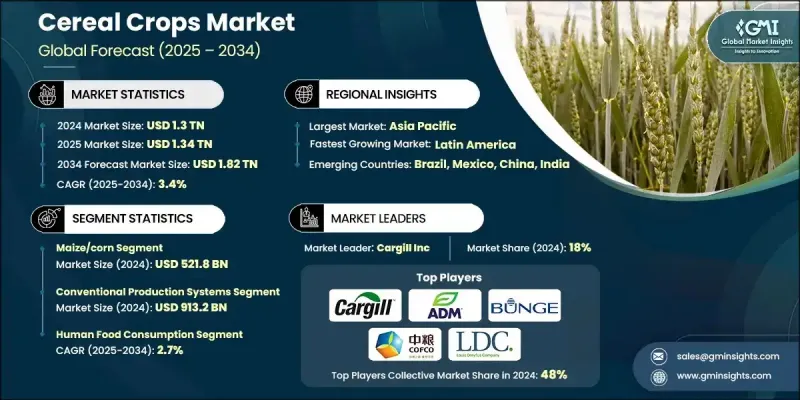
Growth in this sector is largely supported by rising global population, increasing demand for protein-rich diets, and the expanding use of cereals in industrial sectors. Technological advancements are significantly enhancing both productivity and sustainability. Research shows that cereal yields can increase by up to 20%, while inputs such as water and fertilizers may be reduced by as much as 30%. Innovations in precision farming, including the use of crop and soil sensors, smart machinery for controlled traffic farming, and AI-driven data platforms, help to optimize output while reducing operational costs. Biofuel developments are also playing a growing role, with cereal crop residues being tapped for cellulosic ethanol production. Government support for renewable energy policies is further reinforcing this shift. Additionally, cereal-based inputs are increasingly being used across the food processing, nutrition, and bio-based industrial materials sectors. The clean-label trend and shift to plant-derived alternatives are also contributing to the diversification of applications for cereals across multiple verticals.
| Market Scope | |
|---|---|
| Start Year | 2024 |
| Forecast Year | 2025-2034 |
| Start Value | $1.3 Trillion |
| Forecast Value | $1.82 Trillion |
| CAGR | 3.4% |
The maize, or corn segment generated USD 521.8 billion in 2024 and held a 40% share. This leadership is driven by corn's adaptability across food, feed, and industrial applications, backed by well-developed logistics and advanced seed genetics. The broad utility of maize makes it a key global staple, while rice and wheat continue to play critical roles as primary food sources across various regions. Barley and other grains cater to niche markets with specific demand, including beverages and specialty feed.
The conventional production systems segment generated USD 913.2 billion in 2024 and is projected to grow at a 3% CAGR through 2034. These systems remain the cornerstone of the cereal industry, offering reliable yields supported by consistent input use, including synthetic fertilizers and crop protection chemicals. Despite modest growth, their large-scale infrastructure and efficiency make them integral, although some regions are gradually transitioning to alternative and more sustainable models in response to environmental concerns.
Asia Pacific Cereal Crops Market held 47% share in 2024, driven by high domestic production and consumption. China reported a cereal output of 652.29 million tons, while India remains a top producer of rice and wheat. The region's dominance stems from its large population base, growing food requirements, and expanding livestock sector, which boosts the demand for feed grains. While internal consumption remains the focus, export capabilities vary significantly between nations and crop types.
Top companies shaping the Global Cereal Crops Market include Bunge Limited, Nestle, Cargill Inc, COFCO Corporation, Buhler, Agrovita Foods, Archer Daniels Midland Company, Verdesian Life Sciences, Lidea, Avani Seeds Ltd, and Louis Dreyfus Company. Leading players in the Cereal Crops Market are leveraging integrated strategies to solidify their global presence. This includes investment in precision agriculture technologies to boost crop yield and reduce input waste, alongside partnerships with agri-tech firms for digital farm management solutions. Companies are expanding R&D into drought-resistant and high-yield seed varieties to ensure crop performance under climate variability. Many are diversifying product portfolios to include biofuel and industrial-grade cereal derivatives, tapping into alternative revenue streams.
Table of Contents
Chapter 1 Methodology & Scope
- 1.1 Market scope and definition
- 1.2 Research design
- 1.2.1 Research approach
- 1.2.2 Data collection methods
- 1.3 Data mining sources
- 1.3.1 Global
- 1.3.2 Regional/Country
- 1.4 Base estimates and calculations
- 1.4.1 Base year calculation
- 1.4.2 Key trends for market estimation
- 1.5 Primary research and validation
- 1.5.1 Primary sources
- 1.6 Forecast model
- 1.7 Research assumptions and limitations
Chapter 2 Executive Summary
- 2.1 Industry 360° synopsis
- 2.2 Key market trends
- 2.2.1 Regional
- 2.2.2 Admixtures
- 2.2.3 Application Methods
- 2.2.4 Application
- 2.3 TAM Analysis, 2025-2034
- 2.4 CXO perspectives: strategic imperatives
- 2.4.1 Executive decision points
- 2.4.2 Critical success factors
- 2.5 Future Outlook and Strategic Recommendations
Chapter 3 Industry Insights
- 3.1 Industry ecosystem analysis
- 3.1.1 Supplier Landscape
- 3.1.2 Profit Margin
- 3.1.3 Value addition at each stage
- 3.1.4 Factor affecting the value chain
- 3.1.5 Disruptions
- 3.2 Industry impact forces
- 3.2.1 Growth drivers
- 3.2.1.1 Growing global population & food security demands
- 3.2.1.2 Rising demand from animal feed industry
- 3.2.1.3 Expanding biofuel & industrial applications
- 3.2.2 Industry pitfalls and challenges
- 3.2.2.1 Climate change & yield volatility challenges
- 3.2.2.2 Rising input costs (fertilizers, seeds, energy)
- 3.2.2.3 Stringent food safety & quality regulations
- 3.2.3 Market opportunities
- 3.2.3.1 Expansion into functional and fortified cereals
- 3.2.3.2 Adoption of climate-smart agriculture and digital farming tools
- 3.2.1 Growth drivers
- 3.3 Growth potential analysis
- 3.4 Regulatory landscape
- 3.4.1 North America
- 3.4.2 Europe
- 3.4.3 Asia Pacific
- 3.4.4 Latin America
- 3.4.5 Middle East & Africa
- 3.5 Porter's analysis
- 3.6 PESTEL analysis
- 3.6.1 Technology and Innovation Landscape
- 3.6.2 Current technological trends
- 3.6.3 Emerging technologies
- 3.7 Price trends
- 3.7.1 By region
- 3.7.2 By product
- 3.8 Future market trends
- 3.9 Patent Landscape
- 3.10 Trade statistics (HS code) (Note: the trade statistics will be provided for key countries only)
- 3.10.1 Major importing countries
- 3.10.2 Major exporting countries
- 3.11 Sustainability and environmental aspects
- 3.11.1 Sustainable practices
- 3.11.2 Waste reduction strategies
- 3.11.3 Energy efficiency in production
- 3.11.4 Eco-friendly initiatives
- 3.12 Carbon footprint considerations
Chapter 4 Competitive Landscape, 2024
- 4.1 Introduction
- 4.2 Company market share analysis
- 4.2.1 By region
- 4.2.1.1 North America
- 4.2.1.2 Europe
- 4.2.1.3 Asia Pacific
- 4.2.1.4 LATAM
- 4.2.1.5 MEA
- 4.2.1 By region
- 4.3 Company matrix analysis
- 4.4 Competitive analysis of major market players
- 4.5 Competitive positioning matrix
- 4.6 Key developments
- 4.6.1 Mergers & acquisitions
- 4.6.2 Partnerships & collaborations
- 4.6.3 New product launches
- 4.6.4 Expansion plans
Chapter 5 Market Estimates and Forecast, By Product Type, 2021 - 2034 (USD Billion) (Kilo Tons)
- 5.1 Key trends
- 5.2 Wheat & meslin
- 5.3 Maize/Corn
- 5.4 Rice
- 5.5 Barley
- 5.6 Other coarse grains
Chapter 6 Market Estimates and Forecast, By Production System, 2021 - 2034 (USD Billion) (Kilo Tons)
- 6.1 Key trends
- 6.2 Conventional production systems
- 6.3 Organic certified production
- 6.4 Genetically modified varieties
- 6.5 Precision agriculture systems
- 6.6 Identity preserved systems
Chapter 7 Market Estimates and Forecast, By Application, 2021 - 2034 (USD Billion) (Kilo Tons)
- 7.1 Key trends
- 7.2 Human food consumption
- 7.3 Animal feed
- 7.4 Industrial processing
- 7.5 Biofuel production
- 7.6 Seed production
Chapter 8 Market Estimates and Forecast, By Region, 2021 - 2034 (USD Billion) (Kilo Tons)
- 8.1 Key trends
- 8.2 North America
- 8.2.1 U.S.
- 8.2.2 Canada
- 8.3 Europe
- 8.3.1 Germany
- 8.3.2 UK
- 8.3.3 France
- 8.3.4 Spain
- 8.3.5 Italy
- 8.3.6 Rest of Europe
- 8.4 Asia Pacific
- 8.4.1 China
- 8.4.2 India
- 8.4.3 Japan
- 8.4.4 Australia
- 8.4.5 South Korea
- 8.4.6 Rest of Asia Pacific
- 8.5 Latin America
- 8.5.1 Brazil
- 8.5.2 Mexico
- 8.5.3 Rest of Latin America
- 8.6 Middle East and Africa
- 8.6.1 Saudi Arabia
- 8.6.2 South Africa
- 8.6.3 UAE
- 8.6.4 Rest of Middle East and Africa
Chapter 9 Company Profiles
- 9.1 Cargill Inc
- 9.2 Archer Daniels Midland Company
- 9.3 Bunge Limited
- 9.4 COFCO Corporation
- 9.5 Louis Dreyfus Company
- 9.6 Verdesian Life Sciences
- 9.7 Avani Seeds Ltd
- 9.8 Lidea
- 9.9 Buhler
- 9.10 Nestle
- 9.11 Agrovita Foods