

|
시장보고서
상품코드
1871126
식품폐기물 유래 생리활성 펩타이드 시장 : 기회, 성장 요인, 업계 동향 분석 및 예측(2025-2034년)Bioactive Peptide from Food Waste Market Opportunity, Growth Drivers, Industry Trend Analysis, and Forecast 2025 - 2034 |
||||||

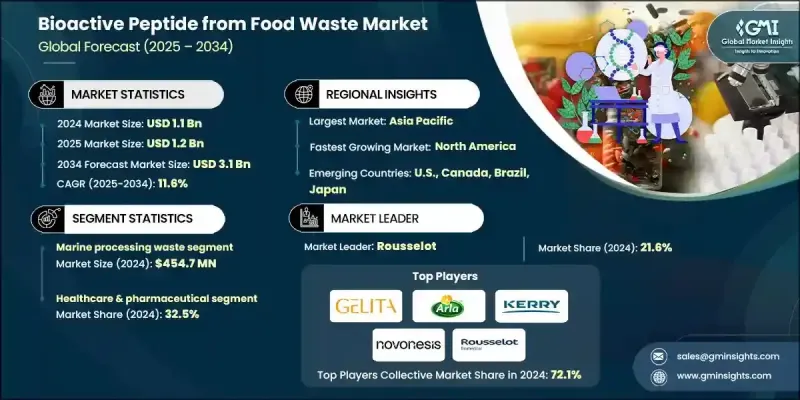
세계의 식품폐기물 유래 생리활성 펩타이드 시장은 2024년 11억 달러로 평가되었고, 2034년까지 연평균 복합 성장률(CAGR)은 11.6%를 나타낼 것으로 예측되며 31억 달러에 달할 전망입니다.
식품 가공 잔여물 및 폐기 원료에서 추출한 생리활성 펩타이드가 기능성 식품, 의약품, 건강기능식품 등 건강 증진 제품 개발에 점점 더 활용되고 있습니다. 지속가능성과 환경 보호에 대한 관심이 높아지면서 산업계는 순환경제 목표에 부합하는 폐기물 가치화 전략을 채택하고 있습니다. 전 세계 정부는 식품 폐기물 감축 및 부가가치 제품 전환을 촉진하기 위한 지원 규제를 도입하고 있습니다. 효소 가수분해 및 첨단 친환경 기술과 같은 친환경 추출 방법의 사용은 수율 향상, 순도 개선, 환경 영향 저감을 통해 이러한 펩타이드 생산 방식을 변화시키고 있습니다. 이러한 혁신은 소비자들의 클린 라벨 및 지속가능성 선호와 부합하여 수요를 촉진하고 있습니다. 식품 폐기물 유래 생리활성 펩타이드들은 항산화, 항균, 항염증 활성과 같은 입증된 건강 증진 특성으로 인해 기능성 식품 응용 부문에서 주목받고 있습니다. 예방 건강에 대한 소비자 인식이 높아짐에 따라 제조업체들은 자연적이고 효과적인 웰니스 솔루션에 대한 증가하는 수요를 충족시키기 위해 첨단 제형을 개발하고 있습니다.
| 시장 범위 | |
|---|---|
| 시작 연도 | 2024년 |
| 예측 기간 | 2025-2034년 |
| 시작 금액 | 11억 달러 |
| 예측 금액 | 31억 달러 |
| CAGR | 11.6% |
수산 가공 폐기물 부문은 2024년 4억 5,470만 달러의 수익을 창출했습니다. 어류, 양식 및 어패류의 잔여물로 구성된 이 범주는 생리활성 분자를 풍부하게 포함하여 고순도 펩타이드 생산의 중요한 원료원이 되고 있습니다. 이러한 화합물은 높은 영양가와 치료 효과의 가능성으로 인해 영양 보충제, 화장품, 기능성 식품 등의 산업에서 점점 더 많이 활용되고 있습니다.
의료 및 의약품 부문는 2024년에 32.5%의 점유율을 차지했습니다. 이러한 우위는 만성 질환 관리를 목표로 한 신약 개발, 의료 영양제, 임상 제형에 생리활성 펩타이드 사용이 증가함에 기인합니다. 고령 인구와 건강 중심 소비자들의 수요 증가로 항염증, 항고혈압, 항산화 효과를 지닌 생리활성 화합물의 채택이 더욱 강화되었습니다.
북미의 식품 폐기물 기반 생리활성 펩타이드 시장은 2025-2034년에 CAGR 11.5%로 확대될 전망입니다. 시장 성장은 천연, 건강, 지속 가능한 식품 원료에 대한 선호도 증가에 힘입고 있습니다. 건강을 중시하는 소비자들이 기능성 식품, 보충제, 기능성 의약품을 점점 더 찾으면서, 해당 지역 제조업체들은 식품 및 음료 혁신에 생리활성 펩타이드 통합을 위한 투자를 확대하고 있습니다.
식품 폐기물 시장에서 생리활성 펩타이드의 주요 기업으로는 Arla Foods Ingredients Group, DSM-Firmenich, Fonterra(NZMP), GELITA, Glanbia plc, Kerry Group plc, Novonesis, PB Leiner, Lussel, Tessenderlo Group이 있습니다. 기업들은 시장 입지를 강화하기 위해 전략적 협력, 지속 가능한 제품 혁신, 첨단 추출 기술에 주력하고 있습니다. 주요 제조업체들은 펩타이드 품질 향상과 환경 영향 최소화를 위해 친환경 생산 방식에 투자하고 있습니다. 많은 기업들이 건강 중심 응용 부문를 겨냥한 제품 포트폴리오 확장을 위해 연구개발 역량을 강화하고 있습니다. 식품 가공업체 및 바이오테크 기업과의 파트너십을 통해 폐기물 자원의 효율적 활용도 가능해지고 있습니다. 또한 시장 참여자들은 친환경 의식이 높은 소비자를 유치하기 위해 지속 가능성과 클린 라벨(Clean Label) 주장을 중심으로 한 브랜딩 전략을 채택하고 있습니다.
자주 묻는 질문
목차
제1장 조사 방법과 범위
제2장 주요 요약
제3장 업계 인사이트
- 생태계 분석
- 공급자의 상황
- 이익률
- 각 단계에서의 부가가치
- 밸류체인에 영향을 주는 요인
- 혁신
- 업계에 미치는 영향요인
- 성장 촉진요인
- 순환 경제 및 폐기물 가치화 부각
- 천연 및 클린 라벨 원료에 대한 수요 증가
- 식품 폐기물 활용 지원 규제 체계
- 업계의 잠재적 억제요인 및 과제
- 폐기물 유래 원료에 대한 소비자 인식 문제
- 품질관리와 오염관리
- 시장 기회
- 신흥 시장의 미개발 식품 폐기물 흐름
- 맞춤형 영양 트렌드와의 통합
- 성장 촉진요인
- 성장 가능성 분석
- 규제 상황
- 북미
- 유럽
- 아시아태평양
- 라틴아메리카
- 중동 및 아프리카
- Porter's Five Forces 분석
- PESTEL 분석
- 기술과 혁신의 상황
- 현재의 기술 동향
- 신흥기술
- 가격 동향
- 지역별
- 소스별
- 장래 시장 동향
- 특허 상황
- 무역 통계(HS코드)(참고 : 무역 통계는 주요 국가에서만 제공됨)
- 주요 수입국
- 주요 수출국
- 지속가능성과 환경면
- 지속가능한 대처
- 폐기물 감축 전략
- 생산에서의 에너지 효율
- 환경에 배려한 대처
- 탄소발자국 고려 사항
제4장 경쟁 구도
- 소개
- 기업의 시장 점유율 분석
- 지역별
- 북미
- 유럽
- 아시아태평양
- 라틴아메리카
- 중동 및 아프리카
- 지역별
- 기업 매트릭스 분석
- 주요 시장 기업의 경쟁 분석
- 경쟁 포지셔닝 매트릭스
- 주요 발전
- 합병 및 인수
- 제휴 및 협업
- 신제품 발매
- 확대 계획
제5장 시장 추계 및 예측 : 원천별(2021-2034년)
- 주요 동향
- 유제품 폐기물
- 유청 가공 잔류물
- 치즈 제조 제품별
- 유가공 폐기물
- 육류 가공 제품별
- 혈액 및 혈장 분획
- 가죽 가공 폐기물
- 뼈 및 연골 잔류물
- 내장육 가공 제품별
- 수산 가공 폐기물
- 어류 가공 잔류물
- 어패류 가공 제품별
- 양식 폐기물류
- 식물성 단백질 잔류물
- 지방종자 가공 잔류물
- 곡물 가공 제품별
- 콩류 가공 잔류물
- 과일 및 야채 가공 폐기물
제6장 시장 추계 및 예측 : 최종 이용 산업별(2021-2034년)
- 주요 동향
- 의료 및 의약품
- 기능성 식품 및 영양보조식품
- 치료제 개발
- 의료용 영양 제품
- 임상 연구 및 개발
- 일반 의약품(OTC 의약품)
- 식품 및 음료
- 기능성 식품 원료
- 단백질 강화
- 천연 보존료
- 풍미 증강제
- 발효 제품
- 음료 영양 강화
- 퍼스널케어 및 화장품
- 안티 에이징 스킨 케어
- 보습 및 수분 보급
- 헤어 케어 및 두피 건강
- 상처 케어 및 치유
- 자외선 차단
- 남성용 그루밍
- 동물사료 및 영양
- 수산 사료
- 가축용 사료 첨가물
- 반려동물 식품 및 간식
- 가금 사료
- 돼지 사료
- 반추동물 사료
- 농업 및 생명공학
- 바이오 자극제
- 식물 성장 촉진제
- 토양 건강 증진
- 작물 보호
- 종자 처리제
- 스포츠 영양 및 피트니스
- 운동 전 보충제
- 운동 후 회복
- 단백질 파우더
- 에너지 바 및 스낵
- 수분 보급 제품
제7장 시장 추계 및 예측 : 지역별(2021-2034년)
- 주요 동향
- 북미
- 미국
- 캐나다
- 유럽
- 독일
- 영국
- 프랑스
- 스페인
- 이탈리아
- 기타 유럽
- 아시아태평양
- 중국
- 인도
- 일본
- 호주
- 한국
- 기타 아시아태평양
- 라틴아메리카
- 브라질
- 멕시코
- 아르헨티나
- 기타 라틴아메리카
- 중동 및 아프리카
- 사우디아라비아
- 남아프리카
- 아랍에미리트(UAE)
- 기타 중동 및 아프리카
제8장 기업 프로파일
- Arla Foods Ingredients Group
- DSM-Firmenich
- Fonterra(NZMP)
- GELITA
- Glanbia plc
- Kerry Group plc
- Novonesis
- PB Leiner
- Rousselot
- Tessenderlo Group
The Global Bioactive Peptide from Food Waste Market was valued at USD 1.1 Billion in 2024 and is estimated to grow at a CAGR of 11.6% to reach USD 3.1 Billion by 2034.
Bioactive peptides obtained from food processing residues and discarded raw materials are increasingly being utilized to develop health-promoting products, including nutraceuticals, pharmaceuticals, and functional foods. Growing attention toward sustainability and environmental protection has encouraged industries to adopt waste valorization strategies that align with circular economy goals. Governments across the world are introducing supportive regulations to promote food waste reduction and its conversion into value-added products. The use of eco-friendly extraction methods, such as enzymatic hydrolysis and advanced green technologies, is transforming the production of these peptides by enhancing yield, improving purity, and lowering environmental impact. These innovations are driving demand as they align with clean-label and sustainability preferences among consumers. Bioactive peptides from food waste are gaining traction in functional food applications due to their proven health-promoting properties, such as antioxidant, antimicrobial, and anti-inflammatory activities. Rising consumer awareness around preventive health has motivated manufacturers to develop advanced formulations that cater to the growing demand for natural and effective wellness solutions.
| Market Scope | |
|---|---|
| Start Year | 2024 |
| Forecast Year | 2025-2034 |
| Start Value | $1.1 Billion |
| Forecast Value | $3.1 Billion |
| CAGR | 11.6% |
The marine processing waste segment generated USD 454.7 million in 2024. This category, comprising fish, aquaculture, and shellfish residues, is rich in bioactive molecules, making it an essential source for high-purity peptide production. These compounds are increasingly used in industries such as nutraceuticals, cosmetics, and functional foods because of their high nutritional and therapeutic potential.
The healthcare and pharmaceutical segment accounted for a 32.5% share in 2024. This dominance is attributed to the growing use of bioactive peptides in drug development, medical nutrition, and clinical formulations aimed at managing chronic diseases. Increasing demand from aging populations and health-focused consumers has further strengthened the adoption of bioactive compounds with anti-inflammatory, antihypertensive, and antioxidant effects.
North America Bioactive Peptide from Food Waste Market will grow at a CAGR of 11.5% between 2025 and 2034. Market growth is supported by the rising preference for natural, healthy, and sustainable food ingredients. As health-conscious consumers increasingly seek functional foods, supplements, and nutraceutical products, manufacturers in the region are investing in bioactive peptide integration within food and beverage innovations.
Leading companies operating in Bioactive Peptide from Food Waste Market include Arla Foods Ingredients Group, DSM-Firmenich, Fonterra (NZMP), GELITA, Glanbia plc, Kerry Group plc, Novonesis, PB Leiner, Rousselot, and Tessenderlo Group. Companies are focusing on strategic collaborations, sustainable product innovations, and advanced extraction technologies to enhance their market presence. Leading manufacturers are investing in green production methods to improve peptide quality and minimize environmental impact. Many firms are strengthening their R&D capabilities to expand product portfolios catering to health-focused applications. Partnerships with food processors and biotech firms are also enabling efficient utilization of waste materials. Additionally, market players are adopting branding strategies centered on sustainability and clean-label claims to attract eco-conscious consumers.
Table of Contents
Chapter 1 Methodology & Scope
- 1.1 Market scope and definition
- 1.2 Research design
- 1.2.1 Research approach
- 1.2.2 Data collection methods
- 1.3 Data mining sources
- 1.3.1 Global
- 1.3.2 Regional/Country
- 1.4 Base estimates and calculations
- 1.4.1 Base year calculation
- 1.4.2 Key trends for market estimation
- 1.5 Primary research and validation
- 1.5.1 Primary sources
- 1.6 Forecast model
- 1.7 Research assumptions and limitations
Chapter 2 Executive Summary
- 2.1 Industry 3600 synopsis
- 2.2 Key market trends
- 2.2.1 Source trends
- 2.2.2 End use industry trends
- 2.2.3 Regional trends
- 2.3 TAM Analysis, 2025-2034
- 2.4 CXO perspectives: strategic imperatives
- 2.4.1 Executive decision points
- 2.4.2 Critical success factors
- 2.5 Future outlook and strategic recommendations
Chapter 3 Industry Insights
- 3.1 Industry ecosystem analysis
- 3.1.1 Supplier landscape
- 3.1.2 Profit margin
- 3.1.3 Value addition at each stage
- 3.1.4 Factor affecting the value chain
- 3.1.5 Disruptions
- 3.2 Industry impact forces
- 3.2.1 Growth drivers
- 3.2.1.1 Growing focus on circular economy & waste valorization
- 3.2.1.2 Rising demand for natural & clean-label ingredients
- 3.2.1.3 Supportive regulatory framework for food waste utilization
- 3.2.2 Industry pitfalls and challenges
- 3.2.2.1 Consumer perception issues with waste-derived ingredients
- 3.2.2.2 Quality control & contamination management
- 3.2.3 Market opportunities
- 3.2.3.1 Untapped food waste streams in emerging markets
- 3.2.3.2 Integration with personalized nutrition trends
- 3.2.1 Growth drivers
- 3.3 Growth potential analysis
- 3.4 Regulatory landscape
- 3.4.1 North America
- 3.4.2 Europe
- 3.4.3 Asia Pacific
- 3.4.4 Latin America
- 3.4.5 Middle East & Africa
- 3.5 Porter's analysis
- 3.6 PESTEL analysis
- 3.7 Technology and Innovation landscape
- 3.7.1 Current technological trends
- 3.7.2 Emerging technologies
- 3.8 Price trends
- 3.8.1 By region
- 3.8.2 By source
- 3.9 Future market trends
- 3.10 Patent Landscape
- 3.11 Trade statistics (HS code) ( Note: the trade statistics will be provided for key countries only)
- 3.11.1 Major importing countries
- 3.11.2 Major exporting countries
- 3.12 Sustainability and environmental aspects
- 3.12.1 Sustainable practices
- 3.12.2 Waste reduction strategies
- 3.12.3 Energy efficiency in production
- 3.12.4 Eco-friendly initiatives
- 3.13 Carbon footprint consideration
Chapter 4 Competitive Landscape, 2024
- 4.1 Introduction
- 4.2 Company market share analysis
- 4.2.1 By region
- 4.2.1.1 North America
- 4.2.1.2 Europe
- 4.2.1.3 Asia Pacific
- 4.2.1.4 LATAM
- 4.2.1.5 MEA
- 4.2.1 By region
- 4.3 Company matrix analysis
- 4.4 Competitive analysis of major market players
- 4.5 Competitive positioning matrix
- 4.6 Key developments
- 4.6.1 Mergers & acquisitions
- 4.6.2 Partnerships & collaborations
- 4.6.3 New product launches
- 4.6.4 Expansion plans
Chapter 5 Market Estimates and Forecast, By Source, 2021-2034 (USD Million) (Kilo Tons)
- 5.1 Key trends
- 5.2 Dairy waste streams
- 5.2.1 Whey processing residues
- 5.2.2 Cheese manufacturing byproducts
- 5.2.3 Milk processing waste
- 5.3 Meat processing byproducts
- 5.3.1 Blood & plasma fractions
- 5.3.2 Skin & hide processing waste
- 5.3.3 Bone & cartilage residues
- 5.3.4 Organ meat processing byproducts
- 5.4 Marine processing waste
- 5.4.1 Fish processing residues
- 5.4.2 Shellfish processing byproducts
- 5.4.3 Aquaculture waste streams
- 5.5 Plant protein residues
- 5.5.1 Oilseed processing meals
- 5.5.2 Grain processing byproducts
- 5.5.3 Pulse processing residues
- 5.5.4 Fruit & vegetable processing waste
Chapter 6 Market Estimates and Forecast, By End Use Industry, 2021-2034 (USD Million) (Kilo Tons)
- 6.1 Key trends
- 6.2 Healthcare & pharmaceutical
- 6.2.1 Nutraceutical & dietary supplement
- 6.2.2 Therapeutic drug development
- 6.2.3 Medical nutrition
- 6.2.4 Clinical research & development
- 6.2.5 Over-the-counter (OTC) medicine
- 6.3 Food & beverage
- 6.3.1 Functional food ingredient
- 6.3.2 Protein fortification
- 6.3.3 Natural preservative
- 6.3.4 Flavor enhancement
- 6.3.5 Fermented product
- 6.3.6 Beverage fortification
- 6.4 Personal care & cosmetics
- 6.4.1 Anti-aging skincare
- 6.4.2 Moisturizing & hydration
- 6.4.3 Hair care & scalp health
- 6.4.4 Wound care & healing
- 6.4.5 Sun protection
- 6.4.6 Men's grooming
- 6.5 Animal feed & nutrition
- 6.5.1 Aquaculture feed
- 6.5.2 Livestock feed supplement
- 6.5.3 Pet food & treats
- 6.5.4 Poultry feed
- 6.5.5 Swine feed
- 6.5.6 Ruminant feed
- 6.6 Agriculture & biotechnology
- 6.6.1 Bio-stimulant
- 6.6.2 Plant growth promoter
- 6.6.3 Soil health enhancement
- 6.6.4 Crop protection
- 6.6.5 Seed treatment
- 6.7 Sports nutrition & fitness
- 6.7.1 Pre-workout supplement
- 6.7.2 Post-workout recovery
- 6.7.3 Protein powder
- 6.7.4 Energy bar & snack
- 6.7.5 Hydration product
Chapter 7 Market Estimates and Forecast, By Region, 2021-2034 (USD Million) (Kilo Tons)
- 7.1 Key trends
- 7.2 North America
- 7.2.1 U.S.
- 7.2.2 Canada
- 7.3 Europe
- 7.3.1 Germany
- 7.3.2 UK
- 7.3.3 France
- 7.3.4 Spain
- 7.3.5 Italy
- 7.3.6 Rest of Europe
- 7.4 Asia Pacific
- 7.4.1 China
- 7.4.2 India
- 7.4.3 Japan
- 7.4.4 Australia
- 7.4.5 South Korea
- 7.4.6 Rest of Asia Pacific
- 7.5 Latin America
- 7.5.1 Brazil
- 7.5.2 Mexico
- 7.5.3 Argentina
- 7.5.4 Rest of Latin America
- 7.6 Middle East and Africa
- 7.6.1 Saudi Arabia
- 7.6.2 South Africa
- 7.6.3 UAE
- 7.6.4 Rest of Middle East and Africa
Chapter 8 Company Profiles
- 8.1 Arla Foods Ingredients Group
- 8.2 DSM-Firmenich
- 8.3 Fonterra (NZMP)
- 8.4 GELITA
- 8.5 Glanbia plc
- 8.6 Kerry Group plc
- 8.7 Novonesis
- 8.8 PB Leiner
- 8.9 Rousselot
- 8.10 Tessenderlo Group


