|
시장보고서
상품코드
1871127
나트륨 이온 배터리용 화학물질 시장 : 기회, 성장 요인, 업계 동향 분석 및 예측(2025-2034년)Sodium-Ion Battery Chemicals Market Opportunity, Growth Drivers, Industry Trend Analysis, and Forecast 2025 - 2034 |
||||||

세계의 나트륨 이온 배터리용 화학물질 시장은 2024년 1억 5,000만 달러로 평가되었고, 2034년까지 연평균 복합 성장률(CAGR)은 55%를 나타낼 것으로 예측되며 85억 달러에 달할 전망입니다.
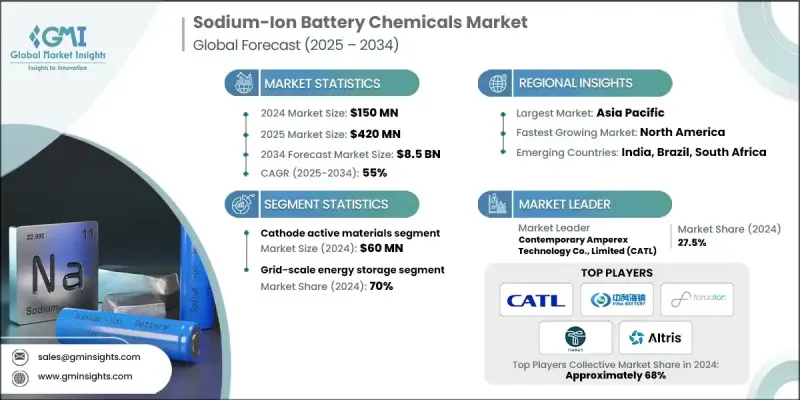
이 시장의 급속한 성장은 풍부한 코발트 프리 소재와 최적화된 전해질-음극 조합에 기반한 나트륨 이온 시스템의 비용 효율성에 힘입은 것입니다. 산업 및 전력망 규모 사용자들은 킬로와트시당 비용, 사이클 수명, 안전성을 우선시하며, 이로 인해 나트륨 이온 화학은 해당 부문에서 특히 매력적입니다. 이동성 응용 부문는 부피당 에너지 제약으로 인해 여전히 신중한 태도를 유지하고 있으며, 에너지 밀도가 200Wh/kg을 초과할 때 광범위한 채택이 예상됩니다. 지역 정책 또한 핵심적인 역할을 합니다 : EU는 재활용성과 수명 종료 관리를 강조하며 나트륨 중심 화학물질을 지원하고, 중국의 제14차 5개년 계획 하 산업 전략은 국내 시범 사업 및 소재 규모 확대를 가속화합니다. 전력망 중심의 채택은 전해질 및 첨가제를 비롯한 상류 화학물질에 대한 예측 가능한 수요를 보장하며, 성능 개선, 비용 절감, 양극 혁신은 산업용, 전력망, 특정 모빌리티 틈새시장에서의 시장 입지를 강화합니다.
| 시장 범위 | |
|---|---|
| 시작 연도 | 2024년 |
| 예측 연도 | 2025-2034년 |
| 시작 금액 | 1억 5,000만 달러 |
| 예측 금액 | 85억 달러 |
| CAGR | 55% |
양극 활성 물질 부문은 2024년 6,000만 달러를 창출했습니다. 에너지 밀도와 수명 주기 성능에서 핵심적인 역할을 수행하기 때문에 가장 큰 가치 점유율을 차지하며, 양극 재료는 약 30%를 차지하고 나머지는 보조 화학물질 및 기타 재료에 해당합니다. 초기 세대 나트륨 이온 전지는 약 175Wh/kg의 에너지 밀도를 제공하며, 나트륨 바나듐 인산염 및 나시콘(NASICON) 양극재의 발전으로 2027년까지 에너지 밀도가 200Wh/kg 이상으로 향상될 것으로 예상됩니다. 양극 혁신은 Wh/kg 증가를 주도하는 반면, 경질 탄소 음극은 초기 사이클 효율과 장기 용량 유지율을 개선합니다.
2024년 기준 그리드 규모 에너지 저장 부문은 70% 점유율(1억 500만 달러 규모)을 차지했습니다. 나트륨 이온 배터리는 재생에너지 통합 및 부하 평준화를 위한 비용 효율적이고 열 안전성이 우수한 솔루션을 제공합니다. 또한 경제성과 안전성이 부피당 에너지 밀도 요구사항보다 중요한 저속 전기차 시장에서도 점유율을 확대하고 있습니다.
북미의 나트륨 이온 배터리용 화학물질 시장은 2024년 1,800만 달러에 이르렀습니다. 연방정부에 의한 연구개발 및 상업화에 대한 자금원조와 산업용 및 데이터센터용도를 타겟으로 한 민간자본투자가 주요한 성장요인입니다. 미국 정부 기관의 이니셔티브는 대체 화학 기술의 확장에 많은 자원을 투입하고 있습니다. 특히 노스캐롤라이나와 미시간의 제조 프로젝트는 산업용 UPS, 그리드 서비스 및 통신 용도에 대한 조기 도입을 부각하고 있습니다. 북미는 강력한 공급업체 생태계의 혜택을 누리고 있으며 캐나다는 국내 재료 기반과 지리적 이점을 활용합니다.
나트륨 이온 배터리용 화학물질 시장의 주요 기업으로는 TIAMAT SAS, HiNa Battery Technology Co., Ltd., Altris AB, Contemporary Amperex Technology Co., Limited(CATL), Faradion(Reliance) 등이 있습니다. 기업들은 에너지 밀도와 사이클 수명 향상을 위해 양극 및 음극 화학 기술 발전에 주력하며, 나트륨 이온 배터리의 모빌리티 적용 가능성을 목표로 하고 있습니다. 전력망 운영사 및 산업 최종 사용자와의 전략적 파트너십은 예측 가능한 수요 확보와 도입 가속화에 기여합니다. 기업들은 전해질 조성 및 안전 첨가제 개선을 위한 R&D에 대규모 투자하여 제품 차별화를 도모하고 있습니다. 생산 능력 확대와 현지화 생산은 공급망 리스크를 줄이고 시장 출시 기간을 단축합니다. 기업들은 정부 인센티브와 자금 지원 프로그램을 활용해 상용화와 시범 프로젝트를 가속화합니다. 학술 기관 및 소재 공급업체와의 협업은 혁신을 지원합니다. 또한 마케팅 활동은 안전성, 지속가능성, 비용 경쟁력을 강조하여 전력망, 산업, 틈새 모빌리티 부문 전반에서 브랜드 포지셔닝을 강화하고 고객 신뢰를 구축합니다.
자주 묻는 질문
목차
제1장 조사 방법
- 시장 범위와 정의
- 조사 설계
- 조사 접근
- 데이터 수집 방법
- 데이터 마이닝 소스
- 세계
- 지역별/국가별
- 기본 추정치와 계산
- 기준연도 계산
- 시장 추정에서의 주요 동향
- 1차 조사 및 검증
- 1차 정보
- 예측 모델
- 조사의 전제조건과 제한 사항
제2장 주요 요약
제3장 업계 인사이트
- 생태계 분석
- 공급자의 상황
- 이익률
- 각 단계에서의 부가가치
- 밸류체인에 영향을 주는 요인
- 혁신
- 업계에 미치는 영향요인
- 성장 촉진요인
- 업계의 잠재적 억제요인 및 과제
- 공급망의 복잡성
- 시장 기회
- 성장 가능성 분석
- 규제 상황
- 북미
- 유럽
- 아시아태평양
- 라틴아메리카
- 중동 및 아프리카
- Porter's Five Forces 분석
- PESTEL 분석
- 가격 동향
- 지역별
- 유효성분별
- 장래 시장 동향
- 기술과 혁신의 상황
- 현재의 기술 동향
- 신흥기술
- 특허 상황
- 무역 통계(주 : 무역 통계는 주요 국가에서만 제공됨)
- 주요 수입국
- 주요 수출국
- 지속가능성과 환경적 측면
- 지속가능한 실천
- 폐기물 감축 전략
- 생산에서의 에너지 효율
- 환경에 배려한 대처
- 탄소발자국에 관한 고려 사항
제4장 경쟁 구도
- 소개
- 기업의 시장 점유율 분석
- 지역별
- 북미
- 유럽
- 아시아태평양
- 라틴아메리카
- 중동 및 아프리카
- 지역별
- 기업 매트릭스 분석
- 주요 시장 기업의 경쟁 분석
- 경쟁 포지셔닝 매트릭스
- 주요 발전
- 합병 및 인수
- 제휴 및 협력관계
- 신제품 발매
- 사업 확대 계획
제5장 시장 추계 및 예측 : 활성 물질 유형별(2021-2034년)
- 주요 동향
- 양극 활성 물질
- 층상 전이 금속 산화물(TMLO)
- 나시콘 기반 재료
- 플루시안 블루 유사체(PBA)
- 폴리음이온 화합물
- 음극 활성 물질
- 경질 탄소 재료
- 바이오매스 기반 경질 탄소
- 석유 코크스 기반 경질 탄소
- 합성 경질 탄소
- 티타늄 기반 음극 재료
- 신흥 음극 재료
- 기타
제6장 시장 추계 및 예측 : 보조 재료별(2021-2034년)
- 주요 동향
- 전해질 재료
- 나트륨염
- 과염소산나트륨(NaClO4)
- 고급 나트륨염
- 유기용제
- 탄산염 용제(EC, DMC, PC, EMC)
- 대체 용제 시스템
- 전해질 첨가제
- 피막 형성 첨가제(FEC, VC)
- 특수 성능 첨가제
- 바인더 재료
- 카르복시메틸셀룰로오스나트륨(Na-CMC)
- 폴리불화비닐리덴(PVDF)
- 대체 바인더 시스템
- 전도성 첨가제
- 카본블랙
- 선진 전도성 재료
- 기타 재료
제7장 시장 추계 및 예측 : 용도별(2021-2034년)
- 주요 동향
- 그리드 규모 에너지 저장 용도
- 유틸리티 규모 저장 시스템(10MW 초과)
- 재생에너지 통합 시스템
- EV 급속 충전 인프라
- 운송 용도
- 전기자동차 시스템
- 특수 운송
- 산업 및 상업 용도
- 데이터센터용 UPS 시스템
- 산업용 백업 전원
- 통신 인프라
- 기타 용도
제8장 시장 추계 및 예측 : 지역별(2021-2034년)
- 주요 동향
- 북미
- 미국
- 캐나다
- 유럽
- 독일
- 영국
- 프랑스
- 이탈리아
- 스페인
- 기타 유럽
- 아시아태평양
- 중국
- 인도
- 일본
- 호주
- 한국
- 기타 아시아태평양
- 라틴아메리카
- 브라질
- 멕시코
- 아르헨티나
- 기타 라틴아메리카
- 중동 및 아프리카
- 사우디아라비아
- 남아프리카
- 아랍에미리트(UAE)
- 기타 중동 및 아프리카
제9장 기업 프로파일
- Contemporary Amperex Technology Co., Limited(CATL)
- HiNa Battery Technology Co., Ltd.
- Faradion Limited(acquired by Reliance Industries)
- TIAMAT SAS
- Altris AB
- Kuraray Co., Ltd.
- Sumitomo Bakelite Co., Ltd.
- BTR New Material Group Co., Ltd.
- Shengquan Group Co., Ltd.
- Kureha Corporation
- Tinci Materials Technology Co., Ltd.
- DFD New Energy Materials Co., Ltd.
- CAPCHEM Technology Co., Ltd.
- YONGTA Chemical Technology Co., Ltd.
- RTXC New Energy Technology Co., Ltd.
- NGK Insulators, Ltd.
- AMTE Power plc
- MSE Supplies LLC
- MTI
- XTL Corporation
- NATRIUM Energy Technology Co., Ltd.
The Global Sodium-Ion Battery Chemicals Market was valued at USD 150 million in 2024 and is estimated to grow at a CAGR of 55% to reach USD 8.5 Billion by 2034.
The market's rapid growth is fueled by the cost-effectiveness of sodium-ion systems, which rely on abundant, cobalt-free materials and optimized electrolyte-cathode pairings. Industrial and grid-scale users prioritize cost per kilowatt-hour, cycle life, and safety, which makes sodium-ion chemistry particularly attractive in these sectors. Mobility applications remain cautious due to volumetric energy constraints, with wider adoption expected once energy densities surpass 200 Wh/kg. Regional policies also play a key role: the EU emphasizes recyclability and end-of-life management, supporting sodium-heavy chemistries, while China's industrial strategy under the 14th Five-Year Plan accelerates domestic pilots and materials scale-up. Grid-focused adoption ensures predictable demand for upstream chemicals, particularly electrolytes and additives, while performance improvements, cost reductions, and cathode innovations strengthen the market foothold in industrial, grid, and select mobility niches.
| Market Scope | |
|---|---|
| Start Year | 2024 |
| Forecast Year | 2025-2034 |
| Start Value | $150 Million |
| Forecast Value | $8.5 Billion |
| CAGR | 55% |
The cathode active materials segment generated USD 60 million in 2024. They hold the largest value share due to their critical role in energy density and lifecycle performance, while anode materials account for roughly 30%, with the remainder in supporting chemicals and other materials. Early-generation sodium-ion cells deliver about 175 Wh/kg, with advancements in sodium vanadium phosphate and NASICON cathodes expected to push energy density above 200 Wh/kg by 2027. Cathode innovation drives the greatest Wh/kg gains, while hard carbon anodes improve first-cycle efficiency and long-term capacity retention.
The grid-scale energy storage segment held a 70% share, valued at USD 105 million in 2024. Sodium-ion batteries offer cost-efficient and thermally safe solutions for renewable energy integration and load-leveling. Additionally, they are gaining traction in low-speed electric vehicles, where affordability and safety outweigh volumetric energy density requirements.
North America Sodium-Ion Battery Chemicals Market reached USD 18 million in 2024. Federal funding for R&D and commercialization, along with private capital investment targeting industrial and data center applications, are key growth drivers. Initiatives by U.S. government agencies funnel substantial resources into scaling alternative chemistries. Manufacturing projects, particularly in North Carolina and Michigan, highlight early adoption in industrial UPS, grid services, and telecom applications. North America benefits from a strong supplier ecosystem, while Canada leverages its domestic materials base and geographic advantages.
Key players in the Sodium-Ion Battery Chemicals Market include TIAMAT SAS, HiNa Battery Technology Co., Ltd., Altris AB, Contemporary Amperex Technology Co., Limited (CATL), Faradion (Reliance), and others. Companies are focusing on advancing cathode and anode chemistries to increase energy density and cycle life, aiming to make sodium-ion viable for mobility applications. Strategic partnerships with grid operators and industrial end-users help secure predictable demand and accelerate adoption. Firms are investing heavily in R&D to enhance electrolyte formulations and safety additives, which differentiate their offerings. Expanding manufacturing capacity and localizing production reduces supply chain risks and shortens time-to-market. Companies leverage government incentives and funding programs to accelerate commercialization and pilot projects. Collaborations with academic institutions and material suppliers support innovation. Additionally, marketing efforts emphasize safety, sustainability, and cost advantages to strengthen brand positioning and build customer trust across grid, industrial, and niche mobility segments.
Table of Contents
Chapter 1 Methodology
- 1.1 Market scope and definition
- 1.2 Research design
- 1.2.1 Research approach
- 1.2.2 Data collection methods
- 1.3 Data mining sources
- 1.3.1 Global
- 1.3.2 Regional/Country
- 1.4 Base estimates and calculations
- 1.4.1 Base year calculation
- 1.4.2 Key trends for market estimation
- 1.5 Primary research and validation
- 1.5.1 Primary sources
- 1.6 Forecast model
- 1.7 Research assumptions and limitations
Chapter 2 Executive Summary
- 2.1 Industry 360° synopsis
- 2.2 Key market trends
- 2.2.1 Regional
- 2.2.2 Active Material Type
- 2.2.3 Supporting Materials
- 2.2.4 Application
- 2.3 TAM Analysis, 2025-2034
- 2.4 CXO perspectives: Strategic imperatives
- 2.4.1 Executive decision points
- 2.4.2 Critical success factors
- 2.5 Future Outlook and Strategic Recommendations
Chapter 3 Industry Insights
- 3.1 Industry ecosystem analysis
- 3.1.1 Supplier Landscape
- 3.1.2 Profit Margin
- 3.1.3 Value addition at each stage
- 3.1.4 Factor affecting the value chain
- 3.1.5 Disruptions
- 3.2 Industry impact forces
- 3.2.1 Growth drivers
- 3.2.2 Industry pitfalls and challenges
- 3.2.2.1 Supply chain complexity
- 3.2.3 Market opportunities
- 3.3 Growth potential analysis
- 3.4 Regulatory landscape
- 3.4.1 North America
- 3.4.2 Europe
- 3.4.3 Asia Pacific
- 3.4.4 Latin America
- 3.4.5 Middle East & Africa
- 3.5 Porter's analysis
- 3.6 PESTEL analysis
- 3.7 Price trends
- 3.7.1 By region
- 3.7.2 By active material
- 3.8 Future market trends
- 3.9 Technology and Innovation landscape
- 3.9.1 Current technological trends
- 3.9.2 Emerging technologies
- 3.10 Patent Landscape
- 3.11 Trade statistics (Note: the trade statistics will be provided for key countries only)
- 3.11.1 Major importing countries
- 3.11.2 Major exporting countries
- 3.12 Sustainability and Environmental Aspects
- 3.12.1 Sustainable Practices
- 3.12.2 Waste Reduction Strategies
- 3.12.3 Energy Efficiency in Production
- 3.12.4 Eco-friendly Initiatives
- 3.13 Carbon Footprint Considerations
Chapter 4 Competitive Landscape, 2024
- 4.1 Introduction
- 4.2 Company market share analysis
- 4.2.1 By region
- 4.2.1.1 North America
- 4.2.1.2 Europe
- 4.2.1.3 Asia Pacific
- 4.2.1.4 LATAM
- 4.2.1.5 MEA
- 4.2.1 By region
- 4.3 Company matrix analysis
- 4.4 Competitive analysis of major market players
- 4.5 Competitive positioning matrix
- 4.6 Key developments
- 4.6.1 Mergers & acquisitions
- 4.6.2 Partnerships & collaborations
- 4.6.3 New Product Launches
- 4.6.4 Expansion Plans
Chapter 5 Market Estimates and Forecast, By Active Material Type, 2021- 2034 (USD Million, Kilo Tons)
- 5.1 Key trends
- 5.2 Cathode active materials
- 5.2.1 Layered transition metal oxides (TMLO)
- 5.2.2 NASICON-type materials
- 5.2.3 Prussian blue analogues (PBAs)
- 5.2.4 Polyanionic compounds
- 5.3 Anode active materials
- 5.3.1 Hard carbon materials
- 5.3.2 Biomass-derived hard carbon
- 5.3.3 Petroleum coke-derived hard carbon
- 5.3.4 Synthetic hard carbon
- 5.3.5 Titanium-based anode materials
- 5.3.6 Emerging anode materials
- 5.4 Others
Chapter 6 Market Estimates and Forecast, By Supporting Materials, 2021- 2034 (USD Million, Kilo Tons)
- 6.1 Key trends
- 6.2 Electrolyte materials
- 6.2.1 Sodium salts
- 6.2.2 Sodium perchlorate (NaClO4)
- 6.2.3 Advanced sodium salts
- 6.3 Organic solvents
- 6.3.1 Carbonate solvents (EC, DMC, PC, EMC)
- 6.3.2 Alternative solvent systems
- 6.4 Electrolyte additives
- 6.4.1 Film-forming additives (FEC, VC)
- 6.4.2 Specialized performance additives
- 6.5 Binder materials
- 6.5.1 Sodium carboxymethyl cellulose (Na-CMC)
- 6.5.2 Polyvinylidene fluoride (PVDF)
- 6.5.3 Alternative binder systems
- 6.6 Conductive additives
- 6.6.1 Carbon black
- 6.6.2 Advanced conductive materials
- 6.7 Other materials
Chapter 7 Market Estimates and Forecast, By Application, 2021 - 2034 (USD Million, Kilo Tons)
- 7.1 Key trends
- 7.2 Grid-scale energy storage applications
- 7.2.1 Utility-scale storage systems (>10 MW)
- 7.2.2 Renewable energy integration systems
- 7.2.3 EV fast charging infrastructure
- 7.3 Transportation applications
- 7.3.1 Electric vehicle systems
- 7.3.2 Specialized transportation
- 7.4 Industrial & commercial applications
- 7.4.1 Data center UPS systems
- 7.4.2 Industrial backup power
- 7.4.3 Telecommunications infrastructure
- 7.5 Other applications
Chapter 8 Market Estimates and Forecast, By Region, 2021 - 2034 (USD Million, Kilo Tons)
- 8.1 Key trends
- 8.2 North America
- 8.2.1 U.S.
- 8.2.2 Canada
- 8.3 Europe
- 8.3.1 Germany
- 8.3.2 UK
- 8.3.3 France
- 8.3.4 Italy
- 8.3.5 Spain
- 8.3.6 Rest of Europe
- 8.4 Asia Pacific
- 8.4.1 China
- 8.4.2 India
- 8.4.3 Japan
- 8.4.4 Australia
- 8.4.5 South Korea
- 8.4.6 Rest of Asia Pacific
- 8.5 Latin America
- 8.5.1 Brazil
- 8.5.2 Mexico
- 8.5.3 Argentina
- 8.5.4 Rest of Latin America
- 8.6 Middle East & Africa
- 8.6.1 Saudi Arabia
- 8.6.2 South Africa
- 8.6.3 UAE
- 8.6.4 Rest of Middle East & Africa
Chapter 9 Company Profiles
- 9.1 Contemporary Amperex Technology Co., Limited (CATL)
- 9.2 HiNa Battery Technology Co., Ltd.
- 9.3 Faradion Limited (acquired by Reliance Industries)
- 9.4 TIAMAT SAS
- 9.5 Altris AB
- 9.6 Kuraray Co., Ltd.
- 9.7 Sumitomo Bakelite Co., Ltd.
- 9.8 BTR New Material Group Co., Ltd.
- 9.9 Shengquan Group Co., Ltd.
- 9.10 Kureha Corporation
- 9.11 Tinci Materials Technology Co., Ltd.
- 9.12 DFD New Energy Materials Co., Ltd.
- 9.13 CAPCHEM Technology Co., Ltd.
- 9.14 YONGTA Chemical Technology Co., Ltd.
- 9.15 RTXC New Energy Technology Co., Ltd.
- 9.16 NGK Insulators, Ltd.
- 9.17 AMTE Power plc
- 9.18 MSE Supplies LLC
- 9.19 MTI
- 9.20 XTL Corporation
- 9.21 NATRIUM Energy Technology Co., Ltd.