|
시장보고서
상품코드
1871138
초음파 식품 가공 기술 시장 : 기회, 성장 요인, 업계 동향 분석 및 예측(2025-2034년)Ultrasonic Food Processing Technology Market Opportunity, Growth Drivers, Industry Trend Analysis, and Forecast 2025 - 2034 |
||||||

세계의 초음파 식품 가공 기술 시장은 2024년 3억 1,500만 달러로 평가되었고, 2034년까지 연평균 복합 성장률(CAGR)은 8%를 나타낼 것으로 예측되며 6억 6,400만 달러에 달할 전망입니다.

소비자들이 품질 저하 없이 식품 안전성, 영양 및 유통 기한을 우선시함에 따라 비열처리 방식의 인기가 높아지면서 식품 제조 트렌드가 재편되고 있습니다. 초음파 처리, 고압 처리, 펄스 전기장(PEF)과 같은 기술들은 감각적·영양적 특성을 유지하면서 규제 안전 기준을 충족시키는 능력 덕분에 점점 더 널리 수용되고 있습니다. 오염에 대한 소비자 우려가 증가하고 추적 가능하며 위생적으로 가공된 식품에 대한 수요가 높아짐에 따라, 제조업체들은 엄격한 글로벌 안전 지침을 충족하는 혁신적인 가공 시스템에 투자하고 있습니다. 진화하는 수출 기준과 소비자 기대에 부응하기 위해 생산자들은 생산성 향상과 규정 준수를 위해 초음파 기술을 점점 더 많이 도입하고 있습니다. 이러한 시스템은 클린 라벨 제품에 대한 업계의 증가하는 수요, 향상된 가공 효율성, 지속 가능한 생산 관행을 충족하는 데 도움이 됩니다. 초음파 장비의 광범위한 식품 기술 생태계 통합은 특히 선진적인 식품 제조 인프라를 갖춘 지역에서 생산 라인 전반에 걸친 운영을 간소화하고 있습니다.
| 시장 범위 | |
|---|---|
| 시작 연도 | 2024년 |
| 예측 연도 | 2025-2034년 |
| 시작 금액 | 3억 1,500만 달러 |
| 예측 금액 | 6억 6,400만 달러 |
| CAGR | 8% |
20-100kHz의 주파수 대역에서 작동하는 고출력 초음파 시스템은 2024년 1억 9,190만 달러의 매출을 기록했습니다. 이러한 시스템은 유화, 균질화, 추출과 같은 물질 전달 공정 촉진에 핵심적인 역할을 합니다. 캐비테이션 효과를 활용함으로써 초음파 시스템은 가치 있는 생리활성 화합물, 영양소 및 풍미 성분의 방출을 촉진하여 식물성 및 동물성 원료 가공에 매우 효과적입니다. 특히 일관성과 품질이 핵심인 고수율 유화 제품 생산에서 그 효과가 두드러집니다.
식품 가공 및 보존 부문은 2024년 35%의 점유율을 기록했습니다. 제조업체들이 식품의 영양적 완전성을 보존하고 바람직한 감각적 특성을 유지하는 기술을 우선시함에 따라 이 부문은 급속히 확장 중입니다. 소비자의 수요가 최소한의 가공을 거친 기능성 풍부 식품으로 이동함에 따라 초음파 처리, 동결 건조, 진공 포장 등의 방법이 주목받고 있습니다. 이러한 기술들은 원료의 기능적 가치를 유지하면서 유통기한을 연장하는 데 핵심적인 역할을 합니다.
미국의 초음파 식품 가공 기술 시장은 2024년에 75.6%의 점유율을 차지하여 8,380만 달러의 수익을 창출했습니다. 이러한 선도적 지위는 식품 혁신, 디지털 전환, 식품 안전 규정 준수에 대한 강력한 강조에서 비롯됩니다. 북미 지역이 자동화와 디지털 추적 솔루션을 지속적으로 도입함에 따라 대규모 및 중견 식품 생산 시설 모두에서 첨단 가공 기술에 대한 수요가 증가하고 있습니다. 이 지역의 클린 라벨 제품 개발 및 장기 유통기한 안정성에 대한 집중은 제조업체들이 경쟁력 강화를 위해 비열처리 방식을 채택하도록 유도하고 있습니다.
세계의 초음파 식품 가공 기술 시장에서 사업을 전개하고 있는 주요 기업으로는 Dukane, Telsonic, FoodTools, Cavitus, Emerson Electric, Herrmann Ultrasonics, Weber Ultrasonics, Hielscher Ultrasonics, AERZEN, Marchant Schmidt, Ultrasonic Power, MS Ultrasonic Technology Group, Innovative Ultrasonics, RINCO ULTRASONICS, Sonimat, Sonics & Materials 등이 있습니다. 초음파 식품 가공 기술 시장에서의 입지를 강화하기 위해 선도 기업들은 다양한 식품 제품군에 맞춤화된 응용 부문별 초음파 시스템 개발에 주력하고 있습니다. 다수는 글로벌 유통망 확장, 순수 제조업체 및 OEM·식품 제조사와의 전략적 제휴 확대, 원활한 공장 운영을 위한 자동화 통합 투자에 나서고 있습니다. 또한 수율과 일관성을 극대화하기 위해 캐비테이션 제어 및 전력 효율성 향상에 중점을 두고 있습니다.
자주 묻는 질문
목차
제1장 조사 방법과 범위
제2장 주요 요약
제3장 업계 인사이트
- 생태계 분석
- 공급자의 상황
- 이익률
- 각 단계에서의 부가가치
- 밸류체인에 영향을 주는 요인
- 업계에 미치는 영향요인
- 성장 촉진요인
- 비열처리 방식의 인기 증가
- 식품안전 및 위생요건
- 식물성 식품 및 기능성 식품의 성장
- 업계의 잠재적 억제요인 및 과제
- 높은 초기 투자 비용
- 확장성에 관한 과제
- 기회
- 자동화 및 스마트 제조와의 통합
- 식물성 식품 및 기능성 식품에의 전개
- 성장 촉진요인
- 성장 가능성 분석
- 장래 시장 동향
- 기술과 혁신의 상황
- 현재의 기술 동향
- 신흥기술
- 가격 동향
- 지역별
- 기술 유형별
- 규제 상황
- 규격 및 규정 준수 요건
- 지역별 규제 프레임워크
- 인증기준
- Porter's Five Forces 분석
- PESTEL 분석
제4장 경쟁 구도
- 소개
- 기업의 시장 점유율 분석
- 지역별
- 기업 매트릭스 분석
- 주요 시장 기업의 경쟁 분석
- 경쟁 포지셔닝 매트릭스
- 주요 발전
- 합병 및 인수
- 제휴 및 협업
- 신제품 발매
- 확대 계획
제5장 시장 추계 및 예측 : 기술 유형별(2021-2034년)
- 주요 동향
- 고출력 초음파 시스템(20-100kHz)
- 초음파 화학 시스템(100kHz-1MHz)
- 진단용 초음파 시스템 (1-10MHz)
- 하이브리드 초음파 시스템
제6장 시장 추계 및 예측 : 용도별(2021-2034년)
- 주요 동향
- 식품 가공 및 보존
- 추출 및 분리
- 균질화 및 유화
- 절단 및 씰 가공
- 세정 및 살균
- 품질관리 및 분석
제7장 시장 추계 및 예측 : 최종 이용 산업별(2021-2034년)
- 주요 동향
- 유제품
- 육류 및 수산물 가공
- 음료
- 제빵 및 제과
- 포장
- 식품 원료 및 첨가물
제8장 시장 추계 및 예측 : 지역별(2021-2034년)
- 주요 동향
- 북미
- 미국
- 캐나다
- 유럽
- 독일
- 영국
- 프랑스
- 이탈리아
- 스페인
- 아시아태평양
- 중국
- 일본
- 인도
- 호주
- 한국
- 라틴아메리카
- 브라질
- 멕시코
- 아르헨티나
- 중동 및 아프리카
- 남아프리카
- 사우디아라비아
- 아랍에미리트(UAE)
제9장 기업 프로파일
- Cavitus
- Dukane
- Emerson Electric
- FoodTools
- Herrmann Ultrasonics
- Hielscher Ultrasonics
- Innovative Ultrasonics
- Marchant Schmidt
- MS Ultrasonic Technology Group
- RINCO ULTRASONICS
- Sonics &Materials
- Sonimat
- Telsonic
- Ultrasonic Power
- Weber Ultrasonics
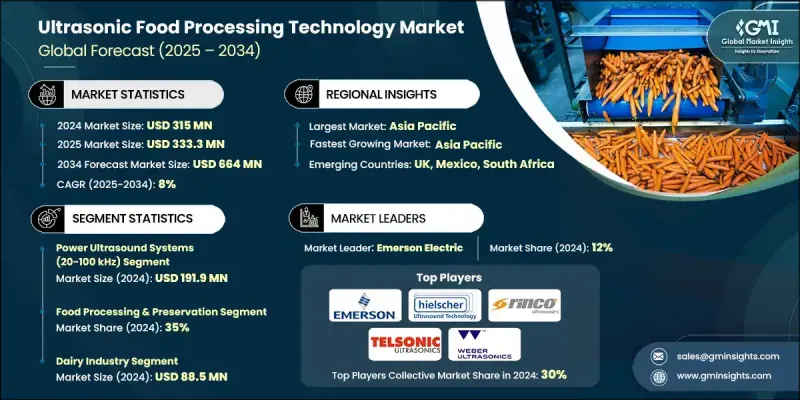
The Global Ultrasonic Food Processing Technology Market was valued at USD 315 million in 2024 and is estimated to grow at a CAGR of 8% to reach USD 664 million by 2034.
The growing popularity of non-thermal processing methods is reshaping food manufacturing trends, as consumers prioritize food safety, nutrition, and shelf life without compromising on quality. Technologies such as ultrasonic processing, high-pressure treatment, and pulsed electric fields are becoming more widely accepted due to their ability to maintain sensory and nutritional properties while meeting regulatory safety standards. With rising consumer concerns over contamination and the demand for traceable and hygienically processed food, manufacturers are investing in innovative processing systems that meet strict global safety guidelines. In response to evolving export standards and consumer expectations, producers are increasingly turning to ultrasonic technology to improve productivity and ensure compliance. These systems help meet the industry's growing need for clean-label products, enhanced processing efficiency, and sustainable production practices. The integration of ultrasonic equipment into broader food tech ecosystems is also streamlining operations across production lines, especially in regions with advanced food manufacturing infrastructure.
| Market Scope | |
|---|---|
| Start Year | 2024 |
| Forecast Year | 2025-2034 |
| Start Value | $315 Million |
| Forecast Value | $664 Million |
| CAGR | 8% |
The power ultrasound systems operating within the 20-100 kHz range segment generated USD 191.9 million in 2024. These systems play a critical role in boosting mass transfer operations such as emulsification, homogenization, and extraction. By leveraging cavitation effects, ultrasonic systems facilitate the release of valuable bioactive compounds, nutrients, and flavors, making them highly effective in processing plant- and animal-based materials. Their benefits are especially notable in producing high-yield emulsified products, where consistency and quality are key.
The food processing and preservation segment held 35% share in 2024. This segment is expanding rapidly as manufacturers prioritize techniques that preserve nutritional integrity and maintain desirable sensory attributes in food products. As consumer demand shifts toward minimally processed, functionally rich foods, methods like ultrasonic treatment, freeze-drying, and vacuum packaging are gaining ground. These techniques are instrumental in extending shelf life while retaining the functional value of ingredients.
U.S. Ultrasonic Food Processing Technology Market held 75.6% share and generated USD 83.8 million in 2024. This leadership position stems from a strong emphasis on food innovation, digital transformation, and compliance with food safety mandates. As North America continues to embrace automation and digitized tracking solutions, demand for advanced processing technologies is rising across both large-scale and mid-tier food production facilities. The region's focus on clean-label product development and longer shelf stability is pushing manufacturers toward non-thermal methods for enhanced competitiveness.
Key players operating in the Global Ultrasonic Food Processing Technology Market include Dukane, Telsonic, FoodTools, Cavitus, Emerson Electric, Herrmann Ultrasonics, Weber Ultrasonics, Hielscher Ultrasonics, AERZEN, Marchant Schmidt, Ultrasonic Power, MS Ultrasonic Technology Group, Innovative Ultrasonics, RINCO ULTRASONICS, Sonimat, and Sonics & Materials. To strengthen their position in the Ultrasonic Food Processing Technology Market, leading companies are focusing on developing application-specific ultrasonic systems tailored to different food product categories. Many are expanding global distribution networks, net manufacturers and strategic partnerships with OEMs and food manufacturers and investing in automation integration for seamless plant operations. Emphasis is also placed on advancing cavitation control and power efficiency to maximize yield and consistency.
Table of Contents
Chapter 1 Methodology and Scope
- 1.1 Market scope and definition
- 1.2 Research design
- 1.2.1 Research approach
- 1.2.2 Data collection methods
- 1.3 Data mining sources
- 1.3.1 Global
- 1.3.2 Regional/Country
- 1.4 Base estimates and calculations
- 1.4.1 Base year calculation
- 1.4.2 Key trends for market estimation
- 1.5 Primary research and validation
- 1.5.1 Primary sources
- 1.6 Forecast model
- 1.7 Research assumptions and limitations
Chapter 2 Executive Summary
- 2.1 Industry 360° synopsis
- 2.2 Key market trends
- 2.2.1 Regional
- 2.2.2 Technology type
- 2.2.3 Application
- 2.2.4 End use industry
- 2.3 CXO perspectives: Strategic imperatives
- 2.3.1 Key decision points for industry executives
- 2.3.2 Critical success factors for market players
- 2.4 Future outlook and strategic recommendations
Chapter 3 Industry Insights
- 3.1 Industry ecosystem analysis
- 3.1.1 Supplier landscape
- 3.1.2 Profit margin
- 3.1.3 Value addition at each stage
- 3.1.4 Factor affecting the value chain
- 3.2 Industry impact forces
- 3.2.1 Growth drivers
- 3.2.1.1 Rising demand for non-thermal processing
- 3.2.1.2 Food safety & hygiene requirements
- 3.2.1.3 Growth in plant-based & functional foods
- 3.2.2 Industry pitfalls & challenges
- 3.2.2.1 High initial investment costs
- 3.2.2.2 Scalability issues
- 3.2.3 Opportunities
- 3.2.3.1 Integration with automation & smart manufacturing
- 3.2.3.2 Expansion into plant-based and functional foods
- 3.2.1 Growth drivers
- 3.3 Growth potential analysis
- 3.4 Future market trends
- 3.5 Technology and innovation landscape
- 3.5.1 Current technological trends
- 3.5.2 Emerging technologies
- 3.6 Price trends
- 3.6.1 By region
- 3.6.2 By technology type
- 3.7 Regulatory landscape
- 3.7.1 Standards and compliance requirements
- 3.7.2 Regional regulatory frameworks
- 3.7.3 Certification standards
- 3.8 Porter's analysis
- 3.9 PESTEL analysis
Chapter 4 Competitive Landscape, 2024
- 4.1 Introduction
- 4.2 Company market share analysis
- 4.2.1 By region
- 4.2.1.1 North America
- 4.2.1.2 Europe
- 4.2.1.3 Asia Pacific
- 4.2.1.4 Latin America
- 4.2.1.5 Middle East and Africa
- 4.2.1 By region
- 4.3 Company matrix analysis
- 4.4 Competitive analysis of major market players
- 4.5 Competitive positioning matrix
- 4.6 Key developments
- 4.6.1 Mergers & acquisitions
- 4.6.2 Partnerships & collaborations
- 4.6.3 New product launches
- 4.6.4 Expansion plans
Chapter 5 Market Estimates and Forecast, By Technology Type, 2021 - 2034 (USD Million) (Thousand Units)
- 5.1 Key trends
- 5.2 Power ultrasound systems (20-100 khz)
- 5.3 Sonochemistry systems (100 khz-1 mhz)
- 5.4 Diagnostic ultrasound systems (1-10 mhz)
- 5.5 Hybrid ultrasonic systems
Chapter 6 Market Estimates and Forecast, By Application, 2021 - 2034 (USD Million) (Thousand Units)
- 6.1 Key trends
- 6.2 Food processing & preservation
- 6.3 Extraction & separation
- 6.4 Homogenization & emulsification
- 6.5 Cutting & sealing
- 6.6 Cleaning & sanitization
- 6.7 Quality control & analysis
Chapter 7 Market Estimates and Forecast, By End use Industry, 2021 - 2034 (USD Million) (Thousand Units)
- 7.1 Key trends
- 7.2 Dairy industry
- 7.3 Meat & seafood processing
- 7.4 Beverage industry
- 7.5 Bakery & confectionery
- 7.6 Packaging industry
- 7.7 Food ingredients & additives
Chapter 8 Market Estimates and Forecast, By Region, 2021 - 2034 (USD Million) (Thousand Units)
- 8.1 Key trends
- 8.2 North America
- 8.2.1 U.S.
- 8.2.2 Canada
- 8.3 Europe
- 8.3.1 Germany
- 8.3.2 UK
- 8.3.3 France
- 8.3.4 Italy
- 8.3.5 Spain
- 8.4 Asia Pacific
- 8.4.1 China
- 8.4.2 Japan
- 8.4.3 India
- 8.4.4 Australia
- 8.4.5 South Korea
- 8.5 Latin America
- 8.5.1 Brazil
- 8.5.2 Mexico
- 8.5.3 Argentina
- 8.6 Middle East and Africa
- 8.6.1 South Africa
- 8.6.2 Saudi Arabia
- 8.6.3 UAE
Chapter 9 Company Profiles
- 9.1 Cavitus
- 9.2 Dukane
- 9.3 Emerson Electric
- 9.4 FoodTools
- 9.5 Herrmann Ultrasonics
- 9.6 Hielscher Ultrasonics
- 9.7 Innovative Ultrasonics
- 9.8 Marchant Schmidt
- 9.9 MS Ultrasonic Technology Group
- 9.10 RINCO ULTRASONICS
- 9.11 Sonics & Materials
- 9.12 Sonimat
- 9.13 Telsonic
- 9.14 Ultrasonic Power
- 9.15 Weber Ultrasonics