

|
시장보고서
상품코드
1871218
특수 통조림 식품 시장 : 기회, 성장 요인, 업계 동향 분석 및 예측(2025-2034년)Specialty Canned Foods Market Opportunity, Growth Drivers, Industry Trend Analysis, and Forecast 2025 - 2034 |
||||||

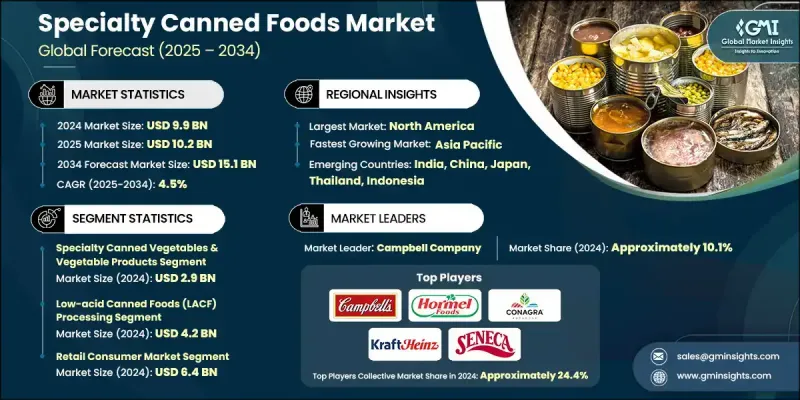
세계의 특수 통조림 식품 시장은 2024년 99억 달러로 평가되었으며, 2034년까지 연평균 복합 성장률(CAGR) 4.5%로 성장하여 151억 달러에 이를 것으로 예측됩니다.

소비자가 고품질의 원료와 독특한 맛을 제공하는 프리미엄, 미식가, 장인의 기술이 빛나는 통조림 식품을 요구하는 경향이 강해지고 있는 가운데, 시장은 강력한 성장을 보이고 있습니다. 현대의 구매층은 대량 생산품에서 소량의 크래프트 스타일 제품으로 이행하고 있으며, 첨단 지역에서 수요를 견인하고 있습니다. 국제적인 요리와 문화적으로 다양한 식품에 대한 관심 증가도 시장을 더욱 확대시키고 있으며, 특수 통조림 식품은 이제 세계의 맛을 제공합니다. 또한 유기농 제품과 깨끗한 라벨 제품에 대한 소비자의 선호도가 계속 성장하고 있습니다. 도시 주민과 건강 지향 소비자의 편리하고 영양이 풍부하고 장기 보존이 가능한 식품에 대한 수요는 국내 시장과 수출 시장 모두에 기회를 만들어 내고 있으며, 제조 업체는 변화하는 기호에 부응하기 위해 제품의 혁신과 다양화를 강요하고 있습니다.
| 시장 범위 | |
|---|---|
| 시작 연도 | 2024년 |
| 예측 연도 | 2025-2034년 |
| 시작 금액 | 99억 달러 |
| 예측 금액 | 151억 달러 |
| CAGR | 4.5% |
특수 통조림 채소 및 야채 제품 부문은 2024년 29억 달러로 평가되었으며 2025년부터 2034년까지 연평균 복합 성장률(CAGR) 5%를 보일 것으로 예측됩니다. 도시 지역의 소비자들이 편리한 식사를 추가하고자 하는 것, 그리고 신선한 농산물에 대한 접근이 제한된 지역에서는 이러한 안정적인 대체품이 유익하기 때문에 영양가가 높고 오래 지속되는 통조림 과일 및 채소에 대한 수요가 높아지고 있습니다.
저산성 통조림 식품(LACF) 가공 부문은 2024년 42억 달러 규모에 이르렀으며, 2034년까지 연평균 복합 성장률(CAGR) 4.6%를 보일 것으로 예측됩니다. 이 성장은 안전과 보존 기간을 보장하기 위해 정확한 열 살균이 필요한 고기, 해산물 및 야채 기반 LACF 제품의 생산 증가로 추진되고 있습니다. 밀봉 기술과 살균 추적 시스템의 진보로 제품 품질과 소비자 신뢰가 향상되어 국내외 시장에서 시장 확대를 촉진하고 있습니다.
북미의 특수 통조림 식품 시장은 2024년 32.1%의 점유율을 차지했습니다. 시장의 성장은 편리하고 건강하고 빨리 먹을 수 있는 선택을 요구하는 소비자의 취향에 견인하고 있습니다. 장인적인 맛과 민족적인 맛 수요 증가로 통조림 과일, 야채, 소스, 레토르트 식품의 구색이 확대되고 있습니다. 도시의 라이프 스타일과 단신 가구 증가로 보존성이 높고 고품질의 제품에 대한 요구가 높아지고 있습니다. 소매 및 전자상거래 채널의 확대로 입수가능성이 향상되고, 유기적이고 영양가가 높은 제품이 중시되어 지역에서의 꾸준한 성장을 지원하고 있습니다.
세계의 특수 통조림 식품 시장의 주요 기업으로는 Hormel Foods Corporation, Conagra Brands Inc., Campbell Company, Kraft Heinz Company, Seneca Foods Corporation, 그 외 기타 회사 등을 들 수 있습니다. 각 회사는 건강 지향과 미식 지향 소비자를 수용하기 위해 제품 혁신에 주력하고 소량 생산의 공예 스타일의 고급 제품을 개발하고 있습니다. 재봉 가능, 환경 친화적, 분량 조정 가능한 디자인 등 포장의 개량에 의해 편리성이 향상되어 식품 폐기물이 삭감되고 있습니다. 소매업체와 전자상거래 플랫폼과의 전략적 제휴로 유통 채널이 확대되고 시장 인지도가 높아지고 있습니다. 또한 기업은 진화하는 음식의 취향에 부응하기 위해 독자적인 맛, 영양 강화 식품, 유기 제품을 개발하기 위한 연구 개발에도 투자하고 있습니다. 고성장 지역에 대한 시장 개척과 현지 식문화 동향에 대한 적응은 시장 침투를 촉진하는 데 도움이 됩니다. 브랜딩 및 마케팅 캠페인은 품질, 신뢰성, 지속가능성을 강조하고 소비자 충성도를 강화합니다.
자주 묻는 질문
목차
제1장 조사 방법
- 시장 범위와 정의
- 조사 설계
- 조사 접근
- 데이터 수집 방법
- 데이터 마이닝 소스
- 세계
- 지역별/국가별
- 기본 추정치와 계산
- 기준연도 계산
- 시장 추정에서의 주요 동향
- 1차 조사 및 검증
- 1차 정보
- 예측 모델
- 조사의 전제조건과 제한 사항
제2장 주요 요약
제3장 업계 인사이트
- 생태계 분석
- 공급자의 상황
- 이익률
- 각 단계에서의 부가가치
- 밸류체인에 영향을 주는 요인
- 혁신
- 업계에 미치는 영향요인
- 성장 촉진요인
- 업계의 잠재적 위험 및 과제
- 공급망의 복잡성
- 시장 기회
- 성장 가능성 분석
- 규제 상황
- 북미
- 유럽
- 아시아태평양
- 라틴아메리카
- 중동 및 아프리카
- Porter's Five Forces 분석
- PESTEL 분석
- 가격 동향
- 지역별
- 제품별
- 장래 시장 동향
- 기술과 혁신의 상황
- 현재의 기술 동향
- 신흥기술
- 특허 상황
- 무역 통계(주: 무역 통계는 주요 국가에서만 제공됨)
- 주요 수입국
- 주요 수출국
- 지속가능성과 환경적 측면
- 지속가능한 실천
- 폐기물 감축 전략
- 생산에 있어서의 에너지 효율
- 환경에 배려한 대처
- 탄소발자국에 관한 고려 사항
제4장 경쟁 구도
- 소개
- 기업의 시장 점유율 분석
- 지역별
- 북미
- 유럽
- 아시아태평양
- 라틴아메리카
- 중동 및 아프리카
- 지역별
- 기업 매트릭스 분석
- 주요 시장 기업의 경쟁 분석
- 경쟁 포지셔닝 매트릭스
- 주요 발전
- 인수합병
- 제휴 및 협력관계
- 신제품 발매
- 사업 확대 계획
제5장 시장 추계 및 예측 : 제품 유형별, 2021-2034년
- 주요 동향
- 특제 통조림 과일 및 과일 제품
- 식품 과일 가공품
- 장인 기술에 의한 과일 샐러드 및 믹스 과일
- 프리미엄 복숭아 및 배 품종
- 이국적인 과일 및 열대 과일 컬렉션
- 유기농 과일 제품
- 과일 베이스 소스 및 콤폿
- 식품 과일 소스
- 디저트용 콤폿 및 토핑
- 조리 및 제과용도
- 식품 과일 가공품
- 특제 통조림 야채 및 야채 제품
- 아티잔 야채 가공품
- 전통품종 및 재래품종
- 소량 가공
- 요리사가 감수한 조리된 식품
- 유기 및 자연 재배 야채
- 인증 유기농 제품
- 비유전자 재조합 인증 상품
- 무농약 대체품
- 민족 야채 가공품
- 멕시코 및 라틴아메리카 야채
- 아시아 야채 특산품
- 지중해풍 조리품
- 아티잔 야채 가공품
- 특제 스프, 스튜, 조리 식품
- 각종 요리 스프
- 비스크 및 크림 기반 수프
- 스프 기반 고급 스프
- 계절 한정품 및 수량 한정품
- 민족 요리 수프
- 아시아 스프류(라면, 포, 된장)
- 유럽 전통 스프
- 라틴아메리카 스프 특산품
- 프리미엄 스튜 및 완전 조리된 식품
- 천천히 조리한 각종 스튜
- 즉시 섭취 가능한 식사 솔루션
- 1인분 사이즈 및 분량 관리
- 각종 요리 스프
- 특제 소스, 조미료, 보존 식품
- 아티잔 파스타 및 조리용 소스
- 미식 마리나라 소스 및 토마토 소스
- 페스트 및 허브 기반 소스
- 각종 국제적인 소스
- 프리미엄 살사 및 딥 소스
- 각종 수제 살사
- 특제 딥 및 스프레드
- 핫 소스 및 매운 가공품
- 보존 식품 및 잼류
- 소량 생산 과일 잼
- 무당 및 저당 옵션
- 풍미가 풍부한 보존 식품 및 처트니
- 아티잔 파스타 및 조리용 소스
- 특선 육류 및 어패류 제품
- 프리미엄 통조림 육류
- 목초 사육 및 유기육 제품
- 특제 칠리 및 고기 스튜
- 미식가 퍼티 및 스프레드
- 지속가능 수산물
- MSC 인증 해산물
- 천연 고급 생선
- 특제 해산물 가공품
- 민족 고기 및 해산물 가공품
- 아시아 해산물 제품
- 유럽 육류 특산품
- 라틴아메리카 조리품
- 프리미엄 통조림 육류
- 에스닉 및 인터내셔널 스페셜티 푸드
- 라틴계 및 히스패닉계 특산품
- 멕시코 본고장 제품
- 각종 중앙아메리카 제품
- 남아메리카 특산품
- 조리된 아시아 요리
- 중국 전통 식품
- 일본 특산품
- 동남아시아 제품
- 유럽산 음식 제품
- 이탈리아 특산 식품
- 프랑스 요리 상품
- 지중해 조리품
- 라틴계 및 히스패닉계 특산품
제6장 시장 추계 및 예측 : 가공 기술별, 2021-2034년
- 주요 동향
- 저산성 통조림 식품(LACF) 가공
- 레토르트 가공 기술
- 증기 레토르트 시스템
- 수침식 레토르트
- 연속 레토르트 가공
- 가압처리 응용
- 정지식 레토르트 조작
- 교반식 레토르트 시스템
- 정수압 레토르트
- FDA 등록 및 프로세스 신고 요건
- 보다 우수한 프로세스 관리 훈련 적합성
- 레토르트 가공 기술
- 산성화 식품 가공
- 제어된 산성화 방법
- 아세트산계 산성화
- 구연산 처리
- 젖산 발효
- pH 제어 및 모니터링 시스템
- 평형 pH 달성 프로토콜
- 프로세스 권한 검증 요건
- 제어된 산성화 방법
- 고산성 식품 가공
- 저온 살균 기술
- 중탕 처리
- 증기 처리
- 터널식 살균
- 핫필 가공법
- 핫필 앤 홀드 시스템
- 반전 처리
- 진공 씰 용도
- 저온 살균 기술
- 첨단 가공 기술
- 고압처리(HPP)
- 저온 HPP 용도
- 열 보조 고압 처리
- 레토르트 파우치 가공
- 플렉서블 파우치 시스템
- 스탠드 업 파우치 용도
- 무균 가공 및 포장
- UHT 살균
- 무균 충전 시스템
- 고압처리(HPP)
제7장 시장 추계 및 예측 : 최종 용도별, 2021-2034년
- 주요 동향
- 소매 소비자 시장
- 식료품 체인 유통
- 전국 규모 식료품 소매업체
- 지역 슈퍼마켓 체인
- 할인 소매 채널
- 전문점
- 미식 요리 소매점
- 건강식품점
- 민족 식품 시장
- 전자상거래 및 소비자용 직접 판매
- 온라인 마켓플레이스 판매
- 직접 브랜드 웹사이트
- 정기 구입 박스 서비스
- 식료품 체인 유통
- 외식산업 및 시설용 시장
- 레스토랑 및 케이터링용 용도
- 고급 레스토랑
- 캐주얼 다이닝 체인
- 퀵 서비스 레스토랑
- 시설용 푸드서비스
- 의료시설
- 교육기관
- 기업내 식당
- 접객 및 여행
- 호텔 및 리조트용 외식 산업
- 항공기용 케이터링
- 크루즈 선박용 용도
- 레스토랑 및 케이터링용 용도
- 식품 제조 및 원료
- 식품 가공 제조업체용 용도
- 레토르트 식품 제조업체
- 소스 및 조미료 제조업체
- 베이커리 및 스낵 식품 회사
- 프라이빗 브랜드 제조
- 소매업체 브랜드 제품 제조
- 유통업체 프라이빗 브랜드
- 공동제조서비스
- 원료 공급 용도
- 원료 도매 판매
- 외식산업용 원료공급
- 공업용 식품 가공
- 식품 가공 제조업체용 용도
제8장 시장 추계 및 예측 : 지역별, 2021-2034년
- 주요 동향
- 북미
- 미국
- 캐나다
- 유럽
- 독일
- 영국
- 프랑스
- 이탈리아
- 스페인
- 기타 유럽
- 아시아태평양
- 중국
- 인도
- 일본
- 호주
- 한국
- 기타 아시아태평양
- 라틴아메리카
- 브라질
- 멕시코
- 아르헨티나
- 기타 라틴아메리카
- 중동 및 아프리카
- 사우디아라비아
- 남아프리카
- 아랍에미리트(UAE)
- 기타 중동 및 아프리카
제9장 기업 프로파일
- The JM Smucker Company
- Seneca Foods Corporation
- Pacific Coast Producers
- Del Monte Foods Inc.
- Campbell Company
- Conagra Brands Inc.
- Nestle USA
- Teasdale Latin Foods
- LiDestri Foods Inc.
- Giovanni Foods
- Lakeside Foods Inc.
- Hirzel Canning Company/Dei Fratelli
- Stanislaus Food Products
- Wild Planet Foods
- Bianco DiNapoli
- Initiative Foods
- Patriot Pickle
- Victory's Kitchen
The Global Specialty Canned Foods Market was valued at USD 9.9 Billion in 2024 and is expected to grow at a CAGR of 4.5% to reach USD 15.1 Billion by 2034.
The market is witnessing strong growth as consumers increasingly seek premium, gourmet, and artisanal canned foods that deliver high-quality ingredients and unique flavors. Modern buyers are shifting from mass-produced offerings to small-batch, craft-style products, driving demand in developed regions. Rising interest in international cuisines and culturally diverse foods has further expanded the market, as specialty canned foods now provide flavors from around the world. Additionally, consumer preference for organic and clean-label products continues to support growth. The demand for convenient, nutrient-rich, and shelf-stable foods among urban populations and health-conscious consumers is creating opportunities for both domestic and export markets, pushing manufacturers to innovate and diversify their offerings to meet evolving tastes.
| Market Scope | |
|---|---|
| Start Year | 2024 |
| Forecast Year | 2025-2034 |
| Start Value | $9.9 Billion |
| Forecast Value | $15.1 Billion |
| CAGR | 4.5% |
The specialty canned vegetables and vegetable products segment was valued at USD 2.9 Billion in 2024 and is expected to grow at a CAGR of 5% from 2025 to 2034. The demand for nutrient-rich, long-lasting canned fruits and vegetables is increasing as urban consumers seek convenient dietary additions, and regions with limited access to fresh produce benefit from these stable alternatives.
The low-acid canned foods (LACF) processing segment was valued at USD 4.2 Billion in 2024 and is projected to grow at a CAGR of 4.6% through 2034. This growth is fueled by the rising production of meat, seafood, and vegetable-based LACF products, which require precise thermal sterilization for safety and shelf life. Advances in sealing and sterilization tracking have improved product quality and consumer confidence, boosting market expansion in both domestic and international markets.
North America Specialty Canned Foods Market held a 32.1% share in 2024. The market's growth is driven by consumers' preference for convenient, healthy, and ready-to-eat options. Rising demand for artisanal and ethnic flavors has expanded the range of canned fruits, vegetables, sauces, and ready meals. Urban lifestyles and single-person households have increased the need for shelf-stable, premium products. The expansion of retail and e-commerce channels has improved accessibility, while an emphasis on organic and nutrient-rich offerings supports steady regional growth.
Key players in the Global Specialty Canned Foods Market include Hormel Foods Corporation, Conagra Brands Inc., Campbell Company, Kraft Heinz Company, Seneca Foods Corporation, and others. Companies are focusing on product innovation, creating small-batch, craft-style, and premium offerings to cater to health-conscious and gourmet-focused consumers. Packaging enhancements, including resealable, eco-friendly, and portion-controlled designs, improve convenience and reduce food waste. Strategic partnerships with retailers and e-commerce platforms expand distribution channels and enhance market visibility. Firms are also investing in R&D to develop unique flavors, fortified options, and organic products to meet evolving dietary preferences. Market expansion into high-growth regions and adaptation to local culinary trends help increase market penetration. Branding and marketing campaigns highlight quality, authenticity, and sustainability to strengthen consumer loyalty.
Table of Contents
Chapter 1 Methodology
- 1.1 Market scope and definition
- 1.2 Research design
- 1.2.1 Research approach
- 1.2.2 Data collection methods
- 1.3 Data mining sources
- 1.3.1 Global
- 1.3.2 Regional/Country
- 1.4 Base estimates and calculations
- 1.4.1 Base year calculation
- 1.4.2 Key trends for market estimation
- 1.5 Primary research and validation
- 1.5.1 Primary sources
- 1.6 Forecast model
- 1.7 Research assumptions and limitations
Chapter 2 Executive Summary
- 2.1 Industry 360° synopsis
- 2.2 Key market trends
- 2.2.1 Regional
- 2.2.2 Product Type
- 2.2.3 Processing Technology
- 2.2.4 End use Application
- 2.3 TAM Analysis, 2025-2034
- 2.4 CXO perspectives: Strategic imperatives
- 2.4.1 Executive decision points
- 2.4.2 Critical success factors
- 2.5 Future Outlook and Strategic Recommendations
Chapter 3 Industry Insights
- 3.1 Industry ecosystem analysis
- 3.1.1 Supplier Landscape
- 3.1.2 Profit Margin
- 3.1.3 Value addition at each stage
- 3.1.4 Factor affecting the value chain
- 3.1.5 Disruptions
- 3.2 Industry impact forces
- 3.2.1 Growth drivers
- 3.2.2 Industry pitfalls and challenges
- 3.2.2.1 Supply chain complexity
- 3.2.3 Market opportunities
- 3.3 Growth potential analysis
- 3.4 Regulatory landscape
- 3.4.1 North America
- 3.4.2 Europe
- 3.4.3 Asia Pacific
- 3.4.4 Latin America
- 3.4.5 Middle East & Africa
- 3.5 Porter's analysis
- 3.6 PESTEL analysis
- 3.7 Price trends
- 3.7.1 By region
- 3.7.2 By product
- 3.8 Future market trends
- 3.9 Technology and Innovation landscape
- 3.9.1 Current technological trends
- 3.9.2 Emerging technologies
- 3.10 Patent Landscape
- 3.11 Trade statistics (Note: the trade statistics will be provided for key countries only)
- 3.11.1 Major importing countries
- 3.11.2 Major exporting countries
- 3.12 Sustainability and Environmental Aspects
- 3.12.1 Sustainable Practices
- 3.12.2 Waste Reduction Strategies
- 3.12.3 Energy Efficiency in Production
- 3.12.4 Eco-friendly Initiatives
- 3.13 Carbon Footprint Considerations
Chapter 4 Competitive Landscape, 2024
- 4.1 Introduction
- 4.2 Company market share analysis
- 4.2.1 By region
- 4.2.1.1 North America
- 4.2.1.2 Europe
- 4.2.1.3 Asia Pacific
- 4.2.1.4 LATAM
- 4.2.1.5 MEA
- 4.2.1 By region
- 4.3 Company matrix analysis
- 4.4 Competitive analysis of major market players
- 4.5 Competitive positioning matrix
- 4.6 Key developments
- 4.6.1 Mergers & acquisitions
- 4.6.2 Partnerships & collaborations
- 4.6.3 New Product Launches
- 4.6.4 Expansion Plans
Chapter 5 Market Estimates and Forecast, By Product Type, 2021-2034 (USD Billion, Kilo Tons)
- 5.1 Key trends
- 5.2 Specialty Canned Fruits & Fruit Products
- 5.2.1 Gourmet fruit preparations
- 5.2.1.1 Artisanal fruit salads and medleys
- 5.2.1.2 Premium peach and pear varieties
- 5.2.1.3 Exotic and tropical fruit collections
- 5.2.2 Organic fruit products
- 5.2.3 Fruit-based sauces and compotes
- 5.2.3.1 Gourmet fruit sauces
- 5.2.3.2 Dessert compotes and toppings
- 5.2.3.3 Cooking and baking applications
- 5.2.1 Gourmet fruit preparations
- 5.3 Specialty Canned Vegetables & Vegetable Products
- 5.3.1 Artisanal vegetable preparations
- 5.3.1.1 Heirloom and heritage varieties
- 5.3.1.2 Small-batch processing
- 5.3.1.3 Chef-inspired preparations
- 5.3.2 Organic and natural vegetables
- 5.3.2.1 Certified organic products
- 5.3.2.2 Non-GMO verified options
- 5.3.2.3 Pesticide-free alternatives
- 5.3.3 Ethnic vegetable preparations
- 5.3.3.1 Mexican and Latino vegetables
- 5.3.3.2 Asian vegetable specialties
- 5.3.3.3 Mediterranean preparations
- 5.3.1 Artisanal vegetable preparations
- 5.4 Specialty Soups, Stews & Ready Meals
- 5.4.1 Gourmet soup varieties
- 5.4.1.1 Bisques and cream-based soups
- 5.4.1.2 Broth-based premium soups
- 5.4.1.3 Seasonal and limited edition varieties
- 5.4.2 Ethnic cuisine soups
- 5.4.2.1 Asian soup varieties (ramen, pho, miso)
- 5.4.2.2 European soup traditions
- 5.4.2.3 Latin American soup specialties
- 5.4.3 Premium stews and complete meals
- 5.4.3.1 Slow-cooked stew varieties
- 5.4.3.2 Ready-to-eat meal solutions
- 5.4.3.3 Single-serve and portion control
- 5.4.1 Gourmet soup varieties
- 5.5 Specialty Sauces, Condiments & Preserves
- 5.5.1 Artisanal pasta and cooking sauces
- 5.5.1.1 Gourmet marinara and tomato sauces
- 5.5.1.2 Pesto and herb-based sauces
- 5.5.1.3 International sauce varieties
- 5.5.2 Premium salsas and dips
- 5.5.2.1 Artisanal salsa varieties
- 5.5.2.2 Specialty dips and spreads
- 5.5.2.3 Hot sauce and spicy preparations
- 5.5.3 Gourmet preserves and jams
- 5.5.3.1 Small-batch fruit preserves
- 5.5.3.2 Sugar-free and low-sugar options
- 5.5.3.3 Savory preserves and chutneys
- 5.5.1 Artisanal pasta and cooking sauces
- 5.6 Specialty Meat & Seafood Products
- 5.6.1 Premium canned meats
- 5.6.1.1 Grass-fed and organic meat products
- 5.6.1.2 Specialty chili and meat stews
- 5.6.1.3 Gourmet pates and spreads
- 5.6.2 Sustainable seafood products
- 5.6.2.1 MSC certified seafood
- 5.6.2.2 Wild-caught premium fish
- 5.6.2.3 Specialty seafood preparations
- 5.6.3 Ethnic meat and seafood preparations
- 5.6.3.1 Asian-style seafood products
- 5.6.3.2 European meat specialties
- 5.6.3.3 Latin American preparations
- 5.6.1 Premium canned meats
- 5.7 Ethnic & International Specialty Foods
- 5.7.1 Latino/Hispanic specialties
- 5.7.1.1 Mexican authentic products
- 5.7.1.2 Central American varieties
- 5.7.1.3 South American specialties
- 5.7.2 Asian cuisine preparations
- 5.7.2.1 Chinese traditional foods
- 5.7.2.2 Japanese specialty items
- 5.7.2.3 Southeast Asian products
- 5.7.3 European gourmet products
- 5.7.3.1 Italian specialty foods
- 5.7.3.2 French gourmet items
- 5.7.3.3 Mediterranean preparations
- 5.7.1 Latino/Hispanic specialties
Chapter 6 Market Estimates and Forecast, By Processing Technology, 2021-2034 (USD Billion, Kilo Tons)
- 6.1 Key trends
- 6.2 Low-Acid Canned Foods (LACF) Processing
- 6.2.1 Retort processing technology
- 6.2.1.1 Steam retort systems
- 6.2.1.2 Water immersion retorts
- 6.2.1.3 Continuous retort processing
- 6.2.2 Pressure processing applications
- 6.2.2.1 Still retort operations
- 6.2.2.2 Agitating retort systems
- 6.2.2.3 Hydrostatic retorts
- 6.2.3 FDA registration and process filing requirements
- 6.2.4 Better Process Control School compliance
- 6.2.1 Retort processing technology
- 6.3 Acidified Foods Processing
- 6.3.1 Controlled acidification methods
- 6.3.1.1 Vinegar-based acidification
- 6.3.1.2 Citric acid processing
- 6.3.1.3 Lactic acid fermentation
- 6.3.2 pH control and monitoring systems
- 6.3.3 Equilibrium pH achievement protocols
- 6.3.4 Process authority validation requirements
- 6.3.1 Controlled acidification methods
- 6.4 High-Acid Foods Processing
- 6.4.1 Pasteurization technologies
- 6.4.1.1 Water bath processing
- 6.4.1.2 Steam processing
- 6.4.1.3 Tunnel pasteurization
- 6.4.2 Hot-fill processing methods
- 6.4.2.1 Hot-fill and hold systems
- 6.4.2.2 Inversion processing
- 6.4.2.3 Vacuum sealing applications
- 6.4.1 Pasteurization technologies
- 6.5 Advanced Processing Technologies
- 6.5.1 High-pressure processing (HPP)
- 6.5.1.1 Cold HPP applications
- 6.5.1.2 Thermal-assisted HPP
- 6.5.2 Retort pouch processing
- 6.5.2.1 Flexible pouch systems
- 6.5.2.2 Stand-up pouch applications
- 6.5.3 Aseptic processing and packaging
- 6.5.3.1 UHT sterilization
- 6.5.3.2 Sterile filling systems
- 6.5.1 High-pressure processing (HPP)
Chapter 7 Market Estimates and Forecast, By End Use Application, 2021-2034 (USD Billion, Kilo Tons)
- 7.1 Key trends
- 7.2 Retail Consumer Market
- 7.2.1 Grocery chain distribution
- 7.2.1.1 National grocery retailers
- 7.2.1.2 Regional grocery chains
- 7.2.1.3 Discount retail channels
- 7.2.2 Specialty food stores
- 7.2.2.1 Gourmet food retailers
- 7.2.2.2 Health food stores
- 7.2.2.3 Ethnic food markets
- 7.2.3 E-commerce and direct-to-consumer
- 7.2.3.1 Online marketplace sales
- 7.2.3.2 Direct brand websites
- 7.2.3.3 Subscription box services
- 7.2.1 Grocery chain distribution
- 7.3 Foodservice & Institutional Market
- 7.3.1 Restaurant and catering applications
- 7.3.1.1 Fine dining establishments
- 7.3.1.2 Casual dining chains
- 7.3.1.3 Quick service restaurants
- 7.3.2 Institutional foodservice
- 7.3.2.1 Healthcare facilities
- 7.3.2.2 Educational institutions
- 7.3.2.3 Corporate cafeterias
- 7.3.3 Hospitality and travel
- 7.3.3.1 Hotel and resort food service
- 7.3.3.2 Airline catering
- 7.3.3.3 Cruise line applications
- 7.3.1 Restaurant and catering applications
- 7.4 Food Manufacturing & Ingredients
- 7.4.1 Food processor applications
- 7.4.1.1 Ready meal manufacturers
- 7.4.1.2 Sauce and condiment producers
- 7.4.1.3 Bakery and snack food companies
- 7.4.2 Private label manufacturing
- 7.4.2.1 Retailer brand production
- 7.4.2.2 Distributor private labels
- 7.4.2.3 Co-manufacturing services
- 7.4.3 Ingredient supply applications
- 7.4.3.1 Bulk ingredient sales
- 7.4.3.2 Food service ingredient supply
- 7.4.3.3 Industrial food processing
- 7.4.1 Food processor applications
Chapter 8 Market Estimates and Forecast, By Region, 2021-2034 (USD Billion, Kilo Tons)
- 8.1 Key trends
- 8.2 North America
- 8.2.1 U.S.
- 8.2.2 Canada
- 8.3 Europe
- 8.3.1 Germany
- 8.3.2 UK
- 8.3.3 France
- 8.3.4 Italy
- 8.3.5 Spain
- 8.3.6 Rest of Europe
- 8.4 Asia Pacific
- 8.4.1 China
- 8.4.2 India
- 8.4.3 Japan
- 8.4.4 Australia
- 8.4.5 South Korea
- 8.4.6 Rest of Asia Pacific
- 8.5 Latin America
- 8.5.1 Brazil
- 8.5.2 Mexico
- 8.5.3 Argentina
- 8.5.4 Rest of Latin America
- 8.6 Middle East & Africa
- 8.6.1 Saudi Arabia
- 8.6.2 South Africa
- 8.6.3 UAE
- 8.6.4 Rest of Middle East & Africa
Chapter 9 Company Profiles
- 9.1 The J.M. Smucker Company
- 9.2 Seneca Foods Corporation
- 9.3 Pacific Coast Producers
- 9.4 Del Monte Foods Inc.
- 9.5 Campbell Company
- 9.6 Conagra Brands Inc.
- 9.7 Nestle USA
- 9.8 Teasdale Latin Foods
- 9.9 LiDestri Foods Inc.
- 9.10 Giovanni Foods
- 9.11 Lakeside Foods Inc.
- 9.12 Hirzel Canning Company/Dei Fratelli
- 9.13 Stanislaus Food Products
- 9.14 Wild Planet Foods
- 9.15 Bianco DiNapoli
- 9.16 Initiative Foods
- 9.17 Patriot Pickle
- 9.18 Victory's Kitchen


