

|
시장보고서
상품코드
1876559
맞춤형 암 백신 시장 : 기회, 성장 촉진요인, 업계 동향 분석, 예측(2025-2034년)Personalized Cancer Vaccine Market Opportunity, Growth Drivers, Industry Trend Analysis, and Forecast 2025 - 2034 |
||||||

세계의 맞춤형 암 백신 시장은 2024년에 2억 1,690만 달러로 평가되었고, 2034년까지 연평균 복합 성장률(CAGR) 26.4%로 성장하고 22억 달러에 달할 것으로 예측되고 있습니다.
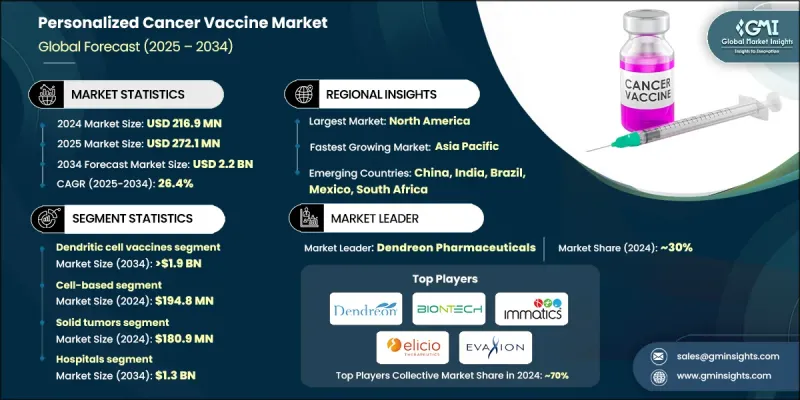
이 급속한 성장은 세계적인 암 환자 증가에 더하여 유전체학, 정밀의료, 면역요법의 진보에 의해 추진되고 있습니다. 차세대 시퀀싱(NGS)과 유전체 프로파일링을 통해 임상의는 환자 고유의 백신 개발에 필수적인 종양 특이적 네오 항원을 확인할 수 있게 되었습니다. 시퀀싱 비용이 낮아짐에 따라 이러한 기술은 임상 현장에서 더 쉽게 사용할 수 있습니다. 맞춤형 암 백신은 환자의 면역계를 훈련하고 그 쪽 특유의 암세포를 인식·공격시킴으로써 기존의 치료법을 대체하는 표적요법을 제공합니다. 암 증례 증가, 고령화, 세계적인 의료비의 확대가 수요를 뒷받침하고 있으며, 특히 북미 및 아시아태평양에서는 선진적인 진단·헬스케어 인프라가 맞춤형 치료를 지지하고 있습니다. 이 백신은 정밀의료, 면역 요법, 개인화된 환자 관리로의 광범위한 전환과 일치합니다.
| 시장 범위 | |
|---|---|
| 시작 연도 | 2024년 |
| 예측 연도 | 2025-2034년 |
| 시작 금액 | 2억 1,690만 달러 |
| 예측 금액 | 22억 달러 |
| CAGR | 26.4% |
수지상 세포 백신 부문은 2024년에 85.5%의 점유율을 차지했고, 2034년까지 19억 달러에 달할 것으로 예측됩니다. 수지상세포는 강력한 T세포 반응을 유도할 수 있는 매우 효과적인 항원제시세포이며, 개별화암 백신에 최적입니다. DC 백신은 표적을 좁히는 작용을 제공하여 비표적 효과를 최소화하고 환자의 치료 성과를 향상시킵니다.
고형 종양 부문은 2024년에 1억 8,090만 달러 시장 규모를 창출했습니다. 고형 종양은 흑색종, 비소세포 폐암, 교아종, 췌장암 등 진행 중인 맞춤형 암 백신 임상시험의 절반 이상에서 중심적인 대상이 되고 있습니다. 좋은 임상 결과는 규제 당국의 승인을 가속화하고 채택을 촉진하고 고형 종양 치료에서 이러한 백신의 효능이 입증되었습니다.
병원 부문은 2034년까지 13억 달러 규모에 이를 것으로 예측됩니다. 병원은 백신 투여, 환자 모니터링, 임상시험의 주요 거점으로서 맞춤형 암 백신 제공에 있어서 가장 신뢰성이 높고 효율적인 경로로서의 지위를 확립하고 있습니다. 진단 및 통합 의료에서의 역할로부터, 환자 중심의 치료 경로에 있어서 필수적인 존재입니다.
북미 개인화 암 백신 시장은 2024년 46.2%의 점유율을 차지했습니다. 이 지역에서는 이러한 백신에 관한 세계 전체의 임상시험의 거의 절반이 실시되고 있으며, 특히 악성 흑색종, 비소세포 폐암, 교아종에 초점을 맞추었습니다. 주요 생명 공학 기업은 민간 협력, 연방 정부 보조금 및 벤처 캐피탈 자금에 의해 지원되며 북미의 연구 개발에 많은 투자를하고 있습니다.
세계 개인화 암 백신 시장의 주요 기업으로는 Immunomic Therapeutics, BioNTech, Elicio Therapeutics, Immatics, Takis Biotech, Candel Therapeutics, VacV Biotherapeutics, Agenus, Moderna, OSE Immunotherapeutics, Evaxion Biotech, Dendreon Pharmaceuticals, ImmunityBio, Infinitopes, Imugene 등을 들 수 있습니다. 개인화 암 백신 시장의 기업은 시장에서의 지위를 강화하기 위해 여러 전략을 실시했습니다. 백신의 효능 향상, 항원 선택의 최적화, 환자 특이적인 제제의 개선을 위해 연구 개발에 많은 투자를 실시했습니다. 학술기관, 병원, 생명공학 기업과의 전략적 제휴는 임상 검증 및 규제 당국의 승인을 가속화하는 데 도움이 됩니다. 각 회사는 파트너십과 라이선싱을 통해 지리적 전개를 확대하여 신흥 시장에 접근하고 있습니다. 또한 디지털 툴, AI, 유전체 해석을 활용하여 백신 설계의 효율화와 제조 기간의 단축에 임하고 있습니다.
자주 묻는 질문
목차
제1장 조사 방법과 범위
제2장 주요 요약
제3장 업계 인사이트
- 업계 생태계 분석
- 공급자의 상황
- 각 단계에서의 부가가치
- 밸류체인에 영향을 주는 요인
- 업계에 미치는 영향요인
- 성장 촉진요인
- 유전체학·시퀀싱 기술의 진보
- 인공지능과 바이오인포매틱스의 통합의 진전
- 세계적으로 증가하는 암·만성질환의 유병률
- 정밀의료로의 이행의 가속
- 업계의 잠재적 리스크 및 과제
- 높은 생산 비용
- 복잡한 규제 상황
- 시장 기회
- 예방 종양학 분야로의 진출
- 확대하는 임상시험 파이프라인
- 성장 촉진요인
- 성장 가능성 분석
- 규제 상황
- 북미
- 유럽
- 아시아태평양
- 기술환경
- 현재의 기술 동향
- 신규 기술
- 장래 시장 동향
- 가격 분석
- 임상시험 분석
- Porter's Five Forces 분석
- PESTEL 분석
제4장 경쟁 구도
- 소개
- 기업의 시장 점유율 분석
- 세계
- 북미
- 유럽
- 기업 매트릭스 분석
- 주요 시장 기업의 경쟁 분석
- 경쟁 포지셔닝 매트릭스
- 주요 발전
- 합병 및 인수
- 제휴 및 협력관계
- 신제품 발매
- 확대 계획
제5장 시장 추정 및 예측 : 백신 유형별, 2021년-2034년
- 주요 동향
- 수지상 세포 백신
- mRNA 기반 백신
- 펩타이드 기반 백신
- 신항원(Neoantigen) 기반 백신
- 기타 백신 유형
제6장 시장 추정 및 예측 : 기술별, 2021년-2034년
- 주요 동향
- 세포 기반
- mRNA PCV
- 기타 기술
제7장 시장 추정 및 예측 : 적응증별, 2021년-2034년
- 주요 동향
- 고형 종양
- 혈액 악성 종양
제8장 시장 추정 및 예측 : 최종 용도별, 2021년-2034년
- 주요 동향
- 병원
- 암 연구센터
- 바이오테크놀러지·제약기업
- 기타 용도
제9장 시장 추정 및 예측 : 지역별, 2021년-2034년
- 주요 동향
- 북미
- 미국
- 캐나다
- 유럽
- 독일
- 영국
- 프랑스
- 스페인
- 이탈리아
- 네덜란드
- 아시아태평양
- 중국
- 일본
- 인도
- 호주
- 한국
- 라틴아메리카
- 브라질
- 멕시코
- 아르헨티나
- 중동 및 아프리카
- 남아프리카
- 사우디아라비아
- 아랍에미리트(UAE)
제10장 기업 프로파일
- BioNTech
- Moderna
- Immatics
- Candel Therapeutics
- Elicio Therapeutics
- Evaxion Biotech
- Immunomic Therapeutics
- Imugene
- Infinitopes
- OSE Immunotherapeutics
- Takis Biotech
- VacV Biotherapeutics
- ImmunityBio
- Agenus
- Dendreon Pharmaceuticals
The Global Personalized Cancer Vaccine Market was valued at USD 216.9 million in 2024 and is estimated to grow at a CAGR of 26.4% to reach USD 2.2 billion by 2034.
This rapid growth is driven by the increasing prevalence of cancer worldwide, coupled with advancements in genomics, precision medicine, and immunotherapy. Next-generation sequencing (NGS) and genomic profiling allow clinicians to identify tumor-specific neoantigens, which are critical for developing patient-specific vaccines. Declining sequencing costs have made these technologies more accessible in clinical practice. Personalized cancer vaccines train a patient's immune system to recognize and attack their unique cancer cells, offering a targeted alternative to conventional therapies. The rise in cancer cases, aging populations, and growing healthcare expenditure globally are fueling demand, particularly in North America and the Asia-Pacific, where advanced diagnostic and healthcare infrastructure support personalized treatments. These vaccines align with the broader shift toward precision medicine, immunotherapy, and individualized patient care.
| Market Scope | |
|---|---|
| Start Year | 2024 |
| Forecast Year | 2025-2034 |
| Start Value | $216.9 Million |
| Forecast Value | $2.2 Billion |
| CAGR | 26.4% |
The dendritic cell vaccine segment accounted for an 85.5% share in 2024 and is expected to reach USD 1.9 billion by 2034. Dendritic cells are highly effective antigen-presenting cells capable of eliciting strong T-cell responses, making them ideal for personalized cancer vaccines. DC vaccines provide targeted action, minimize off-target effects, and enhance patient outcomes.
The solid tumors segment generated USD 180.9 million in 2024. Solid tumors are central to more than half of ongoing personalized cancer vaccine trials, including melanoma, non-small cell lung cancer, glioblastoma, and pancreatic cancer. Positive clinical outcomes are accelerating regulatory approvals and driving adoption, validating the efficacy of these vaccines in solid tumor treatment.
The hospitals segment is expected to reach USD 1.3 billion by 2034. Hospitals are the primary sites for vaccine administration, patient monitoring, and clinical trials, positioning them as the most trusted and efficient channels for delivering personalized cancer vaccines. Their role in diagnostics and integrated care makes them essential in patient-centric treatment pathways.
North America Personalized Cancer Vaccine Market held a 46.2% share in 2024. The region hosts nearly half of the global clinical trials for these vaccines, focusing on melanoma, NSCLC, and glioblastoma. Major biotech companies are heavily investing in research and development in North America, supported by public-private partnerships, federal grants, and venture capital funding.
Prominent players in the Global Personalized Cancer Vaccine Market include Immunomic Therapeutics, BioNTech, Elicio Therapeutics, Immatics, Takis Biotech, Candel Therapeutics, VacV Biotherapeutics, Agenus, Moderna, OSE Immunotherapeutics, Evaxion Biotech, Dendreon Pharmaceuticals, ImmunityBio, Infinitopes, and Imugene. Companies in the Personalized Cancer Vaccine Market are implementing multiple strategies to strengthen their market position. They are investing heavily in research and development to enhance vaccine efficacy, optimize antigen selection, and improve patient-specific formulations. Strategic collaborations with academic institutions, hospitals, and biotechnology partners help accelerate clinical validation and regulatory approvals. Firms are expanding geographic footprints through partnerships and licensing agreements to access emerging markets. Additionally, they are leveraging digital tools, AI, and genomic analytics to streamline vaccine design and reduce production timelines.
Table of Contents
Chapter 1 Methodology and Scope
- 1.1 Market scope and definition
- 1.2 Research design
- 1.2.1 Research approach
- 1.2.2 Data collection methods
- 1.3 Data mining sources
- 1.3.1 Global
- 1.3.2 Regional/Country
- 1.4 Base estimates and calculations
- 1.4.1 Base year calculation
- 1.4.2 Key trends for market estimation
- 1.5 Primary research and validation
- 1.5.1 Primary sources
- 1.6 Forecast model
- 1.7 Research assumptions and limitations
Chapter 2 Executive Summary
- 2.1 Industry 360° synopsis
- 2.2 Key market trends
- 2.2.1 Regional trends
- 2.2.2 Vaccine type trends
- 2.2.3 Technology area trends
- 2.2.4 Indication trends
- 2.2.5 End use trends
- 2.3 CXO perspectives: Strategic imperatives
- 2.3.1 Key decision points for industry executives
- 2.3.2 Critical success factors for market players
- 2.4 Future outlook and strategic recommendations
Chapter 3 Industry Insights
- 3.1 Industry ecosystem analysis
- 3.1.1 Supplier landscape
- 3.1.2 Value addition at each stage
- 3.1.3 Factors affecting the value chain
- 3.2 Industry impact forces
- 3.2.1 Growth drivers
- 3.2.1.1 Advancements in genomics and sequencing technologies
- 3.2.1.2 Increasing integration of artificial intelligence and bioinformatics
- 3.2.1.3 Growing prevalence of cancer and chronic diseases globally
- 3.2.1.4 Increasing shift towards precision medicine
- 3.2.2 Industry pitfalls and challenges
- 3.2.2.1 High production costs
- 3.2.2.2 Complex regulatory landscape
- 3.2.3 Market opportunities
- 3.2.3.1 Expansion into preventive oncology
- 3.2.3.2 Growing pipeline of clinical trials
- 3.2.1 Growth drivers
- 3.3 Growth potential analysis
- 3.4 Regulatory landscape
- 3.4.1 North America
- 3.4.2 Europe
- 3.4.3 Asia Pacific
- 3.5 Technology landscape
- 3.5.1 Current technological trends
- 3.5.2 Emerging technologies
- 3.6 Future market trends
- 3.7 Pricing analysis
- 3.8 Clinical trial analysis
- 3.9 Porter's analysis
- 3.10 PESTEL analysis
Chapter 4 Competitive Landscape, 2024
- 4.1 Introduction
- 4.2 Company market share analysis
- 4.2.1 Global
- 4.2.2 North America
- 4.2.3 Europe
- 4.3 Company matrix analysis
- 4.4 Competitive analysis of major market players
- 4.5 Competitive positioning matrix
- 4.6 Key developments
- 4.6.1 Merger and acquisition
- 4.6.2 Partnership and collaboration
- 4.6.3 New product launches
- 4.6.4 Expansion plans
Chapter 5 Market Estimates and Forecast, By Vaccine Type, 2021 - 2034 ($ Mn)
- 5.1 Key trends
- 5.2 Dendritic cell vaccines
- 5.3 mRNA-based vaccines
- 5.4 Peptide-based vaccines
- 5.5 Neoantigen-based vaccines
- 5.6 Other vaccine types
Chapter 6 Market Estimates and Forecast, By Technology, 2021 - 2034 ($ Mn)
- 6.1 Key trends
- 6.2 Cell-based
- 6.3 mRNA PCV
- 6.4 Other technologies
Chapter 7 Market Estimates and Forecast, By Indication, 2021 - 2034 ($ Mn)
- 7.1 Key trends
- 7.2 Solid tumors
- 7.3 Hematological malignancies
Chapter 8 Market Estimates and Forecast, By End Use, 2021 - 2034 ($ Mn)
- 8.1 Key trends
- 8.2 Hospitals
- 8.3 Cancer research centers
- 8.4 Biotechnology and pharmaceutical companies
- 8.5 Other end use
Chapter 9 Market Estimates and Forecast, By Region, 2021 - 2034 ($ Mn)
- 9.1 Key trends
- 9.2 North America
- 9.2.1 U.S.
- 9.2.2 Canada
- 9.3 Europe
- 9.3.1 Germany
- 9.3.2 UK
- 9.3.3 France
- 9.3.4 Spain
- 9.3.5 Italy
- 9.3.6 Netherlands
- 9.4 Asia Pacific
- 9.4.1 China
- 9.4.2 Japan
- 9.4.3 India
- 9.4.4 Australia
- 9.4.5 South Korea
- 9.5 Latin America
- 9.5.1 Brazil
- 9.5.2 Mexico
- 9.5.3 Argentina
- 9.6 Middle East and Africa
- 9.6.1 South Africa
- 9.6.2 Saudi Arabia
- 9.6.3 UAE
Chapter 10 Company Profiles
- 10.1 BioNTech
- 10.2 Moderna
- 10.3 Immatics
- 10.4 Candel Therapeutics
- 10.5 Elicio Therapeutics
- 10.6 Evaxion Biotech
- 10.7 Immunomic Therapeutics
- 10.8 Imugene
- 10.9 Infinitopes
- 10.10 OSE Immunotherapeutics
- 10.11 Takis Biotech
- 10.12 VacV Biotherapeutics
- 10.13 ImmunityBio
- 10.14 Agenus
- 10.15 Dendreon Pharmaceuticals


