|
시장보고서
상품코드
1876572
자동차 이더넷 PHY 칩 시장 기회, 성장 촉진요인, 업계 동향 분석 및 예측(2025-2034년)Automotive Ethernet PHY Chip Market Opportunity, Growth Drivers, Industry Trend Analysis, and Forecast 2025 - 2034 |
||||||

세계의 자동차 이더넷 PHY 칩 시장은 2024년 8억 780만 달러로 평가되었으며, 2034년까지 연평균 복합 성장률(CAGR) 16.5%를 나타내 40억 9,000만 달러에 이를 것으로 예측됩니다.
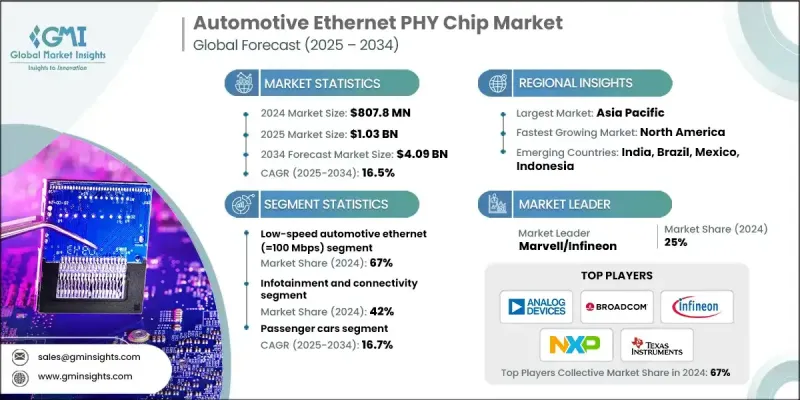
시장 성장은 보다 빠르고 안정적인 데이터 전송을 필요로 하는 자동차 전자 아키텍처의 급속한 진화에 의해 견인되고 있습니다. 이러한 PHY 칩은 복잡한 자동차 네트워크에서 단일 비차폐 트위스트 페어 케이블을 통한 신뢰성 있는 통신을 가능하게 합니다. 이 칩은 극단적인 온도, 진동, 전자기 간섭과 같은 가혹한 자동차 환경 조건을 견딜 수 있도록 설계되었으며 기능 안전 및 장기 신뢰성에 대한 AEC-Q100 Grade 1 및 IEC 61508과 같은 엄격한 표준을 충족하도록 설계되었습니다. 차량 네트워크가 IEEE 802.3bw 및 IEEE 802.3bp와 같은 표준화된 IEEE 이더넷 프로토콜을 점점 더 많이 채택함에 따라 자동차 제조업체는 플랫폼간에 높은 상호 운용성과 일관성을 실현하고 있습니다. ADAS(첨단 운전자 보조 시스템)와 자율주행기술의 확대에 따라 고속 및 저지연의 접속성에 대한 요구는 계속 증가하고 있습니다. PHY 칩은 센서, 레이더, 카메라, 인포테인먼트 시스템 간의 원활한 데이터 흐름을 지원하여 현대 차량의 안전성 향상과 커넥티드 모빌리티 경험의 실현에 기여하고 있습니다.
| 시장 범위 | |
|---|---|
| 시작 연도 | 2024년 |
| 예측 연도 | 2025-2034년 |
| 시작 가치 | 8억780만 달러 |
| 예측 금액 | 40억 9,000만 달러 |
| CAGR | 16.5% |
2024년 저속 자동차 이더넷(최대 100Mbps) 부문은 67%의 점유율을 차지했습니다. 이 부문은 광범위한 도입 실적과 널리 채택된 이더넷 표준과의 호환성으로 시장을 선도했습니다. 단일 트위스트 페어 케이블에서 효율적인 전이중 100Mbps 데이터 전송을 제공하는 이러한 PHY 칩은 게이트웨이 연결, 인포테인먼트 시스템 및 차량의 기본 네트워크 용도에 널리 사용됩니다.
승용차 부문은 2025년부터 2034년까지 연평균 복합 성장률(CAGR) 16.7%를 나타낼 것으로 예측됩니다. 세단, 해치백, SUV 및 고급 차량을 포함한 승용차는 이더넷 PHY 칩에 대한 수요를 가장 견인하고 있습니다. 그 이점은 전자 시스템의 통합 확대, 연결 기능에 대한 소비자의 관심 증가, 상용 차량에 비해 ADAS 기술의 조기 채용에 기인하고 있습니다.
중국의 자동차 이더넷 PHY 칩 시장은 2024년 2억 4,660만 달러 규모에 이르렀습니다. 세계 최대의 자동차 생산국인 중국에서는 2023년 승용차 2,610만대 이상, 상용차 400만대 이상을 생산했습니다. 이 생산 규모는 이더넷 기반 연결 시스템 도입에 유리한 환경을 창출하고 있습니다. 정부에 의한 지능화·커넥티드카 추진 시책이 국내 차종 전체에서의 PHY 칩 솔루션 채용을 가속시키고 있습니다. 자율주행, 텔레매틱스, 디지털 조종실 기술에 대한 규제 측면의 지원은 현지 자동차 제조업체들이 첨단 네트워크 아키텍처를 새로운 플랫폼에 통합하는 동기를 더욱 강화하고 있습니다.
자동차 이더넷 PHY 칩 시장의 주요 기업으로는 Analog Devices, Broadcom, Cadence Design Systems, Intel, Marvell / Infineon, Microchip Technology, MaxLinear, NXP Semiconductors, Qualcomm Technologies, Texas Instruments 등이 있습니다. 자동차 이더넷 PHY 칩 시장의 주요 기업은 경쟁 우위를 강화하기 위해 몇 가지 전략적 노력에 주력하고 있습니다. 많은 기업들이 진화하는 차량 아키텍처를 지원하는 고속, 에너지 절약, 컴팩트한 PHY 솔루션 개발을 위해 연구 개발에 많은 투자를 하고 있습니다. 제품 통합 및 테스트를 가속화하기 위해 자동차 제조업체 및 Tier 1 공급업체와의 전략적 제휴도 추진되고 있습니다. 또한 커넥티드카 수요 증가에 대응하기 위해 생산 능력 확대와 장기적인 공급망 확보에도 노력하고 있습니다.
자주 묻는 질문
목차
제1장 조사 방법
- 시장 범위와 정의
- 조사 설계
- 조사 접근
- 데이터 수집 방법
- 데이터 마이닝의 출처
- 세계
- 지역별/국가별
- 기본 추정치와 계산
- 기준연도 계산
- 시장 추정에서의 주요 동향
- 1차 조사 및 검증
- 1차 정보
- 예측
- 조사의 전제조건과 제한 사항
제2장 주요 요약
제3장 업계 인사이트
- 생태계 분석
- 공급자의 상황
- 이익률 분석
- 비용 구조
- 각 단계에서의 부가가치
- 밸류체인에 영향을 주는 요인
- 파괴적 혁신
- 업계에 미치는 영향요인
- 성장 촉진요인
- 전기자동차(EV) 및 첨단 운전자 보조 시스템(ADAS)의 보급 확대
- 소프트웨어 정의 차량(SDV)으로의 전환
- 신흥 시장에서의 자동차 생산 증가
- 저지연, 안전한 데이터 전송에 대한 수요
- 업계의 잠재적 위험 및 과제
- 자동차 등급 칩의 고액 개발 비용
- 연결 시스템의 사이버 보안 취약성
- 시장 기회
- 자율주행 및 V2X 생태계 성장
- EV 배터리 관리 및 텔레매틱스 확장
- 성장 촉진요인
- 성장 가능성 분석
- 규제 상황
- 북미
- 유럽
- 아시아태평양
- 라틴아메리카
- 중동 및 아프리카
- Porter's Five Forces 분석
- PESTEL 분석
- 기술과 혁신 동향
- 현재의 기술 동향
- 신흥기술
- 가격 동향
- 지역별
- 제품별
- 코스트 내역 분석
- 특허 분석
- 지속가능성과 환경면
- 탄소발자국 평가
- 순환형 경제에의 통합
- 전자폐기물 관리 요건
- 그린 제조 이니셔티브
- 이용 사례와 응용 예
- 최상의 시나리오
- 총소유비용분석
- 자동차 인증 프로세스 및 일정
- 공급망의 탄력성과 리스크 관리
- 제조 공정 분석과 수율 최적화
- 품질과 신뢰성의 지표
- 열 관리 솔루션과 소비 전력 분석
- 상호운용성 시험 및 인증 요건
- 진부화 관리 및 장기 지원 전략
제4장 경쟁 구도
- 서론
- 기업의 시장 점유율 분석
- 북미
- 유럽
- 아시아태평양
- 라틴아메리카
- 중동 및 아프리카
- 주요 시장 기업의 경쟁 분석
- 경쟁 포지셔닝 매트릭스
- 전략적 전망 매트릭스
- 주요 발전
- 인수 및 합병
- 파트너십 및 협력
- 신제품 발매
- 사업 확장 계획과 자금 조달
제5장 시장 추계·예측 : 제품별(2021-2034년)
- 주요 동향
- 저속 자동차 이더넷(=100Mbps)
- 10BASE-T1S
- 100BASE-T1
- 기가비트 자동차 이더넷(1000BASE-T1)
- 멀티기가비트 자동차 이더넷(1Gbps 초과)
- 2.5/5/10GBASE-T1
- 향후 표준(25G 이상)
제6장 시장 추계·예측 : 차량별(2021-2034년)
- 주요 동향
- 승용차
- 해치백
- 세단
- SUV
- 상용차
- 소형 상용차(LCV)
- 중형 상용차(MCV)
- 대형 상용차(HCV)
제7장 시장 추계·예측 : 용도별(2021-2034년)
- 주요 동향
- ADAS 및 자율주행
- 레이더 시스템
- LiDAR 센서
- 카메라
- 센서 융합
- 도메인 컨트롤러
- 인포테인먼트 및 커넥티비티
- 디스플레이 시스템
- 오디오 시스템
- 텔레매틱스
- 무선 업데이트
- 접속 게이트웨이
- 파워트레인 및 차량 다이나믹스
- 엔진 제어
- 변속기 제어
- 배터리 관리
- 섀시 제어
- 열 관리
- 차체 전자장치 및 편의 기능
- 도어 모듈
- 조명 시스템
- 기후 제어
- 시트 제어
- 접근 제어
- 게이트웨이 및 백본
- 중앙 게이트웨이
- 존 컨트롤러
- 이더넷 스위치
- 진단 시스템
- 보안 게이트웨이
제8장 시장 추계·예측 : 지역별(2021-2034년)
- 주요 동향
- 북미
- 미국
- 캐나다
- 유럽
- 독일
- 영국
- 프랑스
- 이탈리아
- 스페인
- 북유럽 국가
- 러시아
- 아시아태평양
- 중국
- 인도
- 일본
- 호주
- 한국
- 동남아시아
- 라틴아메리카
- 브라질
- 멕시코
- 아르헨티나
- 중동 및 아프리카
- 남아프리카
- 사우디아라비아
- 아랍에미리트(UAE)
제9장 기업 프로파일
- 세계의 기업
- Analog Devices
- Broadcom
- Marvell/Infineon
- Intel
- Marvell Technology
- NXP Semiconductors
- Qualcomm Technologies
- Texas Instruments
- 지역 기업
- Cadence Design Systems(PHY IP)
- MaxLinear
- MediaTek
- Onsemi
- Realtek Semiconductor
- Renesas Electronics
- Rohm Semiconductor
- STMicroelectronics
- 신흥기업/혁신기업
- Alphawave IP
- Aquantia
- Canova Tech
- Ethernovia
- Kandou Bus
- Valens Semiconductor
The Global Automotive Ethernet PHY Chip Market was valued at USD 807.8 million in 2024 and is estimated to grow at a CAGR of 16.5% to reach USD 4.09 billion by 2034.
Market growth is driven by the rapid evolution of in-vehicle electronic architectures that demand faster and more reliable data transmission. These PHY chips enable dependable communication over single, unshielded twisted pair cables across intricate automotive networks. Built to endure rigorous automotive conditions such as extreme temperatures, vibration, and electromagnetic interference, these chips are designed to meet stringent standards like AEC-Q100 Grade 1 and IEC 61508 for functional safety and long-term reliability. As vehicle networks increasingly adopt standardized IEEE Ethernet protocols, such as IEEE 802.3bw and IEEE 802.3bp, automakers are achieving greater interoperability and consistency across platforms. With advanced driver-assistance and autonomous driving technologies expanding, the need for high-speed, low-latency connectivity continues to grow. PHY chips support seamless data flow between sensors, radar, cameras, and infotainment systems, contributing to enhanced safety and connected mobility experiences across modern vehicles.
| Market Scope | |
|---|---|
| Start Year | 2024 |
| Forecast Year | 2025-2034 |
| Start Value | $807.8 Million |
| Forecast Value | $4.09 Billion |
| CAGR | 16.5% |
In 2024, the low-speed automotive Ethernet (up to 100 Mbps) segment held a 67% share. This segment remains the market leader due to its extensive installed base and compatibility with widely adopted Ethernet standards. Offering efficient full-duplex 100 Mbps data transfer over a single twisted pair cable, these PHY chips are widely utilized for gateway connections, infotainment systems, and basic networking applications within vehicles.
The passenger car segment is anticipated to grow at a CAGR of 16.7% from 2025 to 2034. Passenger cars, including sedans, hatchbacks, SUVs, and luxury models, continue to drive the highest demand for Ethernet PHY chips. Their dominance stems from the growing integration of electronic systems, increasing consumer interest in connectivity features, and early adoption of ADAS technologies compared with commercial vehicles.
China Automotive Ethernet PHY Chip Market generated USD 246.6 million in 2024. As the leading global producer of automobiles, China manufactured over 26.1 million passenger vehicles and 4 million commercial vehicles in 2023. This production scale has created a favorable environment for implementing Ethernet-based connectivity systems. Government initiatives promoting intelligent and connected vehicles have accelerated the use of PHY chip solutions across domestic vehicle models. Regulatory encouragement for autonomous driving, telematics, and digital cockpit technologies has further motivated local automakers to integrate advanced networking architectures into new platforms.
Leading companies in the Automotive Ethernet PHY Chip Market include Analog Devices, Broadcom, Cadence Design Systems, Intel, Marvell / Infineon, Microchip Technology, MaxLinear, NXP Semiconductors, Qualcomm Technologies, and Texas Instruments. Major players in the Automotive Ethernet PHY Chip Market are focusing on several strategic initiatives to strengthen their competitive position. Many companies are investing heavily in R&D to develop high-speed, energy-efficient, and compact PHY solutions that support evolving vehicle architectures. Strategic collaborations with automotive OEMs and Tier 1 suppliers are being pursued to accelerate product integration and testing. Firms are also expanding production capabilities and securing long-term supply chains to meet the growing demand for connected vehicles.
Table of Contents
Chapter 1 Methodology
- 1.1 Market scope and definition
- 1.2 Research design
- 1.2.1 Research approach
- 1.2.2 Data collection methods
- 1.3 Data mining sources
- 1.3.1 Global
- 1.3.2 Regional/Country
- 1.4 Base estimates and calculations
- 1.4.1 Base year calculation
- 1.4.2 Key trends for market estimation
- 1.5 Primary research and validation
- 1.5.1 Primary sources
- 1.6 Forecast
- 1.7 Research assumptions and limitations
Chapter 2 Executive Summary
- 2.1 Industry 360° synopsis, 2021 - 2034
- 2.2 Key market trends
- 2.2.1 Regional
- 2.2.2 Product
- 2.2.3 Vehicle
- 2.2.4 Application
- 2.3 TAM Analysis, 2025-2034
- 2.4 CXO perspectives: Strategic imperatives
- 2.4.1 Executive decision points
- 2.4.2 Critical success factors
- 2.5 Future outlook and strategic recommendations
Chapter 3 Industry Insights
- 3.1 Industry ecosystem analysis
- 3.1.1 Supplier landscape
- 3.1.2 Profit margin analysis
- 3.1.3 Cost structure
- 3.1.4 Value addition at each stage
- 3.1.5 Factor affecting the value chain
- 3.1.6 Disruptions
- 3.2 Industry impact forces
- 3.2.1 Growth drivers
- 3.2.1.1 Increasing adoption of EVs and ADAS
- 3.2.1.2 Shift to software-defined vehicles (SDV)
- 3.2.1.3 Rising vehicle production in emerging markets
- 3.2.1.4 Demand for low-latency, secure data transmission
- 3.2.2 Industry pitfalls and challenges
- 3.2.2.1 High development costs for automotive-grade chips
- 3.2.2.2 Cybersecurity vulnerabilities in connected systems
- 3.2.3 Market opportunities
- 3.2.3.1 Growth in autonomous driving and V2X ecosystems
- 3.2.3.2 Expansion of EV battery management and telematics
- 3.2.1 Growth drivers
- 3.3 Growth potential analysis
- 3.4 Regulatory landscape
- 3.4.1 North America
- 3.4.2 Europe
- 3.4.3 Asia Pacific
- 3.4.4 Latin America
- 3.4.5 Middle East & Africa
- 3.5 Porter's analysis
- 3.6 Pestel analysis
- 3.7 Technology and innovation landscape
- 3.7.1 Current technological trends
- 3.7.2 Emerging technologies
- 3.8 Price trends
- 3.8.1 By region
- 3.8.2 By product
- 3.9 Cost breakdown analysis
- 3.10 Patent analysis
- 3.11 Sustainability & environmental aspects
- 3.11.1 Carbon Footprint Assessment
- 3.11.2 Circular Economy Integration
- 3.11.3 E-Waste Management Requirements
- 3.11.4 Green Manufacturing Initiatives
- 3.12 Use cases and applications
- 3.13 Best-case scenario
- 3.14 Total cost of ownership analysis
- 3.15 Automotive qualification processes & timelines
- 3.16 Supply chain resilience & risk management
- 3.17 Manufacturing process analysis & yield optimization
- 3.18 Quality & reliability metrics
- 3.19 Thermal management solutions & power Consumption Analysis
- 3.20 Interoperability Testing & Certification Requirements
- 3.21 Obsolescence Management & Long-Term Support Strategies
Chapter 4 Competitive Landscape, 2024
- 4.1 Introduction
- 4.2 Company market share analysis
- 4.2.1 North America
- 4.2.2 Europe
- 4.2.3 Asia Pacific
- 4.2.4 LATAM
- 4.2.5 MEA
- 4.3 Competitive analysis of major market players
- 4.4 Competitive positioning matrix
- 4.5 Strategic outlook matrix
- 4.6 Key developments
- 4.6.1 Mergers & acquisitions
- 4.6.2 Partnerships & collaborations
- 4.6.3 New product launches
- 4.6.4 Expansion plans and funding
Chapter 5 Market Estimates & Forecast, By Product, 2021 - 2034 ($Mn, units)
- 5.1 Key trends
- 5.2 Low-Speed Automotive Ethernet (=100 Mbps)
- 5.2.1 10BASE-T1S
- 5.2.2 100BASE-T1
- 5.3 Gigabit Automotive Ethernet (1000BASE-T1)
- 5.4 Multi-Gigabit Automotive Ethernet (>1 Gbps)
- 5.4.1 2.5/5/10GBASE-T1
- 5.4.2 Future Standards (25G+)
Chapter 6 Market Estimates & Forecast, By Vehicle, 2021 - 2034 ($Mn, Units)
- 6.1 Key trends
- 6.2 Passenger Cars
- 6.2.1 Hatchback
- 6.2.2 Sedan
- 6.2.3 SUV
- 6.3 Commercial Vehicles
- 6.3.1 Light Commercial Vehicles (LCV)
- 6.3.2 Medium Commercial Vehicles (MCV)
- 6.3.3 Heavy Commercial Vehicles (HCV)
Chapter 7 Market Estimates & Forecast, By Application, 2021 - 2034 ($Mn, Units)
- 7.1 Key trends
- 7.2 ADAS and Autonomous Driving
- 7.2.1 Radar Systems
- 7.2.2 LiDAR Sensors
- 7.2.3 Cameras
- 7.2.4 Sensor Fusion
- 7.2.5 Domain Controllers
- 7.3 Infotainment and Connectivity
- 7.3.1 Display Systems
- 7.3.2 Audio Systems
- 7.3.3 Telematics
- 7.3.4 Over-the-Air Updates
- 7.3.5 Connectivity Gateways
- 7.4 Powertrain and Vehicle Dynamics
- 7.4.1 Engine Control
- 7.4.2 Transmission Control
- 7.4.3 Battery Management
- 7.4.4 Chassis Control
- 7.4.5 Thermal Management
- 7.5 Body Electronics and Comfort
- 7.5.1 Door Modules
- 7.5.2 Lighting Systems
- 7.5.3 Climate Control
- 7.5.4 Seat Control
- 7.5.5 Access Control
- 7.6 Gateway and Backbone
- 7.6.1 Central Gateways
- 7.6.2 Zone Controllers
- 7.6.3 Ethernet Switches
- 7.6.4 Diagnostic Systems
- 7.6.5 Security Gateways
Chapter 8 Market Estimates & Forecast, By Region, 2021 - 2034 ($Mn, Units)
- 8.1 Key trends
- 8.2 North America
- 8.2.1 US
- 8.2.2 Canada
- 8.3 Europe
- 8.3.1 Germany
- 8.3.2 UK
- 8.3.3 France
- 8.3.4 Italy
- 8.3.5 Spain
- 8.3.6 Nordics
- 8.3.7 Russia
- 8.4 Asia Pacific
- 8.4.1 China
- 8.4.2 India
- 8.4.3 Japan
- 8.4.4 Australia
- 8.4.5 South Korea
- 8.4.6 Southeast Asia
- 8.5 Latin America
- 8.5.1 Brazil
- 8.5.2 Mexico
- 8.5.3 Argentina
- 8.6 MEA
- 8.6.1 South Africa
- 8.6.2 Saudi Arabia
- 8.6.3 UAE
Chapter 9 Company Profiles
- 9.1 Global Players
- 9.1.1 Analog Devices
- 9.1.2 Broadcom
- 9.1.3 Marvell / Infineon
- 9.1.4 Intel
- 9.1.5 Marvell Technology
- 9.1.6 NXP Semiconductors
- 9.1.7 Qualcomm Technologies
- 9.1.8 Texas Instruments
- 9.2 Regional Players
- 9.2.1 Cadence Design Systems (PHY IP)
- 9.2.2 MaxLinear
- 9.2.3 MediaTek
- 9.2.4 Onsemi
- 9.2.5 Realtek Semiconductor
- 9.2.6 Renesas Electronics
- 9.2.7 Rohm Semiconductor
- 9.2.8 STMicroelectronics
- 9.3 Emerging Players/Disruptors
- 9.3.1 Alphawave IP
- 9.3.2 Aquantia
- 9.3.3 Canova Tech
- 9.3.4 Ethernovia
- 9.3.5 Kandou Bus
- 9.3.6 Valens Semiconductor