
|
시장보고서
상품코드
1876600
디지털 페노타이핑 시장 : 시장 기회, 성장 요인, 업계 동향 분석 및 예측(2025-2034년)Digital Phenotyping Market Opportunity, Growth Drivers, Industry Trend Analysis, and Forecast 2025 - 2034 |
||||||

세계의 디지털 페노타이핑 시장은 2024년에 15억 달러로 평가되었고, 2034년까지 연평균 복합 성장률(CAGR) 9.7%로 성장할 전망이며, 38억 달러에 이를 것으로 예측됩니다.
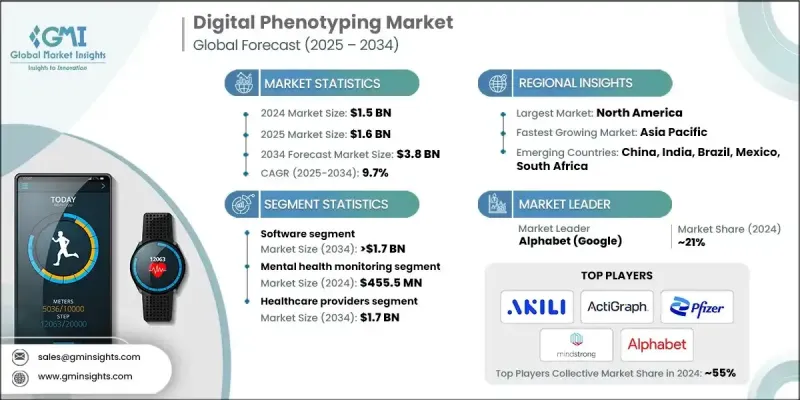
시장 성장은 만성질환 및 정신질환의 발생률 증가에 더해 스마트폰 및 웨어러블 건강기기의 보급에 의해 추진되고 있습니다. 이러한 기술은 움직임, 심박수, 수면 패턴, 위치 정보를 추적하는 센서를 통한 수동적이고 지속적인 데이터 수집을 가능하게 합니다. 수집된 데이터는 디지털 페노타이핑 시스템의 기반을 형성하고 건강 모니터링 및 행동 분석을 지원합니다. 인공지능(AI) 및 머신러닝(ML)의 통합이 진행됨에 따라 예측 분석, 맞춤형 치료, 질병의 조기 발견이 가능해지고 시장은 더욱 변화하고 있습니다. 또한 디지털 페노타이핑은 모바일 디바이스와의 상호작용, 음성 및 활동 데이터를 통해 인간 행동의 미묘한 변화를 포착함으로써 행동 조사 및 임상시험의 방식을 재정의합니다. 이 진화하는 분야는 지금까지 객관적으로 측정하기가 어려웠던 환자의 건강 상태 및 생활 습관 패턴에 관한 지견을 제공함으로써, 헬스케어에 혁명을 가져오고 있습니다.
| 시장 범위 | |
|---|---|
| 시작 연도 | 2024년 |
| 예측 기간 | 2025-2034년 |
| 시작 시 가치 | 15억 달러 |
| 예측 금액 | 38억 달러 |
| CAGR | 9.7% |
소프트웨어 부문은 2024년에 43.3%의 점유율을 차지했고, 2034년까지 17억 달러에 이를 전망이며, CAGR 10.1%로 성장할 것으로 예측됩니다. 이 부문에는 클라우드 기반 및 온프레미스 플랫폼이 모두 포함됩니다. 소프트웨어는 스마트폰 및 웨어러블 센서를 이용한 행동 및 생리 데이터의 실시간 수집 및 분석을 가능하게 함으로써 디지털 페노타이핑에 중요한 역할을 합니다. 이러한 시스템의 AI 및 머신러닝 기술은 예측 모델링, 이상 감지 및 지속적인 행동 모니터링을 촉진합니다. 이 부문의 성장은 전통적인 임상 환경을 넘어서는 임상의와 조사자에게 실용적인 지식 제공 능력, 정신적, 신체적 건강 용도 분야 모두에서 환자 참여 및 헬스케어 성과의 향상에 의해 견인되었습니다.
정신건강 모니터링 분야는 2024년 4억 5,550만 달러 시장 규모를 기록했습니다. 불안 장애, 우울증, 양극성 장애와 같은 정신 질환의 유병률은 세계적으로 증가하고 있으며, 확장 가능한 기술 중심의 정신 건강 솔루션의 필요성을 가속화하고 있습니다. COVID-19 팬데믹의 지속적인 영향은 이 수요를 더욱 증폭시키며, 지속적이고 객관적인 모니터링을 가능하게 하는 디지털 툴의 도입 확대로 이어지고 있습니다. 디지털 페노타이핑 애플리케이션은 스마트폰 기반 데이터와 인간 및 컴퓨터 간의 상호작용을 활용하고 정신 건강을 평가함으로써 고통과 행동 변화에 대한 조기 경고 표시를 제공합니다. 이 접근법은 전통적인 치료 모델을 대체하기 위해 합리적인 가격으로 원격 및 스티그마가 없는 옵션을 제공함으로써 정신 건강 관리의 접근성 격차 해소에 기여합니다.
북미의 디지털 페노타이핑 시장은 2024년 44.6%의 점유율을 차지했습니다. 이 지역의 주도적 입장은 견고한 헬스케어 인프라, 높은 스마트폰 보급률, 웨어러블 기술의 조기 도입에 의해 지원되고 있습니다. 북미 기업은 AI 및 머신러닝 기능을 디지털 페노타이핑 플랫폼에 빠르게 통합하여 맞춤 치료 계획, 예측 분석 및 환자 참여를 향상시킵니다. 첨단 기술 생태계와 적극적인 의료 혁신의 융합으로, 이 지역은 디지털 페노타이핑 도입의 주요 성장 기지로서의 지위를 확립하고 있습니다.
세계 디지털 페노타이핑 시장의 주요 기업으로는 Akili Interactive Labs, AliveCor, Fitbit, F. Hoffmann-La Roche, GlaxoSmithKline, ActiGraph, HumanAPI, Mindstrong, Alphabet(Google), Onnela Lab, Novartis, Sanofi, Takeda Pharmaceuticals, Pfizer 등이 포함됩니다. 디지털 페노타이핑 시장의 주요 기업은 경쟁 우위와 시장 포지션을 강화하기 위해 여러 전략을 채택하고 있습니다. 많은 기업들이 예측 능력을 향상시키고 맞춤형 건강 인사이트를 제공하기 위해 고급 AI 및 머신러닝 알고리즘에 대한 투자를 추진하고 있습니다. 또한 데이터 통합 및 임상 검증을 가속화하기 위해 의료 제공업체, 연구 기관 및 디지털 건강 스타트업과의 전략적 제휴를 확대하고 있습니다. 또한 다양한 최종 사용자를 지원하기 위해 클라우드 기반 및 하이브리드 플랫폼 제공을 통한 제품 다양화에 주력하고 있습니다.
자주 묻는 질문
목차
제1장 조사 방법 및 범위
제2장 주요 요약
제3장 업계 인사이트
- 생태계 분석
- 각 단계에서의 부가가치
- 밸류체인에 영향을 주는 요인
- 업계에 미치는 영향요인
- 성장 촉진요인
- 정신 건강 및 만성 질환의 유병률 상승
- 스마트폰 및 웨어러블 디바이스의 보급 확대
- 가치에 기초한 의료 및 예방 의료로의 이행의 진전
- 원격 의료 및 원격 모니터링의 확대 진행
- 업계의 잠재적 위험 및 과제
- 데이터 프라이버시에 관한 우려, 규제상의 과제
- 표준화의 부족
- 시장 기회
- 임상시험 및 제약 분야로의 확대
- 행동조사 및 집단 건강 분석에 대한 주목의 고조
- 성장 촉진요인
- 성장 가능성 분석
- 규제 상황
- 북미
- 미국
- 캐나다
- 유럽
- 아시아태평양
- 북미
- 기술 동향
- 현재의 기술 동향
- 신흥 기술
- 장래 시장 동향
- Porter's Five Forces 분석
- PESTEL 분석
제4장 경쟁 구도
- 서문
- 기업의 시장 점유율 분석
- 세계
- 북미
- 유럽
- 기업 매트릭스 분석
- 주요 시장 기업의 경쟁 분석
- 경쟁 포지셔닝 매트릭스
- 주요 발전
- 합병 및 인수
- 제휴 및 협력 관계
- 신제품 발매
- 확대 계획
제5장 시장 추계 및 예측 : 컴포넌트별(2021-2034년)
- 주요 동향
- 하드웨어
- 웨어러블 디바이스
- 바이오센서
- 기타 접속 디바이스
- 소프트웨어
- 클라우드 기반
- 온프레미스
- 서비스
제6장 시장 추계 및 예측 : 용도별(2021-2034년)
- 주요 동향
- 정신 건강 모니터링
- 만성 질환 관리
- 행동 조사
- 수면 및 변동 분석
- 신경퇴행성 질환
- 기타 용도
제7장 시장 추계 및 예측 : 최종 용도별(2021-2034년)
- 주요 동향
- 의료 제공자
- 지불 기관
- 제약회사
- 기타 최종 용도
제8장 시장 추계 및 예측 : 지역별(2021-2034년)
- 주요 동향
- 북미
- 미국
- 캐나다
- 유럽
- 독일
- 영국
- 프랑스
- 스페인
- 이탈리아
- 네덜란드
- 아시아태평양
- 중국
- 일본
- 인도
- 호주
- 한국
- 라틴아메리카
- 브라질
- 멕시코
- 아르헨티나
- 중동 및 아프리카
- 남아프리카
- 사우디아라비아
- 아랍에미리트(UAE)
제9장 기업 프로파일
- Akili Interactive Labs
- ActiGraph
- AliveCor
- Alphabet(Google)
- F. Hoffmann-La Roche
- Fitbit
- GlaxoSmithKline
- HumanAPI
- Mindstrong
- Novartis
- Onnela lab
- Pfizer
- Sanofi
- Takeda Pharmaceuticals
The Global Digital Phenotyping Market was valued at USD 1.5 billion in 2024 and is estimated to grow at a CAGR of 9.7% to reach USD 3.8 billion by 2034.
Market growth is propelled by the increasing incidence of chronic diseases and mental health conditions, along with the widespread adoption of smartphones and wearable health devices. These technologies enable passive, continuous data collection through sensors that track movement, heart rate, sleep patterns, and location. The collected data form the foundation of digital phenotyping systems, supporting health monitoring and behavioral analysis. The growing integration of artificial intelligence (AI) and machine learning (ML) is further transforming the market by enabling predictive analytics, personalized treatments, and early disease detection. Additionally, digital phenotyping is redefining behavioral research and clinical trials by capturing subtle changes in human behavior through mobile device interactions, speech, and activity data. This evolving field is revolutionizing healthcare by providing insights into patient health and lifestyle patterns that were previously difficult to measure objectively.
| Market Scope | |
|---|---|
| Start Year | 2024 |
| Forecast Year | 2025-2034 |
| Start Value | $1.5 Billion |
| Forecast Value | $3.8 Billion |
| CAGR | 9.7% |
The software segment held a 43.3% share in 2024 and is expected to reach USD 1.7 billion by 2034, growing at a CAGR of 10.1%. This segment includes both cloud-based and on-premises platforms. Software plays a critical role in digital phenotyping by enabling the real-time collection and analysis of behavioral and physiological data using smartphone and wearable sensors. AI and ML technologies within these systems facilitate predictive modeling, anomaly detection, and continuous behavioral monitoring. The segment's growth is driven by its ability to provide actionable insights for clinicians and researchers beyond traditional clinical settings, improving patient engagement and health management outcomes across both mental and physical health applications.
The mental health monitoring segment captured USD 455.5 million in 2024. The prevalence of mental health disorders such as anxiety, depression, and bipolar disorder continues to rise worldwide, accelerating the need for scalable, technology-driven mental health solutions. The lingering effects of the COVID-19 pandemic have amplified this demand, leading to increased adoption of digital tools that allow for continuous and objective monitoring. Digital phenotyping applications use smartphone-based data and human-computer interactions to evaluate mental well-being, providing early warning signs of distress or behavioral changes. This approach helps bridge accessibility gaps in mental healthcare by offering affordable, remote, and stigma-free alternatives to traditional therapy models.
North America Digital Phenotyping Market held a 44.6% share in 2024. The region's leadership is driven by strong healthcare infrastructure, high smartphone usage, and early adoption of wearable technologies. Companies in North America are rapidly incorporating AI and ML capabilities into digital phenotyping platforms, enabling personalized treatment planning, predictive analysis, and improved patient engagement. The combination of advanced technological ecosystems and proactive healthcare innovation has positioned the region as a key growth hub for digital phenotyping adoption.
Major players in the Global Digital Phenotyping Market include Akili Interactive Labs, AliveCor, Fitbit, F. Hoffmann-La Roche, GlaxoSmithKline, ActiGraph, HumanAPI, Mindstrong, Alphabet (Google), Onnela Lab, Novartis, Sanofi, Takeda Pharmaceuticals, and Pfizer. Leading companies in the Digital Phenotyping Market are employing multiple strategies to strengthen their competitive edge and market position. Many are investing in advanced AI and ML algorithms to enhance predictive capabilities and deliver personalized health insights. Firms are expanding strategic collaborations with healthcare providers, research organizations, and digital health startups to accelerate data integration and clinical validation. Companies are also focusing on product diversification, offering cloud-based and hybrid platforms to serve varied end users.
Table of Contents
Chapter 1 Methodology and Scope
- 1.1 Market scope and definition
- 1.2 Research design
- 1.2.1 Research approach
- 1.2.2 Data collection methods
- 1.3 Data mining sources
- 1.3.1 Global
- 1.3.2 Regional/Country
- 1.4 Base estimates and calculations
- 1.4.1 Base year calculation
- 1.4.2 Key trends for market estimation
- 1.5 Primary research and validation
- 1.5.1 Primary sources
- 1.6 Forecast model
- 1.7 Research assumptions and limitations
Chapter 2 Executive Summary
- 2.1 Industry 360° synopsis
- 2.2 Key market trends
- 2.2.1 Regional trends
- 2.2.2 Component trends
- 2.2.3 Application trends
- 2.2.4 End Use trends
- 2.3 CXO perspectives: Strategic imperatives
- 2.3.1 Key decision points for industry executives
- 2.3.2 Critical success factors for market players
- 2.4 Future outlook and strategic recommendations
Chapter 3 Industry Insights
- 3.1 Industry ecosystem analysis
- 3.1.1 Value addition at each stage
- 3.1.2 Factors affecting the value chain
- 3.2 Industry impact forces
- 3.2.1 Growth drivers
- 3.2.1.1 Rising prevalence of mental health and chronic conditions
- 3.2.1.2 Increasing proliferation of smartphones and wearables
- 3.2.1.3 Growing shift toward value-based and preventive care
- 3.2.1.4 Increasing expansion of telehealth and remote monitoring
- 3.2.2 Industry pitfalls and challenges
- 3.2.2.1 Data privacy concerns, regulatory challenges
- 3.2.2.2 Lack of standardization
- 3.2.3 Market opportunities
- 3.2.3.1 Expansion into clinical trials and pharma
- 3.2.3.2 Growing focus on behavioral research and population health analytics
- 3.2.1 Growth drivers
- 3.3 Growth potential analysis
- 3.4 Regulatory landscape
- 3.4.1 North America
- 3.4.1.1 U.S.
- 3.4.1.2 Canada
- 3.4.2 Europe
- 3.4.3 Asia Pacific
- 3.4.1 North America
- 3.5 Technology landscape
- 3.5.1 Current technological trends
- 3.5.2 Emerging technologies
- 3.6 Future market trends
- 3.7 Porter's analysis
- 3.8 PESTEL analysis
Chapter 4 Competitive Landscape, 2024
- 4.1 Introduction
- 4.2 Company market share analysis
- 4.2.1 Global
- 4.2.2 North America
- 4.2.3 Europe
- 4.3 Company matrix analysis
- 4.4 Competitive analysis of major market players
- 4.5 Competitive positioning matrix
- 4.6 Key developments
- 4.6.1 Merger and acquisition
- 4.6.2 Partnership and collaboration
- 4.6.3 New product launches
- 4.6.4 Expansion plans
Chapter 5 Market Estimates and Forecast, By Component, 2021 - 2034 ($ Mn)
- 5.1 Key trends
- 5.2 Hardware
- 5.2.1 Wearables
- 5.2.2 Biosensors
- 5.2.3 Other connected devices
- 5.3 Software
- 5.3.1 Cloud-based
- 5.3.2 On-premises
- 5.4 Services
Chapter 6 Market Estimates and Forecast, By Application, 2021 - 2034 ($ Mn)
- 6.1 Key trends
- 6.2 Mental health monitoring
- 6.3 Chronic disease management
- 6.4 Behavioral research
- 6.5 Sleep and movement analysis
- 6.6 Neurodegenerative disorders
- 6.7 Other applications
Chapter 7 Market Estimates and Forecast, By End Use, 2021 - 2034 ($ Mn)
- 7.1 Key trends
- 7.2 Healthcare providers
- 7.3 Payers
- 7.4 Pharmaceutical companies
- 7.5 Other End Use
Chapter 8 Market Estimates and Forecast, By Region, 2021 - 2034 ($ Mn)
- 8.1 Key trends
- 8.2 North America
- 8.2.1 U.S.
- 8.2.2 Canada
- 8.3 Europe
- 8.3.1 Germany
- 8.3.2 UK
- 8.3.3 France
- 8.3.4 Spain
- 8.3.5 Italy
- 8.3.6 Netherlands
- 8.4 Asia Pacific
- 8.4.1 China
- 8.4.2 Japan
- 8.4.3 India
- 8.4.4 Australia
- 8.4.5 South Korea
- 8.5 Latin America
- 8.5.1 Brazil
- 8.5.2 Mexico
- 8.5.3 Argentina
- 8.6 Middle East and Africa
- 8.6.1 South Africa
- 8.6.2 Saudi Arabia
- 8.6.3 UAE
Chapter 9 Company Profiles
- 9.1 Akili Interactive Labs
- 9.2 ActiGraph
- 9.3 AliveCor
- 9.4 Alphabet (Google)
- 9.5 F. Hoffmann-La Roche
- 9.6 Fitbit
- 9.7 GlaxoSmithKline
- 9.8 HumanAPI
- 9.9 Mindstrong
- 9.10 Novartis
- 9.11 Onnela lab
- 9.12 Pfizer
- 9.13 Sanofi
- 9.14 Takeda Pharmaceuticals