

|
시장보고서
상품코드
1876610
저장 증기 회수 장치 시장 : 시장 기회, 성장 촉진요인, 업계 동향 분석, 예측(2025-2034년)Storage Vapor Recovery Units Market Opportunity, Growth Drivers, Industry Trend Analysis, and Forecast 2025 - 2034 |
||||||

세계의 저장 증기 회수 장치 시장은 2024년에 5억 9,160만 달러로 평가되었고, 2034년까지 연평균 복합 성장률(CAGR) 5.5%로 성장할 전망이며, 10억 1,000만 달러에 이를 것으로 예측됩니다.
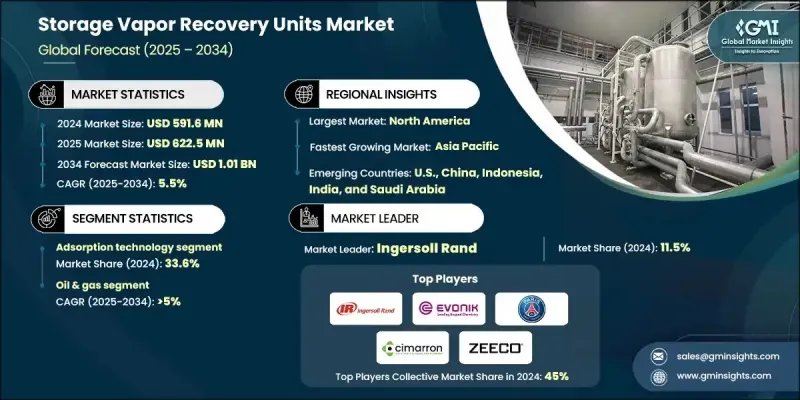
시장의 꾸준한 확대는 모듈식이고 에너지 효율적인 시스템 설계의 진보와 더불어 업계 전반에 걸쳐 유지보수의 노력이 적은 회수 솔루션에 대한 수요가 높아지고 있기 때문입니다. 저장 증기 회수 장치(VRU)는 충전 작업 및 온도 변동과 같은 작동 중에 저장 탱크에서 방출되는 탄화수소 증기를 포착 및 회수하도록 설계되었습니다. 이러한 증기는 휘발성 유기 화합물(VOC)을 포함하며, 환경 오염의 원인이 될 뿐만 아니라 귀중한 탄화수소의 손실로 이어집니다. 스마트 센서와 원격 감시 시스템의 통합이 진행됨에 따라 예지 보전의 실현과 투명성의 향상을 통해 운영 환경이 변화되고 있습니다. 화학 및 의약품 저장 시설에서의 VOC 배출 관리의 중요성이 높아지는 가운데 고효율 회수 기술의 채용이 더욱 촉진되고 있습니다. 소규모 및 도시 설치용으로 설계된 컴팩트 VRU의 채용이 급속히 진행되는 한편, 우수한 회수 효율과 유연성을 갖춘 활성탄 기반의 시스템도 인기를 끌고 있습니다. 또한, 온도에 민감한 저장 작업에서 극저온 응축 기술의 전개는 특수 용도에서 새로운 기회를 창출하고 있습니다. 기존의 석유 및 가스 분야를 넘어서는 배출 규제 프레임워크 확대는 여러 산업에 걸친 선진적인 증기회수 인프라 수요를 더욱 촉진하고 있습니다.
| 시장 범위 | |
|---|---|
| 시작 연도 | 2024년 |
| 예측 기간 | 2025-2034년 |
| 시작 금액 | 5억 9,160만 달러 |
| 예측 금액 | 10억 1,000만 달러 |
| CAGR | 5.5% |
응축 기반 기술 부문은 2024년 1억 3,710만 달러로 평가되었습니다. 저온 증기 회수에 대한 요구 증가가 특히 화학 및 제약 시설에 있어서 응축 베이스의 VRU(증기 회수 장치)의 도입을 촉진하고 있습니다. 기계 및 극저온 응축 기술의 지속적인 혁신으로 증기 회수율이 크게 향상되고 산업 배출 가스 제어 효율이 향상되었습니다.
석유 및 가스 분야에서는 2025-2034년 연평균 복합 성장률(CAGR) 5%의 성장이 예상됩니다. 업스트림 및 중류 저장 인프라의 개발 확대가 석유 및 가스 용도에 있어서 증기 회수 장치 수요를 견인하는 주요인이 되고 있습니다. 탱크 농장, 정유소 및 적출 터미널에서 탄화수소 배출을 줄이기 위해 환경 규제를 강화함으로써 VRU의 도입은 컴플라이언스의 필수 요구 사항이 되었습니다. 메탄 및 VOC 감축 전략에 중점화가 진행되고 있는 가운데, 이러한 시스템은 에너지 산업 전체의 배출 관리 틀에서 필수적인 구성 요소가 되고 있습니다.
유럽의 저장 증기 회수 장치 시장은 2024년에 1억 7,240만 달러로 평가되었습니다. EU의 VOC 지침에 근거한 엄격한 규제 기준은 산업 저장 시설 전체에서 VRU 도입을 촉진하는 견조한 환경을 창출하고 있습니다. 지속 가능한 물류와 친환경 인프라 투자 증가는 이 지역 시장 확대에 계속 기여하고 있습니다. 첨단 멤브레인 기술과 흡착 기술의 지속적인 도입으로 시스템 효율성이 향상되고 지역의 저배출형 산업 관행으로의 전환을 지원하고 있습니다.
세계의 저장 증기 회수 장치 시장에서 활동하는 주요 기업으로는 Cimarron Energy, KAPPA GI, Koch Engineered Solutions, Cool Sorption, Ingersoll Rand, Tecam, ALMA Group, Kilburn Engineering, BORSIG, Evonik, Zeeco, VOCZero, Flogistix, SCS Technologies, S&S Technical, LeROI, PETROGAS, SYMEX Technologies, PSG, Reynold India 등이 있습니다. 저장 증기 회수 장치 시장의 주요 기업은 시장의 지위를 강화하기 위해 제품 혁신, 기술 진보 및 전략적 제휴에 주력하고 있습니다. 많은 기업들이 스마트 센서 및 디지털 감시 기능을 갖춘 모듈식 플러그 앤 플레이 VRU를 개발하여 운영 효율성을 높이고 유지보수 수요를 줄이기 위해 노력하고 있습니다. 기업은 공간 제약이 있는 산업 환경에 대응하기 위해 에너지 최적화와 시스템의 컴팩트화를 중시하고 있습니다. 최종 사용자와 EPC 계약자와의 전략적 제휴는 유통 네트워크의 확대와 애프터 서비스의 향상에 기여하고 있습니다.
자주 묻는 질문
목차
제1장 조사 방법 및 범위
제2장 주요 요약
제3장 업계 인사이트
- 업계 생태계 분석
- 원재료 가용성 및 조달 분석
- 제조 능력 평가
- 공급망의 회복력 및 리스크 요인
- 유통 네트워크 분석
- 규제 상황
- 업계에 미치는 영향요인
- 성장 촉진요인
- 업계의 잠재적 리스크 및 과제
- 성장 가능성 분석
- Porter's Five Forces 분석
- PESTEL 분석
- 증기 회수 장치의 비용 구조 분석
- 새로운 기회 및 동향
- 디지털화 및 IoT 통합
- 투자 분석 및 전망
제4장 경쟁 구도
- 서문
- 기업의 시장 점유율 분석 : 지역별
- 북미
- 유럽
- 아시아태평양
- 중동 및 아프리카
- 라틴아메리카
- 전략적 대시보드
- 주요 파트너십 협업
- 주요 M&A 활동
- 제품의 혁신 및 발매
- 시장 확대 전략
- 전략적 노력
- 경쟁 벤치마킹
- 혁신 및 기술 동향
제5장 시장 규모 및 예측 : 기술별(2021-2034년)
- 주요 동향
- 응축
- 흡착
- 흡수
- 압축
제6장 시장 규모 및 예측 : 최종 용도별(2021-2034년)
- 주요 동향
- 석유 및 가스
- 화학제품 및 석유화학제품
- 기타
제7장 시장 규모 및 예측 : 지역별(2021-2034년)
- 주요 동향
- 북미
- 미국
- 캐나다
- 유럽
- 영국
- 독일
- 프랑스
- 이탈리아
- 스페인
- 러시아
- 노르웨이
- 폴란드
- 아시아태평양
- 중국
- 인도
- 일본
- 한국
- 인도네시아
- 말레이시아
- 중동 및 아프리카
- 사우디아라비아
- 아랍에미리트(UAE)
- 카타르
- 이집트
- 오만
- 남아프리카
- 나이지리아
- 라틴아메리카
- 브라질
- 멕시코
- 아르헨티나
제8장 기업 프로파일
- ALMA Group
- BORSIG
- Cimarron Energy
- Cool Sorption
- Evonik
- Flogistix
- Ingersoll Rand
- KAPPA GI
- Kilburn Engineering
- Koch Engineered Solutions
- LeROI
- PETROGAS
- PSG
- Reynold India
- S&S Technical
- SCS Technologies
- SYMEX Technologies
- Tecam
- VOCZero
- Zeeco
The Global Storage Vapor Recovery Units Market was valued at USD 591.6 million in 2024 and is estimated to grow at a CAGR of 5.5% to reach USD 1.01 billion by 2034.
The market's steady expansion is driven by advancements in modular and energy-efficient system design, coupled with the rising need for low-maintenance recovery solutions across industries. Storage vapor recovery units (VRUs) are engineered to capture and reclaim hydrocarbon vapors released from storage tanks during operations such as filling or temperature variations. These vapors contain volatile organic compounds that not only contribute to environmental pollution but also represent a loss of valuable hydrocarbons. The growing integration of smart sensors and remote monitoring systems is transforming the operational landscape by enabling predictive maintenance and improving transparency. Increasing emphasis on controlling VOC emissions in chemical and pharmaceutical storage facilities continues to propel the adoption of high-efficiency recovery technologies. Compact VRUs designed for small-scale and urban installations are witnessing rapid uptake, while activated carbon-based systems are gaining popularity due to their superior recovery efficiency and flexibility. Furthermore, the deployment of cryogenic condensation technologies in temperature-sensitive storage operations is creating new opportunities in specialized applications. Expanding regulatory frameworks addressing emission control beyond traditional oil and gas sectors are further driving demand for advanced vapor recovery infrastructure across multiple industries.
| Market Scope | |
|---|---|
| Start Year | 2024 |
| Forecast Year | 2025-2034 |
| Start Value | $591.6 Million |
| Forecast Value | $1.01 Billion |
| CAGR | 5.5% |
The condensation-based technology segment was valued at USD 137.1 million in 2024. Rising requirements for low-temperature vapor recovery are fueling the adoption of condensation-based VRUs, especially in chemical and pharmaceutical facilities. Continued innovation in mechanical and cryogenic condensation techniques is significantly improving vapor capture rates and enhancing the efficiency of industrial emission control.
The oil & gas sector is projected to grow at a CAGR of 5% between 2025 and 2034. The increasing development of upstream and midstream storage infrastructure is a major factor driving the need for vapor recovery units in oil and gas applications. Strengthening environmental regulations aimed at reducing hydrocarbon emissions from tank farms, refineries, and loading terminals has made the integration of VRUs a compliance imperative. With a growing emphasis on methane and VOC reduction strategies, these systems are becoming vital components in emission management frameworks throughout the energy industry.
Europe Storage Vapor Recovery Units Market was valued at USD 172.4 million in 2024. Strict regulatory standards under EU VOC directives are creating a robust environment for VRU adoption across industrial storage sites. Rising investment in sustainable logistics and environmentally responsible infrastructure continues to contribute to the region's market expansion. Ongoing adoption of advanced membrane and adsorption technologies is improving system efficiency and supporting the region's transition toward low-emission industrial practices.
Prominent companies operating in the Global Storage Vapor Recovery Units Market include Cimarron Energy, KAPPA GI, Koch Engineered Solutions, Cool Sorption, Ingersoll Rand, Tecam, ALMA Group, Kilburn Engineering, BORSIG, Evonik, Zeeco, VOCZero, Flogistix, SCS Technologies, S&S Technical, LeROI, PETROGAS, SYMEX Technologies, PSG, and Reynold India. Leading players in the Storage Vapor Recovery Units Market are focusing on product innovation, technological advancement, and strategic collaborations to strengthen their market position. Many companies are developing modular, plug-and-play VRUs equipped with smart sensors and digital monitoring to enhance operational efficiency and reduce maintenance needs. Firms are emphasizing energy optimization and system compactness to cater to space-constrained industrial settings. Strategic partnerships with end-users and EPC contractors are helping expand distribution networks and improve after-sales service.
Table of Contents
Chapter 1 Methodology & Scope
- 1.1 Research design
- 1.1.1 Research approach
- 1.1.2 Data collection methods
- 1.2 Base estimates and calculations
- 1.2.1 Base year calculation
- 1.2.2 Market estimates & forecast parameters
- 1.3 Forecast
- 1.3.1 Key trends for market estimates
- 1.3.2 Quantified market impact analysis
- 1.3.2.1 Mathematical impact of growth parameters on forecast
- 1.3.3 Scenario analysis framework
- 1.4 Primary research and validation
- 1.4.1 Some of the primary sources (but not limited to)
- 1.5 Data mining sources
- 1.5.1 Paid Sources
- 1.5.2 Sources, by region
- 1.6 Research trail & scoring components
- 1.6.1 Research trail components
- 1.6.2 Scoring components
- 1.7 Research transparency addendum
- 1.7.1 Source attribution framework
- 1.7.2 Quality assurance metrics
- 1.7.3 Our commitment to trust
- 1.8 Market definitions
Chapter 2 Executive Summary
- 2.1 Industry 360° synopsis, 2021 - 2034
- 2.2 Business trends
- 2.3 Technology trends
- 2.4 End Use trends
- 2.5 Regional trends
Chapter 3 Industry Insights
- 3.1 Industry ecosystem analysis
- 3.1.1 Raw material availability & sourcing analysis
- 3.1.2 Manufacturing capacity assessment
- 3.1.3 Supply chain resilience & risk factors
- 3.1.4 Distribution network analysis
- 3.2 Regulatory landscape
- 3.3 Industry impact forces
- 3.3.1 Growth drivers
- 3.3.2 Industry pitfalls & challenges
- 3.4 Growth potential analysis
- 3.5 Porter's analysis
- 3.5.1 Bargaining power of suppliers
- 3.5.2 Bargaining power of buyers
- 3.5.3 Threat of new entrants
- 3.5.4 Threat of substitutes
- 3.6 PESTEL analysis
- 3.6.1 Political factors
- 3.6.2 Economic factors
- 3.6.3 Social factors
- 3.6.4 Technological factors
- 3.6.5 Legal factors
- 3.6.6 Environmental factors
- 3.7 Cost structure analysis of vapor recovery units
- 3.8 Emerging opportunities & trends
- 3.9 Digitalization and IoT integration
- 3.10 Investment analysis & future outlook
Chapter 4 Competitive Landscape, 2025
- 4.1 Introduction
- 4.2 Company market share analysis, by region, 2024
- 4.2.1 North America
- 4.2.2 Europe
- 4.2.3 Asia Pacific
- 4.2.4 Middle East & Africa
- 4.2.5 Latin America
- 4.3 Strategic dashboard
- 4.3.1 Key partnerships & collaborations
- 4.3.2 Major M&A activities
- 4.3.3 Product innovations & launches
- 4.3.4 Market expansion strategies
- 4.4 Strategic initiatives
- 4.5 Competitive benchmarking
- 4.6 Innovation & technology landscape
Chapter 5 Market Size and Forecast, By Technology, 2021 - 2034 (USD Million)
- 5.1 Key trends
- 5.2 Condensation
- 5.3 Adsorption
- 5.4 Absorption
- 5.5 Compression
Chapter 6 Market Size and Forecast, By End Use, 2021 - 2034 (USD Million)
- 6.1 Key trends
- 6.2 Oil & gas
- 6.3 Chemical & petrochemical
- 6.4 Others
Chapter 7 Market Size and Forecast, By Region, 2021 - 2034 (USD Million)
- 7.1 Key trends
- 7.2 North America
- 7.2.1 U.S.
- 7.2.2 Canada
- 7.3 Europe
- 7.3.1 UK
- 7.3.2 Germany
- 7.3.3 France
- 7.3.4 Italy
- 7.3.5 Spain
- 7.3.6 Russia
- 7.3.7 Norway
- 7.3.8 Poland
- 7.4 Asia Pacific
- 7.4.1 China
- 7.4.2 India
- 7.4.3 Japan
- 7.4.4 South Korea
- 7.4.5 Indonesia
- 7.4.6 Malaysia
- 7.5 Middle East & Africa
- 7.5.1 Saudi Arabia
- 7.5.2 UAE
- 7.5.3 Qatar
- 7.5.4 Egypt
- 7.5.5 Oman
- 7.5.6 South Africa
- 7.5.7 Nigeria
- 7.6 Latin America
- 7.6.1 Brazil
- 7.6.2 Mexico
- 7.6.3 Argentina
Chapter 8 Company Profiles
- 8.1 ALMA Group
- 8.2 BORSIG
- 8.3 Cimarron Energy
- 8.4 Cool Sorption
- 8.5 Evonik
- 8.6 Flogistix
- 8.7 Ingersoll Rand
- 8.8 KAPPA GI
- 8.9 Kilburn Engineering
- 8.10 Koch Engineered Solutions
- 8.11 LeROI
- 8.12 PETROGAS
- 8.13 PSG
- 8.14 Reynold India
- 8.15 S&S Technical
- 8.16 SCS Technologies
- 8.17 SYMEX Technologies
- 8.18 Tecam
- 8.19 VOCZero
- 8.20 Zeeco


