



|
시장보고서
상품코드
1876652
바스 증후군 치료 시장 : 시장 기회, 성장 요인, 업계 동향 분석 및 예측(2025-2034년)Barth Syndrome Treatment Market Opportunity, Growth Drivers, Industry Trend Analysis, and Forecast 2025 - 2034 |
||||||

세계의 바스 증후군 치료 시장은 2024년에 1억 5,710만 달러로 평가되었고, 2034년까지 연평균 복합 성장률(CAGR) 11.2%로 성장할 전망이며, 4억 4,230만 달러에 이를 것으로 예측되고 있습니다.

진단 사례 증가, 임상의와 가족 간의 인지도 향상, 유전자 기반 및 효소에 중점을 둔 치료법의 현저한 진보에 따라 시장은 계속 확대되고 있습니다. 당 업계는 유전자 연구, 치료법 개발, 환자 케어를 위한 전문적인 솔루션을 제공함으로써 바이오테크놀러지 개발 기업, 제약회사, 연구기관, 헬스케어를 제공업체를 지원하고 있습니다. 치료 옵션은 유전자 요법, 효소 보충 요법, 심장 및 근육 증상을 개선하고 전반적인 삶의 질을 향상시키기 위한 지지 요법을 다룹니다. 유전자 치료의 진전은 시장의 기세를 강화하고 있으며, 본 질환의 원인이 되는 TAZ 유전자 변이를 수정하는 새로운 방법이 개발되어 장기적인 치료 효과를 가져올 가능성이 있습니다. 효소 보충 요법은 미토콘드리아 기능의 회복과 근본적인 생화학적 결함의 개선을 목표로 빠르게 진화하고 있습니다. 심근병증과 혈액학적 합병증의 약물 관리를 포함한 지지 요법은 생존율 향상과 시장 성장 지속에 중요한 역할을 하고 있습니다.
| 시장 범위 | |
|---|---|
| 시작 연도 | 2024년 |
| 예측 연도 | 2025-2034년 |
| 시작 시 가치 | 1억 5,710만 달러 |
| 예측 금액 | 4억 4,230만 달러 |
| CAGR | 11.2% |
효소 보충 요법 부문은 타파진 결핍증의 치료에 직접 관여하고, 미토콘드리아 활성을 크게 개선하며, 환자의 결과를 향상시켰기 때문에 2024년에는 39.3%의 점유율을 차지했습니다. 심장 및 근육 기능을 지원하기 위해 부족한 효소를 보충하는 표적 메커니즘은 바스 증후군 환자에게 주요 치료 옵션으로 자리를 잡고 있습니다.
카르디올리핀 전구체 부문은 2024년에 44.3%의 점유율을 차지했으며, 2025-2034년 2억 880만 달러에 달할 것으로 예측되고 있습니다. 이러한 치료법은 TAZ 유전자 변이에 의한 카디오리핀 리모델링 장애를 보완하고 에너지 생산 및 세포 기능 장애를 개선함으로써 미토콘드리아 막의 안정성을 회복시키기 위해 널리 사용됩니다.
북미의 바스 증후군 치료 시장은 고도로 발달한 헬스케어 인프라와 희귀한 유전성 질환의 진단 검사에 대한 폭넓은 접근에 힘입어 2024년에는 35.3%의 점유율을 차지했습니다. 차세대 시퀀싱 및 기타 고급 검사 장비를 통한 조기 발견은 신속한 치료 개입과 환자의 장기 치료 성과 향상에 기여합니다.
세계의 바스 증후군 치료 시장에서 활동하는 주요 기업으로는 Stealth BioTherapeutics, TransCellular Therapeutics (TCT), Abbott, Nutricia, Amneal Pharmaceuticals, Boehringer Ingelheim, Amgen, Teva, Novartis, Scenic Biotech, Pfizer 및 B. Braun 등이 있습니다. 바스 증후군 치료 시장의 기업은 그 존재를 강화하기 위해 몇 가지 전략적 접근을 추구하고 있습니다. 많은 기업들이 이 질환의 근본 원인을 해결할 수 있는 치료법을 개발하기 위해 유전자 치료 및 효소 보충 요법을 중심으로 한 연구 프로그램의 확대에 주력하고 있습니다. 제약회사, 학술연구팀, 바이오테크놀러지의 혁신자들과의 협력으로 임상개발 및 규제의 진행이 가속화되고 있습니다. 또한 기업은 특수 치료법의 일관된 생산을 지원하기 위해 첨단 제조 기술에 투자하고 있습니다.
자주 묻는 질문
목차
제1장 조사 방법 및 범위
제2장 주요 요약
제3장 업계 인사이트
- 생태계 분석
- 업계에 미치는 영향요인
- 성장 촉진요인
- 높아지는 인지도 및 진단 기술의 향상
- 희소질환에 대한 규제 상의 우대조치
- 치료과학의 진보
- 희귀질환 분야에서의 헬스케어 투자 확대
- 업계의 잠재적 위험 및 과제
- 매우 적은 환자 수
- 임상시험 및 피험자 모집에 있어서의 과제
- 시장 기회
- 치료적 및 신규 요법의 개발
- 환자 등록 제도 및 실세계 데이터에 근거한 근거 구축의 대처
- 성장 촉진요인
- 성장 가능성 분석
- 규제 상황
- 북미
- 유럽
- 아시아태평양
- 기술 동향
- 현재의 기술 동향
- 신흥 기술 및 그 영향
- 장래 시장 동향
- 시장 진입을 가속시키는 규제 상의 이정표
- 연구개발 및 투자활동 증가
- 미토콘드리아 요법의 임상 효능 향상
- 가격 분석
- 투자 및 자금 조달 환경
- 파이프라인 상황
- Porter's Five Forces 분석
- PESTEL 분석
제4장 경쟁 구도
- 서문
- 기업 매트릭스 분석
- 기업의 시장 점유율 분석
- 세계
- 북미
- 유럽
- 아시아태평양
- LAMEA
- 경쟁 포지셔닝 매트릭스
- 주요 시장 기업의 경쟁 분석
- 주요 발전
- 합병 및 인수
- 제휴 및 협업
- 확대 계획
제5장 시장 추계 및 예측 : 치료 접근법별(2021-2034년)
- 주요 동향
- 효소 보충 요법
- 유전자 치료
- 지지요법
- 줄기세포 요법
- 기타 치료 방법
제6장 시장 추계 및 예측 : 약제 클래스별(2021-2034년)
- 주요 동향
- 카르디올리핀 전구체
- 항산화제
- 면역조절제
- 영양보조식품
- 항생제
- 기타 약제 분류
제7장 시장 추계 및 예측 : 투여 경로별(2021-2034년)
- 주요 동향
- 경구 투여
- 정맥내 투여
- 피하 투여
제8장 시장 추계 및 예측 : 최종 용도별(2021-2034년)
- 주요 동향
- 병원
- 전문 클리닉
- 기타 최종 용도
제9장 시장 추계 및 예측 : 지역별(2021-2034년)
- 주요 동향
- 북미
- 미국
- 캐나다
- 유럽
- 독일
- 영국
- 프랑스
- 스페인
- 이탈리아
- 네덜란드
- 아시아태평양
- 중국
- 일본
- 인도
- 호주
- 한국
- 라틴아메리카
- 브라질
- 멕시코
- 아르헨티나
- 중동 및 아프리카
- 남아프리카
- 사우디아라비아
- 아랍에미리트(UAE)
제10장 기업 프로파일
- Abbott
- Amgen
- Amneal Pharmaceuticals
- B. Braun
- Boehringer Ingelheim
- Novartis
- Nutricia
- Pfizer
- Scenic Biotech
- Stealth BioTherapeutics
- Teva
- TransCellular Therapeutics(TCT)
The Global Barth Syndrome Treatment Market was valued at USD 157.1 million in 2024 and is estimated to grow at a CAGR of 11.2% to reach USD 442.3 million by 2034.
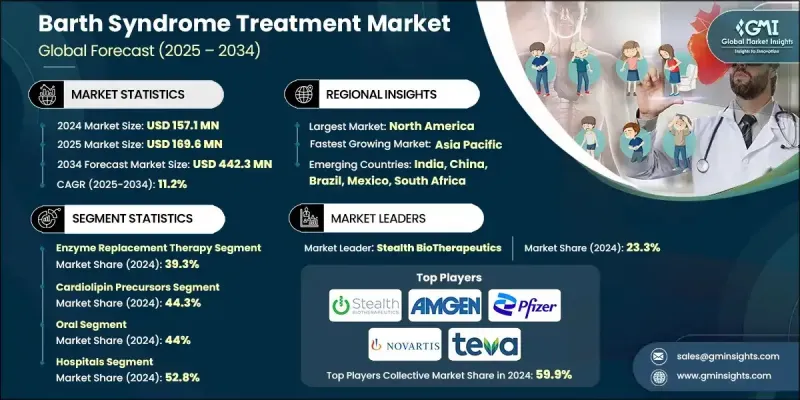
The market continues to expand as the number of diagnosed cases rises, awareness improves among clinicians and families, and significant advancements occur in gene-based and enzyme-focused therapies. The industry supports biotechnology developers, pharmaceutical companies, research institutions, and healthcare providers by offering specialized solutions for genetic research, therapeutic development, and patient care. Treatment options span gene therapy, enzyme replacement therapy, and supportive care aimed at improving cardiac and muscular symptoms while enhancing overall quality of life. Progress in gene therapy has strengthened market momentum, with emerging methods designed to correct TAZ gene mutations that drive the condition, potentially delivering long-term therapeutic benefits. Enzyme replacement therapies are evolving rapidly as they work to restore mitochondrial function and address the underlying biochemical defects. Supportive care, including pharmacologic management of cardiomyopathy and hematologic complications, continues to play a vital role in improving survival outcomes and sustaining market growth.
| Market Scope | |
|---|---|
| Start Year | 2024 |
| Forecast Year | 2025-2034 |
| Start Value | $157.1 Million |
| Forecast Value | $442.3 Million |
| CAGR | 11.2% |
The enzyme replacement therapy segment held a 39.3% share in 2024 owing to its direct role in addressing tafazzin deficiency, which significantly improves mitochondrial activity and enhances patient outcomes. Its targeted mechanism, which replenishes the missing enzyme to support cardiac and muscular function, has positioned it as a leading treatment option for individuals with Barth syndrome.
The cardiolipin precursors segment held a 44.3% share in 2024 and is expected to reach USD 208.8 million during 2025-2034. These treatments command substantial usage because they help restore mitochondrial membrane stability, compensating for impaired cardiolipin remodeling caused by TAZ gene mutations, which disrupt energy production and cellular performance.
North America Barth Syndrome Treatment Market held a 35.3% share in 2024, supported by a highly developed healthcare infrastructure and widespread access to diagnostic testing for rare genetic disorders. Early detection enabled by next-generation sequencing and other advanced laboratory tools contributes to prompt therapeutic intervention and better long-term outcomes for patients.
Key companies active in the Global Barth Syndrome Treatment Market include Stealth BioTherapeutics, TransCellular Therapeutics (TCT), Abbott, Nutricia, Amneal Pharmaceuticals, Boehringer Ingelheim, Amgen, Teva, Novartis, Scenic Biotech, Pfizer, and B. Braun. Companies in the Barth Syndrome Treatment Market pursue several strategic approaches to reinforce their presence. Many focus on expanding research programs centered on gene therapy and enzyme replacement therapy to develop treatments capable of addressing the root cause of the disorder. Collaborations between pharmaceutical firms, academic research teams, and biotechnology innovators help accelerate clinical development and regulatory progress. Firms also invest in advanced manufacturing technologies to support consistent production of specialized therapies.
Table of Contents
Chapter 1 Methodology and Scope
- 1.1 Market scope and definitions
- 1.2 Research design
- 1.2.1 Research approach
- 1.2.2 Data collection methods
- 1.3 Data mining sources
- 1.3.1 Global
- 1.3.2 Regional/country
- 1.4 Base estimates and calculations
- 1.4.1 Base year calculation
- 1.4.2 Key trends for market estimation
- 1.5 Primary research and validation
- 1.5.1 Primary sources
- 1.6 Forecast model
- 1.7 Research assumptions and limitations
Chapter 2 Executive Summary
- 2.1 Industry 3600 synopsis
- 2.2 Key market trends
- 2.2.1 Regional trends
- 2.2.2 Therapeutic approaches trends
- 2.2.3 Drug class trends
- 2.2.4 Route of administration trends
- 2.2.5 End Use trends
- 2.3 CXO perspectives: Strategic imperatives
- 2.3.1 Key decision points for industry executives
- 2.3.2 Critical success factors for market players
- 2.4 Future outlook and strategic recommendations
Chapter 3 Industry Insights
- 3.1 Industry ecosystem analysis
- 3.2 Industry impact forces
- 3.2.1 Growth drivers
- 3.2.1.1 Rising awareness & improved diagnostics
- 3.2.1.2 Regulatory incentives for orphan/rare diseases
- 3.2.1.3 Advances in therapeutic science
- 3.2.1.4 Growing healthcare investment in rare diseases
- 3.2.2 Industry pitfalls and challenges
- 3.2.2.1 Extremely small patient population
- 3.2.2.2 Clinical trial & recruitment challenges
- 3.2.3 Market opportunities
- 3.2.3.1 Development of curative/novel therapies
- 3.2.3.2 Patient registry & real-world evidence initiatives
- 3.2.1 Growth drivers
- 3.3 Growth potential analysis
- 3.4 Regulatory landscape
- 3.4.1 North America
- 3.4.2 Europe
- 3.4.3 Asia Pacific
- 3.5 Technology landscape
- 3.5.1 Current technological trends
- 3.5.2 Emerging technologies and their impacts
- 3.6 Future market trends
- 3.6.1 Regulatory milestone accelerating market entry
- 3.6.2 Increased R&D and investment activity
- 3.6.3 Enhanced clinical validation for mitochondrial therapies
- 3.7 Pricing analysis
- 3.8 Investment and funding landscape
- 3.9 Pipeline landscape
- 3.10 Porter's analysis
- 3.11 PESTEL analysis
Chapter 4 Competitive Landscape, 2024
- 4.1 Introduction
- 4.2 Company matrix analysis
- 4.3 Company market share analysis
- 4.3.1 Global
- 4.3.2 North America
- 4.3.3 Europe
- 4.3.4 Asia Pacific
- 4.3.5 LAMEA
- 4.4 Competitive positioning matrix
- 4.5 Competitive analysis of major market players
- 4.6 Key developments
- 4.6.1 Mergers & acquisitions
- 4.6.2 Partnerships & collaborations
- 4.6.3 Expansion plans
Chapter 5 Market Estimates and Forecast, By Therapeutic Approaches, 2021 - 2034 ($ Mn)
- 5.1 Key trends
- 5.2 Enzyme replacement therapy
- 5.3 Gene therapy
- 5.4 Supportive care
- 5.5 Stem cell therapy
- 5.6 Other therapeutic approaches
Chapter 6 Market Estimates and Forecast, By Drug Class, 2021 - 2034 ($ Mn)
- 6.1 Key trends
- 6.2 Cardiolipin precursors
- 6.3 Antioxidants
- 6.4 Immunomodulators
- 6.5 Dietary supplements
- 6.6 Antibiotics
- 6.7 Other drug classes
Chapter 7 Market Estimates and Forecast, By Route of Administration, 2021 - 2034 ($ Mn)
- 7.1 Key trends
- 7.2 Oral
- 7.3 Intravenous
- 7.4 Subcutaneous
Chapter 8 Market Estimates and Forecast, By End Use, 2021 - 2034 ($ Mn)
- 8.1 Key trends
- 8.2 Hospitals
- 8.3 Specialty clinics
- 8.4 Other End Use
Chapter 9 Market Estimates and Forecast, By Region, 2021 - 2034 ($ Mn)
- 9.1 Key trends
- 9.2 North America
- 9.2.1 U.S.
- 9.2.2 Canada
- 9.3 Europe
- 9.3.1 Germany
- 9.3.2 UK
- 9.3.3 France
- 9.3.4 Spain
- 9.3.5 Italy
- 9.3.6 Netherlands
- 9.4 Asia Pacific
- 9.4.1 China
- 9.4.2 Japan
- 9.4.3 India
- 9.4.4 Australia
- 9.4.5 South Korea
- 9.5 Latin America
- 9.5.1 Brazil
- 9.5.2 Mexico
- 9.5.3 Argentina
- 9.6 Middle East and Africa
- 9.6.1 South Africa
- 9.6.2 Saudi Arabia
- 9.6.3 UAE
Chapter 10 Company Profiles
- 10.1 Abbott
- 10.2 Amgen
- 10.3 Amneal Pharmaceuticals
- 10.4 B. Braun
- 10.5 Boehringer Ingelheim
- 10.6 Novartis
- 10.7 Nutricia
- 10.8 Pfizer
- 10.9 Scenic Biotech
- 10.10 Stealth BioTherapeutics
- 10.11 Teva
- 10.12 TransCellular Therapeutics (TCT)


