|
시장보고서
상품코드
1876654
화학적 재활용 시장 : 시장 기회, 성장 요인, 산업 동향 분석 및 예측(2025-2034년)Chemical Recycling Market Opportunity, Growth Drivers, Industry Trend Analysis, and Forecast 2025 - 2034 |
||||||

세계의 화학적 재활용 시장은 2024년 8억 1,500만 달러로 평가되었고, 2034년까지 연평균 복합 성장률(CAGR) 36.1%로 성장할 전망이며, 185억 달러에 이를 것으로 예측됩니다.
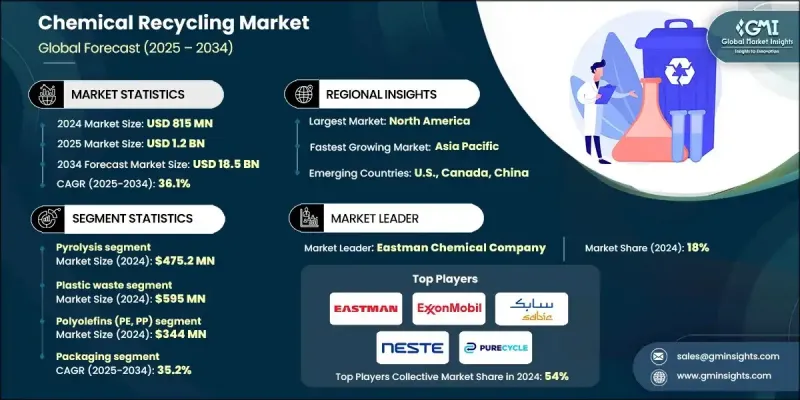
산업이 고성능 재료와 지속 가능한 생산 방법으로 전환함에 따라 수요가 가속화되고 있습니다. 포장, 전자기기 및 자동차 제조에서 스마트 재료의 사용 확대는 기계적 공정에서 공급이 어려운 고순도 재활용 플라스틱의 필요성을 계속 증가시키고 있습니다. 세계적으로 회수되는 플라스틱 폐기물의 양은 탈중합 및 열분해와 같은 첨단 변환 공정에 큰 기회를 나타내며, 보다 순환적인 재료 시스템으로의 이행을 지원하고 있습니다. 일관성 및 추적성을 갖춘 폴리머 원료는 특히 엄격한 품질 기준이 요구되는 분야에서 전문 용도에 필수적입니다. 이 추세는 차세대 재료가 엄격한 성능 기준을 충족함을 보장하면서 제조업체가 장기적인 지속가능성 전략의 일환으로 화학적 재활용 원료를 채택하도록 촉구합니다. 화학적 재활용 기술이 지속적으로 발전함에 따라 전략적 투자 및 생산 능력의 확대가 시장 기반을 강화하고 대규모 도입으로의 전환을 가속화하고 있습니다. 이로 인해 화학적 재활용 분야의 주요 점유율이 계속 유지됩니다.
| 시장 범위 | |
|---|---|
| 시작 연도 | 2024년 |
| 예측 기간 | 2025-2034년 |
| 시작 시 가치 | 8억 1,500만 달러 |
| 예측 금액 | 185억 달러 |
| CAGR | 36.1% |
열분해 부문은 2024년 4억 7,520만 달러에 달했습니다. 그 매력은 다양한 폐기물 스트림을 처리하고 합성가스, 나프타, 열분해유 등의 가치 있는 순환형 원료로 변환할 수 있다는 점에 있습니다. 이 원료는 현대 석유화학 체계에 재투입 가능합니다. 적응성 및 기존 정제 설비와의 호환성은 첨단 재활용 사업을 확대하는 기업들 사이에서 우선적인 선택이 되고 있습니다.
폴리올레핀 부문은 2024년에 3억 4,400만 달러를 차지했습니다. 이는 세계 폐기물량의 존재와 소비재, 포장재, 자동차 부품의 광범위한 사용을 반영합니다. 분자 구조는 이러한 중합체를 순환형 중합체 생산에 사용되는 새로운 탄화수소계 물질로 전환시키는 화학적 재활용 기술에 특히 적합합니다.
북미의 화학적 재활용 시장은 2024년 30.2%의 점유율을 차지했습니다. 이는 지역의 광범위한 산업 인프라, 충분한 자본력을 갖춘 시장, 첨단 재활용 플랫폼의 급속한 도입으로 인한 것입니다. 생산 능력 증가 및 구매자의 신뢰감 증가에 힘입어 이 지역은 강한 성장세를 보이고 있습니다.
세계의 화학적 재활용 시장에서 주요 기업으로는 BASF SE, Dow Inc., Eastman Chemical Company, PureCycle Technologies, Shell plc, ExxonMobil Corporation, SABIC, Agilyx Corporation, Neste Corporation, Evonik, USEON Technology Limited, Andritz, Sulzer Ltd, Carbios SA, Shell Global 및 Mura Technology 등이 있습니다. 화학적 재활용 시장에서 경쟁하는 기업들은 보다 견고한 시장 포지션을 확보하기 위해 몇 가지 전략적 조치에 주력하고 있습니다. 많은 기업들이 순환형 원료의 생산량 확대를 위한 생산 능력을 증강하고 있는 한편, 폴리머 제조업체 및 폐기물 관리 기업과의 제휴에 의해 안정 공급 루트의 확립을 도모하는 움직임도 볼 수 있습니다. 각 회사는 탈중합 및 열분해 효율 향상, 운영 비용 절감, 단량체 순도 향상을 목적으로 한 연구 개발 투자를 가속화하고 있습니다. 또한 여러 조직이 기술의 세계적 전개를 위한 라이선싱 모델을 채용하고 있습니다.
자주 묻는 질문
목차
제1장 조사 방법 및 범위
제2장 주요 요약
제3장 업계 인사이트
- 생태계 분석
- 공급자의 상황
- 이익률
- 각 단계에서의 부가가치
- 밸류체인에 영향을 주는 요인
- 혁신
- 업계에 미치는 영향요인
- 성장 촉진요인
- 스마트 재료에 대한 수요 증가
- 바이오메디컬 용도 분야에서의 진전
- 성장을 계속하는 항공우주 및 방위 분야
- 세계의 지속가능성 규제에 의한 압력 증가
- 업계의 잠재적 위험 및 과제
- 높은 에너지 비용 및 운영 비용
- 제한된 확장성 및 인프라
- 혼합 플라스틱 폐기물의 복잡성
- 시장 기회
- 기존 석유화학 자산과의 통합
- 고품질 재생 폴리머에 대한 수요 증가
- 지원적인 정부 정책 및 자금 조달
- 성장 촉진요인
- 성장 가능성 분석
- 규제 상황
- 북미
- 유럽
- 아시아태평양
- 라틴아메리카
- 중동 및 아프리카
- Porter's Five Forces 분석
- PESTEL 분석
- 가격 동향
- 지역별
- 기술
- 원료의 유형
- 폴리머의 유형
- 최종 이용 산업
- 장래 시장 동향
- 기술 및 혁신 동향
- 현재의 기술 동향
- 신흥 기술
- 특허 상황
- 무역 통계(HS코드)(참고 : 무역 통계는 주요 국가에서만 제공됨)
- 주요 수입국
- 주요 수출국
- 지속가능성 및 환경면
- 지속가능한 대처
- 폐기물 감축 전략
- 생산에 있어서 에너지 효율
- 환경에 배려한 대처
- 탄소발자국에 관한 고려 사항
제4장 경쟁 구도
- 서문
- 기업의 시장 점유율 분석
- 지역별
- 북미
- 유럽
- 아시아태평양
- 라틴아메리카
- 중동 및 아프리카
- 지역별
- 기업 매트릭스 분석
- 주요 시장 기업의 경쟁 분석
- 경쟁 포지셔닝 매트릭스
- 주요 발전
- 합병 및 인수
- 제휴 및 협업
- 신제품 발매
- 사업 확대 계획
제5장 시장 추계 및 예측 : 기술별(2021-2034년)
- 주요 동향
- 열분해
- 열분해
- 촉매 열분해
- 가스화
- 플라즈마 가스화
- 수증기 개질
- 탈중합
- 글리콜 분해
- 메탄올리시스
- 가수분해
- 용해 분해
- 알코올 분해
- 암모니아 분해
- 수열처리
- 용해 및 용매계 재활용
- 선택적 용해
- 용매 추출
- 기타
- 효소에 의한 재활용
- 마이크로파 보조 재활용
제6장 시장 추계 및 예측 : 원료 유형별(2021-2034년)
- 주요 동향
- 플라스틱 폐기물
- 플라스틱 폐기물(PE)
- 폴리에틸렌(PP)
- 폴리프로필렌(PS)
- 폴리에틸렌테레프탈레이트(PET)
- 폴리염화비닐
- 다층 및 혼합 플라스틱
- 섬유 폐기물
- 폴리에스테르 섬유
- 나일론
- 고무 폐기물
- 산업 포장 폐기물
제7장 시장 추계 및 예측 : 폴리머 유형별(2021-2034년)
- 주요 동향
- 폴리올레핀(PE, PP)
- 폴리에스테르(PET, PBT)
- 폴리스티렌(PS)
- 폴리아미드(PA, 나일론)
- 폴리염화비닐(PVC)
- 폴리카보네이트(PC)
- 기타
제8장 시장 추계 및 예측 : 최종 이용 산업별(2021-2034년)
- 주요 동향
- 포장
- 식품 및 음료 포장
- 산업용 포장
- 자동차
- 내장 및 외장 부품
- 보닛 내 용도
- 섬유 및 의류
- 합성 섬유
- 의류
- 건축 및 건설
- 전기 및 전자 기기
- 소비재
제9장 시장 추계 및 예측 : 지역별(2021-2034년)
- 주요 동향
- 북미
- 미국
- 캐나다
- 유럽
- 독일
- 영국
- 프랑스
- 스페인
- 이탈리아
- 기타 유럽
- 아시아태평양
- 중국
- 인도
- 일본
- 호주
- 한국
- 기타 아시아태평양
- 라틴아메리카
- 브라질
- 멕시코
- 기타 라틴아메리카
- 중동 및 아프리카
- 사우디아라비아
- 남아프리카
- 아랍에미리트(UAE)
- 기타 중동 및 아프리카
제10장 기업 프로파일
- Eastman Chemical Company
- BASF SE
- ExxonMobil Corporation
- Evonik
- Dow Inc.
- SABIC
- Shell plc
- Neste Corporation
- PureCycle Technologies
- Agilyx Corporation
- Carbios SA
- USEON Technology Limited
- Andritz
- Sulzer Ltd
- Shell Global
- Mura Technology
The Global Chemical Recycling Market was valued at USD 815 million in 2024 and is estimated to grow at a CAGR of 36.1% to reach USD 18.5 billion by 2034.
Demand is accelerating as industries shift toward high-performance materials and sustainable production methods. The growing use of smart materials across packaging, electronics, and automotive manufacturing continues to elevate the need for high-purity recycled plastics, which mechanical processes often cannot supply. The volume of plastic waste collected worldwide highlights a significant opportunity for advanced conversion pathways such as depolymerization and pyrolysis, supporting the transition toward a more circular materials system. Consistent and traceable polymer feedstocks are becoming essential for specialized applications, particularly in sectors that require strict quality benchmarks. This trend encourages manufacturers to adopt chemically recycled inputs as part of their long-term sustainability strategies while ensuring that next-generation materials meet rigorous performance criteria. As chemical recycling technologies continue to evolve, strategic investments and expanding capacity are strengthening the market's foundation and accelerating the shift toward large-scale implementation, and continue to secure a major share of the chemical recycling landscape.
| Market Scope | |
|---|---|
| Start Year | 2024 |
| Forecast Year | 2025-2034 |
| Start Value | $815 Million |
| Forecast Value | $18.5 Billion |
| CAGR | 36.1% |
The pyrolysis segment reached USD 475.2 million in 2024. Its appeal stems from its ability to process diverse waste streams and convert them into valuable circular feedstocks such as syngas, naphtha, and pyrolysis oil, which can be routed back into modern petrochemical systems. Its adaptable nature and compatibility with current refining assets position it as a preferred choice among companies scaling advanced recycling operations.
The polyolefins segment accounted for USD 344 million in 2024, reflecting their substantial presence in global waste volumes and widespread use in consumer goods, packaging, and automotive components. Their molecular structure makes them particularly suitable for chemical recycling technologies that convert these polymers into new hydrocarbon-based materials used in circular polymer production.
North America Chemical Recycling Market held 30.2% share in 2024 owing to its expansive industrial infrastructure, well-capitalized market, and rapid adoption of advanced recycling platforms. The region demonstrates strong momentum supported by increasing production capacity and rising purchaser confidence.
Major companies in the Global Chemical Recycling Market include BASF SE, Dow Inc., Eastman Chemical Company, PureCycle Technologies, Shell plc, ExxonMobil Corporation, SABIC, Agilyx Corporation, Neste Corporation, Evonik, USEON Technology Limited, Andritz, Sulzer Ltd, Carbios SA, Shell Global, and Mura Technology. Companies competing in the Chemical Recycling Market focus on several strategic measures to secure stronger market positioning. Many are expanding production capacity to boost output of circular feedstocks, while others are entering partnerships with polymer producers and waste management firms to establish stable supply channels. Firms are accelerating R&D investments to improve depolymerization and pyrolysis efficiency, reduce operating costs, and enhance monomer purity. Several organizations are also adopting licensing models to scale their technology globally.
Table of Contents
Chapter 1 Methodology & Scope
- 1.1 Market scope and definition
- 1.2 Research design
- 1.2.1 Research approach
- 1.2.2 Data collection methods
- 1.3 Data mining sources
- 1.3.1 Global
- 1.3.2 Regional/Country
- 1.4 Base estimates and calculations
- 1.4.1 Base year calculation
- 1.4.2 Key trends for market estimation
- 1.5 Primary research and validation
- 1.5.1 Primary sources
- 1.6 Forecast model
- 1.7 Research assumptions and limitations
Chapter 2 Executive Summary
- 2.1 Industry 3600 synopsis
- 2.2 Key market trends
- 2.2.1 Regional
- 2.2.2 Technology
- 2.2.3 Feedstock Type
- 2.2.4 Polymer Type
- 2.2.5 End Use Industry
- 2.3 TAM Analysis, 2025-2034
- 2.4 CXO perspectives: Strategic imperatives
- 2.4.1 Executive decision points
- 2.4.2 Critical success factors
- 2.5 Future Outlook and Strategic Recommendations
Chapter 3 Industry Insights
- 3.1 Industry ecosystem analysis
- 3.1.1 Supplier Landscape
- 3.1.2 Profit Margin
- 3.1.3 Value addition at each stage
- 3.1.4 Factor affecting the value chain
- 3.1.5 Disruptions
- 3.2 Industry impact forces
- 3.2.1 Growth drivers
- 3.2.1.1 Rising demand for smart materials
- 3.2.1.2 Advancements in biomedical applications
- 3.2.1.3 Growing aerospace and defense sector
- 3.2.1.4 Increasing pressure from global sustainability regulations
- 3.2.2 Industry pitfalls and challenges
- 3.2.2.1 High energy and operational costs
- 3.2.2.2 Limited scalability and infrastructure
- 3.2.2.3 Complexity of mixed plastic waste
- 3.2.3 Market opportunities
- 3.2.3.1 Integration with existing petrochemical assets
- 3.2.3.2 Growing demand for high-quality recycled polymers
- 3.2.3.3 Supportive government policies and funding
- 3.2.1 Growth drivers
- 3.3 Growth potential analysis
- 3.4 Regulatory landscape
- 3.4.1 North America
- 3.4.2 Europe
- 3.4.3 Asia Pacific
- 3.4.4 Latin America
- 3.4.5 Middle East & Africa
- 3.5 Porter's analysis
- 3.6 PESTEL analysis
- 3.7 Price trends
- 3.7.1 By region
- 3.7.2 Technology
- 3.7.3 Feedstock Type
- 3.7.4 Polymer Type
- 3.7.5 End Use Industry
- 3.8 Future market trends
- 3.9 Technology and Innovation Landscape
- 3.9.1 Current technological trends
- 3.9.2 Emerging technologies
- 3.10 Patent Landscape
- 3.11 Trade statistics (HS code) (Note: the trade statistics will be provided for key countries only)
- 3.11.1 Major importing countries
- 3.11.2 Major exporting countries
- 3.12 Sustainability and environmental aspects
- 3.12.1 Sustainable practices
- 3.12.2 Waste reduction strategies
- 3.12.3 Energy efficiency in production
- 3.12.4 Eco-friendly initiatives
- 3.13 Carbon footprint considerations
Chapter 4 Competitive Landscape, 2024
- 4.1 Introduction
- 4.2 Company market share analysis
- 4.2.1 By region
- 4.2.1.1 North America
- 4.2.1.2 Europe
- 4.2.1.3 Asia Pacific
- 4.2.1.4 LATAM
- 4.2.1.5 MEA
- 4.2.1 By region
- 4.3 Company matrix analysis
- 4.4 Competitive analysis of major market players
- 4.5 Competitive positioning matrix
- 4.6 Key developments
- 4.6.1 Mergers & acquisitions
- 4.6.2 Partnerships & collaborations
- 4.6.3 New product launches
- 4.6.4 Expansion plans
Chapter 5 Market Estimates and Forecast, By Technology, 2021 - 2034 (USD Million) (Kilo Tons)
- 5.1 Key trends
- 5.2 Pyrolysis
- 5.2.1 Thermal cracking
- 5.2.2 Catalytic pyrolysis
- 5.3 Gasification
- 5.3.1 Plasma gasification
- 5.3.2 Steam reforming
- 5.4 Depolymerization
- 5.4.1 Glycolysis
- 5.4.2 Methanolysis
- 5.4.3 Hydrolysis
- 5.5 Solvolysis
- 5.5.1 Alcoholysis
- 5.5.2 Ammonolysis
- 5.5.3 Hydrothermal processing
- 5.6 Dissolution & Solvent-based recycling
- 5.6.1 Selective dissolution
- 5.6.2 Solvent extraction
- 5.7 Others
- 5.7.1 Enzymatic recycling
- 5.7.2 Microwave assisted recycling
Chapter 6 Market Estimates and Forecast, By Feedstock Type, 2021 - 2034 (USD Million) (Kilo Tons)
- 6.1 Key trends
- 6.2 Plastic waste
- 6.2.1 Plastic waste (PE)
- 6.2.2 Polyethylene (PP)
- 6.2.3 Polypropylene (PS)
- 6.2.4 Polyethylene terephthalate (PET)
- 6.2.5 Polyvinyl chloride
- 6.2.6 Multilayer & mixed plastics
- 6.3 Textile waste
- 6.3.1 Polyester fiber
- 6.3.2 Nylon
- 6.4 Rubber waste
- 6.5 Industrial packaging waste
Chapter 7 Market Estimates and Forecast, By Polymer Type, 2021 - 2034 (USD Million) (Kilo Tons)
- 7.1 Key trends
- 7.2 Polyolefins (PE, PP)
- 7.3 Polyesters (PET, PBT)
- 7.4 Polystyrene (PS)
- 7.5 Polyamides (PA, Nylon)
- 7.6 Polyvinyl chloride (PVC)
- 7.7 Polycarbonate (PC)
- 7.8 Others
Chapter 8 Market Estimates and Forecast, By End Use Industry, 2021 - 2034 (USD Million) (Kilo Tons)
- 8.1 Key trends
- 8.2 Packaging
- 8.2.1 Food & beverage packaging
- 8.2.2 Industrial packaging
- 8.3 Automotive
- 8.3.1 Interior and exterior components
- 8.3.2 Under-the-hood applications
- 8.4 Textiles & Apparel
- 8.4.1 Synthetic fiber
- 8.4.2 Clothing
- 8.5 Building & Construction
- 8.6 Electrical & Electronics
- 8.7 Consumer Goods
Chapter 9 Market Estimates and Forecast, By Region, 2021 - 2034 (USD million) (Kilo Tons)
- 9.1 Key trends
- 9.2 North America
- 9.2.1 U.S.
- 9.2.2 Canada
- 9.3 Europe
- 9.3.1 Germany
- 9.3.2 UK
- 9.3.3 France
- 9.3.4 Spain
- 9.3.5 Italy
- 9.3.6 Rest of Europe
- 9.4 Asia Pacific
- 9.4.1 China
- 9.4.2 India
- 9.4.3 Japan
- 9.4.4 Australia
- 9.4.5 South Korea
- 9.4.6 Rest of Asia Pacific
- 9.5 Latin America
- 9.5.1 Brazil
- 9.5.2 Mexico
- 9.5.3 Rest of Latin America
- 9.6 Middle East and Africa
- 9.6.1 Saudi Arabia
- 9.6.2 South Africa
- 9.6.3 UAE
- 9.6.4 Rest of Middle East and Africa
Chapter 10 Company Profiles
- 10.1 Eastman Chemical Company
- 10.2 BASF SE
- 10.3 ExxonMobil Corporation
- 10.4 Evonik
- 10.5 Dow Inc.
- 10.6 SABIC
- 10.7 Shell plc
- 10.8 Neste Corporation
- 10.9 PureCycle Technologies
- 10.10 Agilyx Corporation
- 10.11 Carbios SA
- 10.12 USEON Technology Limited
- 10.13 Andritz
- 10.14 Sulzer Ltd
- 10.15 Shell Global
- 10.16 Mura Technology