|
시장보고서
상품코드
1876790
크레인 렌탈 시장 : 시장 기회, 성장 요인, 업계 동향 분석 및 예측(2025-2034년)Crane Rental Market Opportunity, Growth Drivers, Industry Trend Analysis, and Forecast 2025 - 2034 |
||||||

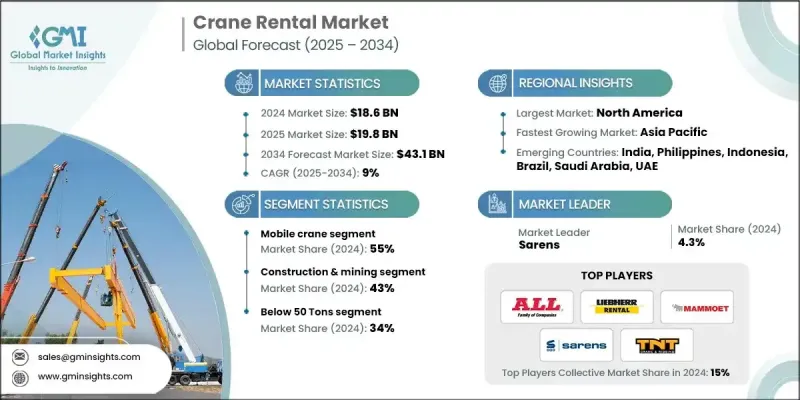
세계의 크레인 렌탈 시장은 2024년 186억 달러로 평가되었고, 2034년까지 연평균 복합 성장률(CAGR) 9%로 성장할 전망이며, 431억 달러에 이를 것으로 예측됩니다.
시장 확대는 건설, 인프라 및 산업 분야에서 임대 기반 중량물 운반 솔루션의 채용 증가로 인한 것입니다. 크레인 렌탈을 통해 계약자와 프로젝트 개발자는 엄청난 자본 투자 없이 선진적인 운반 시설을 이용할 수 있어 보다 효율적인 자본 배분과 운영 유연성을 제공합니다. 급속도로 확대되는 도시 메가 프로젝트, 재생에너지 설비, 대규모 물류 업무는 전문 운영자 및 유지보수 서비스를 포함한 신뢰성 있는 온디맨드 운반 솔루션에 대한 수요를 촉진하고 있습니다. 진행 중인 에너지 전환 및 인프라 현대화도 크레인 렌탈을 더욱 가속화하고 있습니다. 풍력발전소, 태양광 발전 설비, 송전망 확장 등의 재생에너지 프로젝트에서는 터빈, 모듈, 구조 부품의 중량물 운반 지원이 필요하기 때문입니다. 크레인 렌탈 회사는 원격지에서 사용하기에 적합한 고용량 크롤러 크레인과 거친 테레인 크레인에 대한 투자를 추진하고 물류 비용을 최적화하는 동시에 운영의 지속가능성을 촉진합니다. COVID-19 이후의 디지털화 및 장비 공유 모델은 서비스 보증이 포함된 유연한 대여 계약, 온라인 예약 플랫폼 및 텔레매틱스 기반 유지보수 지원을 촉진합니다.
| 시장 범위 | |
|---|---|
| 시작 연도 | 2024년 |
| 예측 연도 | 2025-2034년 |
| 시작 시 가치 | 186억 달러 |
| 예측 금액 | 431억 달러 |
| CAGR | 9% |
이동식 크레인 부문은 2024년에 55%의 점유율을 차지했으며, 2034년까지 연평균 복합 성장률(CAGR) 8.6%로 성장할 것으로 예측됩니다. 이동식 크레인은 범용성, 운송 용이성, 건설, 산업 및 인프라 프로젝트에서 광범위한 리프팅 작업을 수행할 수 있는 능력으로 시장을 독점하고 있습니다. 신속한 설치와 기동성으로 다운타임을 줄이고, 전지형 대응형, 러프테레인형, 트럭 탑재형 등의 바리에이션에 의해 도시와 원격지의 양쪽 모두의 환경에 적합합니다.
건설 및 광업 부문은 2024년에 43%의 점유율을 차지했으며, 2025-2034년 연평균 복합 성장률(CAGR) 9.7%로 성장할 것으로 예측됩니다. 인프라 프로젝트, 상업 개발 및 광업 확장 증가는 이 부문 수요를 이끌고 있습니다. 고층 건축, 도로 공사, 교량 프로젝트에서 무거운 물자 및 무거운 기계를 들어 올리는 데 크레인이 필수적이며 대여 솔루션은 비용 효율적이고 유연한 선택입니다. 대규모 프로젝트에서 첨단 리프팅 기술과 효율성에 대한 요구가 이 부문 시장 포지션을 더욱 강화하고 있습니다.
북미의 크레인 렌탈 시장은 2024년 85%의 점유율을 차지했으며, 91억 달러의 수익을 창출했습니다. 성장은 인프라 개발, 산업 건설, 재생에너지 프로젝트에 의해 추진되고 있습니다. 고속도로, 교량, 유틸리티 프로젝트를 포함한 연방 정부의 투자가 중량물 운반 솔루션 수요를 증가시키고 있는 한편, 해상 풍력 및 태양광 발전 프로젝트가 이동식 및 고용량 크레인의 필요성을 높이고 있습니다.
세계 크레인 렌탈 시장의 주요 기업으로는 Sarens, Maxim Crane Works, Ainscough Crane, Bigge Crane, Liebherr Rental, United Rentals, TNT Crane & Rigging, All Family/All Crane, Sanghvi Movers 및 Mammoet 등이 있습니다. 세계 크레인 렌탈 시장의 기업들은 존재감 및 시장 점유율을 강화하기 위해 몇 가지 전략적 노력에 주력하고 있습니다. 원격지, 도시 및 재생에너지 프로젝트 현장용으로, 고용량 및 특수 크레인에 의한 플릿 확충에 투자하고 있습니다. 건설 회사, 물류 사업자, 산업 고객과의 제휴로 시장 도달범위를 확대합니다. 온라인 예약 플랫폼, 텔레매틱스 대응 유지보수, 실시간 모니터링 등의 디지털 솔루션 도입으로 서비스 효율성과 고객 만족도 향상을 도모하고 있습니다. 지리적 확대, 타겟 마케팅 캠페인, 업계 전시회 참여로 브랜드 인지도를 높이고 있습니다.
자주 묻는 질문
목차
제1장 조사 방법
- 시장 범위 및 정의
- 조사 설계
- 조사 접근
- 데이터 수집 방법
- 데이터 마이닝의 출처
- 세계
- 지역별 및 국가별
- 기본 추정치 및 계산
- 기준 연도 계산
- 시장 추정에서의 주요 동향
- 1차 조사 및 검증
- 1차 정보
- 예측 모델
- 조사의 전제조건 및 제한 사항
제2장 주요 요약
제3장 업계 인사이트
- 생태계 분석
- 공급자의 상황
- 이익률 분석
- 비용 구조
- 각 단계에서의 부가가치
- 밸류체인에 영향을 주는 요인
- 혁신
- 업계에 미치는 영향요인
- 성장 촉진요인
- 증가하는 인프라 개발 프로젝트
- 산업 시설의 건설 급증
- 플릿의 현대화와 하이브리드 및 전기식 크레인의 도입 증가
- OEM 제조업체 및 렌탈 회사 간 제휴 증가
- 업계의 잠재적 위험 및 과제
- 숙련된 유자격 오퍼레이터의 부족
- 높은 유지 관리비 및 수리 비용
- 시장 기회
- 설비리스에 디지털 플랫폼 도입
- 항만 및 물류 인프라의 확장
- 관민 연계(PPP) 프로젝트의 성장
- 기술 통합 및 자동화
- 애프터마켓 서비스 및 부가가치 제공
- 성장 촉진요인
- 성장 가능성 분석
- 규제 상황
- 북미
- 유럽
- 아시아태평양
- LAMEA
- Porter's Five Forces 분석
- PESTEL 분석
- 기술 및 혁신 동향
- 현재의 기술 동향
- 신흥 기술
- 특허 분석
- 가격 동향
- 지역별
- 유형별
- 비용 내역 분석
- 비즈니스 케이스 및 투자 이익률(ROI) 분석
- 총소유비용의 틀
- ROI 산출 조사 방법
- 실시 스케줄 및 주요 이정표
- 리스크 평가 및 경감 전략
- 지속가능성 및 환경 영향 분석
- 지속가능한 실천
- 폐기물 감축 전략
- 생산에 있어서 에너지 효율
- 환경에 배려한 대처
- 탄소발자국에 관한 고려 사항
- 전망 및 기회
- 새로운 이용 사례 및 용도 범위 확대
- 차세대 크레인 기술
- 자동화 및 디지털 최적화의 동향
- 규제의 변천 및 컴플라이언스에 대한 영향
- 공급망 및 렌탈 모델의 변화
- 투자의 중점 분야 및 성장 리스크
- 에너지 효율 및 하이브리드 기술의 평가
제4장 경쟁 구도
- 서문
- 기업의 시장 점유율 분석
- 북미
- 유럽
- 아시아태평양
- LAMEA
- 주요 시장 기업의 경쟁 분석
- 경쟁 포지셔닝 매트릭스
- 전략적 전망 매트릭스
- 주요 발전
- 합병 및 인수
- 제휴 및 공동 사업
- 신제품 발매
- 사업 확대 계획 및 자금 조달
제5장 시장 추계 및 예측 : 유형별(2021-2034년)
- 주요 동향
- 이동식 크레인
- 전지형 대응 크레인
- 러프테레인 크레인
- 트럭 크레인
- 픽앤캐리 크레인
- 고정식 크레인
- 타워 크레인
- 천장 크레인 및 교형 크레인
- 갠트리 크레인
- 지브 크레인
- 크롤러 크레인
- 선박용 및 해양용 크레인
제6장 시장 추계 및 예측 : 용도별(2021-2034년)
- 주요 동향
- 건설 및 광업
- 유틸리티
- 제조업
- 운송
- 석유 및 가스
- 기타
제7장 시장 추계 및 예측 : 매달기 능력별(2021-2034년)
- 주요 동향
- 50톤 미만
- 50-150톤
- 150-300톤
- 300톤 이상
제8장 시장 추계 및 예측 : 렌탈 기간별(2021-2034년)
- 주요 동향
- 단기 대여
- 장기 대여
- 프로젝트 기반 렌탈
제9장 시장 추계 및 예측 : 지역별(2021-2034년)
- 주요 동향
- 북미
- 미국
- 캐나다
- 유럽
- 독일
- 영국
- 프랑스
- 이탈리아
- 스페인
- 러시아
- 아시아태평양
- 중국
- 인도
- 일본
- 호주
- 한국
- 필리핀
- 인도네시아
- 라틴아메리카
- 브라질
- 멕시코
- 아르헨티나
- 중동 및 아프리카
- 남아프리카
- 사우디아라비아
- 아랍에미리트(UAE)
제10장 기업 프로파일
- 세계 기업
- Ashtead
- Kobelco Construction Machinery
- Liebherr
- Link-Belt Cranes
- Mammoet
- Manitowoc Company
- National Crane
- Palfinger North America
- Sarens
- Tadano
- Terex
- United Rentals
- 지역 기업
- Action Crane & Equipment
- ALL Erection & Crane Rental
- Barnhart Crane & Rigging
- Bigge Crane and Rigging
- Crane Rental
- Crane Service
- Lampson International
- Liebherr Rental
- Maxim Crane Works
- NessCampbell Crane Rigging
- TNT Crane & Rigging
- 신흥 기업
- BigRentz
- Crane Network
- Cranes for Rent
- EquipmentShare
- Sanghvi Movers
- Sany America
The Global Crane Rental Market was valued at USD 18.6 billion in 2024 and is estimated to grow at a CAGR of 9% to reach USD 43.1 billion by 2034.
The market's expansion is driven by the increasing adoption of rental-based heavy lifting solutions across construction, infrastructure, and industrial sectors. Renting cranes allows contractors and project developers to access advanced lifting equipment without large capital investments, enabling more efficient capital allocation and operational flexibility. Rapidly growing urban megaprojects, renewable energy installations, and large-scale logistics operations are fueling demand for reliable, on-demand lifting solutions that include professional operators and maintenance services. The ongoing energy transition and modernization of infrastructure are further accelerating crane rentals, as renewable projects such as wind farms, solar arrays, and grid expansions require heavy-lifting support for turbines, modules, and structural components. Crane rental companies are investing in high-capacity crawler and rough-terrain cranes suitable for remote sites, optimizing logistics costs while promoting operational sustainability. Post-COVID-19 digitalization and equipment-sharing models have encouraged flexible rental contracts with service guarantees, online booking platforms, and telematics-based maintenance support.
| Market Scope | |
|---|---|
| Start Year | 2024 |
| Forecast Year | 2025-2034 |
| Start Value | $18.6 Billion |
| Forecast Value | $43.1 Billion |
| CAGR | 9% |
The mobile crane segment held a 55% share in 2024 and is expected to grow at a CAGR of 8.6% through 2034. Mobile cranes dominate due to their versatility, ease of transport, and ability to perform a wide range of lifting tasks across construction, industrial, and infrastructure projects. Their rapid setup and mobility reduce downtime, and options like all-terrain, rough-terrain, and truck-mounted variants make them suitable for both urban and remote environments.
The construction & mining sector held a 43% share in 2024 and is forecast to grow at a CAGR of 9.7% from 2025 to 2034. Rising infrastructure projects, commercial developments, and mining expansions drive demand in this segment. Cranes are critical for lifting heavy materials and equipment in high-rise construction, roadworks, and bridge projects, making rental solutions cost-effective and flexible. Advanced lifting technologies and efficiency requirements in large-scale projects further strengthen this segment's market position.
North America Crane Rental Market held 85% share and generated USD 9.1 billion in 2024. Growth is fueled by infrastructure development, industrial construction, and renewable energy projects. Federal investments, including highway, bridge, and utility projects, are increasing demand for heavy-lifting solutions, while offshore wind and solar initiatives amplify the need for mobile and high-capacity cranes.
Key players in the Global Crane Rental Market include Sarens, Maxim Crane Works, Ainscough Crane, Bigge Crane, Liebherr Rental, United Rentals, TNT Crane & Rigging, All Family/All Crane, Sanghvi Movers, and Mammoet. Companies in the Global Crane Rental Market focus on several strategic initiatives to enhance their presence and market share. They invest in expanding their fleet with high-capacity, specialized cranes for remote, urban, and renewable project sites. Partnerships with construction firms, logistics providers, and industrial clients help broaden market reach. Firms are also adopting digital solutions, including online booking platforms, telematics-enabled maintenance, and real-time monitoring, to improve service efficiency and client satisfaction. Geographic expansion, targeted marketing campaigns, and participation in industry exhibitions enhance brand recognition.
Table of Contents
Chapter 1 Methodology
- 1.1 Market scope and definition
- 1.2 Research design
- 1.2.1 Research approach
- 1.2.2 Data collection methods
- 1.3 Data mining sources
- 1.3.1 Global
- 1.3.2 Regional/Country
- 1.4 Base estimates and calculations
- 1.4.1 Base year calculation
- 1.4.2 Key trends for market estimation
- 1.5 Primary research and validation
- 1.5.1 Primary sources
- 1.6 Forecast model
- 1.7 Research assumptions and limitations
Chapter 2 Executive Summary
- 2.1 Industry 360° synopsis, 2021 - 2034
- 2.2 Key market trends
- 2.2.1 Regional
- 2.2.2 Type
- 2.2.3 Application
- 2.2.4 Lifting capacity
- 2.2.5 Rental duration
- 2.3 TAM Analysis, 2025-2034
- 2.4 CXO perspectives: Strategic imperatives
- 2.4.1 Executive decision points
- 2.4.2 Critical success factors
- 2.5 Future outlook and strategic recommendations
Chapter 3 Industry Insights
- 3.1 Industry ecosystem analysis
- 3.1.1 Supplier landscape
- 3.1.2 Profit margin analysis
- 3.1.3 Cost structure
- 3.1.4 Value addition at each stage
- 3.1.5 Factor affecting the value chain
- 3.1.6 Disruptions
- 3.2 Industry impact forces
- 3.2.1 Growth drivers
- 3.2.1.1 Rising Infrastructure Development Projects
- 3.2.1.2 Surge in Construction of Industrial Facilities
- 3.2.1.3 Increase in fleet modernization and adoption of hybrid/electric cranes
- 3.2.1.4 Rise in collaborations between OEMs and rental companies
- 3.2.2 Industry pitfalls and challenges
- 3.2.2.1 Lack of skilled and qualified operators
- 3.2.2.2 High maintenance and repair costs
- 3.2.3 Market opportunities
- 3.2.3.1 Adoption of digital platforms for equipment leasing
- 3.2.3.2 Expansion in port and logistics infrastructure
- 3.2.3.3 Growth of public-private partnership (PPP) projects
- 3.2.3.4 Technological integration and automation
- 3.2.3.5 Aftermarket services and value-added offerings
- 3.2.1 Growth drivers
- 3.3 Growth potential analysis
- 3.4 Regulatory landscape
- 3.4.1 North America
- 3.4.2 Europe
- 3.4.3 Asia Pacific
- 3.4.4 LAMEA
- 3.5 Porter's analysis
- 3.6 PESTEL analysis
- 3.7 Technology and Innovation landscape
- 3.7.1 Current technological trends
- 3.7.2 Emerging technologies
- 3.8 Patent analysis
- 3.9 Price trends
- 3.9.1 By region
- 3.9.2 By type
- 3.10 Cost breakdown analysis
- 3.11 Business Case & ROI Analysis
- 3.11.1 Total cost of ownership framework
- 3.11.2 ROI calculation methodologies
- 3.11.3 Implementation timeline & milestones
- 3.11.4 Risk assessment & mitigation strategies
- 3.12 Sustainability and environmental impact analysis
- 3.12.1 Sustainable practices
- 3.12.2 Waste reduction strategies
- 3.12.3 Energy efficiency in production
- 3.12.4 Eco-friendly initiatives
- 3.12.5 Carbon footprint considerations
- 3.13 Future outlook & opportunities
- 3.13.1 Emerging use cases and application expansion
- 3.13.2 Next-generation crane technologies
- 3.13.3 Automation and digital optimization trends
- 3.13.4 Regulatory shifts and compliance impact
- 3.13.5 Supply chain and rental model transformation
- 3.13.6 Investment hotspots and growth risks
- 3.13.7 Energy efficiency and hybrid technology assessment
Chapter 4 Competitive Landscape, 2024
- 4.1 Introduction
- 4.2 Company market share analysis
- 4.2.1 North America
- 4.2.2 Europe
- 4.2.3 Asia Pacific
- 4.2.4 LAMEA
- 4.3 Competitive analysis of major market players
- 4.4 Competitive positioning matrix
- 4.5 Strategic outlook matrix
- 4.6 Key developments
- 4.6.1 Mergers & acquisitions
- 4.6.2 Partnerships & collaborations
- 4.6.3 New Product Launches
- 4.6.4 Expansion Plans and funding
Chapter 5 Market Estimates & Forecast, By Type, 2021 - 2034 ($Bn, Units)
- 5.1 Key trends
- 5.2 Mobile Cranes
- 5.2.1 All-Terrain Cranes
- 5.2.2 Rough Terrain Cranes
- 5.2.3 Truck-Mounted Cranes
- 5.2.4 Pick and Carry Cranes
- 5.3 Fixed Cranes
- 5.3.1 Tower Cranes
- 5.3.2 Overhead/Bridge Cranes
- 5.3.3 Gantry Cranes
- 5.3.4 Jib Cranes
- 5.4 Crawler Cranes
- 5.5 Marine and Offshore Cranes
Chapter 6 Market Estimates & Forecast, By Application, 2021 - 2034 ($Bn, Units)
- 6.1 Key trends
- 6.1.1 Construction & mining
- 6.1.2 Utility
- 6.1.3 Manufacturing
- 6.1.4 Transportation
- 6.1.5 Oil & gas
- 6.1.6 Others
Chapter 7 Market Estimates & Forecast, By Lifting Capacity, 2021 - 2034 ($Bn, Units)
- 7.1 Key trends
- 7.2 Below 50 Tons
- 7.3 50-150 Tons
- 7.4 150-300 Tons
- 7.5 Above 300 Tons
Chapter 8 Market Estimates & Forecast, By Rental Duration, 2021 - 2034 ($Bn, Units)
- 8.1 Key trends
- 8.2 Short-Term Rental
- 8.3 Long-Term Rental
- 8.4 Project-Based Rental
Chapter 9 Market Estimates & Forecast, By Region, 2021 - 2034 ($Bn, Units)
- 9.1 Key trends
- 9.2 North America
- 9.2.1 US
- 9.2.2 Canada
- 9.3 Europe
- 9.3.1 Germany
- 9.3.2 UK
- 9.3.3 France
- 9.3.4 Italy
- 9.3.5 Spain
- 9.3.6 Russia
- 9.4 Asia Pacific
- 9.4.1 China
- 9.4.2 India
- 9.4.3 Japan
- 9.4.4 Australia
- 9.4.5 South Korea
- 9.4.6 Philippines
- 9.4.7 Indonesia
- 9.5 Latin America
- 9.5.1 Brazil
- 9.5.2 Mexico
- 9.5.3 Argentina
- 9.6 MEA
- 9.6.1 South Africa
- 9.6.2 Saudi Arabia
- 9.6.3 UAE
Chapter 10 Company Profiles
- 10.1 Global Players
- 10.1.1 Ashtead
- 10.1.2 Kobelco Construction Machinery
- 10.1.3 Liebherr
- 10.1.4 Link-Belt Cranes
- 10.1.5 Mammoet
- 10.1.6 Manitowoc Company
- 10.1.7 National Crane
- 10.1.8 Palfinger North America
- 10.1.9 Sarens
- 10.1.10 Tadano
- 10.1.11 Terex
- 10.1.12 United Rentals
- 10.2 Regional Players
- 10.2.1 Action Crane & Equipment
- 10.2.2 ALL Erection & Crane Rental
- 10.2.3 Barnhart Crane & Rigging
- 10.2.4 Bigge Crane and Rigging
- 10.2.5 Crane Rental
- 10.2.6 Crane Service
- 10.2.7 Lampson International
- 10.2.8 Liebherr Rental
- 10.2.9 Maxim Crane Works
- 10.2.10 NessCampbell Crane + Rigging
- 10.2.11 TNT Crane & Rigging
- 10.3 Emerging Players
- 10.3.1 BigRentz
- 10.3.2 Crane Network
- 10.3.3 Cranes for Rent
- 10.3.4 EquipmentShare
- 10.3.5 Sanghvi Movers
- 10.3.6 Sany America