|
시장보고서
상품코드
1876796
상처 관리 치료 기기 시장 기회, 성장요인, 업계 동향 분석 및 예측(2025-2034년)Wound Care Therapy Devices Market Opportunity, Growth Drivers, Industry Trend Analysis, and Forecast 2025 - 2034 |
||||||

세계의 상처 관리 치료 기기 시장은 2024년에 21억 달러로 평가되었고, 2034년까지 연평균 복합 성장률(CAGR) 5.1%로 성장하여 34억 달러에 이를 것으로 예측됩니다.
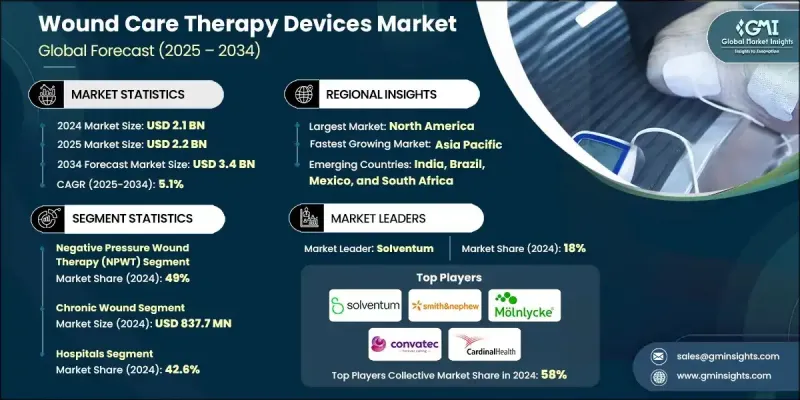
특히 노년층의 만성 상처 유병률 증가가 시장 확대의 주요 촉진요인으로 작용하고 있습니다. 상처 치료 장치는 급성 및 만성 상처의 치유를 촉진하고 가속화하기 위해 개발된 첨단 의료 시스템입니다. 기존의 상처 드레싱과 달리 음압치료, 산소공급, 전기자극 등의 방법으로 상처 환경을 능동적으로 조절하는 기술입니다. 이러한 메커니즘은 조직 재생을 촉진하고, 감염 위험을 줄이며, 회복을 가속화하는 데 기여합니다. 지속적인 기술 발전으로 온도, 습도, 감염 지표 등의 상처 매개변수를 실시간으로 추적할 수 있는 스마트 상처 치료 시스템 개발이 가능해졌습니다. 이러한 혁신을 통해 의료진은 적시에 정확한 치료 결정을 내릴 수 있어 치료 결과를 개선하고 합병증을 줄일 수 있습니다. 소형 음압상처치료(NPWT) 장치를 포함한 휴대용 상처치료 시스템은 재택의료 및 외래진료에서 점점 더 널리 사용되고 있으며, 입원 의존도를 낮추고 의료비 절감에 기여하고 있습니다. 당뇨병성 족부 궤양과 같은 만성 상처 발생 위험이 높은 당뇨병 환자 증가도 시장의 지속적인 성장을 더욱 촉진하고 있습니다.
| 시장 범위 | |
|---|---|
| 개시 연도 | 2024년 |
| 예측 기간 | 2025-2034년 |
| 시작 금액 | 21억 달러 |
| 예측 금액 | 34억 달러 |
| CAGR | 5.1% |
음압상처치료(NPWT)는 2024년 49%의 점유율을 차지했습니다. 이 요법은 상처 가장자리를 흡입하여 끌어당겨 조직 육아 형성을 촉진하고, 환부의 혈류 개선을 촉진하여 상처 폐쇄를 촉진합니다. NPWT는 체액, 삼출물, 박테리아를 효율적으로 제거하여 감염 위험을 최소화하고 치유를 가속화합니다. 따라서 외상이나 수술로 인한 복잡한 상처 관리에 특히 유용합니다.
병원 부문은 2024년 42.6%의 점유율을 차지했으며, 2034년까지 15억 달러에 달할 것으로 예측됩니다. 병원은 외과적 상처, 급성 상처, 만성 상처에 대한 종합적인 치료를 제공하고 있으며, 상처 관리의 주요 거점 역할을 하고 있습니다. NPWT 시스템, 전기 자극기, 산소 기반 치료 솔루션 등 다양한 첨단 치료 장비에 대한 접근성은 시장에서 주요 최종 사용자로서의 입지를 확고히 하고 있습니다.
미국 상처 치료 기기 시장은 2024년 6억 9,740만 달러에 달했습니다. 미국 내 당뇨병 환자 증가율이 시장 성장에 크게 기여하고 있으며, 당뇨병 환자는 고도의 상처 치료 시스템을 필요로 하는 만성 궤양이 발생하기 쉬운 경향이 있습니다. 현대적이고 효율적인 상처 관리 기술에 대한 수요가 증가함에 따라 세계 시장에서의 선도적 입지를 더욱 강화해 나가고 있습니다.
세계 상처 치료 기기 시장에서 활동하는 주요 기업으로는 Axelheal Technologies, Cardinal Health, Convatech, DeRoyal Industries, Medaxis, Molnicke Healthcare, Sky Medical Technology, Smith & Nephew, Solventum, Tally Group, Woundell Healthcare 등이 있습니다. Tally Group, Woundell Healthcare 등을 들 수 있습니다. 세계 상처 치료 기기 시장의 주요 기업들은 시장에서의 입지를 강화하기 위해 혁신, 파트너십, 제품 다각화를 우선시하고 있습니다. 연구개발에 대한 지속적인 투자를 통해 기능성, 휴대성, 환자 편의성을 향상시킨 첨단 상처 치유 솔루션을 도입할 수 있습니다. 많은 기업들이 원격 모니터링 및 데이터 분석을 위한 센서와 디지털 연결 기능을 내장한 스마트 상처 관리 시스템을 통해 제품 포트폴리오를 확장하고 있습니다.
자주 묻는 질문
목차
제1장 조사 방법과 범위
제2장 주요 요약
제3장 업계 인사이트
- 생태계 분석
- 공급업체 상황
- 각 단계 부가가치
- 밸류체인에 영향을 미치는 요인
- 업계에 대한 영향요인
- 성장 촉진요인
- 업계의 잠재적 리스크&과제
- 시장 기회
- 성장 가능성 분석
- 규제 상황
- 북미
- 아시아태평양
- 유럽
- 라틴아메리카
- 중동 및 아프리카
- 기술 동향
- 현재 기술 동향
- 신기술
- 향후 시장 동향
- 가격 분석, 2024
- 특허 분석
- Porter's Five Forces 분석
- PESTEL 분석
제4장 경쟁 구도
- 서론
- 기업의 시장 점유율 분석
- 세계
- 북미
- 유럽
- 아시아태평양
- 기업 매트릭스 분석
- 주요 시장 기업의 경쟁 분석
- 경쟁 포지셔닝 매트릭스
- 전략 대시보드
- 주요 발전
- 인수합병(M&A)
- 제휴 및 협력 관계
- 신제품 발매
- 확대 계획
제5장 시장 추산·예측 : 제품별, 2021-2034
- 주요 동향
- 음압창상 요법
- 산소 및 고기압 산소 장비
- 전기 자극 장치
- 감압 장비
- 기타 제품
제6장 시장 추산·예측 : 용도별, 2021-2034
- 주요 동향
- 만성 창상
- 당뇨병성 족부궤양
- 욕창
- 정맥성 종아리 궤양
- 기타 만성 창상
- 급성 창상
- 외과적 창상
- 외상성 창상
- 화상
제7장 시장 추산·예측 : 최종 용도별, 2021-2034
- 주요 동향
- 병원
- 전문 클리닉
- 재택치료 환경
- 기타 최종 용도
제8장 시장 추산·예측 : 지역별, 2021-2034
- 주요 동향
- 북미
- 미국
- 캐나다
- 유럽
- 독일
- 영국
- 프랑스
- 스페인
- 이탈리아
- 네덜란드
- 아시아태평양
- 중국
- 일본
- 인도
- 호주
- 한국
- 라틴아메리카
- 브라질
- 멕시코
- 아르헨티나
- 중동 및 아프리카
- 남아프리카공화국
- 사우디아라비아
- 아랍에미리트(UAE)
제9장 기업 개요
- Accel-Heal Technologies
- Cardinal Health
- ConvaTec
- DeRoyal Industries
- Medaxis
- Molnlycke Health Care
- Sky Medical Technology
- Smith+Nephew
- Solventum
- Talley Group
- WoundEL Health Care
The Global Wound Care Therapy Devices Market was valued at USD 2.1 billion in 2024 and is estimated to grow at a CAGR of 5.1% to reach USD 3.4 billion by 2034.
The growing prevalence of chronic wounds, particularly among elderly populations, is a major driver of market expansion. Wound care therapy devices are advanced medical systems developed to facilitate and accelerate healing in both acute and chronic wounds. Unlike conventional wound dressings, these technologies actively regulate the wound environment through methods such as negative pressure, oxygen delivery, or electrical stimulation. Such mechanisms help enhance tissue regeneration, minimize the risk of infection, and support faster recovery. Ongoing technological progress has enabled the development of smart wound therapy systems capable of tracking wound parameters like temperature, moisture, and infection indicators in real time. These innovations enable clinicians to make timely and precise treatment decisions, improving healing outcomes and reducing complications. Portable wound care systems, including compact negative pressure wound therapy (NPWT) devices, are becoming increasingly popular for use in homecare and outpatient settings, reducing hospital dependency and healthcare expenses. The rising number of diabetic patients who are at higher risk of developing chronic wounds such as diabetic foot ulcers further contributes to the market's continued growth.
| Market Scope | |
|---|---|
| Start Year | 2024 |
| Forecast Year | 2025-2034 |
| Start Value | $2.1 Billion |
| Forecast Value | $3.4 Billion |
| CAGR | 5.1% |
The negative pressure wound therapy (NPWT) accounted for a 49% share in 2024. This therapy enhances wound closure by drawing wound edges together, stimulating tissue granulation, and promoting improved blood circulation at the site. By efficiently removing fluids, exudates, and bacteria, NPWT minimizes the chances of infection and accelerates healing, making it particularly valuable in managing complex wounds caused by trauma or surgery.
The hospitals segment held 42.6% share in 2024 and is expected to reach USD 1.5 billion by 2034. Hospitals continue to be the primary centers for wound care management, offering comprehensive treatment for surgical, acute, and chronic wounds. Their access to a wide range of advanced therapy devices including NPWT systems, electrical stimulation units, and oxygen-based treatment solutions consolidates their position as the leading end users within the market.
U.S. Wound Care Therapy Devices Market reached USD 697.4 million in 2024. The increasing rate of diabetes in the U.S. has substantially influenced market growth, as diabetic patients are prone to chronic ulcers that require advanced wound therapy systems. The growing preference for modern, efficient wound management technologies continues to strengthen the country's leadership in the global market.
Prominent players operating in the Global Wound Care Therapy Devices Market include Accel-Heal Technologies, Cardinal Health, ConvaTec, DeRoyal Industries, Medaxis, Molnlycke Health Care, Sky Medical Technology, Smith+Nephew, Solventum, Talley Group, and WoundEL Health Care. Leading companies in the Global Wound Care Therapy Devices Market are prioritizing innovation, partnerships, and product diversification to strengthen their market presence. Continuous investment in research and development enables them to introduce advanced wound healing solutions with enhanced functionality, portability, and patient comfort. Many firms are expanding their portfolios with smart wound management systems that incorporate sensors and digital connectivity for remote monitoring and data analysis.
Table of Contents
Chapter 1 Methodology and Scope
- 1.1 Market scope and definitions
- 1.2 Research design
- 1.2.1 Research approach
- 1.2.2 Data collection methods
- 1.3 Data mining sources
- 1.3.1 Global
- 1.3.2 Regional/Country
- 1.4 Base estimates and calculations
- 1.4.1 Base year calculation
- 1.4.2 Key trends for market estimation
- 1.5 Primary research and validation
- 1.5.1 Primary sources
- 1.6 Forecast model
- 1.7 Research assumptions and limitations
Chapter 2 Executive Summary
- 2.1 Industry 3600 synopsis
- 2.2 Key market trends
- 2.2.1 Regional trends
- 2.2.2 Product trends
- 2.2.3 Application trends
- 2.2.4 End Use trends
- 2.3 CXO perspectives: Strategic imperatives
- 2.3.1 Key decision points for industry executives
- 2.3.2 Critical success factors for market players
- 2.4 Future outlook and strategic recommendations
Chapter 3 Industry Insights
- 3.1 Industry ecosystem analysis
- 3.1.1 Supplier landscape
- 3.1.2 Value addition at each stage
- 3.1.3 Factor affecting the value chain
- 3.2 Industry impact forces
- 3.2.1 Growth drivers
- 3.2.1.1 Rising prevalence of chronic wounds
- 3.2.1.2 Increasing number of surgical procedures
- 3.2.1.3 Surge in government initiatives regarding wound care treatment
- 3.2.1.4 Technological advancements in wound care therapy devices
- 3.2.2 Industry pitfalls and challenges
- 3.2.2.1 High cost of advanced devices
- 3.2.2.2 Lack of skilled healthcare professionals
- 3.2.3 Market opportunities
- 3.2.3.1 Integration of smart technologies
- 3.2.3.2 Home healthcare and remote monitoring
- 3.2.1 Growth drivers
- 3.3 Growth potential analysis
- 3.4 Regulatory landscape
- 3.4.1 North America
- 3.4.2 Asia Pacific
- 3.4.3 Europe
- 3.4.4 Latin America
- 3.4.5 Middle East and Africa
- 3.5 Technology landscape
- 3.5.1 Current technological trends
- 3.5.2 Emerging technologies
- 3.6 Future market trends
- 3.7 Pricing analysis, 2024
- 3.8 Patent analysis
- 3.9 Porter's analysis
- 3.10 PESTEL analysis
Chapter 4 Competitive Landscape, 2024
- 4.1 Introduction
- 4.2 Company market share analysis
- 4.2.1 Global
- 4.2.2 North America
- 4.2.3 Europe
- 4.2.4 Asia Pacific
- 4.3 Company matrix analysis
- 4.4 Competitive analysis of major market players
- 4.5 Competitive positioning matrix
- 4.6 Strategy dashboard
- 4.7 Key developments
- 4.7.1 Mergers and acquisitions
- 4.7.2 Partnerships and collaborations
- 4.7.3 New product launches
- 4.7.4 Expansion plans
Chapter 5 Market Estimates and Forecast, By Product, 2021 - 2034 ($ Mn)
- 5.1 Key trends
- 5.2 Negative pressure wound therapy
- 5.3 Oxygen and hyperbaric oxygen equipment
- 5.4 Electric stimulation devices
- 5.5 Pressure relief devices
- 5.6 Other products
Chapter 6 Market Estimates and Forecast, By Application, 2021 - 2034 ($ Mn)
- 6.1 Key trends
- 6.2 Chronic wounds
- 6.2.1 Diabetic foot ulcers
- 6.2.2 Pressure ulcers
- 6.2.3 Venous legs ulcers
- 6.2.4 Other chronic wounds
- 6.3 Acute wounds
- 6.3.1 Surgical wounds
- 6.3.2 Traumatic wounds
- 6.3.3 Burns
Chapter 7 Market Estimates and Forecast, By End Use, 2021 - 2034 ($ Mn)
- 7.1 Key trends
- 7.2 Hospitals
- 7.3 Specialty clinics
- 7.4 Home care settings
- 7.5 Other End Use
Chapter 8 Market Estimates and Forecast, By Region, 2021 - 2034 ($ Mn)
- 8.1 Key trends
- 8.2 North America
- 8.2.1 U.S.
- 8.2.2 Canada
- 8.3 Europe
- 8.3.1 Germany
- 8.3.2 UK
- 8.3.3 France
- 8.3.4 Spain
- 8.3.5 Italy
- 8.3.6 Netherlands
- 8.4 Asia Pacific
- 8.4.1 China
- 8.4.2 Japan
- 8.4.3 India
- 8.4.4 Australia
- 8.4.5 South Korea
- 8.5 Latin America
- 8.5.1 Brazil
- 8.5.2 Mexico
- 8.5.3 Argentina
- 8.6 Middle East and Africa
- 8.6.1 South Africa
- 8.6.2 Saudi Arabia
- 8.6.3 UAE
Chapter 9 Company Profiles
- 9.1 Accel-Heal Technologies
- 9.2 Cardinal Health
- 9.3 ConvaTec
- 9.4 DeRoyal Industries
- 9.5 Medaxis
- 9.6 Molnlycke Health Care
- 9.7 Sky Medical Technology
- 9.8 Smith+Nephew
- 9.9 Solventum
- 9.10 Talley Group
- 9.11 WoundEL Health Care