
|
시장보고서
상품코드
1885823
항공우주 복합재료에서 탄소섬유 재활용 시장 : 시장 기회, 성장 요인, 업계 동향 분석 및 예측(2025-2034년)Carbon Fiber Recycling from Aerospace Composites Market Opportunity, Growth Drivers, Industry Trend Analysis, and Forecast 2025 - 2034 |
||||||

세계의 항공우주 복합재료에서 탄소섬유 재활용 시장은 2024년 1억 4,260만 달러로 평가되었고, 2034년까지 연평균 복합 성장률(CAGR) 12.1%로 성장할 전망이며, 4억 4,690만 달러에 이를 것으로 예측됩니다.

회수 기술의 급속한 진보로 재생 탄소섬유는 비용 효율성이 높고 품질도 향상되어 항공우주 및 관련 분야에서 광범위한 사용이 촉진되고 있습니다. 기계적 강도를 유지하면서 에너지 소비를 크게 줄이는 새로운 기술은 상업적 채택을 가속화하고 프로세스의 지속가능성을 향상시킵니다. 재활용 인프라의 확대 및 산업 능력의 성숙은 항공기의 퇴역과 함께 발생하는 복합재 폐기물 증가를 지원합니다. 세계 순환형 제조에 중점을 두고, 보다 엄격한 환경 목표, 강화된 규제의 방향성도 첨단 재활용 시스템에 대한 투자를 촉진하고 있습니다. 사용된 복합재료의 가용성이 높아지고, 이들을 고부가가치의 2차 섬유로 변환하는 기술적 실현가능성이 대규모 도입에 유리한 조건을 만들어내고 있습니다. 재활용 기술이 진화하고 공급망이 보다 효율적으로 통합됨에 따라 재생 탄소섬유는 항공우주, 자동차 및 산업 분야에서 점점 더 전략적인 재료가 되고 있습니다.
| 시장 범위 | |
|---|---|
| 시작 연도 | 2024년 |
| 예측 기간 | 2025-2034년 |
| 시작 시 가치 | 1억 4,260만 달러 |
| 예측 금액 | 4억 4,690만 달러 |
| CAGR | 12.1% |
2024년 사용된 항공기 부품은 5,990만 달러 시장 규모를 창출했습니다. 퇴역 항공기에는 동체 부품, 날개 어셈블리, 꼬리 부품 등 탄소섬유 강화 구조재가 대량으로 포함되어 있어 귀중한 회수 자원이 되고 있습니다. 세계적으로 오래된 기체의 퇴역 사이클이 가속됨에 따라 원료 공급이 계속 확대되고 있으며, 재활용 사업에 있어서 이 재료의 흐름의 중요성이 더욱 높아지고 있습니다.
열분해를 포함한 열 재활용은 2024년 3,990만 달러에 달했습니다. 이 방법이 주류인 이유는 구조 특성을 손상시키지 않고 고품질의 섬유를 확실하게 추출할 수 있다는 점에 있습니다. 그 확장성, 대량의 복합재 처리 능력, 비교적 낮은 운용 비용으로, 가장 상업적으로 실현 가능한 기술로 자리매김하고 있습니다. 지속적인 시스템 개선과 에너지 회수 방법의 향상으로 경제성이 더욱 높아지고 있습니다. 대체 공정에서도 고순도 섬유의 회수는 가능하지만, 높은 비용이 보급의 장벽이 되고 있어 열분해 리사이클이 산업 솔루션의 주류로서의 지위를 확고하게 하고 있습니다.
북미의 항공우주 복합재료에서 탄소섬유 재활용 시장은 2024년 5,200만 달러 규모에 달했습니다. 이는 항공우주 제조 활동의 활성화 및 재활용 능력 확대로 인한 것입니다. 이 지역은 OEM 제조업체, Tier 1 공급업체 및 신흥 재활용 기업의 높은 집중도를 배경으로 생산 능력을 강화하고 있습니다. 상업 시설의 확충 및 지속적인 조사가 국내 공급 기반을 강화하는 한편, 하류 분야에서의 수요가 지역 성장을 뒷받침하고 있습니다.
자주 묻는 질문
목차
제1장 조사 방법 및 범위
제2장 주요 요약
제3장 업계 인사이트
- 생태계 분석
- 공급자의 상황
- 이익률
- 각 단계에서의 부가가치
- 밸류체인에 영향을 주는 요인
- 혁신
- 업계에 미치는 영향요인
- 성장 촉진요인
- 항공기 퇴역률 증가
- 지속가능성 규제 및 순환형 경제목표
- 재활용 공정에서의 기술적 진보
- 업계의 잠재적 위험 및 과제
- 재생 탄소섬유의 불균일한 기계적 특성
- 표준화 및 인증 틀의 부족
- 시장 기회
- 항공우주 분야에서 경량 소재 수요 증가
- 정부의 장려책 및 그린 조달 정책
- 성장 촉진요인
- 성장 가능성 분석
- 규제 상황
- 북미
- 유럽
- 아시아태평양
- 라틴아메리카
- 중동 및 아프리카
- Porter's Five Forces 분석
- PESTEL 분석
- 가격 동향
- 지역별
- 원료 공급원
- 기술
- 용도
- 장래 시장 동향
- 기술 및 혁신 동향
- 현재의 기술 동향
- 신흥 기술
- 특허 동향
- 무역 통계(HS코드)(참고 : 무역 통계는 주요 국가에서만 제공됨)
- 주요 수입국
- 주요 수출국
- 지속가능성 및 환경면
- 지속가능한 대처
- 폐기물 감축 전략
- 생산에 있어서의 에너지 효율
- 환경에 배려한 대처
- 탄소발자국에 관한 고려 사항
제4장 경쟁 구도
- 서문
- 기업의 시장 점유율 분석
- 지역별
- 북미
- 유럽
- 아시아태평양
- 라틴아메리카
- 중동 및 아프리카
- 지역별
- 기업 매트릭스 분석
- 주요 시장 기업의 경쟁 분석
- 경쟁 포지셔닝 매트릭스
- 주요 발전
- 합병 및 인수
- 제휴 및 협업
- 신제품 발매
- 확대 계획
제5장 시장 추계 및 예측 : 원료 공급원별(2021-2034년)
- 주요 동향
- 사용한 항공기 부품
- 퇴역한 동체 섹션
- 주익 및 꼬리날개 구조
- 내장 패널 및 고정구
- 엔진 카울 및 나셀
- 생산 스크랩
- 프리프레그 단재 및 트리밍재
- 불량품 또는 폐기된 적층품
- 오토클레이브 불량품 및 경화 폐기물
- MRO(정비, 수리 및 오버홀) 폐기물
- 교환 또는 수리된 패널
- 오버홀에 의한 손상 복합재 부품
- 개조에 의한 잔류 부품
- 프로토타입 및 연구개발용 폐기물
- 개발 로트로부터의 시험 부품
- 비인증 실험용 부품
- 기타
제6장 시장 추계 및 예측 : 기술별(2021-2034년)
- 주요 동향
- 기계적 재활용
- 슈레딩
- 밀링 및 연마
- 조립
- 열적 재활용(열분해)
- 기존 열분해(불활성 가스)
- 마이크로파 보조 열분해
- 유동층 열분해
- 화학적 재활용(용해 분해 및 중합 분해)
- 산 및 염기 촉매에 의한 용해 분해
- 알코올 분해 및 글리콜 분해법
- 초임계 유체 용해 분해
- 초임계 유체 처리
- 초임계 CO2
- 초임계 수산화
- 기타
제7장 시장 추계 및 예측 : 용도별(2021-2034년)
- 주요 동향
- 자동차 부품
- 구조용 자동차 부품
- 바디 패널 및 외장 부품
- 내장 용도
- 전자기기 제조
- 회로 기판 용도
- 전자기기 케이스 및 인클로저
- 열 관리 부품
- 인프라 용도
- 전력망 부품
- 건설 및 건축자재
- 교통 인프라
- 스포츠 용품 및 소비재
- 레크리에이션 기기
- 가정용 전자 기기
- 기타
제8장 시장 추계 및 예측 : 지역별(2021-2034년)
- 주요 동향
- 북미
- 미국
- 캐나다
- 유럽
- 독일
- 영국
- 프랑스
- 스페인
- 이탈리아
- 기타 유럽
- 아시아태평양
- 중국
- 인도
- 일본
- 호주
- 한국
- 기타 아시아태평양
- 라틴아메리카
- 브라질
- 멕시코
- 기타 라틴아메리카
- 중동 및 아프리카
- 사우디아라비아
- 남아프리카
- 아랍에미리트(UAE)
- 기타 중동 및 아프리카
제9장 기업 프로파일
- Mitsubishi Chemical
- ELG Carbon Fibre
- Carbon Fiber Conversions GmbH
- Carbon Fiber Recycling(CFR)
- Carbon Conversions
- Teijin Limited
- SGL Carbon
- Toray Advanced Composites(Toray Group)
- Westlake Corporation
- Vartega Inc
The Global Carbon Fiber Recycling from Aerospace Composites Market was valued at USD 142.6 million in 2024 and is estimated to grow at a CAGR of 12.1% to reach USD 446.9 million by 2034.
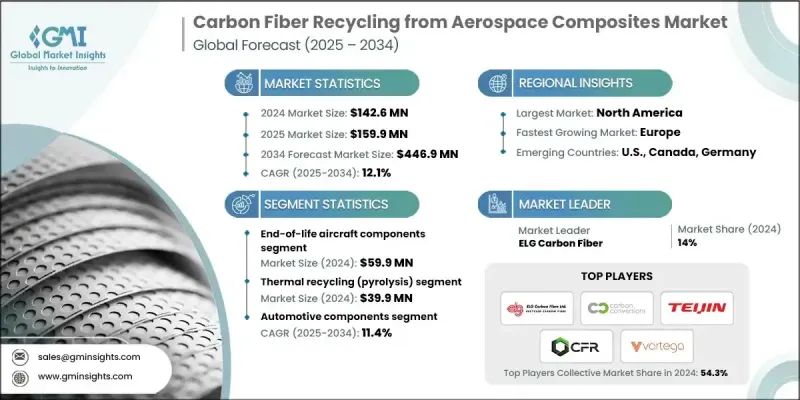
Rapid progress in recovery technologies is making recycled carbon fiber more cost-effective and higher in quality, encouraging its wider use in aerospace and related sectors. New methods that significantly reduce energy consumption while preserving mechanical strength are accelerating commercial adoption and improving process sustainability. Expanding recycling infrastructure and maturing industrial capabilities support the rising volume of composite waste generated from aircraft decommissioning. Global emphasis on circular manufacturing, stricter environmental targets, and stronger regulatory direction are also driving investments in advanced recycling systems. The increasing availability of end-of-life composite materials and the technical viability of converting them into high-value secondary fibers are creating favorable conditions for large-scale deployment. As recycling technologies evolve and supply chains integrate more efficiently, recycled carbon fiber is becoming an increasingly strategic material for aerospace, automotive, and industrial applications.
| Market Scope | |
|---|---|
| Start Year | 2024 |
| Forecast Year | 2025-2034 |
| Start Value | $142.6 Million |
| Forecast Value | $446.9 Million |
| CAGR | 12.1% |
The end-of-life aircraft components generated USD 59.9 million in 2024. Retired aircraft contain substantial quantities of carbon-fiber-based structures such as fuselage elements, wing assemblies, and tail components, making them a valuable source for recovery. The accelerating retirement cycle of older fleets worldwide continues to expand feedstock supply, reinforcing the importance of this material stream in recycling operations.
Thermal recycling, including pyrolysis, reached USD 39.9 million in 2024. This method dominates because it reliably extracts high-quality fibers without undermining their structural characteristics. Its scalability, ability to process large composite volumes, and comparatively low operational costs position it as the most commercially feasible technique. Continuous system advancements and improved energy-recovery approaches further enhance its economic performance. While alternative processes can recover fibers with high purity, their elevated costs limit broad adoption, solidifying thermal recycling as the leading industrial solution.
North America Carbon Fiber Recycling from Aerospace Composites Market captured USD 52 million in 2024, owing to strong aerospace manufacturing activity and expanding recycling capacities. The region benefits from a strong concentration of OEMs, Tier-1 suppliers, and emerging recyclers, increasing their production capabilities. Expanding commercial facilities and ongoing research initiatives strengthen domestic supply, while demand from downstream sectors reinforces regional growth.
Key companies active in the Carbon Fiber Recycling from Aerospace Composites Market include Toray Advanced Composites (Toray Group), ELG Carbon Fibre, Mitsubishi Chemical, Carbon Conversions, SGL Carbon, Carbon Fiber Recycling (CFR), Teijin Limited, Carbon Fiber Conversions GmbH, Westlake Corporation, and Vartega Inc. Companies operating in Carbon Fiber Recycling from Aerospace Composites Market enhance their competitive position by scaling production capacity, adopting advanced recovery technologies, and investing in energy-efficient processes that preserve fiber strength. Many pursue strategic partnerships with aerospace OEMs to secure consistent feedstock and integrate recycled materials into next-generation components. Efforts to improve process automation, reduce operational costs, and expand continuous recycling systems help increase output reliability. Organizations also focus on establishing certification standards, ensuring recycled fibers meet aerospace-grade performance requirements.
Table of Contents
Chapter 1 Methodology & Scope
- 1.1 Market scope and definition
- 1.2 Research design
- 1.2.1 Research approach
- 1.2.2 Data collection methods
- 1.3 Data mining sources
- 1.3.1 Global
- 1.3.2 Regional/Country
- 1.4 Base estimates and calculations
- 1.4.1 Base year calculation
- 1.4.2 Key trends for market estimation
- 1.5 Primary research and validation
- 1.5.1 Primary sources
- 1.6 Forecast model
- 1.7 Research assumptions and limitations
Chapter 2 Executive Summary
- 2.1 Industry 360° synopsis
- 2.2 Key market trends
- 2.2.1 Regional
- 2.2.2 Feedstock Source
- 2.2.3 Technology
- 2.2.4 Application
- 2.3 TAM Analysis, 2025-2034
- 2.4 CXO perspectives: Strategic imperatives
- 2.4.1 Executive decision points
- 2.4.2 Critical success factors
- 2.5 Future Outlook and Strategic Recommendations
Chapter 3 Industry Insights
- 3.1 Industry ecosystem analysis
- 3.1.1 Supplier Landscape
- 3.1.2 Profit Margin
- 3.1.3 Value addition at each stage
- 3.1.4 Factor affecting the value chain
- 3.1.5 Disruptions
- 3.2 Industry impact forces
- 3.2.1 Growth drivers
- 3.2.1.1 Increasing aircraft decommissioning rates
- 3.2.1.2 Sustainability regulations and circular economy goals
- 3.2.1.3 Technological advancements in recycling processes
- 3.2.2 Industry pitfalls and challenges
- 3.2.2.1 Inconsistent mechanical properties of recycled carbon fiber
- 3.2.2.2 Lack of standardization and certification frameworks
- 3.2.3 Market opportunities
- 3.2.3.1 Growing demand for lightweight materials in aerospace
- 3.2.3.2 Government incentives and green procurement policies
- 3.2.1 Growth drivers
- 3.3 Growth potential analysis
- 3.4 Regulatory landscape
- 3.4.1 North America
- 3.4.2 Europe
- 3.4.3 Asia Pacific
- 3.4.4 Latin America
- 3.4.5 Middle East & Africa
- 3.5 Porter's analysis
- 3.6 PESTEL analysis
- 3.7 Price trends
- 3.7.1 By region
- 3.7.2 Feedstock Source
- 3.7.3 Technology
- 3.7.4 Application
- 3.8 Future market trends
- 3.9 Technology and Innovation Landscape
- 3.9.1 Current technological trends
- 3.9.2 Emerging technologies
- 3.10 Patent Landscape
- 3.11 Trade statistics (HS code) (Note: the trade statistics will be provided for key countries only)
- 3.11.1 Major importing countries
- 3.11.2 Major exporting countries
- 3.12 Sustainability and environmental aspects
- 3.12.1 Sustainable practices
- 3.12.2 Waste reduction strategies
- 3.12.3 Energy efficiency in production
- 3.12.4 Eco-friendly initiatives
- 3.13 Carbon footprint considerations
Chapter 4 Competitive Landscape, 2024
- 4.1 Introduction
- 4.2 Company market share analysis
- 4.2.1 By region
- 4.2.1.1 North America
- 4.2.1.2 Europe
- 4.2.1.3 Asia Pacific
- 4.2.1.4 LATAM
- 4.2.1.5 MEA
- 4.2.1 By region
- 4.3 Company matrix analysis
- 4.4 Competitive analysis of major market players
- 4.5 Competitive positioning matrix
- 4.6 Key developments
- 4.6.1 Mergers & acquisitions
- 4.6.2 Partnerships & collaborations
- 4.6.3 New product launches
- 4.6.4 Expansion plans
Chapter 5 Market Estimates and Forecast, By Feedstock Source, 2021 - 2034 (USD Million) (Kilo Tons)
- 5.1 Key trends
- 5.2 End-of-Life Aircraft Components
- 5.2.1 Retired fuselage sections
- 5.2.2 Wing and tail structures
- 5.2.3 Interior panels and fixtures
- 5.2.4 Engine cowls and nacelles
- 5.3 Production Scrap
- 5.3.1 Prepreg offcuts and trimmings
- 5.3.2 Defective or rejected layups
- 5.3.3 Autoclave rejects and cured waste
- 5.4 MRO (Maintenance, Repair & Overhaul) Waste
- 5.4.1 Replaced or repaired panels
- 5.4.2 Damaged composite parts from overhaul
- 5.4.3 Residual parts from retrofitting
- 5.5 Prototyping and R&D Scrap
- 5.5.1 Test parts from development batches
- 5.5.2 Non-certified experimental components
- 5.6 Others
Chapter 6 Market Estimates and Forecast, By Technology, 2021 - 2034 (USD Million) (Kilo Tons)
- 6.1 Key trends
- 6.2 Mechanical recycling
- 6.2.1 Shredding
- 6.2.2 Milling and grinding
- 6.2.3 Granulation
- 6.3 Thermal Recycling (Pyrolysis)
- 6.3.1 Conventional pyrolysis (inert gas)
- 6.3.2 Microwave-assisted pyrolysis
- 6.3.3 Fluidized bed pyrolysis
- 6.4 Chemical Recycling (Solvolysis / Depolymerization)
- 6.4.1 Acid/base catalyzed solvolysis
- 6.4.2 Alcoholysis and glycolysis methods
- 6.4.3 Supercritical fluid solvolysis
- 6.5 Supercritical fluid processing
- 6.5.1 Supercritical CO2
- 6.5.2 Supercritical water oxidation
- 6.6 Others
Chapter 7 Market Estimates and Forecast, By Application, 2021 - 2034 (USD Million) (Kilo Tons)
- 7.1 Key trends
- 7.2 Automotive components
- 7.2.1 Structural automotive parts
- 7.2.2 Body panels & exterior components
- 7.2.3 Interior applications
- 7.3 Electronics manufacturing
- 7.3.1 Circuit board applications
- 7.3.2 Electronic housings & enclosures
- 7.3.3 Thermal management components
- 7.4 Infrastructure applications
- 7.4.1 Electrical grid components
- 7.4.2 Construction & building materials
- 7.4.3 Transportation infrastructure
- 7.5 Sporting goods & consumer products
- 7.5.1 Recreational equipment
- 7.5.2 Consumer electronics
- 7.6 Others
Chapter 8 Market Estimates and Forecast, By Region, 2021 - 2034 (USD million) (Kilo Tons)
- 8.1 Key trends
- 8.2 North America
- 8.2.1 U.S.
- 8.2.2 Canada
- 8.3 Europe
- 8.3.1 Germany
- 8.3.2 UK
- 8.3.3 France
- 8.3.4 Spain
- 8.3.5 Italy
- 8.3.6 Rest of Europe
- 8.4 Asia Pacific
- 8.4.1 China
- 8.4.2 India
- 8.4.3 Japan
- 8.4.4 Australia
- 8.4.5 South Korea
- 8.4.6 Rest of Asia Pacific
- 8.5 Latin America
- 8.5.1 Brazil
- 8.5.2 Mexico
- 8.5.3 Rest of Latin America
- 8.6 Middle East and Africa
- 8.6.1 Saudi Arabia
- 8.6.2 South Africa
- 8.6.3 UAE
- 8.6.4 Rest of Middle East and Africa
Chapter 9 Company Profiles
- 9.1 Mitsubishi Chemical
- 9.2 ELG Carbon Fibre
- 9.3 Carbon Fiber Conversions GmbH
- 9.4 Carbon Fiber Recycling (CFR)
- 9.5 Carbon Conversions
- 9.6 Teijin Limited
- 9.7 SGL Carbon
- 9.8 Toray Advanced Composites(Toray Group)
- 9.9 Westlake Corporation
- 9.10 Vartega Inc