

|
시장보고서
상품코드
1892716
지속가능한 건설용 화학제품 시장 기회, 성장요인, 업계 동향 분석 및 예측(2025-2034년)Sustainable Construction Chemicals Market Opportunity, Growth Drivers, Industry Trend Analysis, and Forecast 2025 - 2034 |
||||||

세계의 지속가능한 건설용 화학제품 시장은 2024년에 721억 달러로 평가되었고, 2034년까지 연평균 복합 성장률(CAGR) 6.3%로 성장하여 1,322억 달러에 이를 것으로 예측됩니다.
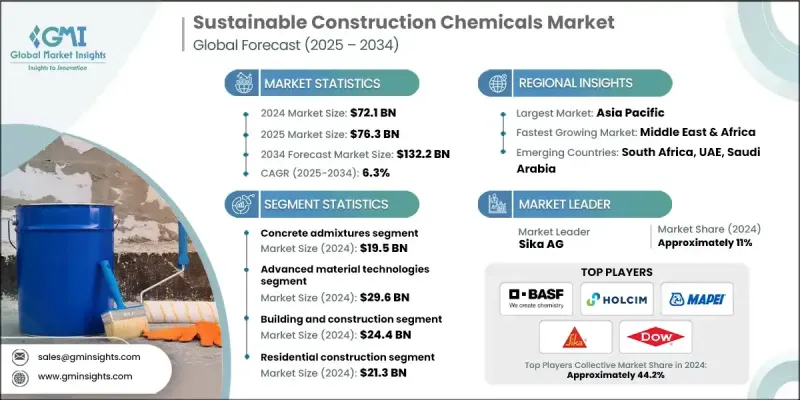
본 시장에는 바이오 방수 코팅, 친환경 접착제 및 실란트, 단열재, 환경 부하 저감 및 내구성 향상을 위한 특수 화학제품 등 다양한 제품이 포함됩니다. 이 제품들은 건설 산업의 탄소 발자국을 줄이고 자재 수명을 연장하는 데 기여하고 있습니다. 환경 규제 강화, 에너지 절약형 건축에 대한 수요 증가, 지속 가능한 건설 방식에 대한 관심 증가가 시장 성장을 견인하고 있습니다. 유럽 전역의 규제 프레임워크는 업계가 저탄소, 재활용 가능한 재료와 혁신적인 화학 솔루션을 채택하도록 장려하고 있습니다. 정책 주도 수요와 기술 발전의 시너지 효과로 인해 건설 부문은 지속가능성에 대한 소비자의 진화하는 기대에 부응하는 동시에 견고하고 친환경적인 인프라를 제공할 수 있게 되었습니다.
| 시장 범위 | |
|---|---|
| 개시 연도 | 2024년 |
| 예측 연도 | 2025-2034년 |
| 개시 연도 시장 규모 | 721억 달러 |
| 예측 금액 | 1,322억 달러 |
| CAGR | 6.3% |
콘크리트 혼화제 부문은 2024년 27%의 점유율을 차지했습니다. 이러한 혼화제는 기계적 특성, 내구성, 환경적 성능을 향상시킵니다. 많은 제품이 바이오 또는 재활용 성분을 함유하고 있어 인프라 및 상업용 건설 프로젝트에 사용되는 콘크리트의 탄소 발자국을 효과적으로 줄일 수 있습니다.
첨단 소재 기술 부문은 2024년 296억 달러로 평가되며 2025년부터 2034년까지 연평균 2.2% 성장할 것으로 예측됩니다. 나노소재, 자기복원 코팅, 고성능 첨가제 분야의 혁신으로 건축물의 강도, 복원력, 지속가능성이 향상되고 있습니다. 이러한 기술을 통해 건설 업계는 환경적 성능과 내구성에 대한 현대적 기준을 충족시키면서 유지보수 비용이 낮은 구조물을 개발할 수 있습니다.
유럽의 지속 가능한 건설용 화학제품 시장은 2024년175억 달러에 달할 것으로 예측됩니다. 건축에너지법(GEG) 및 '기후행동계획 2050'에 따른 규제 등으로 인해 제조업체들은 환경 부하가 적은 원료와 에너지 효율이 높은 배합을 통한 기술 혁신을 추진하고 있습니다. 기업들은 재활용 함량이 높은 혼화제부터 무용제 코팅에 이르기까지 생태학적 기준을 훼손하지 않으면서도 장기적인 성능을 발휘하는 제품을 도입하고 있습니다. 이러한 규제 프레임워크는 라이프사이클 지속가능성 및 실내 환경 품질에 대한 시장의 기대치를 형성하고 보다 친환경적인 솔루션에 대한 투자를 촉진하고 있습니다.
자주 묻는 질문
목차
제1장 조사 방법
- 시장 범위와 정의
- 조사 설계
- 조사 접근
- 데이터 수집 방법
- 데이터 마이닝 소스
- 세계
- 지역별/국가별
- 기본 추정치와 계산
- 기준연도 계산
- 시장 추정 주요 동향
- 1차 조사와 검증
- 1차 정보
- 예측 모델
- 조사의 전제조건과 제한 사항
제2장 주요 요약
제3장 업계 인사이트
- 생태계 분석
- 공급업체 상황
- 이익률
- 각 단계별 부가가치
- 밸류체인에 영향을 미치는 요인
- 파괴적 변화
- 업계에 대한 영향요인
- 성장 촉진요인
- 업계의 잠재적 리스크&과제
- 시장 기회
- 성장 가능성 분석
- 규제 상황
- 북미
- 유럽
- 아시아태평양
- 라틴아메리카
- 중동 및 아프리카
- Porter's Five Forces 분석
- PESTEL 분석
- 가격 동향
- 지역별
- 제품별
- 향후 시장 동향
- 기술과 혁신 동향
- 현재 기술 동향
- 신기술
- 특허 상황
- 무역 통계(주 : 무역 통계는 주요 국가에 한해 제공됩니다)
- 주요 수입국
- 주요 수출국
- 지속가능성과 환경적 측면
- 지속가능한 실천
- 폐기물 감축 전략
- 생산 에너지 효율
- 친환경 이니셔티브
- 탄소발자국에 관한 고려사항
제4장 경쟁 구도
- 서론
- 기업의 시장 점유율 분석
- 지역별
- 북미
- 유럽
- 아시아태평양
- 라틴아메리카
- 중동 및 아프리카
- 지역별
- 기업 매트릭스 분석
- 주요 시장 기업의 경쟁 분석
- 경쟁 포지셔닝 매트릭스
- 주요 발전
- 인수합병(M&A)
- 제휴 및 협업
- 신제품 발매
- 사업 확대 계획
제5장 시장 추산 및 예측 : 제품 유형별, 2021-2034
- 주요 동향
- 콘크리트 혼화제
- 고성능 감수제 및 감수제
- 공기 혼입제
- 가속제 및 지연제
- 특수 혼화제
- 방수 및 보호 코팅
- 방수 시트 시스템
- 액상 도포 코팅
- 결정계 방수
- 바이오 보호 솔루션
- 접착제 및 실란트
- 구조용 접착제
- 건축용 실란트
- 바이오 접착제 시스템
- 저VOC 배합
- 단열재
- 바이오 단열재
- 재생재 함유 단열재
- 상변화 물질
- 에어로겔 기술
- 특수 건설용 화학제품
- 자기치유 재료
- 카본 네거티브 콘크리트
- 지오폴리머 시스템
- 스마트 건축자재
제6장 시장 추산 및 예측 : 기술별, 2021-2034
- 주요 동향
- 바이오 기술
- 식물 유래 원료
- 미생물 생산 시스템
- 효소 프로세스
- 바이오테크놀러지 응용
- 재생 함유 기술
- 사용한 소비자 재활용 재료
- 산업 폐기물 이용
- 순환형 경제 솔루션
- 폐기물로부터 화학제품에의 프로세스
- 저탄소 기술
- 탄소 포집 및 활용
- 재생에너지 통합
- 에너지 효율적 에너지 생산
- 탄소 중립 배합
- 첨단 소재 기술
- 나노테크놀러지 응용
- 스마트 재료 시스템
- 자기치유 기술
- 상변화 소재
제7장 시장 추산 및 예측 : 용도별, 2021-2034
- 주요 동향
- 주택 건설
- 단독주택
- 집합주택
- 저소득자용 주택 프로젝트
- 그린 주택 개발
- 상업 건축
- 오피스 빌딩
- 소매 점포
- 의료시설
- 교육시설
- 인프라 개발
- 교통 인프라
- 상하수도 시스템
- 에너지 인프라
- 스마트 시티 프로젝트
- 산업 건설
- 제조 시설
- 창고 및 물류센터
- 데이터센터
- 청정에너지 시설
제8장 시장 추산 및 예측 : 최종 이용 산업별, 2021-2034
- 주요 동향
- 건축 및 건설
- 인프라 개발
- 산업 용도
- 운송 부문
- 에너지 및 유틸리티
- 해양 및 오프쇼어
- 광업 및 광물
- 농업 및 식품 가공
제9장 시장 추산 및 예측 : 지역별, 2021-2034
- 주요 동향
- 북미
- 미국
- 캐나다
- 유럽
- 독일
- 영국
- 프랑스
- 이탈리아
- 스페인
- 기타 유럽
- 아시아태평양
- 중국
- 인도
- 일본
- 호주
- 한국
- 기타 아시아태평양
- 라틴아메리카
- 브라질
- 멕시코
- 아르헨티나
- 기타 라틴아메리카
- 중동 및 아프리카
- 사우디아라비아
- 남아프리카공화국
- 아랍에미리트(UAE)
- 기타 중동 및 아프리카
제10장 기업 개요
- BASF SE(Master Builders Solutions)
- Sika AG
- Ashland
- Holcim
- Cemex
- 3M Company
- Arkema S.A
- Clariant AG
- Evonik Industries AG
- MAPEI S.p.A.
- The Dow Chemical Company
The Global Sustainable Construction Chemicals Market was valued at USD 72.1 billion in 2024 and is estimated to grow at a CAGR of 6.3% to reach USD 132.2 billion by 2034.
The market includes a wide array of products such as bio-based waterproofing coatings, eco-friendly adhesives and sealants, insulation materials, and specialty chemicals designed to enhance durability while reducing environmental impact. These products are helping the construction industry lower carbon footprints and extend material lifespans. Growth in this market is being fueled by stricter environmental regulations, rising demand for energy-efficient buildings, and greater awareness of sustainable construction practices. Across Europe, regulatory frameworks are compelling the industry to adopt low-carbon, recyclable materials and innovative chemical solutions. This combination of policy-driven demand and technological advancement is enabling the construction sector to deliver resilient, eco-conscious infrastructure while meeting evolving consumer expectations for sustainability.
| Market Scope | |
|---|---|
| Start Year | 2024 |
| Forecast Year | 2025-2034 |
| Start Value | $72.1 Billion |
| Forecast Value | $132.2 Billion |
| CAGR | 6.3% |
The concrete admixture segment held a 27% share in 2024. These admixtures enhance mechanical properties, durability, and environmental performance. Many products incorporate biobased or recycled components, effectively lowering the carbon footprint of concrete used in both infrastructure and commercial construction projects.
The advanced material technologies segment was valued at USD 29.6 billion in 2024 and is expected to grow at a CAGR of 2.2% from 2025 to 2034. Innovations in nanomaterials, self-healing coatings, and high-performance additives are improving building strength, resilience, and sustainability. These technologies allow the construction industry to develop low-maintenance structures while meeting modern standards for environmental performance and durability.
Europe Sustainable Construction Chemicals Market reached USD 17.5 billion in 2024. Regulations such as the Building Energy Act (GEG) and initiatives under the Climate Action Plan 2050 are driving manufacturers to innovate with low-impact raw materials and energy-efficient formulations. Companies are introducing products ranging from recycled-content admixtures to solvent-free coatings that deliver long-term performance without compromising ecological standards. Such regulatory frameworks are shaping market expectations regarding lifecycle sustainability and indoor environmental quality, encouraging investment in greener solutions.
Key players in the Global Sustainable Construction Chemicals Market include Sika AG, BASF SE, Holcim Ltd, MAPEI S.p.A., The Dow Chemical Company, and others. Companies in the Sustainable Construction Chemicals Market are employing several strategies to strengthen their presence. Many are investing in research and development to create eco-friendly, high-performance products, including recycled-content materials and solvent-free coatings. Strategic partnerships with distributors and construction firms expand market reach, while mergers and acquisitions help consolidate portfolios and enter new regions. Firms are also emphasizing sustainability certifications and eco-labels to meet regulatory requirements and attract environmentally conscious buyers.
Table of Contents
Chapter 1 Methodology
- 1.1 Market scope and definition
- 1.2 Research design
- 1.2.1 Research approach
- 1.2.2 Data collection methods
- 1.3 Data mining sources
- 1.3.1 Global
- 1.3.2 Regional/Country
- 1.4 Base estimates and calculations
- 1.4.1 Base year calculation
- 1.4.2 Key trends for market estimation
- 1.5 Primary research and validation
- 1.5.1 Primary sources
- 1.6 Forecast model
- 1.7 Research assumptions and limitations
Chapter 2 Executive Summary
- 2.1 Industry 360° synopsis
- 2.2 Key market trends
- 2.2.1 Regional
- 2.2.2 Product Type
- 2.2.3 Technology
- 2.2.4 Application
- 2.2.5 End use Industry
- 2.3 TAM Analysis, 2025-2034
- 2.4 CXO perspectives: Strategic imperatives
- 2.4.1 Executive decision points
- 2.4.2 Critical success factors
- 2.5 Future Outlook and Strategic Recommendations
Chapter 3 Industry Insights
- 3.1 Industry ecosystem analysis
- 3.1.1 Supplier Landscape
- 3.1.2 Profit Margin
- 3.1.3 Value addition at each stage
- 3.1.4 Factor affecting the value chain
- 3.1.5 Disruptions
- 3.2 Industry impact forces
- 3.2.1 Growth drivers
- 3.2.2 Industry pitfalls and challenges
- 3.2.3 Market opportunities
- 3.3 Growth potential analysis
- 3.4 Regulatory landscape
- 3.4.1 North America
- 3.4.2 Europe
- 3.4.3 Asia Pacific
- 3.4.4 Latin America
- 3.4.5 Middle East & Africa
- 3.5 Porter's analysis
- 3.6 PESTEL analysis
- 3.7 Price trends
- 3.7.1 By region
- 3.7.2 By product
- 3.8 Future market trends
- 3.9 Technology and Innovation landscape
- 3.9.1 Current technological trends
- 3.9.2 Emerging technologies
- 3.10 Patent Landscape
- 3.11 Trade statistics (Note: the trade statistics will be provided for key countries only)
- 3.11.1 Major importing countries
- 3.11.2 Major exporting countries
- 3.12 Sustainability and Environmental Aspects
- 3.12.1 Sustainable Practices
- 3.12.2 Waste Reduction Strategies
- 3.12.3 Energy Efficiency in Production
- 3.12.4 Eco-friendly Initiatives
- 3.13 Carbon Footprint Considerations
Chapter 4 Competitive Landscape, 2024
- 4.1 Introduction
- 4.2 Company market share analysis
- 4.2.1 By region
- 4.2.1.1 North America
- 4.2.1.2 Europe
- 4.2.1.3 Asia Pacific
- 4.2.1.4 LATAM
- 4.2.1.5 MEA
- 4.2.1 By region
- 4.3 Company matrix analysis
- 4.4 Competitive analysis of major market players
- 4.5 Competitive positioning matrix
- 4.6 Key developments
- 4.6.1 Mergers & acquisitions
- 4.6.2 Partnerships & collaborations
- 4.6.3 New Product Launches
- 4.6.4 Expansion Plans
Chapter 5 Market Estimates and Forecast, By Product Type, 2021- 2034 (USD Billion, Kilo Tons)
- 5.1 Key trends
- 5.2 Concrete admixtures
- 5.2.1 Superplasticizers and water reducers
- 5.2.2 Air-entraining agents
- 5.2.3 Accelerating and retarding agents
- 5.2.4 Specialty admixtures
- 5.3 Waterproofing and protective coatings
- 5.3.1 Membrane systems
- 5.3.2 Liquid applied coatings
- 5.3.3 Crystalline waterproofing
- 5.3.4 Bio-based protective solutions
- 5.4 Adhesives and sealants
- 5.4.1 Structural adhesives
- 5.4.2 Construction sealants
- 5.4.3 Bio-based adhesive systems
- 5.4.4 Low-voc formulations
- 5.5 Insulation materials
- 5.5.1 Bio-based insulation
- 5.5.2 Recycled content insulation
- 5.5.3 Phase change materials
- 5.5.4 Aerogel technologies
- 5.6 Specialty construction chemicals
- 5.6.1 Self-healing materials
- 5.6.2 Carbon-negative concrete
- 5.6.3 Geopolymer systems
- 5.6.4 Smart construction materials
Chapter 6 Market Estimates and Forecast, By Technology, 2021 - 2034 (USD Billion, Kilo Tons)
- 6.1 Key trends
- 6.2 Bio-based technologies
- 6.2.1 Plant-based raw materials
- 6.2.2 Microbial production systems
- 6.2.3 Enzymatic processes
- 6.2.4 Biotechnology applications
- 6.3 Recycled content technologies
- 6.3.1 Post-consumer recycled materials
- 6.3.2 Post-industrial waste utilization
- 6.3.3 Circular economy solutions
- 6.3.4 Waste-to-chemical processes
- 6.4 Low-carbon technologies
- 6.4.1 Carbon capture and utilization
- 6.4.2 Renewable energy integration
- 6.4.3 Energy-efficient production
- 6.4.4 Carbon-neutral formulations
- 6.5 Advanced material technologies
- 6.5.1 Nanotechnology applications
- 6.5.2 Smart material systems
- 6.5.3 Self-healing technologies
- 6.5.4 Phase change materials
Chapter 7 Market Estimates and Forecast, By Application, 2021 - 2034 (USD Billion, Kilo Tons)
- 7.1 Key trends
- 7.2 Residential construction
- 7.2.1 Single-family homes
- 7.2.2 Multi-family housing
- 7.2.3 Affordable housing projects
- 7.2.4 Green residential developments
- 7.3 Commercial construction
- 7.3.1 Office buildings
- 7.3.2 Retail spaces
- 7.3.3 Healthcare facilities
- 7.3.4 Educational buildings
- 7.4 Infrastructure development
- 7.4.1 Transportation infrastructure
- 7.4.2 Water and wastewater systems
- 7.4.3 Energy infrastructure
- 7.4.4 Smart city projects
- 7.5 Industrial construction
- 7.5.1 Manufacturing facilities
- 7.5.2 Warehouses and distribution centers
- 7.5.3 Data centers
- 7.5.4 Clean energy facilities
Chapter 8 Market Estimates and Forecast, By End use Industry, 2021 - 2034 (USD Billion, Kilo Tons)
- 8.1 Key trends
- 8.2 Building and construction
- 8.3 Infrastructure development
- 8.4 Industrial applications
- 8.5 Transportation sector
- 8.6 Energy and utilities
- 8.7 Marine and offshore
- 8.8 Mining and minerals
- 8.9 Agriculture and food processing
Chapter 9 Market Estimates and Forecast, By Region, 2021 - 2034 (USD Billion, Kilo Tons)
- 9.1 Key trends
- 9.2 North America
- 9.2.1 U.S.
- 9.2.2 Canada
- 9.3 Europe
- 9.3.1 Germany
- 9.3.2 UK
- 9.3.3 France
- 9.3.4 Italy
- 9.3.5 Spain
- 9.3.6 Rest of Europe
- 9.4 Asia Pacific
- 9.4.1 China
- 9.4.2 India
- 9.4.3 Japan
- 9.4.4 Australia
- 9.4.5 South Korea
- 9.4.6 Rest of Asia Pacific
- 9.5 Latin America
- 9.5.1 Brazil
- 9.5.2 Mexico
- 9.5.3 Argentina
- 9.5.4 Rest of Latin America
- 9.6 Middle East & Africa
- 9.6.1 Saudi Arabia
- 9.6.2 South Africa
- 9.6.3 UAE
- 9.6.4 Rest of Middle East & Africa
Chapter 10 Company Profiles
- 10.1 BASF SE (Master Builders Solutions)
- 10.2 Sika AG
- 10.3 Ashland
- 10.4 Holcim
- 10.5 Cemex
- 10.6 3M Company
- 10.7 Arkema S.A
- 10.8 Clariant AG
- 10.9 Evonik Industries AG
- 10.10 MAPEI S.p.A.
- 10.11 The Dow Chemical Company


