|
시장보고서
상품코드
1892782
인대시 내비게이션 시스템 시장 기회, 성장요인, 업계 동향 분석 및 예측(2026-2035년)In-dash Navigation System Market Opportunity, Growth Drivers, Industry Trend Analysis, and Forecast 2026 - 2035 |
||||||

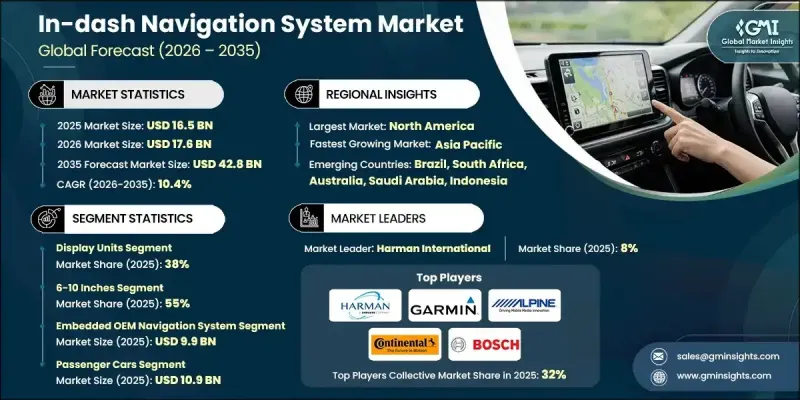
세계의 인대시 내비게이션 시스템 시장은 2025년에 165억 달러로 평가되었고, 2035년까지 연평균 복합 성장률(CAGR) 10.4%로 성장하여 428억 달러에 이를 것으로 예측됩니다.
시장 확대의 배경에는 스마트폰 기반 내비게이션 앱과 공장 출하 시 장착된 OEM 내비게이션 시스템의 통합이 진행되어 엔트리 모델과 저가 모델을 포함한 모든 차종에서 내비게이션 사용이 용이해진 것이 주요 원인으로 꼽힙니다. 소비자들은 임베디드 시스템이 주요 자동차 제조업체의 프리미엄 제품만큼 고급스럽지 않더라도 내비게이션 툴을 표준으로 채택하는 추세입니다. 대형 디스플레이, 증강현실(AR) 헤드업 디스플레이, 멀티존 콕핏 통합과 같은 기술 혁신은 사용자 경험을 향상시키고, 모든 차종 카테고리에서 첨단 내비게이션 솔루션의 도입을 촉진하고 있습니다. 최신 시스템은 더 빠른 지도 그리기, 우수한 메모리 및 저장 용량, 눈부심 감소, 인포테인먼트와 내비게이션 기능을 통합한 매끄러운 인터페이스를 제공합니다. 연결성, 편의성, 차량 내 몰입감에 대한 소비자의 기대치가 높아지면서 스마트 음성비서 및 커넥티드카 서비스의 보급과 함께 시장 성장을 견인하고 있습니다.
| 시장 범위 | |
|---|---|
| 개시 연도 | 2025년 |
| 예측 연도 | 2026-2035년 |
| 개시 연도 시장 규모 | 165억 달러 |
| 예측 금액 | 428억 달러 |
| CAGR | 10.4% |
디스플레이 유닛 부문은 2025년 38%의 점유율을 차지할 것으로 예상되며, 2026년부터 2035년까지 연평균 복합 성장률(CAGR) 11.6%를 보일 것으로 예측됩니다. 대형 및 고해상도 디스플레이는 빠른 응답 속도와 향상된 가시성으로 인해 내비게이션 및 인포테인먼트의 주요 인터페이스로 선택되는 경향이 있습니다.
6인치 미만의 소형 디스플레이 부문은 2025년 19.9%의 점유율을 차지할 것으로 예상되며, 대시보드 공간이 제한된 보급형 차량과 상용차를 중심으로 2034년까지 연평균 복합 성장률(CAGR) 11%로 성장할 것으로 전망됩니다. 이러한 컴팩트한 시스템은 안드로이드 오토나 애플 카플레이와 같은 스마트폰 프로젝션 기술에 의존하는 경향이 강해지고 있으며, 대형 내장 화면 없이도 효율적으로 내비게이션 기능을 제공합니다.
미국의 차량용 내비게이션 시스템 시장은 2025년 39억 달러에 달할 것으로 예측됩니다. 미국 시장의 성장은 커넥티드 서비스의 보급, 음성 조작 기능, 통합 인포테인먼트 기능의 표준 장착으로 운전자의 편의성과 참여도가 높아지면서 성장세를 이어가고 있습니다. 자동차 제조업체들은 안전, 연결성, 엔터테인먼트에 대한 소비자의 높은 기대에 부응하기 위해 첨단 내비게이션 기술을 탑재하고 있습니다.
자주 묻는 질문
목차
제1장 조사 방법과 범위
제2장 주요 요약
제3장 업계 인사이트
- 생태계 분석
- 공급업체 상황
- 부품 제조업체
- 지도제작과 소프트웨어 프로바이더
- 애프터마켓 유통 네트워크
- 최종 용도
- 비용 구조
- 이익률
- 각 단계별 부가가치
- 수직통합 동향
- 디스럽터
- 공급업체 상황
- 영향요인
- 성장 촉진요인
- 업계의 잠재적 리스크&과제
- 시장 기회
- 기술 동향과 혁신 에코시스템
- 현행 기술
- 차량내 맵과 GNSS 수신기를 갖춘 OEM 내비게이션 시스템
- 스마트폰용 프로젝션 플랫폼
- 4G/5G 텔레매틱스에 의한 실시간 교통 정보 연동 내비게이션
- 디지털 기기 클러스터+HUD 내비게이션 통합
- 신기술
- 첨단 헤드업 디스플레이(HUD)에 의한 증강현실(AR) 내비게이션 오버레이
- 도메인 컨트롤러/HPC 기반 내비게이션에 의한 SDV 아키텍처 운영
- HD맵을 활용한 ADAS 및 자율주행용 레인 레벨 내비게이션
- 하이브리드 위성+5G 내비게이션 접속에 의한 끊김 없는 커버리지
- 현행 기술
- 성장 가능성 분석
- 규제 상황
- NHTSA 운전자 주의 산만 가이드라인
- ISO 26262 기능 안전 요건
- 데이터 프라이버시 규제
- 유엔 규제
- 지역별 규제 비교
- 북미
- 유럽
- 아시아태평양
- 라틴아메리카
- 중동 및 아프리카
- Porter's Five Forces 분석
- PESTEL 분석
- 특허 분석
- AR-HUD 및 아이트래킹 기술에 관한 특허
- AI 및 머신러닝 특허
- V2X 통신 특허
- 주요 기업에 의한 특허 포트폴리오 분석
- 특허 소송 및 라이선싱 상황
- 비용 내역 분석
- 가격 동향
- OEM대 애프터마켓 가격 결정 동향
- 컴포넌트 비용 동향과 학습 곡선
- 구독 및 서비스 수익 모델
- 가격 탄력성 분석
- 기술별 비용 절감 로드맵
- 리스크 평가와 경감 전략
- 기술 진부화 리스크
- 반도체 부족 리스크
- 변화하는 규제 요건
- 가격 압력과 이익률 저하
- 제품 파이프라인과 연구개발 로드맵
- 제품 개발 파이프라인 분석
- 주요 기업별 기술 로드맵
- 연구개발 중점 분야와 투자 우선순위
- 공동 연구개발 구상
- 지속가능성과 환경면
- 내비게이션 시스템 탄소발자국
- 순환형 경제 전략
- 지속가능내비게이션 기능
- 기업 지속가능성 시책
- 기후 변화가 항행에 미치는 영향
- 시장 도입과 침투 분석
- 기술 채택 곡선 분석
- 지역별 침투율
- 차량 부문별 보급률
- 기능 채택 분석
- 도입 촉진 전략
- 이용 사례 분석과 적용 시나리오
- 이용 사례 프레임워크와 선정 기준
- 시스템 요건과 통합 포인트
- 결제 시스템 통합
- 이용 사례 비교 매트릭스
- 고객 여정과 경험 지도제작
- 고객 세분화와 페르소나
- 고객 요구와 과제점
- 고객 여정 매핑
- 행동 분석과 이용 패턴
- 리스크 평가와 리스크 매트릭스
- 소프트웨어 품질·신뢰성 리스크
- 데이터 프라이버시 및 GDPR(EU 개인정보보호규정) 준거 리스크
- 단일 공급원 리스크
- 리스크 우선순위 설정 매트릭스
- 시나리오 플래닝과 감도 분석
- 시나리오 플래닝 프레임워크
- 기반 케이스 시나리오
- 규제 영향 감응도
- 신규 참여 기업과 비즈니스 모델
제4장 경쟁 구도
- 서론
- 기업의 시장 점유율 분석
- 북미
- 유럽
- 아시아태평양
- 라틴아메리카
- 중동 및 아프리카
- 경쟁 포지셔닝 매트릭스
- 전략적 전망 매트릭스
- 주요 발전
- 인수합병(M&A)
- 제휴 및 협업
- 신제품 발매
- 사업 확대 계획과 자금조달
- 프리미엄 포지셔닝 전략
- 경쟁 분석과 독자적인 강점(USP)
제5장 시장 추산 및 예측 : 컴포넌트별, 2022-2035
- 주요 동향
- 표시 유닛
- 제어 모듈
- 안테나 모듈
- 와이어 하네스
제6장 시장 추산 및 예측 : 기술별, 2022-2035
- 주요 동향
- 임베디드 OEM 내비게이션 시스템
- 스마트폰 통합형 내비게이션 플랫폼
- 접속형 및 클라우드 기반 내비게이션 시스템
- 계기 클러스터+HUD 통합 내비게이션
- 도메인 컨트롤러 및 콕핏용 HPC 통합 내비게이션
제7장 시장 추산 및 예측 : 지역별, 2022-2035
- 주요 동향
- 2D 맵
- 3D 맵
제8장 시장 추산 및 예측 : 화면 사이즈별, 2022-2035
- 주요 동향
- 6인치 미만
- 6-10인치
- 10인치 이상
제9장 시장 추산 및 예측 : 차량별, 2022-2035
- 주요 동향
- 승용차
- SUV
- 세단
- 해치백
- 상용차
- 상업용 경차(LCV)
- MCV
- 대형 상용차(HCV)
제10장 시장 추산 및 예측 : 판매채널별, 2022-2035
- 주요 동향
- OEM
- 애프터마켓
제11장 시장 추산 및 예측 : 지역별, 2022-2035
- 북미
- 미국
- 캐나다
- 유럽
- 영국
- 독일
- 프랑스
- 이탈리아
- 스페인
- 벨기에
- 네덜란드
- 스웨덴
- 러시아
- 아시아태평양
- 중국
- 인도
- 일본
- 호주
- 싱가포르
- 한국
- 베트남
- 인도네시아
- 라틴아메리카
- 브라질
- 멕시코
- 아르헨티나
- 중동 및 아프리카
- 남아프리카공화국
- 사우디아라비아
- 아랍에미리트(UAE)
제12장 기업 개요
- 세계 기업
- Continental
- HARMAN International
- Panasonic
- Garmin
- Robert Bosch
- Denso
- Hyundai Mobis
- Mitsubishi Electric
- Delphi Technologies
- DXC Technology Company
- Region players
- Alpine Electronics
- Pioneer
- Clarion
- Visteon
- Valeo
- LG Electronics
- JVCKENWOOD
- Marelli
- Desay SV Automotive
- 신규 기업
- Aisin
- Luxoft
- NNG Software
- Preh Car Connect
- Dynavin
- Vinland
The Global In-dash Navigation System Market was valued at USD 16.5 billion in 2025 and is estimated to grow at a CAGR of 10.4% to reach USD 42.8 billion by 2035.
The market expansion is fueled by the integration of smartphone-based navigation apps with factory-installed OEM navigation systems, making navigation more accessible across vehicle segments, including entry-level and budget models. Consumers are increasingly adopting navigation tools as standard vehicle features, even if the embedded systems are less advanced than premium offerings from leading automakers. Technological innovations, such as large-format displays, augmented reality heads-up displays, and multi-zone cockpit integration, are enhancing user experience and driving adoption of sophisticated navigation solutions across all vehicle categories. Modern systems now offer faster map rendering, better memory and storage capacities, and reduced glare, providing a seamless interface that merges infotainment and navigation functionalities. Rising consumer expectations for connectivity, convenience, and in-vehicle engagement are also propelling market growth, alongside the increasing popularity of smart voice assistants and connected car services.
| Market Scope | |
|---|---|
| Start Year | 2025 |
| Forecast Year | 2026-2035 |
| Start Value | $16.5 Billion |
| Forecast Value | $42.8 Billion |
| CAGR | 10.4% |
The display units segment held a 38% share in 2025 and is expected to grow at a CAGR of 11.6% from 2026 to 2035. Large-format, high-resolution displays are becoming the preferred interface for navigation and infotainment, offering faster response times and improved visibility.
The smaller displays under 6" segment held a 19.9% share in 2025, expected to grow at 11% CAGR through 2034, driven by entry-level and commercial vehicles where dashboard space is limited. These compact systems increasingly rely on smartphone projection technologies, such as Android Auto and Apple CarPlay, to provide navigation functionality efficiently without requiring larger embedded screens.
United States In-dash Navigation System Market reached USD 3.9 billion in 2025. Growth in the U.S. market is supported by widespread adoption of connected services, voice-activated controls, and integrated infotainment features in standard vehicle offerings, enhancing driver convenience and engagement. Automakers are embedding advanced navigation technologies to meet rising consumer expectations for safety, connectivity, and entertainment.
Key players in the Global In-dash Navigation System Market include Alpine Electronics, Continental, Delphi Technologies, Denso, DXC Technology Company, Garmin, Harman International, JVCKENWOOD, Pioneer, and Robert Bosch. Companies in the Global In-dash Navigation System Market are focusing on strategies such as continuous R&D to introduce faster, more intuitive, and high-resolution display systems. Partnerships with automakers allow for deeper integration of navigation and infotainment features. Firms are also enhancing smartphone compatibility, voice control, and augmented reality functionalities to differentiate products. Expanding after-sales support, leveraging direct and digital sales channels, and targeting emerging markets are key strategies to boost market penetration. Investments in software updates, cloud-based navigation, and connected services strengthen brand loyalty and provide recurring revenue streams, helping companies solidify their position in an increasingly competitive industry.
Table of Contents
Chapter 1 Methodology & Scope
- 1.1 Research design
- 1.1.1 Research approach
- 1.1.2 Data collection methods
- 1.2 Base estimates and calculations
- 1.2.1 Base year calculation
- 1.2.2 Key trends for market estimates
- 1.3 Forecast
- 1.4 Primary research and validation
- 1.5 Some of the primary sources
- 1.6 Data mining sources
- 1.6.1 Secondary
- 1.6.1.1 Paid Sources
- 1.6.1.2 Public Sources
- 1.6.1.3 Sources, by region
- 1.6.1 Secondary
- 1.7 Inclusion & Exclusion
Chapter 2 Executive Summary
- 2.1 Industry 360° synopsis
- 2.2 Key market trends
- 2.2.1 Regional
- 2.2.2 Component
- 2.2.3 Technology
- 2.2.4 Map
- 2.2.5 Screen Size
- 2.2.6 Vehicle
- 2.2.7 Sales Channel
- 2.3 TAM Analysis, 2026-2035
- 2.4 CXO perspectives: Strategic imperatives
- 2.4.1 Key decision points for industry executives
- 2.4.2 Critical success factors for market players
- 2.5 Future outlook and strategic recommendations
Chapter 3 Industry Insights
- 3.1 Industry ecosystem analysis
- 3.1.1 Supplier landscape
- 3.1.1.1 Component manufacturers
- 3.1.1.2 Mapping & Software Providers
- 3.1.1.3 Aftermarket Distribution Networks
- 3.1.1.4 End use
- 3.1.2 Cost structure
- 3.1.3 Profit margin
- 3.1.4 Value addition at each stage
- 3.1.5 Vertical integration trends
- 3.1.6 Disruptors
- 3.1.1 Supplier landscape
- 3.2 Impact on forces
- 3.2.1 Growth drivers
- 3.2.1.1 Increasing vehicle connectivity & cloud adoption
- 3.2.1.2 Advanced infotainment & cockpit trends
- 3.2.1.3 EV & ADAS integration
- 3.2.1.4 Regulatory & safety standards
- 3.2.2 Industry pitfalls & challenges
- 3.2.2.1 high system costs
- 3.2.2.2 cybersecurity & privacy concerns
- 3.2.3 Market opportunities
- 3.2.3.1 AI & predictive navigation
- 3.2.3.2 Smartphone & app projection systems
- 3.2.1 Growth drivers
- 3.3 Technology trends & innovation ecosystem
- 3.3.1 Current technologies
- 3.3.1.1 OEM navigation systems with onboard maps and GNSS receivers
- 3.3.1.2 Smartphone projection platforms
- 3.3.1.3 Connected navigation with real-time traffic via 4G/5G telematics
- 3.3.1.4 Digital instrument cluster + HUD navigation integration
- 3.3.2 Emerging technologies
- 3.3.2.1 Augmented reality (AR) navigation overlays via advanced HUDs
- 3.3.2.2 Domain controller / HPC-based navigation running SDV architectures
- 3.3.2.3 HD map-powered ADAS and lane-level navigation for autonomous driving
- 3.3.2.4 Hybrid satellite + 5G navigation connectivity for uninterrupted coverage
- 3.3.1 Current technologies
- 3.4 Growth potential analysis
- 3.5 Regulatory landscape
- 3.5.1 NHTSA driver distraction guidelines
- 3.5.2 ISO 26262 functional safety requirements
- 3.5.3 Data privacy regulations
- 3.5.4 UN regulations
- 3.5.5 Regional regulatory comparison
- 3.5.5.1 North America
- 3.5.5.2 Europe
- 3.5.5.3 Asia-Pacific
- 3.5.5.4 Latin America
- 3.5.5.5 Middle East & Africa
- 3.6 Porter's analysis
- 3.7 PESTEL analysis
- 3.8 Patent analysis
- 3.8.1 AR-HUD & Eye-Tracking patents
- 3.8.2 AI & Machine Learning patents
- 3.8.3 V2X communication patents
- 3.8.4 Patent portfolio analysis by key players
- 3.8.5 Patent litigation & licensing landscape
- 3.9 Cost breakdown analysis
- 3.10 Price trends
- 3.10.1 OEM vs Aftermarket pricing dynamics
- 3.10.2 Component cost trends & learning curves
- 3.10.3 Subscription & service revenue models
- 3.10.4 Price elasticity analysis
- 3.10.5 Cost-down roadmaps by technology
- 3.11 Risk assessment & mitigation strategies
- 3.11.1 Technology obsolescence risk
- 3.11.2 Semiconductor shortage risk
- 3.11.3 Changing regulatory requirements
- 3.11.4 Pricing pressure & margin erosion
- 3.12 Product Pipeline & R&D Roadmap
- 3.12.1 Product development pipeline analysis
- 3.12.2 Technology roadmap by key players
- 3.12.3 R&D focus areas & investment priorities
- 3.12.4 Collaborative R&D initiatives
- 3.13 Sustainability and environmental aspects
- 3.13.1 Carbon footprint of navigation systems
- 3.13.2 Circular economic strategies
- 3.13.3 Sustainable navigation features
- 3.13.4 Corporate sustainability initiatives
- 3.13.5 Climate change impact on navigation
- 3.14 Market adoption & penetration analysis
- 3.14.1 Technology adoption curve analysis
- 3.14.2 Penetration rates by region
- 3.14.3 Penetration rates by vehicle segment
- 3.14.4 Feature adoption analysis
- 3.14.5 Adoption acceleration strategies
- 3.15 Use case analysis & application scenarios
- 3.15.1 Use case framework & selection criteria
- 3.15.2 System requirements & integration points
- 3.15.3 Payment system integration
- 3.15.4 Use case comparison matrix
- 3.16 Customer Journey & Experience Mapping
- 3.16.1 Customer segmentation & personas
- 3.16.2 Customer needs & pain points
- 3.16.3 Customer journey mapping
- 3.16.4 Behavioral analysis & usage patterns
- 3.17 Risk assessment & risk matrix
- 3.17.1 Software quality & reliability risk
- 3.17.2 Data privacy & GDPR compliance risk
- 3.17.3 Single-source supplier risk
- 3.17.4 Risk prioritization matrix
- 3.18 Scenario planning & sensitivity analysis
- 3.18.1 Scenario planning framework
- 3.18.2 Base case scenario
- 3.18.3 Regulatory impact sensitivity
- 3.18.4 New entrants & business models
Chapter 4 Competitive Landscape, 2025
- 4.1 Introduction
- 4.2 Company market share analysis
- 4.2.1 North America
- 4.2.2 Europe
- 4.2.3 Asia-Pacific
- 4.2.4 Latin America
- 4.2.5 Middle East & Africa
- 4.3 Competitive positioning matrix
- 4.4 Strategic outlook matrix
- 4.5 Key developments
- 4.5.1 Mergers & acquisitions
- 4.5.2 Partnerships & collaborations
- 4.5.3 New product launches
- 4.5.4 Expansion plans and funding
- 4.6 Premium positioning strategies
- 4.7 Competitive analysis and USPs
Chapter 5 Market Estimates & Forecast, By Component, 2022 - 2035 ($Bn)
- 5.1 Key trends
- 5.2 Display Unit
- 5.3 Control Module
- 5.4 Antenna Module
- 5.5 Wiring Harness
Chapter 6 Market Estimates & Forecast, By Technology, 2022 - 2035 ($Bn, units)
- 6.1 Key trends
- 6.2 Embedded OEM navigation systems
- 6.3 Smartphone-integrated navigation platforms
- 6.4 Connected & cloud-based navigation systems
- 6.5 Instrument cluster + HUD integrated navigation
- 6.6 Domain controller & cockpit HPC integrated navigation
Chapter 7 Market Estimates & Forecast, By Map, 2022 - 2035 ($Bn, units)
- 7.1 Key trends
- 7.2 2D Maps
- 7.3 3D Maps
Chapter 8 Market Estimates & Forecast, By Screen Size, 2022 - 2035 ($Bn, units)
- 8.1 Key trends
- 8.2 Less Than 6 Inches
- 8.3 6-10 Inches
- 8.4 More Than 10 Inches
Chapter 9 Market Estimates & Forecast, By Vehicle, 2022 - 2035 ($Bn, units)
- 9.1 Key trends
- 9.2 Passenger Cars
- 9.2.1 SUV
- 9.2.2 Sedan
- 9.2.3 Hatchback
- 9.3 Commercial Vehicles
- 9.3.1 LCV
- 9.3.2 MCV
- 9.3.3 HCV
Chapter 10 Market Estimates & Forecast, By Sales Channel, 2022 - 2035 ($Bn, units)
- 10.1 Key trends
- 10.2 OEM
- 10.3 Aftermarket
Chapter 11 Market Estimates & Forecast, By Region, 2022 - 2035 ($Bn, units)
- 11.1 North America
- 11.1.1 US
- 11.1.2 Canada
- 11.2 Europe
- 11.2.1 UK
- 11.2.2 Germany
- 11.2.3 France
- 11.2.4 Italy
- 11.2.5 Spain
- 11.2.6 Belgium
- 11.2.7 Netherlands
- 11.2.8 Sweden
- 11.2.9 Russia
- 11.3 Asia Pacific
- 11.3.1 China
- 11.3.2 India
- 11.3.3 Japan
- 11.3.4 Australia
- 11.3.5 Singapore
- 11.3.6 South Korea
- 11.3.7 Vietnam
- 11.3.8 Indonesia
- 11.4 Latin America
- 11.4.1 Brazil
- 11.4.2 Mexico
- 11.4.3 Argentina
- 11.5 MEA
- 11.5.1 South Africa
- 11.5.2 Saudi Arabia
- 11.5.3 UAE
Chapter 12 Company Profiles
- 12.1 Global players
- 12.1.1 Continental
- 12.1.2 HARMAN International
- 12.1.3 Panasonic
- 12.1.4 Garmin
- 12.1.5 Robert Bosch
- 12.1.6 Denso
- 12.1.7 Hyundai Mobis
- 12.1.8 Mitsubishi Electric
- 12.1.9 Delphi Technologies
- 12.1.10 DXC Technology Company
- 12.2 Region players
- 12.2.1 Alpine Electronics
- 12.2.2 Pioneer
- 12.2.3 Clarion
- 12.2.4 Visteon
- 12.2.5 Valeo
- 12.2.6 LG Electronics
- 12.2.7 JVCKENWOOD
- 12.2.8 Marelli
- 12.2.9 Desay SV Automotive
- 12.3 Emerging players
- 12.3.1 Aisin
- 12.3.2 Luxoft
- 12.3.3 NNG Software
- 12.3.4 Preh Car Connect
- 12.3.5 Dynavin
- 12.3.6 Vinland