

|
시장보고서
상품코드
1892838
고속 송풍기 시장 기회, 성장요인, 업계 동향 분석 및 예측(2026-2035년)High-Speed Blowers Market Opportunity, Growth Drivers, Industry Trend Analysis, and Forecast 2026 - 2035 |
||||||

세계의 고속 송풍기 시장은 2025년에 9억 7,270만 달러로 평가되었고, 2035년까지 연평균 복합 성장률(CAGR) 3.7%로 성장하여 14억 2,000만 달러에 이를 것으로 예측됩니다.
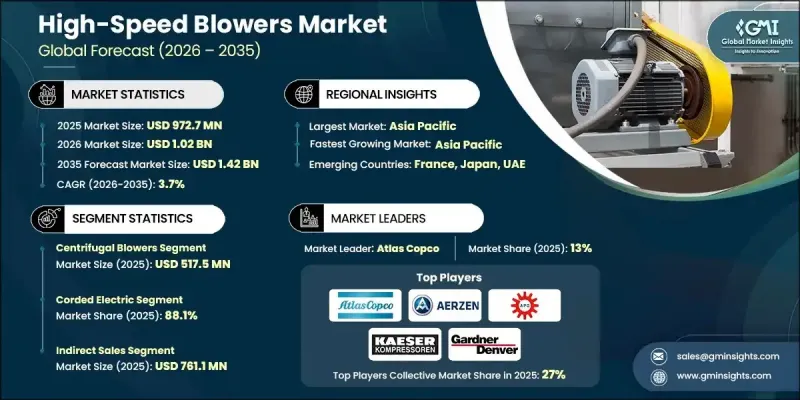
이러한 성장은 산업 전반에 걸쳐 효율적이고 신뢰할 수 있는 고성능 공기 흐름 솔루션에 대한 수요가 증가하고 있기 때문입니다. 고속 송풍기는 산업 운영에 필수적인 요소로, 안정적인 기류 유지, 에너지 소비 감소, 열악한 환경에서의 효과적인 작동을 가능하게 합니다. 석유 및 가스 산업은 가스 압축, 석유 정제 및 제품의 효율적인 운송을 위해 이러한 송풍기에 크게 의존하고 있습니다. 에너지 소비 증가와 운영 안정성에 대한 요구가 증가함에 따라 산업계는 최신 고속 송풍기 기술의 도입을 추진하고 있습니다. 보다 엄격한 환경 규제와 지속가능성 목표에 따라 기업들은 기존 시스템을 고성능을 유지하면서 탄소 배출량을 줄이는 에너지 절약형 송풍기로 교체해야 합니다. 또한, 스마트 모니터링 시스템과 예지보전 도구의 통합을 통해 운영자는 다운타임을 최소화하고, 설비 수명을 연장하며, 총소유비용을 최적화할 수 있어 산업 분야에서 더욱 널리 보급되고 있습니다.
| 시장 범위 | |
|---|---|
| 개시 연도 | 2025년 |
| 예측 연도 | 2026-2035년 |
| 개시 연도 시장 규모 | 9억 7,270만 달러 |
| 예측 금액 | 14억 2,000만 달러 |
| CAGR | 3.7% |
원심 송풍기 부문은 2025년 5억 1,750만 달러의 수익을 창출할 것으로 예측됩니다. 이 송풍기는 원심력을 이용하여 공기와 가스를 효율적으로 이송하고, 공기는 중앙의 임펠러에서 유입되어 운동 에너지를 고압 기류로 변환하는 디퓨저를 통해 배출됩니다. 내구성, 에너지 효율성, 신뢰성으로 정평이 난 원심식 송풍기는 중압 및 고압 범위에서 안정적인 기류가 필요한 산업 제조, HVAC 시스템, 자재관리 공정에 널리 사용되고 있습니다.
2025년 기준, 코드형 전기 송풍기 부문은 88.1%의 점유율을 차지했습니다. 코드형 전기 송풍기는 콘센트에서 지속적으로 전력을 공급하여 산업 및 상업 환경에서 높은 신뢰성을 발휘합니다. 배터리나 연료식과는 달리, 코드식 유닛은 지속적인 작동을 보장하고, 유지보수의 복잡성을 줄이며, 충전 및 급유 주기에 대한 우려를 해소하여 비용 효율적이고 신뢰할 수 있는 솔루션입니다.
미국 고속 송풍기 시장은 2025년 78.7%의 점유율을 차지하며 2억 1,900만 달러의 매출을 기록할 것으로 예측됩니다. 에너지 효율적이고 지속 가능한 운영 방식을 채택하여 성장을 주도하고 있습니다. 규제 요구 사항과 효율적인 폭기에 대한 요구로 인해 폐수 처리 산업은 여전히 주요 사용자로 남아 있습니다. 그러나 환경 및 효율성 기준을 충족하기 위해 기업들이 운영을 현대화하면서 화학 처리, 석유 및 가스, 발전 산업에서도 고속 송풍기 채택이 확대되고 있습니다.
자주 묻는 질문
목차
제1장 조사 방법과 범위
제2장 주요 요약
제3장 업계 인사이트
- 생태계 분석
- 공급업체 상황
- 이익률
- 각 단계별 부가가치
- 밸류체인에 영향을 미치는 요인
- 업계에 대한 영향요인
- 성장 촉진요인
- 업계의 잠재적 리스크&과제
- 기회
- 성장 가능성 분석
- 향후 시장 동향
- 기술과 혁신 동향
- 현재 기술 동향
- 신기술
- 가격 동향
- 지역별
- 유형별
- 규제 상황
- 규격 및 컴플라이언스 요건
- 지역별 규제 구조
- 인증 기준
- Porter's Five Forces 분석
- PESTEL 분석
제4장 경쟁 구도
- 서론
- 기업의 시장 점유율 분석
- 지역별
- 기업 매트릭스 분석
- 주요 시장 기업의 경쟁 분석
- 경쟁 포지셔닝 매트릭스
- 주요 발전
- 인수합병(M&A)
- 제휴 및 협업
- 신제품 발매
- 확대 계획
제5장 시장 추산 및 예측 : 유형별, 2022-2035
- 주요 동향
- 원심 송풍기
- 축류 송풍기
- 크로스 플로우 송풍기
- 기타(스크류 송풍기, 루트 송풍기 등)
제6장 시장 추산 및 예측 : 전력별, 2022-2035
- 주요 동향
- 코드 전기
- 배터리 구동
제7장 시장 추산 및 예측 : 기술별, 2022-2035
- 주요 동향
- Magnetic bearings
- Airfoil bearings
제8장 시장 추산 및 예측 : 용도별, 2022-2035
- 주요 동향
- 폐수 처리
- 석유 및 가스
- 화학
- 선박
- 식품 및 음료
- 기타(펄프 및 제지, 식품 및 음료 등)
제9장 시장 추산 및 예측 : 유통 채널별, 2022-2035
- 주요 동향
- 직접 판매
- 간접 판매
제10장 시장 추산 및 예측 : 지역별, 2022-2035
- 주요 동향
- 북미
- 미국
- 캐나다
- 유럽
- 독일
- 영국
- 프랑스
- 이탈리아
- 스페인
- 아시아태평양
- 중국
- 일본
- 인도
- 호주
- 한국
- 라틴아메리카
- 브라질
- 멕시코
- 아르헨티나
- 중동 및 아프리카
- 남아프리카공화국
- 사우디아라비아
- 아랍에미리트(UAE)
제11장 기업 개요
- Aerzen Turbo
- APG Neuros
- Atlas Copco AB
- Busch Vacuum Solutions
- Continental Industrie
- Esurging(Tianjin) Technology
- Gardner Denver
- Hoffman &Lamson
- Kaeser Kompressoren SE
- Nanjing Magnetic Valley Technology
- Pfeiffer Vacuum
- Spencer Turbine Company
- Sulzer
- Tuthill
- Xylem
The Global High-Speed Blowers Market was valued at USD 972.7 million in 2025 and is estimated to grow at a CAGR of 3.7% to reach USD 1.42 billion by 2035.
This growth is driven by the increasing demand for efficient, reliable, and high-performance airflow solutions across industries. High-speed blowers have become integral to industrial operations, allowing companies to maintain stable airflow, reduce energy consumption, and operate effectively in demanding environments. The oil and gas sector heavily relies on these blowers for compressing gas, refining petroleum, and transporting products efficiently. Rising energy consumption and the need for operational reliability are motivating industries to adopt modern high-speed blower technologies. Stricter environmental regulations and sustainability targets are prompting companies to replace traditional systems with energy-efficient blowers that lower carbon emissions while maintaining high performance. Furthermore, the integration of smart monitoring systems and predictive maintenance tools allows operators to minimize downtime, extend equipment life, and optimize total cost of ownership, driving further adoption in industrial applications.
| Market Scope | |
|---|---|
| Start Year | 2025 |
| Forecast Year | 2026-2035 |
| Start Value | $972.7 Million |
| Forecast Value | $1.42 Billion |
| CAGR | 3.7% |
The centrifugal blowers segment generated USD 517.5 million in 2025. These blowers utilize centrifugal force to transfer air or gas efficiently, with air entering through a central impeller and exiting via diffusers that convert kinetic energy into high-pressure airflow. Renowned for their durability, energy efficiency, and reliability, centrifugal blowers are widely used in industrial manufacturing, HVAC systems, and material handling processes where consistent airflow at moderate to high pressures is required.
The corded electric segment held 88.1% share in 2025. Corded electric blowers provide a continuous power supply from electrical outlets, making them highly reliable in industrial and commercial environments. Unlike battery or fuel-powered alternatives, corded units ensure uninterrupted operation, reduce maintenance complexity, and eliminate concerns about recharge or refueling cycles, making them cost-effective and dependable solutions.
U.S. High-Speed Blowers Market held a 78.7% share, generating USD 201.9 million in 2025. Growth is driven by the adoption of energy-efficient and sustainable operational methods. The wastewater treatment industry remains a major user due to regulatory requirements and the need for efficient aeration. However, high-speed blowers are increasingly adopted across chemical processing, oil and gas, and power generation industries as companies modernize operations to meet environmental and efficiency standards.
Key players in the Global High-Speed Blowers Market include Kaeser Kompressoren SE, Hoffman & Lamson, Spencer Turbine Company, Tuthill, Xylem, APG Neuros, Aerzen Turbo, Atlas Copco AB, Howden North America, Continental Industrie, KTurbo, Sulzer, Nanjing Magnetic Valley Technology, Esurging (Tianjin) Technology, and Gardner Denver. Market leaders focus on strengthening their position through strategic initiatives such as continuous R&D to enhance blower efficiency, reliability, and energy performance. Companies integrate IoT-enabled monitoring systems and predictive maintenance solutions to reduce downtime and operational costs. Expansion of product portfolios, including centrifugal and high-capacity units, allows them to cater to diverse industrial applications. Collaborations with industrial players and service partnerships enhance customer reach, while investments in sustainable and environmentally compliant solutions improve competitiveness.
Table of Contents
Chapter 1 Methodology and Scope
- 1.1 Market scope and definition
- 1.2 Research design
- 1.2.1 Research approach
- 1.2.2 Data collection methods
- 1.3 Data mining sources
- 1.3.1 Global
- 1.3.2 Regional/Country
- 1.4 Base estimates and calculations
- 1.4.1 Base year calculation
- 1.4.2 Key trends for market estimation
- 1.5 Primary research and validation
- 1.5.1 Primary sources
- 1.6 Forecast model
- 1.7 Research assumptions and limitations
Chapter 2 Executive Summary
- 2.1 Industry 3600 synopsis
- 2.2 Key market trends
- 2.2.1 Regional
- 2.2.2 Type
- 2.2.3 Power source
- 2.2.4 Technology
- 2.2.5 Application
- 2.2.6 Distribution channel
- 2.3 CXO perspectives: Strategic imperatives
- 2.3.1 Key decision points for industry executives
- 2.3.2 Critical success factors for market players
- 2.4 Future outlook and strategic recommendations
Chapter 3 Industry Insights
- 3.1 Industry ecosystem analysis
- 3.1.1 Supplier landscape
- 3.1.2 Profit margin
- 3.1.3 Value addition at each stage
- 3.1.4 Factor affecting the value chain
- 3.2 Industry impact forces
- 3.2.1 Growth drivers
- 3.2.1.1 Growth of the oil & gas industry
- 3.2.1.2 Industrialization & infrastructure expansion
- 3.2.1.3 Energy efficiency & operational savings
- 3.2.1.4 Increasing demand for oil free and certified blowers
- 3.2.2 Industry pitfalls & challenges
- 3.2.2.1 High initial investment
- 3.2.2.2 Skilled workforce needs
- 3.2.3 Opportunities
- 3.2.3.1 Wastewater treatment applications
- 3.2.3.2 Adoption of smart & IoT-integrated blowers
- 3.2.1 Growth drivers
- 3.3 Growth potential analysis
- 3.4 Future market trends
- 3.5 Technology and innovation landscape
- 3.5.1 Current technological trends
- 3.5.2 Emerging technologies
- 3.6 Price trends
- 3.6.1 By Region
- 3.6.2 By Type
- 3.7 Regulatory landscape
- 3.7.1 Standards and compliance requirements
- 3.7.2 Regional regulatory frameworks
- 3.7.3 Certification standards
- 3.8 Porter's analysis
- 3.9 PESTEL analysis
Chapter 4 Competitive Landscape, 2025
- 4.1 Introduction
- 4.2 Company market share analysis
- 4.2.1 By region
- 4.2.1.1 North America
- 4.2.1.2 Europe
- 4.2.1.3 Asia Pacific
- 4.2.1.4 Latin America
- 4.2.1.5 Middle East and Africa
- 4.2.1 By region
- 4.3 Company matrix analysis
- 4.4 Competitive analysis of major market players
- 4.5 Competitive positioning matrix
- 4.6 Key developments
- 4.6.1 Mergers & acquisitions
- 4.6.2 Partnerships & collaborations
- 4.6.3 New product launches
- 4.6.4 Expansion plans
Chapter 5 Market Estimates and Forecast, By Type, 2022 - 2035 (USD Million) (Thousand Units)
- 5.1 Key trends
- 5.2 Centrifugal blowers
- 5.3 Axial blowers
- 5.4 Cross-flow blowers
- 5.5 Others (screw blower, roots blower, etc.)
Chapter 6 Market Estimates and Forecast, By Power Source, 2022 - 2035 (USD Million) (Thousand Units)
- 6.1 Key trends
- 6.2 Corded electric
- 6.3 Battery powered
Chapter 7 Market Estimates and Forecast, By Technology, 2022 - 2035 (USD Million) (Thousand Units)
- 7.1 Key trends
- 7.2 Magnetic bearings
- 7.3 Airfoil bearings
Chapter 8 Market Estimates and Forecast, By Application, 2022 - 2035 (USD Million) (Thousand Units)
- 8.1 Key trends
- 8.2 Wastewater treatment
- 8.3 Oil & gas
- 8.4 Chemical
- 8.5 Marine
- 8.6 Food & beverages
- 8.7 Others (pulp and paper, food and beverage, etc.)
Chapter 9 Market Estimates and Forecast, By Distribution Channel, 2022 - 2035 (USD Million) (Thousand Units)
- 9.1 Key trends
- 9.2 Direct sales
- 9.3 Indirect sales
Chapter 10 Market Estimates and Forecast, By Region, 2022 - 2035 (USD Million) (Thousand Units)
- 10.1 Key trends
- 10.2 North America
- 10.2.1 U.S.
- 10.2.2 Canada
- 10.3 Europe
- 10.3.1 Germany
- 10.3.2 UK
- 10.3.3 France
- 10.3.4 Italy
- 10.3.5 Spain
- 10.4 Asia Pacific
- 10.4.1 China
- 10.4.2 Japan
- 10.4.3 India
- 10.4.4 Australia
- 10.4.5 South Korea
- 10.5 Latin America
- 10.5.1 Brazil
- 10.5.2 Mexico
- 10.5.3 Argentina
- 10.6 Middle East and Africa
- 10.6.1 South Africa
- 10.6.2 Saudi Arabia
- 10.6.3 UAE
Chapter 11 Company Profiles
- 11.1 Aerzen Turbo
- 11.2 APG Neuros
- 11.3 Atlas Copco AB
- 11.4 Busch Vacuum Solutions
- 11.5 Continental Industrie
- 11.6 Esurging (Tianjin) Technology
- 11.7 Gardner Denver
- 11.8 Hoffman & Lamson
- 11.9 Kaeser Kompressoren SE
- 11.10 Nanjing Magnetic Valley Technology
- 11.11 Pfeiffer Vacuum
- 11.12 Spencer Turbine Company
- 11.13 Sulzer
- 11.14 Tuthill
- 11.15 Xylem


