|
시장보고서
상품코드
1892857
디지털 텍스타일 프린터 시장 기회, 성장요인, 업계 동향 분석 및 예측(2026-2035년)Digital Textile Printer Market Opportunity, Growth Drivers, Industry Trend Analysis, and Forecast 2026 - 2035 |
||||||

세계의 디지털 텍스타일 프린터 시장은 2025년에 29억 달러로 평가되었고, 2035년까지 연평균 복합 성장률(CAGR) 5.7%로 성장하여 50억 달러에 이를 것으로 예측됩니다.
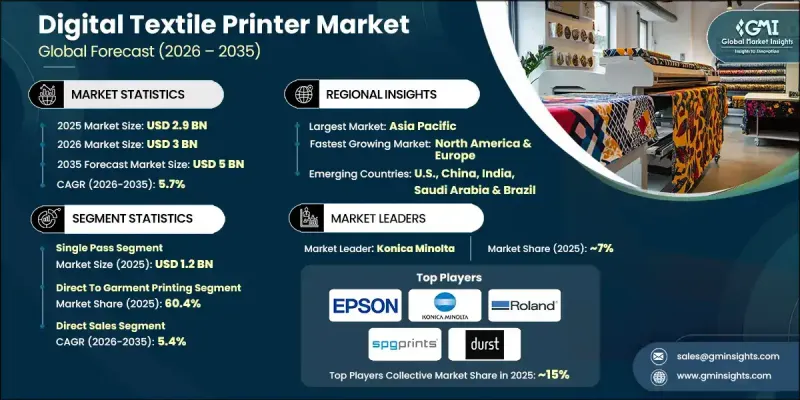
이러한 성장은 섬유 산업을 변화시키는 몇 가지 주요 트렌드에 의해 주도되고 있습니다. 소비자들이 점점 더 많은 주문형 개인화 섬유를 요구함에 따라 제조업체는 더 빠르고 유연한 생산 방법을 도입해야 합니다. 패스트 패션의 부상, 온라인 쇼핑 플랫폼, 소셜 미디어가 주도하는 트렌드는 섬유 기업들이 소량 생산과 고도로 맞춤화된 생산에 박차를 가하고 있습니다. 디지털 섬유 인쇄는 기존 인쇄 방법에 비해 설정 시간 단축, 납기 단축, 재고 비용 절감을 실현하여 브랜드가 이러한 제품을 제공할 수 있습니다. 싱글 패스 프린트 헤드, AI 기반 컬러 관리 시스템, 자동화된 워크플로우와 같은 기술 발전은 효율성, 정확성, 생산성을 더욱 향상시킵니다. 디지털 텍스타일 프린터는 다운타임과 생산 비용을 최소화하면서 다양한 섬유 유형에 고해상도 인쇄를 할 수 있어 현대 의류 및 홈 데코레이션 분야에서 디지털 텍스타일 프린터가 점점 더 중요해지고 있습니다.
| 시장 범위 | |
|---|---|
| 개시 연도 | 2025년 |
| 예측 연도 | 2026-2035년 |
| 개시 연도 시장 규모 | 29억 달러 |
| 예측 금액 | 50억 달러 |
| CAGR | 5.7% |
싱글 패스 프린터 부문은 2025년 12억 달러 시장 규모를 기록할 것으로 예상되며, 2026년부터 2035년까지 연평균 5.7%의 성장률을 보일 것으로 전망됩니다. 이 프린터는 전체 디자인을 한 번의 패스로 완성하기 때문에 생산 시간을 크게 단축하여 제조업체가 빠른 배송 패션 및 대량 주문 수요에 대응할 수 있습니다. 이를 통해 전자상거래 및 개인 맞춤형 의류 생산에 적합합니다.
DTG(Direct-to-Garment) 인쇄 부문은 2025년 60.4%의 점유율을 차지할 것으로 예상되며, 2026년부터 2035년까지 연평균 6%의 성장률을 보일 것으로 예측됩니다. DTG 기술은 복잡한 설정 없이 완성된 의류에 고품질 풀컬러 디자인을 직접 인쇄할 수 있어 주문형 생산 및 전자상거래 중심의 비즈니스 모델을 지원합니다. 그 적응성으로 인해 중소기업, 맞춤형 의류 사업, 개인화된 의류를 제공하는 온라인 플랫폼에 의해 선호되고 있습니다.
미국 디지털 텍스타일 프린터 시장은 2025년에 3억 7,000만 달러로 평가되었고, 2026년부터 2035년까지 연평균 4.6% 성장할 것으로 예측됩니다. 패션, 홈 데코레이션, 테크니컬 섬유 산업의 견조한 수요가 대량 맞춤화와 신속한 디자인 대응을 가능하게 하는 첨단 인쇄 기술에 대한 수요를 주도하고 있습니다. 주문형 생산 모델, 마이크로 팩토리 설치, 무수 인쇄 및 저환경 잉크를 포함한 지속가능성에 대한 노력은 시장의 성장을 가속하고 있습니다.
자주 묻는 질문
목차
제1장 조사 방법과 범위
제2장 주요 요약
제3장 업계 인사이트
- 생태계 분석
- 공급업체 상황
- 이익률
- 각 공정 부가가치
- 밸류체인에 영향을 미치는 요인
- 업계에 대한 영향요인
- 성장 촉진요인
- 업계의 잠재적 리스크&과제
- 성장 가능성 분석
- 향후 시장 동향
- 기술과 혁신 동향
- 현재 기술 동향
- 신기술
- 가격 동향
- 지역별
- 기종별
- 규제 상황
- 규격 및 컴플라이언스 요건
- 지역별 규제 구조
- 인증 기준
- Porter's Five Forces 분석
- PESTEL 분석
제4장 경쟁 구도
- 서론
- 기업의 시장 점유율 분석
- 지역별
- 북미
- 유럽
- 아시아태평양
- 라틴아메리카
- 중동 및 아프리카
- 지역별
- 기업 매트릭스 분석
- 주요 시장 기업의 경쟁 분석
- 경쟁 포지셔닝 매트릭스
- 주요 발전
- 인수합병(M&A)
- 제휴 및 협업
- 신제품 발매
- 확대 계획
제5장 시장 추산 및 예측 : 기종별, 2022-2035
- 주요 동향
- 플로터
- 스캐너
- 싱글패스
제6장 시장 추산 및 예측 : 잉크 유형별, 2022-2035
- 주요 동향
- 반응성 잉크
- 산성 잉크
- 분산형 잉크
- 안료 잉크
- 기타
제7장 시장 추산 및 예측 : 재료별, 2022-2035
- 주요 동향
- 면
- 폴리에스테르
- 견
- 혼방 패브릭
제8장 시장 추산 및 예측 : 기술별, 2022-2035
- 주요 동향
- 서멀 잉크젯
- 압전식 잉크젯
- 연속식 잉크젯
- 열전사
- 정전
- 전자 사진법
- 기타
제9장 시장 추산 및 예측 : 인쇄 프로세스별, 2022-2035
- 주요 동향
- Direct to garment printing
- Direct to fabrics
제10장 시장 추산 및 예측 : 용도별, 2022-2035
- 주요 동향
- 패션 및 의류 산업
- 홈 퍼니싱
- 자동차 및 운송
- 의료 및 헬스케어 분야
- 스포츠 및 피트니스 산업
- 광고 및 마케팅
- 기타(항공우주, 교육, 건설)
제11장 시장 추산 및 예측 : 유통 채널별, 2022-2035
- 주요 동향
- 직접 판매
- 간접 판매
제12장 시장 추산 및 예측 : 지역별, 2022-2035
- 주요 동향
- 북미
- 미국
- 캐나다
- 유럽
- 독일
- 영국
- 프랑스
- 이탈리아
- 스페인
- 아시아태평양
- 중국
- 인도
- 일본
- 한국
- 호주
- 인도네시아
- 말레이시아
- 라틴아메리카
- 브라질
- 멕시코
- 아르헨티나
- 중동 및 아프리카
- 사우디아라비아
- 아랍에미리트(UAE)
- 남아프리카공화국
제13장 기업 개요
- Aleph S.r.l.
- Durst Group
- EFI(Electronics For Imaging)
- Epson
- Hollanders Printing Systems
- JK Group
- Konica Minolta
- Kornit Digital
- Mimaki Engineering
- MS Printing Solutions
- Mutoh
- Reggiani Machine
- Roland DG
- Seiko Epson Corporation
- SPGPrints
The Global Digital Textile Printer Market was valued at USD 2.9 billion in 2025 and is estimated to grow at a CAGR of 5.7% to reach USD 5 billion by 2035.
This growth is driven by several key trends transforming the textile industry. Consumers increasingly demand on-demand and personalized textiles, prompting manufacturers to adopt faster, more flexible production methods. The rise of fast fashion, online shopping platforms, and social media-driven trends is pushing textile companies to produce smaller, highly customized batches. Digital textile printing enables brands to deliver these products with reduced setup times, faster turnaround, and lower inventory costs compared to traditional printing methods. Advancements in technology, including single-pass print heads, AI-driven color management systems, and automated workflows, further boost efficiency, precision, and productivity. High-resolution printing across diverse textile types while minimizing downtime and production costs makes digital textile printers increasingly essential for the modern apparel and home decor sectors.
| Market Scope | |
|---|---|
| Start Year | 2025 |
| Forecast Year | 2026-2035 |
| Start Value | $2.9 Billion |
| Forecast Value | $5 Billion |
| CAGR | 5.7% |
The single-pass printers segment generated USD 1.2 billion in 2025 and is expected to grow at a CAGR of 5.7% from 2026 to 2035. These printers complete entire designs in a single pass, dramatically reducing production time and allowing manufacturers to meet demand for rapid-turnaround fashion and bulk orders, making them ideal for e-commerce and personalized apparel production.
The direct-to-garment (DTG) printing segment held a 60.4% share in 2025 and is projected to grow at a CAGR of 6% from 2026 to 2035. DTG technology allows high-quality, full-color designs to be printed directly onto finished garments without complex setups, supporting on-demand production and e-commerce-driven business models. Its adaptability attracts small and medium enterprises, custom apparel businesses, and online platforms offering personalized clothing.
U.S. Digital Textile Printer Market was valued at USD 370 million in 2025 and is expected to grow at a CAGR of 4.6% from 2026 to 2035. Strong fashion, home decor, and technical textile industries drive demand for advanced printing technologies that support mass customization and rapid design turnaround. On-demand production models, micro-factory setups, and sustainability initiatives, including waterless printing and low-impact inks, further fuel market growth.
Key players in the Global Digital Textile Printer Market include Aleph S.r.l., Durst Group, EFI (Electronics For Imaging), Epson, Hollanders Printing Systems, JK Group, Konica Minolta, Kornit Digital, Mimaki Engineering, MS Printing Solutions, Mutoh, Reggiani Machine, Roland DG, Seiko Epson Corporation, and SPGPrints. Companies in the Global Digital Textile Printer Market are expanding their footprint by investing in advanced printing technologies, such as AI-assisted color management, single-pass printing, and automated workflow systems, to increase efficiency and precision. Strategic partnerships with textile manufacturers, fashion brands, and e-commerce platforms enable wider adoption of digital printing solutions. Firms are also focusing on sustainable and eco-friendly printing methods to meet environmental regulations and consumer demand. Expanding global distribution networks, enhancing after-sales support, and offering training programs help strengthen market presence.
Table of Contents
Chapter 1 Methodology & Scope
- 1.1 Market scope and definition
- 1.2 Research design
- 1.2.1 Research approach
- 1.2.2 Data collection methods
- 1.3 Data mining sources
- 1.3.1 Global
- 1.3.2 Regional/Country
- 1.4 Base estimates and calculations
- 1.4.1 Base year calculation
- 1.4.2 Key trends for market estimation
- 1.5 Primary research and validation
- 1.5.1 Primary sources
- 1.6 Forecast model
- 1.7 Research assumptions and limitations
Chapter 2 Executive Summary
- 2.1 Industry 360° synopsis
- 2.2 Key market trends
- 2.2.1 Regional
- 2.2.2 Machine type
- 2.2.3 Ink type
- 2.2.4 Material
- 2.2.5 Technology
- 2.2.6 Printing process
- 2.2.7 Application
- 2.2.8 Distribution channel
- 2.3 CXO perspectives: Strategic imperatives
- 2.3.1 Key decision points for industry executives
- 2.3.2 Critical success factors for market players
- 2.4 Future outlook and strategic recommendations
Chapter 3 Industry Insights
- 3.1 Industry ecosystem analysis
- 3.1.1 Supplier landscape
- 3.1.2 Profit margin
- 3.1.3 Value addition at each stage
- 3.1.4 Factor affecting the value chain
- 3.2 Industry impact forces
- 3.2.1 Growth drivers
- 3.2.1.1 Consumer demand for personalization & on-demand production
- 3.2.1.2 Water-saving and eco-friendly inks
- 3.2.1.3 Technological advancements
- 3.2.2 Industry pitfalls & challenges
- 3.2.2.1 High initial investments & operating costs
- 3.2.2.2 Ink quality, durability & sustainability hurdles
- 3.2.1 Growth drivers
- 3.3 Growth potential analysis
- 3.4 Future market trends
- 3.5 Technology and innovation landscape
- 3.5.1 Current technological trends
- 3.5.2 Emerging technologies
- 3.6 Price trends
- 3.6.1 By region
- 3.6.2 By machine type
- 3.7 Regulatory landscape
- 3.7.1 Standards and compliance requirements
- 3.7.2 Regional regulatory frameworks
- 3.7.3 Certification standards
- 3.8 Porter's analysis
- 3.9 PESTEL analysis
Chapter 4 Competitive Landscape, 2025
- 4.1 Introduction
- 4.2 Company market share analysis
- 4.2.1 By Region
- 4.2.1.1 North America
- 4.2.1.2 Europe
- 4.2.1.3 Asia Pacific
- 4.2.1.4 Latin America
- 4.2.1.5 Middle East & Africa
- 4.2.1 By Region
- 4.3 Company matrix analysis
- 4.4 Competitive analysis of major market players
- 4.5 Competitive positioning matrix
- 4.6 Key developments
- 4.6.1 Mergers & acquisitions
- 4.6.2 Partnerships & collaborations
- 4.6.3 New product launches
- 4.6.4 Expansion plans
Chapter 5 Market Estimates & Forecast, By Machine Type, 2022 - 2035, (USD Billion) (Thousand Units)
- 5.1 Key trends
- 5.2 Plotter
- 5.3 Scanner
- 5.4 Single pass
Chapter 6 Market Estimates & Forecast, By Ink Type, 2022 - 2035, (USD Billion) (Thousand Units)
- 6.1 Key trends
- 6.2 Reactive ink
- 6.3 Acid ink
- 6.4 Disperse ink
- 6.5 Pigment ink
- 6.6 Other
Chapter 7 Market Estimates & Forecast, By Material, 2022 - 2035, (USD Billion) (Thousand Units)
- 7.1 Key trends
- 7.2 Cotton
- 7.3 Polyester
- 7.4 Silk
- 7.5 Blended fabrics
Chapter 8 Market Estimates & Forecast, By Technology, 2022 - 2035, (USD Billion) (Thousand Units)
- 8.1 Key trends
- 8.2 Thermal inkjet
- 8.3 Piezoelectric inkjet
- 8.4 Continuous inkjet
- 8.5 Thermal transfer
- 8.6 Electrostatic
- 8.7 Electrophotography
- 8.8 Others
Chapter 9 Market Estimates & Forecast, By Printing Process, 2022 - 2035, (USD Billion) (Thousand Units)
- 9.1 Key trends
- 9.2 Direct to garment printing
- 9.3 Direct to fabrics
Chapter 10 Market Estimates & Forecast, By Application, 2022 - 2035, (USD Billion) (Thousand Units)
- 10.1 Key trends
- 10.2 Fashion and clothing industry
- 10.3 Home furnishing
- 10.4 Automotive and transportation
- 10.5 Healthcare and medical
- 10.6 Sports and fitness industry
- 10.7 Advertising and marketing
- 10.8 Others (aerospace, education, construction)
Chapter 11 Market Estimates & Forecast, By Distribution Channel, 2022 - 2035, (USD Billion) (Thousand Units)
- 11.1 Key trends
- 11.2 Direct sales
- 11.3 Indirect sales
Chapter 12 Market Estimates & Forecast, By Region, 2022 - 2035, (USD Billion) (Thousand Units)
- 12.1 Key trends
- 12.2 North America
- 12.2.1 U.S.
- 12.2.2 Canada
- 12.3 Europe
- 12.3.1 Germany
- 12.3.2 UK
- 12.3.3 France
- 12.3.4 Italy
- 12.3.5 Spain
- 12.4 Asia Pacific
- 12.4.1 China
- 12.4.2 India
- 12.4.3 Japan
- 12.4.4 South Korea
- 12.4.5 Australia
- 12.4.6 Indonesia
- 12.4.7 Malaysia
- 12.5 Latin America
- 12.5.1 Brazil
- 12.5.2 Mexico
- 12.5.3 Argentina
- 12.6 MEA
- 12.6.1 Saudi Arabia
- 12.6.2 UAE
- 12.6.3 South Africa
Chapter 13 Company Profiles
- 13.1 Aleph S.r.l.
- 13.2 Durst Group
- 13.3 EFI (Electronics For Imaging)
- 13.4 Epson
- 13.5 Hollanders Printing Systems
- 13.6 JK Group
- 13.7 Konica Minolta
- 13.8 Kornit Digital
- 13.9 Mimaki Engineering
- 13.10 MS Printing Solutions
- 13.11 Mutoh
- 13.12 Reggiani Machine
- 13.13 Roland DG
- 13.14 Seiko Epson Corporation
- 13.15 SPGPrints