



|
시장보고서
상품코드
1913462
체지방 감소 기기 시장 예측 : 기회, 성장 요인, 업계 동향 분석(2026-2035년)Body Fat Reduction Devices Market Opportunity, Growth Drivers, Industry Trend Analysis, and Forecast 2026 - 2035 |
||||||

세계 체지방 감소 기기 시장은 2025년에 47억 달러로 평가되었고, 2035년까지 연평균 복합 성장률(CAGR) 11.1%로 성장하고 129억 달러에 이를 것으로 예측되고 있습니다.

이러한 급속한 성장은 세계 비만 증가, 비침습적 시술에 대한 소비자 선호도 증가, 미용 개선 및 미용 치료에 대한 관심 증가 등 여러 요인에 의해 촉진되고 있습니다. 첨단 크라이올리폴라이시스(동결지방분해), 레이저 보조지방분해, 고주파 기반 시스템 등의 기술 혁신으로 장비의 효율성과 안전성이 향상된 한편, 바디컨터링 솔루션을 제공하는 클리닉 증가가 시장에 대한 접근을 확대하고 있습니다. 체지방 감소 기기는 특정 지방 조직 영역을 표적으로 하는 비침습적 기술을 채택하여 지방 세포를 분해하고 시간이 지남에 따라 체내에서 자연적으로 배출되도록 촉구합니다. 이러한 방법은 바디 셰이프와 체중 관리 목표 달성을 지원할 뿐만 아니라 회복 기간이 최소화되기 때문에 생활 습관 개선과 병용하는 보완적인 선택으로 인기가 높아지고 있습니다.
| 시장 범위 | |
|---|---|
| 시작 연도 | 2025년 |
| 예측 연도 | 2026-2035년 |
| 시작 금액 | 47억 달러 |
| 예측 금액 | 129억 달러 |
| CAGR | 11.1% |
2025년 비외과적 부문은 27억 달러 시장 규모를 창출해 2035년까지 연평균 복합 성장률(CAGR) 11.2%로 성장할 것으로 예측됩니다. 비수술 체지방 감소 방법은 cryoliporizis, 고주파, 레이저 보조 장치와 같은 기술을 사용하여 침습적인 치료없이 추가 지방을 제거합니다. 저 침습성, 회복기간의 단축, 수술적 리스크의 저감에 의해 미용적 개선을 요구하는 환자가 선호하는 선택지가 되고 있습니다.
2025년 시점에서는 여성층이 90.8%의 점유율을 차지했습니다. 이 우위는 여성의 건강, 웰빙, 신체미에 대한 의식의 높아짐과 미용시술에 대한 수용도 향상에 기인합니다. 라이프 스타일의 변화와 안전하고 비 침습적인 지방 감소 치료에 대한 수요 증가도 이 동향을 더욱 강화하고 있습니다.
북미의 체지방 감소 기기 시장은 2025년 33.1%의 점유율을 차지했습니다. 이는 미용 시술에 대한 강한 소비자 수요, 첨단 기술의 광범위한 보급, 확립된 미용 클리닉 및 메디컬 스파 네트워크에 의해 지원됩니다.
자주 묻는 질문
목차
제1장 조사 방법과 범위
제2장 주요 요약
제3장 업계 인사이트
- 생태계 분석
- 업계에 미치는 영향요인
- 성장 촉진요인
- 세계 비만 증가 추세
- 비침습적 시술에 대한 고객의 선호 증가
- 세계적으로 미용 성형이나 미용 시술에 대한 관심 확대
- 지방 감소를 위한 기술적 진보와 신제품 개발
- 바디 컨터링 서비스를 제공하는 시설 증가 경향
- 업계의 잠재적 위험 및 과제
- 수술 후 합병증의 위험
- 외과 수술의 고액의 비용
- 시장 기회
- 복합요법과 다기능 기기에 집중
- 인공지능 및 디지털 기술과의 통합
- 성장 촉진요인
- 성장 가능성 분석
- 규제 상황
- 기술적 진보
- 현재의 기술 동향
- 신규 기술
- 상환 시나리오
- 가격 분석, 2025
- 장래 시장 동향
- 갭 분석
- Porter's Five Forces 분석
- PESTEL 분석
제4장 경쟁 구도
- 소개
- 기업의 시장 점유율 분석
- 기업 매트릭스 분석
- 주요 시장 기업의 경쟁 분석
- 경쟁 포지셔닝 매트릭스
- 주요 발전
- 합병 및 인수
- 제휴 및 공동 사업
- 신제품 발매
- 확대 계획
제5장 시장 추정 및 예측 : 유형별, 2022-2035
- 외과적
- 지방흡입
- 흡입식 지방흡입술
- RF(고주파) 보조 지방 흡입
- 파워 어시스트 지방 흡입
- 초음파 보조 지방 흡입
- 기타 지방흡입술
- 복부 성형술
- 지방흡입
- 비외과적
- 냉동 지방 분해술 (Cryolipolysis)
- 초음파
- 레이저지방분해술
- 주사에 의한 지방 용해
- RF 지방 용해
- 기타 비 수술 장치
제6장 시장 추정 및 예측 : 성별, 2022-2035
- 여성
- 남성
제7장 시장 추정 및 예측 : 최종 용도별, 2022-2035
- 성형외과 의사
- 피부과 의사
- 메디컬 스파
- 기타 최종 용도
제8장 시장 추정 및 예측 : 지역별, 2022-2035
- 북미
- 미국
- 캐나다
- 유럽
- 독일
- 영국
- 프랑스
- 스페인
- 이탈리아
- 네덜란드
- 아시아태평양
- 중국
- 인도
- 일본
- 호주
- 한국
- 라틴아메리카
- 브라질
- 멕시코
- 아르헨티나
- 중동 및 아프리카
- 사우디아라비아
- 남아프리카
- 아랍에미리트(UAE)
제9장 기업 프로파일
- Allergan Plc
- Alma Lasers
- Apyx Medical Corporation
- Asclepion Laser Technologies GmbH
- Bausch Health Companies Inc.
- BTL Industries
- Cutera, Inc.
- Cynosure
- EndyMed Medical Ltd
- Fotona
- InMode Ltd.
- Lumenis
- Sciton, Inc.
- Sientra, Inc.
- Syneron Medical Ltd.
The Global Body Fat Reduction Devices Market was valued at USD 4.7 billion in 2025 and is estimated to grow at a CAGR of 11.1% to reach USD 12.9 billion by 2035.
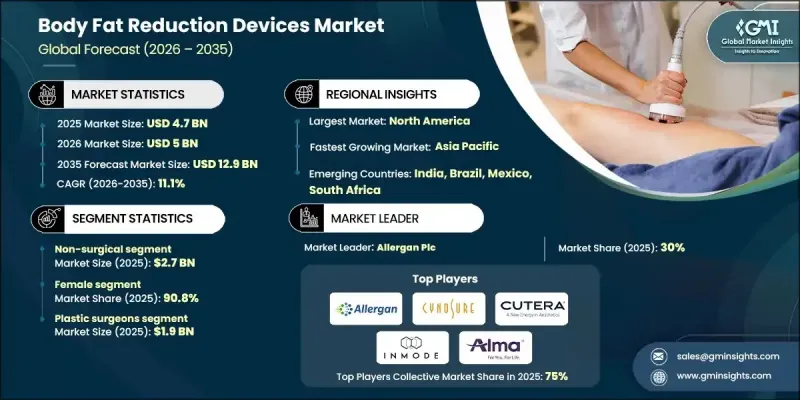
This rapid growth is fueled by a combination of factors, including the rising prevalence of obesity worldwide, increasing consumer preference for non-invasive procedures, and heightened interest in aesthetic enhancements and cosmetic treatments. Technological innovations, such as advanced cryolipolysis, laser-assisted lipolysis, and radiofrequency-based systems, have enhanced device efficacy and safety, while the growing number of clinics offering body contouring solutions has expanded market access. Body fat reduction devices employ non-invasive techniques that target specific areas of adipose tissue, causing fat cells to break down and be naturally eliminated by the body over time. These methods not only support body shaping and weight management goals but also require minimal recovery, making them increasingly popular as complementary options alongside lifestyle modifications.
| Market Scope | |
|---|---|
| Start Year | 2025 |
| Forecast Year | 2026-2035 |
| Start Value | $4.7 Billion |
| Forecast Value | $12.9 Billion |
| CAGR | 11.1% |
In 2025, the non-surgical segment generated USD 2.7 billion and is expected to grow at a CAGR of 11.2% through 2035. Non-surgical body fat reduction employs technologies like cryolipolysis, radiofrequency, and laser-assisted devices to remove excess fat without invasive procedures. Its minimally invasive nature, shorter recovery period, and reduced surgical risks have made it the preferred choice for patients seeking aesthetic improvements.
The female demographic segment held 90.8% share in 2025. This dominance is driven by higher awareness of health, wellness, and body aesthetics among women, along with greater acceptance of cosmetic procedures. Lifestyle changes and growing demand for safe, non-invasive fat reduction treatments further contribute to this trend.
North America Body Fat Reduction Devices Market held a 33.1% share in 2025, driven by strong consumer demand for aesthetic procedures, widespread adoption of advanced technologies, and a well-established network of cosmetic clinics and medical spas.
Key players in the Global Body Fat Reduction Devices Market include InMode Ltd., Syneron Medical Ltd., Allergan Plc, Alma Lasers, Apyx Medical Corporation, Asclepion Laser Technologies GmbH, Bausch Health Companies Inc., Cutera, Inc., Cynosure, EndyMed Medical Ltd., Fotona, Lumenis, Sciton, Inc., and Sientra, Inc. Companies operating in the Global Body Fat Reduction Devices Market are strengthening their presence through strategies such as continuous R&D for advanced device technologies, introduction of multi-functional systems, and expansion of clinic and distributor networks. Strategic partnerships with aesthetic clinics and healthcare providers help secure long-term contracts, while robust marketing campaigns enhance brand visibility. Businesses are also focusing on patient education, demonstrating treatment safety and efficacy, and offering training programs for clinicians, which strengthens adoption rates.
Table of Contents
Chapter 1 Methodology and Scope
- 1.1 Market scope and definition
- 1.2 Research design
- 1.2.1 Research approach
- 1.2.2 Data collection methods
- 1.3 Data mining sources
- 1.3.1 Global
- 1.3.2 Regional/country
- 1.4 Base estimates and calculations
- 1.4.1 Base year calculation
- 1.4.2 Key trends for market estimation
- 1.5 Primary research and validation
- 1.5.1 Primary sources
- 1.6 Forecast model
- 1.7 Research assumptions and limitations
Chapter 2 Executive Summary
- 2.1 Industry 3600 synopsis
- 2.2 Key market trends
- 2.2.1 Regional trends
- 2.2.2 Type trends
- 2.2.3 Gender trends
- 2.2.4 End Use trends
- 2.3 CXO perspectives: Strategic imperatives
- 2.3.1 Key decision points for industry executives
- 2.3.2 Critical success factors for market players
- 2.4 Future outlook and strategic recommendations
Chapter 3 Industry Insights
- 3.1 Industry ecosystem analysis
- 3.2 Industry impact forces
- 3.2.1 Growth drivers
- 3.2.1.1 Increasing prevalence of obesity globally
- 3.2.1.2 Rising customer preference for non-invasive procedures
- 3.2.1.3 Growing focus on aesthetic enhancements and cosmetic procedures globally
- 3.2.1.4 Technological advancements and new product development for fat reduction
- 3.2.1.5 Increasing number of facilities offering body contouring services
- 3.2.2 Industry pitfalls and challenges
- 3.2.2.1 Risk of postoperative complications
- 3.2.2.2 High cost of surgical procedures
- 3.2.3 Market opportunities
- 3.2.3.1 Focus on combination therapies and multi-functional devices
- 3.2.3.2 Integration with artificial intelligence and digital technologies
- 3.2.1 Growth drivers
- 3.3 Growth potential analysis
- 3.4 Regulatory landscape
- 3.5 Technological advancements
- 3.5.1 Current technological trends
- 3.5.2 Emerging technologies
- 3.6 Reimbursement scenario
- 3.7 Pricing analysis, 2025
- 3.8 Future market trends
- 3.9 Gap analysis
- 3.10 Porter's analysis
- 3.11 PESTEL analysis
Chapter 4 Competitive Landscape, 2025
- 4.1 Introduction
- 4.2 Company market share analysis
- 4.3 Company matrix analysis
- 4.4 Competitive analysis of major market players
- 4.5 Competitive positioning matrix
- 4.6 Key developments
- 4.6.1 Mergers and acquisitions
- 4.6.2 Partnerships and collaborations
- 4.6.3 New product launches
- 4.6.4 Expansion plans
Chapter 5 Market Estimates and Forecast, By Type, 2022 - 2035 ($ Mn)
- 5.1 Key trends
- 5.2 Surgical
- 5.2.1 Liposuction
- 5.2.1.1 Suction-assisted liposuction
- 5.2.1.2 RF-assisted liposuction
- 5.2.1.3 Power-assisted liposuction
- 5.2.1.4 Ultrasound-assisted liposuction
- 5.2.1.5 Other liposuctions
- 5.2.2 Abdominoplasty
- 5.2.1 Liposuction
- 5.3 Non-surgical
- 5.3.1 Cryolipolysis
- 5.3.2 Ultrasound
- 5.3.3 Laser lipolysis
- 5.3.4 Injectable lipolysis
- 5.3.5 RF lipolysis
- 5.3.6 Other non-surgical devices
Chapter 6 Market Estimates and Forecast, By Gender, 2022 - 2035 ($ Mn)
- 6.1 Key trends
- 6.2 Female
- 6.3 Male
Chapter 7 Market Estimates and Forecast, By End Use, 2022 - 2035 ($ Mn)
- 7.1 Key trends
- 7.2 Plastic surgeons
- 7.3 Dermatologists
- 7.4 Medical spas
- 7.5 Other end use
Chapter 8 Market Estimates and Forecast, By Region, 2022 - 2035 ($ Mn)
- 8.1 Key trends
- 8.2 North America
- 8.2.1 U.S.
- 8.2.2 Canada
- 8.3 Europe
- 8.3.1 Germany
- 8.3.2 UK
- 8.3.3 France
- 8.3.4 Spain
- 8.3.5 Italy
- 8.3.6 Netherlands
- 8.4 Asia Pacific
- 8.4.1 China
- 8.4.2 India
- 8.4.3 Japan
- 8.4.4 Australia
- 8.4.5 South Korea
- 8.5 Latin America
- 8.5.1 Brazil
- 8.5.2 Mexico
- 8.5.3 Argentina
- 8.6 Middle East and Africa
- 8.6.1 Saudi Arabia
- 8.6.2 South Africa
- 8.6.3 UAE
Chapter 9 Company Profiles
- 9.1 Allergan Plc
- 9.2 Alma Lasers
- 9.3 Apyx Medical Corporation
- 9.4 Asclepion Laser Technologies GmbH
- 9.5 Bausch Health Companies Inc.
- 9.6 BTL Industries
- 9.7 Cutera, Inc.
- 9.8 Cynosure
- 9.9 EndyMed Medical Ltd
- 9.10 Fotona
- 9.11 InMode Ltd.
- 9.12 Lumenis
- 9.13 Sciton, Inc.
- 9.14 Sientra, Inc.
- 9.15 Syneron Medical Ltd.


