|
시장보고서
상품코드
1913467
오토바이 진단 스캔 툴 시장 예측 : 기회, 성장 요인, 업계 동향 분석(2026-2035년)Motorcycle Diagnostic Scan Tools Market Opportunity, Growth Drivers, Industry Trend Analysis, and Forecast 2026 - 2035 |
||||||

세계 오토바이 진단 스캔 툴 시장은 2025년에 12억 달러로 평가되었으며, 2035년까지 연평균 복합 성장률(CAGR) 6.9%로 성장하고 24억 달러에 이를 것으로 예측됩니다.
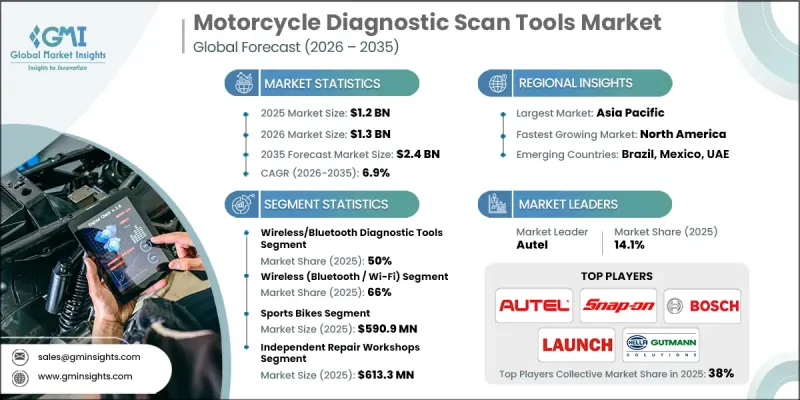
시장 확대는 기술적으로 고급 오토바이의 보급 확대, 안전 기준 및 배출 가스 규제의 강화, 현대의 이륜차에 통합되는 전자 시스템의 복잡화에 의해 지원되고 있습니다. 제조업체, 서비스 센터 및 개인 사용자는 고장의 신속한 식별, 실시간 시스템 모니터링 및 효율적인 유지 보수 절차를 실현하기 위해 진단 도구에 대한 의존도를 높이고 있습니다. 오토바이가 고급 제어 장치 및 디지털 아키텍처와 함께 발전함에 따라 진단 솔루션은 성능 최적화, 규제 준수 및 라이더의 안전을 보장하는 데 필수적입니다. 또한 세계 오토바이 보유 대수 증가, 애프터마켓 정비 수용 확대, 비용 효율적인 유지보수 솔루션에 대한 수요 증가도 시장을 뒷받침하고 있습니다. 진단 기능의 지속적인 혁신은 업무용, 개인용을 불문하고 이용 사례를 촉진하여 업계의 장기적인 성장 전망을 강화하고 있습니다.
| 시장 범위 | |
|---|---|
| 시작 연도 | 2025년 |
| 예측 연도 | 2026-2035년 |
| 시작 금액 | 12억 달러 |
| 예측 금액 | 24억 달러 |
| CAGR | 6.9% |
무선 및 블루투스 지원 진단 도구 부문은 2025년에 50%의 점유율을 차지했고, 2026년부터 2035년까지 연평균 복합 성장률(CAGR)은 6.6%를 보일 것으로 예측됩니다. 이 부문이 주도적인 지위에 있는 이유는 모바일 대응 진단, 다중 브랜드 지원, 정밀도 향상 및 서비스 시간 단축을 실현한 고급 고장 분석을 제공할 수 있기 때문입니다.
Bluetooth 및 Wi-Fi를 포함한 무선 연결 부문은 2025년에 66%의 점유율을 차지했고, 2035년까지 연평균 복합 성장률(CAGR) 6.2%로 성장할 것으로 예측됩니다. 유연성, 휴대성, 현대 진단 워크플로우와의 원활한 통합으로 효율적인 문제 해결 및 원격 시스템 액세스가 가능하기 때문에 강한 수요가 발생하고 있습니다.
중국 오토바이 진단 스캔 툴 시장은 2025년에 33%의 점유율을 차지했으며 2억 1,120만 달러의 수익을 창출했습니다. 오토바이 이용률, 첨단 진단 플랫폼의 보급, 엄격한 컴플라이언스 요건이 함께 이 지역의 주도적 지위를 더욱 강화하고 있습니다.
자주 묻는 질문
목차
제1장 조사 방법과 범위
제2장 주요 요약
제3장 업계 인사이트
- 생태계 분석
- 공급자의 상황
- 이익률
- 비용 구조
- 각 단계에서의 부가가치
- 밸류체인에 영향을 주는 요인
- 혁신
- 업계에 미치는 영향요인
- 성장 촉진요인
- 첨단 오토바이의 보급 확대
- 규제 준수 및 배출 기준
- 성장을 계속하는 독립계 수리 공장 부문
- 기술적 진보
- 업계의 잠재적 위험 및 과제
- 고급 진단 툴의 고비용
- 세분화된 시장 및 표준화 부족
- 시장 기회
- 급속한 기술 진화
- 독립수리공장 및 OEM 서비스센터 확대
- AI, 머신러닝, 예지 보전의 통합:
- 무선 및 Bluetooth 연결의 성장
- 성장 촉진요인
- 성장 가능성 분석
- 규제 상황
- 북미
- 미국 운수성(DOT) 및 국가 도로 교통 안전국(NHTSA)의 규제
- EPA 배출 기준
- 캐나다 운수성 기준
- 유럽
- 독일 TUV 및 BaFin 자동차 규정 준수
- 프랑스 DGCCRF 및 CNIT 표준
- 영국 DVSA 및 FCA 지침
- 이탈리아 국토 교통성의 컴플라이언스
- 아시아태평양
- 중국공업정보화부(MIIT) 가이드라인
- 일본 금융청 자동차 컴플라이언스
- 한국운수성(MOT) 및 금융위원회(FSC)의 규제
- 인도 BIS 및 자동차 연구 협회 가이드라인
- 라틴아메리카
- 브라질 DENATRAN 및 INMETRO 규제
- 멕시코 환경성(SEMARNAT) 및 통신성(SCT) 가이드라인
- 중동 및 아프리카
- 아랍에미리트(UAE) 도로 교통국 가이드라인
- 사우디아라비아 운수 총국(GAT) 규제
- 북미
- Porter's Five Forces 분석
- PESTEL 분석
- 기술과 혁신 동향
- 현재의 기술 동향
- 신규 기술
- 가격 동향
- 지역별
- 제품별
- 생산 통계
- 생산 거점
- 소비 거점
- 수출입
- 코스트 내역 분석
- 특허 분석
- 지속가능성과 환경면
- 지속가능한 실천
- 폐기물 감축 전략
- 생산에 있어서의 에너지 효율
- 환경에 배려한 대처
- 탄소발자국에 관한 고려 사항
- 이용 사례 시나리오
제4장 경쟁 구도
- 소개
- 기업의 시장 점유율 분석
- 북미
- 유럽
- 아시아태평양
- 라틴아메리카
- 중동 및 아프리카
- 주요 시장 기업의 경쟁 분석
- 경쟁 포지셔닝 매트릭스
- 전략적 전망 매트릭스
- 주요 발전
- 합병 및 인수
- 제휴 및 협업
- 신제품 발매
- 사업 확대 계획과 자금 조달
제5장 시장 추정 및 예측 : 제품별, 2022-2035
- 무선 및 Bluetooth 진단 툴
- 핸드헬드 진단 툴
- PC 및 태블릿 기반 진단 도구
- OEM 전용 진단 시스템
제6장 시장 추정 및 예측 : 접속 방식별, 2022-2035
- 무선(Bluetooth/Wi-Fi)
- 유선
제7장 시장 추정 및 예측 : 오토바이별, 2022-2035
- 스포츠 오토바이
- 스쿠터 및 모펫
- 크루저 오토바이
- 오프로드 / 어드벤처 오토바이
- 전기 오토바이
제8장 시장추정 및 예측 : 용도별, 2022-2035
- 독립계 수리 공장
- OEM 인증 서비스 센터
- 자가 정비
제9장 시장추정 및 예측 : 지역별, 2022-2035
- 북미
- 미국
- 캐나다
- 유럽
- 영국
- 독일
- 프랑스
- 이탈리아
- 스페인
- 벨기에
- 네덜란드
- 스웨덴
- 아시아태평양
- 중국
- 인도
- 일본
- 호주
- 싱가포르
- 한국
- 베트남
- 인도네시아
- 라틴아메리카
- 브라질
- 멕시코
- 아르헨티나
- 중동 및 아프리카
- 아랍에미리트(UAE)
- 남아프리카
- 사우디아라비아
제10장 기업 프로파일
- Global Player
- Autel
- Bosch
- Carmanah
- HealTech Electronics
- Hella(Hella Gutmann Solutions)
- KTM PowerParts
- Launch Tech
- Snap-on
- TEXA
- Vectrix Diagnostics
- Regional Player
- ABR Motors Diagnostic Solutions
- Actia
- Autologic
- Autowave Diagnostics
- Delphi Technologies
- HPT Diagnostic Tools
- Midtronics
- MotoScan Asia
- ProScan Tools
- RMC Tools
- 신규기업
- eBike Diagnostic Solutions
- MotoTech Diagnostics
- NeoMotor Diagnostics
- RideScan Electronics
- SmartMoto Diagnostics
The Global Motorcycle Diagnostic Scan Tools Market was valued at USD 1.2 billion in 2025 and is estimated to grow at a CAGR of 6.9% to reach USD 2.4 billion by 2035.
Market expansion is supported by the increasing penetration of technologically advanced motorcycles, stricter safety and emission requirements, and the growing complexity of electronic systems integrated into modern two-wheelers. Manufacturers, service centers, and individual users increasingly rely on diagnostic tools to achieve faster fault identification, real-time system monitoring, and efficient maintenance routines. As motorcycles evolve with advanced control units and digital architectures, diagnostic solutions become essential to ensure performance optimization, regulatory compliance, and rider safety. The market also benefits from the expanding global motorcycle population, rising acceptance of aftermarket servicing, and the growing need for cost-efficient maintenance solutions. Continuous innovation in diagnostic capabilities strengthens adoption across professional and personal use cases, reinforcing long-term growth prospects for the industry.
| Market Scope | |
|---|---|
| Start Year | 2025 |
| Forecast Year | 2026-2035 |
| Start Value | $1.2 Billion |
| Forecast Value | $2.4 Billion |
| CAGR | 6.9% |
The wireless and bluetooth-enabled diagnostic tools segment held 50% share in 2025 and is projected to grow at a CAGR of 6.6% from 2026 to 2035. This segment leads due to its ability to deliver mobile-compatible diagnostics, multi-brand support, and advanced fault analysis with improved accuracy and reduced service time.
The wireless connectivity segment, including Bluetooth and Wi-Fi, held 66% share in 2025 and is expected to grow at a CAGR of 6.2% through 2035. Strong demand stems from flexibility, portability, and seamless integration with modern diagnostic workflows, enabling efficient troubleshooting and remote system access.
China Motorcycle Diagnostic Scan Tools Market held 33% share in 2025 and generated USD 211.2 million. High motorcycle usage, widespread adoption of advanced diagnostic platforms, and strict compliance requirements continue to reinforce its regional leadership.
Key companies operating in the Global Motorcycle Diagnostic Scan Tools Market include Bosch, Snap-on, Autel, TEXA, Launch Tech, HealTech Electronics, Hella Gutmann Solutions, KTM PowerParts, Vectrix Diagnostics, and Carmanah. Companies strengthen their position by investing in software innovation, wireless connectivity, and multi-brand compatibility. Many players focus on integrating artificial intelligence, cloud-based analytics, and mobile applications to improve diagnostic precision and user experience. Strategic partnerships with service networks enhance product reach and customer trust. Continuous firmware updates and scalable platforms support long-term usability. Competitive pricing, training support, and strong after-sales services further improve adoption.
Table of Contents
Chapter 1 Methodology & Scope
- 1.1 Market scope and definition
- 1.2 Research design
- 1.2.1 Research approach
- 1.2.2 Data collection methods
- 1.3 Data mining sources
- 1.3.1 Global
- 1.3.2 Regional/Country
- 1.4 Base estimates and calculations
- 1.4.1 Base year calculation
- 1.4.2 Key trends for market estimation
- 1.5 Primary research and validation
- 1.5.1 Primary sources
- 1.6 Forecast
- 1.7 Research assumptions and limitations
Chapter 2 Executive Summary
- 2.1 Industry 3600 synopsis, 2022 - 2035
- 2.2 Key market trends
- 2.2.1 Regional
- 2.2.2 Product
- 2.2.3 Connectivity
- 2.2.4 Motorcycle
- 2.2.5 Application
- 2.3 TAM Analysis, 2026-2035
- 2.4 CXO perspectives: Strategic imperatives
- 2.4.1 Executive decision points
- 2.4.2 Critical success factors
- 2.5 Future outlook and strategic recommendations
Chapter 3 Industry Insights
- 3.1 Industry ecosystem analysis
- 3.1.1 Supplier Landscape
- 3.1.2 Profit Margin
- 3.1.3 Cost structure
- 3.1.4 Value addition at each stage
- 3.1.5 Factor affecting the value chain
- 3.1.6 Disruptions
- 3.2 Industry impact forces
- 3.2.1 Growth drivers
- 3.2.1.1 Rising Adoption of Advanced Motorcycles
- 3.2.1.2 Regulatory Compliance & Emission Standards
- 3.2.1.3 Growing Independent Repair Workshop Segment
- 3.2.1.4 Technological Advancements
- 3.2.2 Industry pitfalls and challenges
- 3.2.2.1 High Cost of Advanced Diagnostic Tools
- 3.2.2.2 Fragmented Market & Lack of Standardization
- 3.2.3 Market opportunities
- 3.2.3.1 Rapid Technological Evolution
- 3.2.3.2 Expansion of Independent Repair Workshops and OEM Service Centers
- 3.2.3.3 Integration of AI, ML, and Predictive Maintenance:
- 3.2.3.4 Growth of Wireless and Bluetooth Connectivity
- 3.2.1 Growth drivers
- 3.3 Growth potential analysis
- 3.4 Regulatory landscape
- 3.4.1 North America
- 3.4.1.1 U.S. DOT & NHTSA Regulations
- 3.4.1.2 EPA Emission Standards
- 3.4.1.3 Transport Canada Standards
- 3.4.2 Europe
- 3.4.2.1 Germany TUV & BaFin Automotive Compliance
- 3.4.2.2 France DGCCRF & CNIT Standards
- 3.4.2.3 United Kingdom DVSA & FCA Guidelines
- 3.4.2.4 Italy Ministry of Infrastructure & Transport Compliance
- 3.4.3 Asia Pacific
- 3.4.3.1 China MIIT Guidelines
- 3.4.3.2 Japan FSA Automotive Compliance
- 3.4.3.3 South Korea MOT & FSC Regulations
- 3.4.3.4 India BIS & Automotive Research Association Guidelines
- 3.4.4 Latin America
- 3.4.4.1 Brazil DENATRAN & INMETRO Regulations
- 3.4.4.2 Mexico SEMARNAT & SCT Guidelines
- 3.4.5 Middle East and Africa
- 3.4.5.1 UAE Roads & Transport Authority Guidelines
- 3.4.5.2 Saudi Arabia General Authority for Transport (GAT) Regulations
- 3.4.1 North America
- 3.5 Porter's analysis
- 3.6 PESTEL analysis
- 3.7 Technology and Innovation Landscape
- 3.7.1 Current technological trends
- 3.7.2 Emerging technologies
- 3.8 Price trends
- 3.8.1 By region
- 3.8.2 By product
- 3.9 Production statistics
- 3.9.1 Production hubs
- 3.9.2 Consumption hubs
- 3.9.3 Export and import
- 3.10 Cost breakdown analysis
- 3.11 Patent analysis
- 3.12 Sustainability and Environmental Aspects
- 3.12.1 Sustainable practices
- 3.12.2 Waste reduction strategies
- 3.12.3 Energy efficiency in production
- 3.12.4 Eco-friendly initiatives
- 3.12.5 Carbon footprint considerations
- 3.13 Use case scenarios
Chapter 4 Competitive Landscape, 2025
- 4.1 Introduction
- 4.2 Company market share analysis
- 4.2.1 North America
- 4.2.2 Europe
- 4.2.3 Asia Pacific
- 4.2.4 Latin America
- 4.2.5 Middle East & Africa
- 4.3 Competitive analysis of major market players
- 4.4 Competitive positioning matrix
- 4.5 Strategic outlook matrix
- 4.6 Key developments
- 4.6.1 Mergers & acquisitions
- 4.6.2 Partnerships & collaborations
- 4.6.3 New product launches
- 4.6.4 Expansion plans and funding
Chapter 5 Market Estimates & Forecast, By Product, 2022 - 2035 ($ Bn, Units)
- 5.1 Key trends
- 5.2 Wireless / Bluetooth Diagnostic Tools
- 5.3 Handheld Diagnostic Tools
- 5.4 PC-Based / Tablet-Based Diagnostic Tools
- 5.5 OEM Proprietary Diagnostic Systems
Chapter 6 Market Estimates & Forecast, By Connectivity, 2022 - 2035 ($ Bn, Units)
- 6.1 Key trends
- 6.2 Wireless (Bluetooth / Wi-Fi)
- 6.3 Wired
Chapter 7 Market Estimates & Forecast, By Motorcycle, 2022 - 2035 ($ Bn, Units)
- 7.1 Key trends
- 7.2 Sports bikes
- 7.3 Scooters & mopeds
- 7.4 Cruiser motorcycles
- 7.5 Off-road / adventure bikes
- 7.6 Electric motorcycles
Chapter 8 Market Estimates & Forecast, By Application, 2022 - 2035 ($ Bn, Units)
- 8.1 Key trends
- 8.2 Independent Repair Workshops
- 8.3 OEM Authorized Service Centers
- 8.4 Home Mechanics
Chapter 9 Market Estimates & Forecast, By Region, 2022 - 2035 ($ Bn, Units)
- 9.1 Key trends
- 9.2 North America
- 9.2.1 US
- 9.2.2 Canada
- 9.3 Europe
- 9.3.1 UK
- 9.3.2 Germany
- 9.3.3 France
- 9.3.4 Italy
- 9.3.5 Spain
- 9.3.6 Belgium
- 9.3.7 Netherlands
- 9.3.8 Sweden
- 9.4 Asia Pacific
- 9.4.1 China
- 9.4.2 India
- 9.4.3 Japan
- 9.4.4 Australia
- 9.4.5 Singapore
- 9.4.6 South Korea
- 9.4.7 Vietnam
- 9.4.8 Indonesia
- 9.5 Latin America
- 9.5.1 Brazil
- 9.5.2 Mexico
- 9.5.3 Argentina
- 9.6 MEA
- 9.6.1 UAE
- 9.6.2 South Africa
- 9.6.3 Saudi Arabia
Chapter 10 Company Profiles
- 10.1 Global Player
- 10.1.1 Autel
- 10.1.2 Bosch
- 10.1.3 Carmanah
- 10.1.4 HealTech Electronics
- 10.1.5 Hella (Hella Gutmann Solutions)
- 10.1.6 KTM PowerParts
- 10.1.7 Launch Tech
- 10.1.8 Snap-on
- 10.1.9 TEXA
- 10.1.10 Vectrix Diagnostics
- 10.2 Regional Player
- 10.2.1 ABR Motors Diagnostic Solutions
- 10.2.2 Actia
- 10.2.3 Autologic
- 10.2.4 Autowave Diagnostics
- 10.2.5 Delphi Technologies
- 10.2.6 HPT Diagnostic Tools
- 10.2.7 Midtronics
- 10.2.8 MotoScan Asia
- 10.2.9 ProScan Tools
- 10.2.10 RMC Tools
- 10.3 Emerging Players
- 10.3.1 eBike Diagnostic Solutions
- 10.3.2 MotoTech Diagnostics
- 10.3.3 NeoMotor Diagnostics
- 10.3.4 RideScan Electronics
- 10.3.5 SmartMoto Diagnostics