|
시장보고서
상품코드
1928916
자동차 소프트웨어 시장 기회, 성장요인, 업계 동향 분석 및 예측(2026-2035년)Automotive Software Market Opportunity, Growth Drivers, Industry Trend Analysis, and Forecast 2026 - 2035 |
||||||

세계의 자동차 소프트웨어 시장은 2025년에 198억 달러로 평가되었고, 2035년까지 연평균 복합 성장률(CAGR) 11.1%로 성장하여 565억 달러에 이를 것으로 예측됩니다.
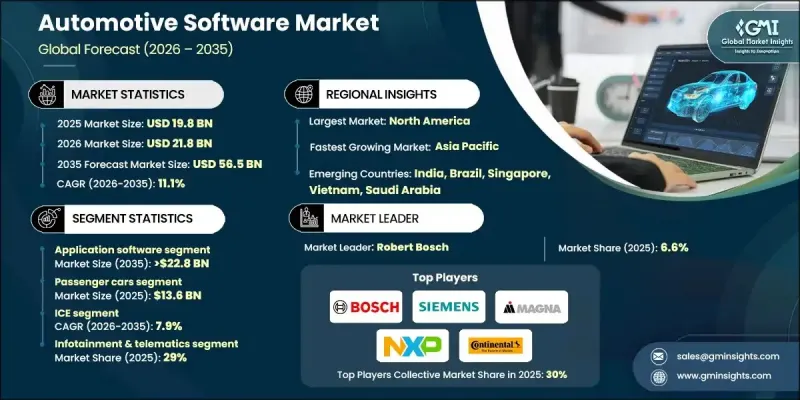
자동차 제조업체들이 기존의 하드웨어 중심 아키텍처에서 소프트웨어 정의 차량으로 전환함에 따라 자동차 산업은 변화를 겪고 있습니다. 소프트웨어 솔루션이 주요 기능, 성능, 차별화의 기반이 되는 이러한 진화에 따라 차량 라이프사이클 전반에 걸친 운영체제, 미들웨어, 용도에 대한 요구가 증가하고 있습니다. 전기자동차 및 전동화 차량의 등장으로 배터리 관리, 에너지 최적화, 열 시스템, 파워 일렉트로닉스 등의 분야에서 소프트웨어의 복잡성이 증가하고 있습니다. 내연기관차에 비해 전기자동차(EV)는 대당 소프트웨어 함량이 많아 시장을 더욱 확대시키고 있습니다. 안전에 대한 규제 요건과 첨단 운전 보조 시스템에 대한 소비자의 기대가 ADAS의 채택을 가속화하고 있습니다. ADAS는 센서 통합, 의사결정, 제어를 위한 실시간 소프트웨어에 의존하고 있습니다. 커넥티드카 플랫폼, 무선 업데이트, 텔레매틱스는 판매 시점을 넘어 지속적인 수익을 창출하고 차량의 기능을 향상시키고 있습니다. 차량 아키텍처는 중앙집중형 및 구역형 컴퓨팅으로 진화하고 있으며, 전체 시스템의 소프트웨어 통합과 효율성을 높이고 있습니다.
| 시장 범위 | |
|---|---|
| 개시 연도 | 2025년 |
| 예측 연도 | 2026-2035년 |
| 개시 연도 가치 | 198억 달러 |
| 예측 금액 | 565억 달러 |
| CAGR | 11.1% |
승용차 부문은 2025년 68%의 점유율을 차지하며 136억 6,000만 달러의 가치가 있습니다. 승용차는 소프트웨어 정의 아키텍처를 점점 더 많이 활용하고 있으며, 고급 인포테인먼트, ADAS, 개인화된 OTA 업데이트를 가능하게 하고 있습니다. 이러한 기능은 사용자 경험을 향상시키고, 지속적인 차량 업그레이드를 가능하게 하며, 라이프사이클 가치를 연장하기 때문에 소프트웨어는 자동차 제조업체에게 중요한 차별화 요소로 자리매김하고 있습니다.
내연기관(ICE) 부문은 2026년부터 2035년까지 연평균 복합 성장률(CAGR) 7.9%를 나타낼 것으로 예측됩니다. 전기자동차(EV)의 부상에도 불구하고 내연기관차는 엔진 성능 모니터링, 배기가스 규제 준수, 기계적 안전성 확보를 위해 소프트웨어에 계속 의존하고 있습니다. 제조업체들은 효율성 향상, 규제 준수, 단계적 기능 강화를 위해 소프트웨어 업데이트를 출시하고 있으며, 자동차 소프트웨어 솔루션에 대한 지속적인 수요를 유지하고 있습니다.
미국 자동차 소프트웨어 시장은 2025년 38억 달러에 달할 것으로 예측됩니다. 미국의 자동차 제조업체와 전기차 스타트업들은 소프트웨어 정의 아키텍처, 중앙집중식 컴퓨팅, 무선 업데이트 기능(OTA)을 우선적으로 도입하고 있습니다. 지속적인 소프트웨어 혁신을 통해 기업은 차량을 디지털 방식으로 차별화하고, 하드웨어 중심의 업그레이드에 비해 경쟁 우위를 확보할 수 있으며, 차량 수명주기 전반에 걸쳐 차량 기능을 강화할 수 있습니다.
자주 묻는 질문
목차
제1장 조사 방법
제2장 주요 요약
제3장 업계 인사이트
- 생태계 분석
- 공급업체 상황
- 이익률 분석
- 비용 구조
- 각 단계 부가가치
- 밸류체인에 영향을 미치는 요인
- 파괴적 변화
- 업계에 대한 영향요인
- 성장 촉진요인
- 소프트웨어 정의 차량
- 전기자동차 보급
- ADAS 및 안전 규제
- 커넥티드카와 OTA
- 차량 전동화 규제
- 업계의 잠재적 리스크&과제
- 소프트웨어 복잡성과 통합 과제
- 사이버 보안과 데이터 프라이버시에 관한 우려
- 시장 기회
- 구독 형 소프트웨어 수익화
- 집중형과 존 별 아키텍처
- AI 및 데이터 분석 통합
- 신흥 시장과 새로운 모빌리티 모델
- 성장 가능성 분석
- 규제 상황
- 북미
- 미국 : NHTSA 자동차 사이버 보안 베스트 프랙티스
- 캐나다 : 캐나다 자동차 안전기준(CMVSS)
- 유럽
- 영국 : 유엔 유럽 경제 위원회 규칙 제13호-차량 제동 시스템 및 안정성 제어 시스템
- 독일 : ISO 26262-도로 차량 전기 전자 시스템 기능 안전
- 프랑스 : 유엔 유럽 경제 위원회 규칙 제79호-스티어링 및 차량 제어 시스템
- 이탈리아 : ISO 21434-도로 차량 사이버 보안 공학
- 스페인 : ISO 14001-환경 매니지먼트 시스템
- 아시아태평양
- 중국 : GB/T 38628-자동차 소프트웨어 및 OTA 갱신 보안 요구 사항
- 일본 : ISO 26262-도로 차량 전기 전자 시스템 기능 안전
- 인도 : AIS 155-자동차 소프트웨어용 사이버 보안 및 OTA 요건
- 라틴아메리카
- 브라질 : ABNT NBR ISO 26262-도로 차량 기능 안전
- 멕시코 : NOM-194-SCFI-차량 안전성능기준
- 아르헨티나 : ISO 9001-자동차 소프트웨어 개발을 위한 품질 매니지먼트 시스템
- 중동 및 아프리카
- 아랍에미리트 : 유엔 유럽 경제 위원회 규칙 제 155호-사이버 보안 및 사이버 보안 관리 시스템
- 남아프리카공화국 : ISO 26262-도로 차량 전기 전자 시스템 기능 안전
- 사우디아라비아 : SASO 자동차 기술 규제-사이버 보안과 소프트웨어 적합성
- 북미
- Porter의 Five Forces 분석
- PESTEL 분석
- 기술 및 혁신 전망
- 현재 기술 동향
- 신기술
- 비용 내역 분석
- 개발비 구조
- 연구개발비용 분석
- 마케팅 및 판매 비용
- 특허 분석
- 지속가능성과 환경면
- 지속가능한 실천
- 폐기물 감축 전략
- 생산 에너지 효율
- 친환경 이니셔티브
- 향후 시장 전망과 기회
- 자동차 소프트웨어 아키텍처와 스택 분석
- 자동차 소프트웨어 스택 구조
- 집중형과 존 별 E/E 아키텍처 영향
- 하드웨어와 소프트웨어 분리화 동향
- 자동차 제조업체 소프트웨어 전략과 자사개발 대외부 조달 프레임워크
- 자동차 제조업체 자사 소프트웨어 개발 동향
- 자사개발·외부 조달·공동 개발 판단
- Tier 1 벤더 및 독립계 소프트웨어 벤더에 대한 영향
- 소프트웨어 수익화와 수익 모델
- 자동차 소프트웨어 구매 담당자 및 조달 분석
- 데이터, 클라우드, OTA 에코시스템에의 의존관계(dependencies)
제4장 경쟁 구도
- 서론
- 기업의 시장 점유율 분석
- 북미
- 유럽
- 아시아태평양
- 라틴아메리카
- 중동 및 아프리카
- 주요 시장 기업의 경쟁 분석
- 경쟁 포지셔닝 매트릭스
- 전략적 전망 매트릭스
- 주요 발전
- 인수합병(M&A)
- 제휴 및 협업
- 신제품 발매
- 사업 확대 계획과 자금조달
제5장 시장 추산·예측 : 제공별, 2022-2035
- 운영체제
- 미들웨어
- 애플리케이션 소프트웨어
제6장 시장 추산·예측 : 차량별, 2022-2035
- 승용차
- 해치백
- 세단
- SUV
- 상용차
- 소형 상용차(LCV)
- 중형 상용차(MCV)
- 대형 상용차(HCV)
제7장 시장 추산·예측 : 추진력별, 2022-2035
- 내연기관(ICE)
- 전기자동차
- BEV(배터리 전기자동차)
- PHEV
- 연료전지 자동차(FCEV)
제8장 시장 추산·예측 : 도입 형태별, 2022-2035
- 클라우드 기반
- On-Premise
제9장 시장 추산·예측 : 판매채널별, 2022-2035
- OEM
- 애프터마켓
제10장 시장 추산·예측 : 용도별, 2022-2035
- 안전 시스템
- 인포테인먼트 및 텔레매틱스
- 파워트레인 및 섀시
- 바디 칸셔스 트롤과 쾌적성
- 기타
제11장 시장 추산·예측 : 지역별, 2022-2035
- 북미
- 미국
- 캐나다
- 유럽
- 독일
- 영국
- 프랑스
- 이탈리아
- 스페인
- 러시아
- 북유럽 국가
- 포르투갈
- 크로아티아
- 베네룩스
- 아시아태평양
- 중국
- 인도
- 일본
- 호주
- 한국
- 싱가포르
- 태국
- 인도네시아
- 베트남
- 라틴아메리카
- 브라질
- 멕시코
- 아르헨티나
- 콜롬비아
- 중동 및 아프리카
- 남아프리카공화국
- 사우디아라비아
- 아랍에미리트
- 튀르키예
제12장 기업 개요
- 세계 기업
- Robert Bosch
- NVIDIA
- Siemens
- Continental
- Aptiv
- NXP Semiconductors
- Denso
- Magna International
- HARMAN International
- Qualcomm Technologies
- Intel
- Samsung Electronics
- 지역 기업
- Valeo
- ZF Friedrichshafen
- Hitachi Astemo
- Panasonic Automotive
- Renesas Electronics
- Tata Elxsi
- KPIT Technologies
- Luxoft
- Elektrobit
- TomTom
- Emerging/Disruptor Players
- BlackBerry
- Mobileye
- Aurora Innovation
- Wind River Systems
- Sonatus
- CARIAD
- Arrival Software
- ECARX
The Global Automotive Software Market was valued at USD 19.8 billion in 2025 and is estimated to grow at a CAGR of 11.1% to reach USD 56.5 billion by 2035.
The industry is transformed as automakers shift from traditional hardware-focused architectures to software-defined vehicles, where key features, performance, and differentiation rely on software solutions. This evolution is fueling demand for operating systems, middleware, and applications throughout the entire vehicle lifecycle. The rise of electric and electrified vehicles has added software complexity in areas such as battery management, energy optimization, thermal systems, and power electronics. Compared with internal combustion engine vehicles, EVs require more software content per unit, further expanding the market. Regulatory mandates for safety and consumer expectations for advanced driving assistance are accelerating the adoption of ADAS, relying on real-time software for sensor integration, decision-making, and control. Connected vehicle platforms, over-the-air updates, and telematics are generating recurring revenue and enhancing vehicle functionality beyond the point of sale. Vehicle architectures are evolving toward centralized and zonal computing, increasing software integration and efficiency across systems.
| Market Scope | |
|---|---|
| Start Year | 2025 |
| Forecast Year | 2026-2035 |
| Start Value | $19.8 Billion |
| Forecast Value | $56.5 Billion |
| CAGR | 11.1% |
The passenger car segment held 68% share and was valued at USD 13.6 billion in 2025. Passenger vehicles are increasingly leveraging software-defined architectures, enabling advanced infotainment, ADAS, and personalized OTA updates. These capabilities enhance user experience, allow continuous vehicle upgrades, and extend lifecycle value, positioning software as a key differentiator for automakers.
The internal combustion engine (ICE) segment is expected to grow at a CAGR of 7.9% between 2026 and 2035. Despite the rise of EVs, ICE vehicles continue to rely on software to monitor engine performance, emissions compliance, and mechanical safety. Manufacturers release software updates to improve efficiency, ensure regulatory compliance, and introduce incremental enhancements, maintaining ongoing demand for automotive software solutions.
U.S. Automotive Software Market reached USD 3.8 billion in 2025. Automakers and EV startups in the U.S. are prioritizing software-defined architectures, centralized computing, and over-the-air functionality. Continuous software innovation allows companies to differentiate their vehicles digitally, providing competitive advantages over hardware-focused upgrades and enhancing vehicle features throughout the lifecycle.
Key players operating in the Global Automotive Software Market include Continental, Aptiv, HARMAN International, NVIDIA, Robert Bosch, Siemens, Denso, Magna International, and NXP Semiconductors. Companies in the Global Automotive Software Market are strengthening their positions through strategic innovation, partnerships, and expansion into new markets. Investment in research and development enables them to offer advanced software platforms for connected, electric, and autonomous vehicles. Strategic collaborations with OEMs and technology firms enhance product integration and accelerate adoption. Over-the-air software deployment, cybersecurity features, and continuous updates create recurring revenue opportunities and improve customer loyalty. Geographic expansion, targeted acquisitions, and open-platform ecosystems allow firms to access broader markets while maintaining technological leadership and competitive differentiation.
Table of Contents
Chapter 1 Methodology
- 1.1 Research approach
- 1.2 Quality commitments
- 1.2.1 GMI AI policy & data integrity commitment
- 1.3 Research trail & confidence scoring
- 1.3.1 Research trail components
- 1.3.2 Scoring components
- 1.4 Data collection
- 1.4.1 Partial list of primary sources
- 1.5 Data mining sources
- 1.5.1 Paid sources
- 1.6 Base estimates and calculations
- 1.6.1 Base year calculation
- 1.7 Forecast
- 1.8 Research transparency addendum
Chapter 2 Executive Summary
- 2.1 Industry 360° synopsis, 2022 - 2035
- 2.2 Key market trends
- 2.2.1 Regional
- 2.2.2 Offering
- 2.2.3 Vehicle
- 2.2.4 Propulsion
- 2.2.5 Deployment mode
- 2.2.6 Sales channel
- 2.2.7 Application
- 2.3 TAM Analysis, 2026-2034
- 2.4 CXO perspectives: Strategic imperatives
- 2.4.1 Executive decision points
- 2.4.2 Critical success factors
- 2.5 Future outlook & strategic recommendations
Chapter 3 Industry Insights
- 3.1 Industry ecosystem analysis
- 3.1.1 Supplier landscape
- 3.1.2 Profit margin analysis
- 3.1.3 Cost structure
- 3.1.4 Value addition at each stage
- 3.1.5 Factor affecting the value chain
- 3.1.6 Disruptions
- 3.2 Industry impact forces
- 3.2.1.1 Growth drivers
- 3.2.1.2 Software-defined vehicles
- 3.2.1.3 Electric vehicle adoption
- 3.2.1.4 ADAS and safety regulations
- 3.2.1.5 Connected vehicles and OTA
- 3.2.1.6 Vehicle electrification regulations
- 3.2.2 Industry pitfalls and challenges
- 3.2.2.1 Software complexity and integration challenges
- 3.2.2.2 Cybersecurity and data privacy concerns
- 3.2.3 Market opportunities
- 3.2.3.1 Subscription-based software monetization
- 3.2.3.2 Centralized and zonal architectures
- 3.2.3.3 AI and data analytics integration
- 3.2.3.4 Emerging markets and new mobility models
- 3.3 Growth potential analysis
- 3.4 Regulatory landscape
- 3.4.1 North America
- 3.4.1.1 United States: NHTSA Automotive Cybersecurity Best Practices
- 3.4.1.2 Canada: Canadian Motor Vehicle Safety Standards (CMVSS)
- 3.4.2 Europe
- 3.4.2.1 United Kingdom: UNECE Regulation No. 13 - Vehicle Braking and Stability Systems
- 3.4.2.2 Germany: ISO 26262 - Functional Safety of Electrical and Electronic Systems in Road Vehicles
- 3.4.2.3 France: UNECE Regulation No. 79 - Steering and Vehicle Control Systems
- 3.4.2.4 Italy: ISO 21434 - Road Vehicles Cybersecurity Engineering
- 3.4.2.5 Spain: ISO 14001 - Environmental Management Systems
- 3.4.3 Asia Pacific
- 3.4.3.1 China: GB/T 38628 - Automotive Software and OTA Update Security Requirements
- 3.4.3.2 Japan: ISO 26262 - Functional Safety of Electrical and Electronic Systems in Road Vehicles
- 3.4.3.3 India: AIS 155 - Cybersecurity and OTA Requirements for Automotive Software
- 3.4.4 Latin America
- 3.4.4.1 Brazil: ABNT NBR ISO 26262 - Functional Safety for Road Vehicles
- 3.4.4.2 Mexico: NOM-194-SCFI - Vehicle Safety and Performance Standards
- 3.4.4.3 Argentina: ISO 9001 - Quality Management Systems for Automotive Software Development
- 3.4.5 Middle East & Africa
- 3.4.5.1 United Arab Emirates: UNECE Regulation No. 155 - Cybersecurity and Cybersecurity Management Systems
- 3.4.5.2 South Africa: ISO 26262 - Functional Safety of Electrical and Electronic Systems in Road Vehicles
- 3.4.5.3 Saudi Arabia: SASO Automotive Technical Regulations - Cybersecurity and Software Compliance
- 3.4.1 North America
- 3.5 Porter';s analysis
- 3.6 PESTEL analysis
- 3.7 Technology and innovation landscape
- 3.7.1 Current technological trends
- 3.7.2 Emerging technologies
- 3.8 Cost breakdown analysis
- 3.8.1 Development cost structure
- 3.8.2 R&D cost analysis
- 3.8.3 Marketing & sales costs
- 3.9 Patent analysis
- 3.10 Sustainability and environmental aspects
- 3.10.1 Sustainable practices
- 3.10.2 Waste reduction strategies
- 3.10.3 Energy efficiency in production
- 3.10.4 Eco-friendly Initiatives
- 3.11 Future market outlook & opportunities
- 3.12 Automotive Software Architecture & Stack Analysis
- 3.12.1 Automotive software stack architecture
- 3.12.2 Centralized vs zonal E/E architecture impact
- 3.12.3 Hardware-software decoupling trends
- 3.13 OEM Software Strategy & Build-vs-Buy Framework
- 3.13.1 OEM in-house software development trends
- 3.13.2 Build vs buy vs co-develop decisions
- 3.13.3 Impact on Tier-1 and independent software vendors
- 3.14 Software Monetization & Revenue Models
- 3.15 Automotive Software Buyer & Procurement Analysis
- 3.16 Data, Cloud & OTA Ecosystem Dependencies
Chapter 4 Competitive Landscape, 2025
- 4.1 Introduction
- 4.2 Company market share analysis
- 4.2.1 North America
- 4.2.2 Europe
- 4.2.3 Asia Pacific
- 4.2.4 LATAM
- 4.2.5 MEA
- 4.3 Competitive analysis of major market players
- 4.4 Competitive positioning matrix
- 4.5 Strategic outlook matrix
- 4.6 Key developments
- 4.6.1 Mergers & acquisitions
- 4.6.2 Partnerships & collaborations
- 4.6.3 New Product Launches
- 4.6.4 Expansion Plans and funding
Chapter 5 Market Estimates & Forecast, By Offering, 2022 - 2035 ($Bn)
- 5.1 Key trends
- 5.2 Operating system
- 5.3 Middleware
- 5.4 Application software
Chapter 6 Market Estimates & Forecast, By Vehicle, 2022 - 2035 ($Bn)
- 6.1 Key trends
- 6.2 Passenger cars
- 6.2.1 Hatchback
- 6.2.2 Sedan
- 6.2.3 SUV
- 6.3 Commercial vehicles
- 6.3.1 Light Commercial Vehicles (LCV)
- 6.3.2 Medium Commercial Vehicles (MCV)
- 6.3.3 Heavy Commercial Vehicles (HCV)
Chapter 7 Market Estimates & Forecast, By Propulsion, 2022 - 2035 ($Bn)
- 7.1 Key trends
- 7.2 ICE
- 7.3 Electric vehicle
- 7.3.1 BEV
- 7.3.2 PHEV
- 7.3.3 FCEV
Chapter 8 Market Estimates & Forecast, By Deployment mode, 2022 - 2035 ($Bn)
- 8.1 Key trends
- 8.2 Cloud based
- 8.3 On premises
Chapter 9 Market Estimates & Forecast, By Sales Channel, 2022 - 2035 ($Bn)
- 9.1 Key trends
- 9.2 OEM
- 9.3 Aftermarket
Chapter 10 Market Estimates & Forecast, By Application, 2022 - 2035 ($Bn)
- 10.1 Key trends
- 10.2 Safety systems
- 10.3 Infotainment & telematics
- 10.4 Powertrain & chassis
- 10.5 Body control & comfort
- 10.6 Others
Chapter 11 Market Estimates & Forecast, By Region, 2022 - 2035 ($Bn)
- 11.1 Key trends
- 11.2 North America
- 11.2.1 US
- 11.2.2 Canada
- 11.3 Europe
- 11.3.1 Germany
- 11.3.2 UK
- 11.3.3 France
- 11.3.4 Italy
- 11.3.5 Spain
- 11.3.6 Russia
- 11.3.7 Nordics
- 11.3.8 Portugal
- 11.3.9 Croatia
- 11.3.10 Benelux
- 11.4 Asia Pacific
- 11.4.1 China
- 11.4.2 India
- 11.4.3 Japan
- 11.4.4 Australia
- 11.4.5 South Korea
- 11.4.6 Singapore
- 11.4.7 Thailand
- 11.4.8 Indonesia
- 11.4.9 Vietnam
- 11.5 Latin America
- 11.5.1 Brazil
- 11.5.2 Mexico
- 11.5.3 Argentina
- 11.5.4 Colombia
- 11.6 MEA
- 11.6.1 South Africa
- 11.6.2 Saudi Arabia
- 11.6.3 UAE
- 11.6.4 Turkey
Chapter 12 Company Profiles
- 12.1 Global Players
- 12.1.1 Robert Bosch
- 12.1.2 NVIDIA
- 12.1.3 Siemens
- 12.1.4 Continental
- 12.1.5 Aptiv
- 12.1.6 NXP Semiconductors
- 12.1.7 Denso
- 12.1.8 Magna International
- 12.1.9 HARMAN International
- 12.1.10 Qualcomm Technologies
- 12.1.11 Intel
- 12.1.12 Samsung Electronics
- 12.2 Regional Players
- 12.2.1 Valeo
- 12.2.2 ZF Friedrichshafen
- 12.2.3 Hitachi Astemo
- 12.2.4 Panasonic Automotive
- 12.2.5 Renesas Electronics
- 12.2.6 Tata Elxsi
- 12.2.7 KPIT Technologies
- 12.2.8 Luxoft
- 12.2.9 Elektrobit
- 12.2.10 TomTom
- 12.3 Emerging / Disruptor Players
- 12.3.1 BlackBerry
- 12.3.2 Mobileye
- 12.3.3 Aurora Innovation
- 12.3.4 Wind River Systems
- 12.3.5 Sonatus
- 12.3.6 CARIAD
- 12.3.7 Arrival Software
- 12.3.8 ECARX