|
시장보고서
상품코드
1936484
난연제 시장 : 시장 기회, 성장 요인, 산업 동향 분석 및 예측(2026-2035년)Flame Retardants Market Opportunity, Growth Drivers, Industry Trend Analysis, and Forecast 2026 - 2035 |
||||||

세계의 난연제 시장은 2025년 98억 달러로 평가되었고, 2035년까지 연평균 복합 성장률(CAGR) 6.1%로 성장할 전망이며, 177억 달러에 이를 것으로 예측됩니다.
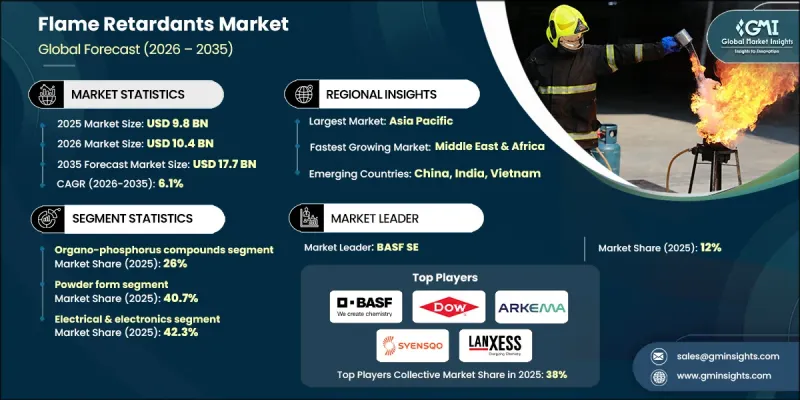
시장 성장은 엄격한 방화 안전 규제, 급속한 도시화, 건설, 전기 전자 및 운송 산업에서의 수요 증가에 의해 견인되고 있습니다. 난연제는 플라스틱, 섬유, 발포체, 코팅 등 폭넓은 재료에서 점화 지연, 불꽃 전파 억제, 연기 발생 억제를 통해 화재 관련 위험을 줄이는 중요한 역할을 합니다. 인프라 개발의 진전, 전기화, 전자기기의 보급이 진행되고 있는 가운데, 내화성 재료의 중요성은 현저하게 높아지고 있습니다. 동시에 주택, 상업 및 산업 시설에 있어서 공공안전 기준의 향상을 요구하는 규제 압력도 선진적인 난연 솔루션에 대한 지속적인 수요를 지지하고 있습니다.
| 시장 범위 | |
|---|---|
| 시작 연도 | 2025년 |
| 예측 연도 | 2026-2035년 |
| 시작 시 가치 | 98억 달러 |
| 예측 금액 | 177억 달러 |
| CAGR | 6.1% |
규제 당국 및 최종 사용자가 지속가능성, 독성 저감, 재활용성을 우선하는 가운데, 시장에서는 환경 친화적이고 무할로겐 난연제로의 현저한 이행이 진행되고 있습니다. 제조업체는 효과적인 방화 성능을 제공하면서 진화하는 환경 규제 기준을 충족하는 인계, 무기계, 폴리머 결합형 난연제 시스템에 주력하는 경향이 강해지고 있습니다. 캡슐화 기술과 분산 기술의 기술적 진보는 성능의 일관성과 현대 폴리머의 적합성을 더욱 향상시킵니다. 이러한 혁신은 화재 안전성이 매우 중요하며, 재료 성능 요구 사항이 점점 엄격해지고 있는 전기자동차, 재생에너지 시스템, 스마트 인프라 등 고성장 분야에서 특히 중요합니다.
유형별로는 유기 인 화합물이 2025년에 26%의 점유율을 차지했습니다. 이러한 화합물은 뛰어난 난연 효율, 다양한 폴리머 시스템에 대한 범용성, 기존의 할로겐계 제품에 비해 높은 규제 적합성으로 널리 채택되었습니다. 유기 인계 난연제는 낮은 발연성 및 높은 열 안정성이 필수적인 엔지니어링 플라스틱, 발포체, 코팅 및 전자 부품에 널리 사용됩니다. 할로겐이 없는 배합제에서의 사용 확대는 세계의 지속가능성 목표와 일치하고 시장에서 주도적 지위를 더욱 강화하고 있습니다.
최종 용도별로는 전기 및 전자기기 분야가 2025년에 42.3%의 점유율을 차지했습니다. 이는 엄격한 방화 안전 기준과 성능 기준을 충족하기 때문에 가전제품의 케이스, 회로 기판, 커넥터, 전선 및 케이블에 있어서 난연제의 사용 증가가 견인하고 있습니다. 가전제품, 데이터센터, 스마트 디바이스, 전력 인프라의 급속한 성장과 함께 고온, 전기적 스트레스 및 장기 가동에 견디는 고성능 난연 재료에 대한 수요가 높아지고 있습니다. 전자 부품의 소형화 및 고성능화가 진행되고 있는 가운데, 기능성을 손상시키지 않고 안전성을 확보하는 선진적인 난연 솔루션의 필요성은 점점 높아지고 있습니다.
미국의 난연제 시장은 2025년 20억 달러 규모에 이르렀습니다. 북미 전체의 성장은 주로 미국에 지지되고 있으며, 성숙한 전자기기 제조거점이 안정된 수요를 지지해 배선, 절연 및 회로 보호 용도로 무할로겐 재료의 채용이 확대되고 있습니다. 건설 분야의 활발한 활동이 내화 재료의 사용을 계속 견인하는 한편, 자동차 생산의 지속은 소비를 더욱 뒷받침하고 있습니다. UL-94나 NFPA 규격 등의 방화 안전 규제의 엄격한 시행, 선진적인 인계 배합 기술 도입, 확립된 컴플라이언스 체제가, 이 나라 시장 기반을 계속 강화하고 있습니다. 다우 잉크, 알베마르 코퍼레이션, 클라리언트 AG와 같은 주요 제조업체들은 공급 안정성을 유지하고 지역 시장에서 미국의 입지를 강화하는 데 핵심적인 역할을 하고 있습니다.
자주 묻는 질문
목차
제1장 조사 방법 및 범위
제2장 주요 요약
제3장 업계 인사이트
- 생태계 분석
- 공급자의 상황
- 이익률
- 각 단계에서의 부가가치
- 밸류체인에 영향을 주는 요인
- 혁신
- 업계에 미치는 영향요인
- 성장 촉진요인
- 업계의 잠재적 위험 및 과제
- 시장 기회
- 성장 가능성 분석
- 규제 상황
- 북미
- 유럽
- 아시아태평양
- 라틴아메리카
- 중동 및 아프리카
- Porter's Five Forces 분석
- PESTEL 분석
- 기술 및 혁신 동향
- 현재 기술 동향
- 신흥 기술
- 가격 동향
- 지역별
- 유형별
- 장래 시장 동향
- 기술 및 혁신 동향
- 현재 기술 동향
- 신흥 기술
- 특허 상황
- 무역 통계(HS코드)
- 주요 수입국
- 주요 수출국
- 지속가능성 및 환경면
- 지속가능한 대처
- 폐기물 감축 전략
- 생산에 있어서 에너지 효율
- 환경에 배려한 대처
- 탄소발자국 고려
제4장 경쟁 구도
- 서문
- 기업의 시장 점유율 분석
- 지역별
- 북미
- 유럽
- 아시아태평양
- 라틴아메리카
- 중동 및 아프리카
- 지역별
- 기업 매트릭스 분석
- 주요 시장 기업의 경쟁 분석
- 경쟁 포지셔닝 매트릭스
- 주요 발전
- 합병 및 인수
- 제휴 및 협업
- 신제품 발매
- 확대 계획
제5장 시장 추계 및 예측 : 유형별(2022-2035년)
- 브롬화 화합물
- 데카 BDE(데카브로모디페닐에테르)
- HBCD(헥사브로모시클로도데칸)
- TBBPA(테트라브로모비스페놀 A)
- DBDPE(데카브로모디페닐에탄)
- 기타 브롬화 화합물
- 염소화 화합물
- 염소화 파라핀
- 데크로램프라스
- 기타 염소화 화합물
- 안티몬 화합물(ATO)
- 수산화알루미늄(ATH)
- ATH 분말
- ATH 마스터 배치
- 피복 ATH 각종
- 유기 인 화합물
- DOPO(9,10-디히드로-9-옥사-10-포스파페난트렌-10-옥사이드)
- RDP(레조르시놀비스(디페닐인산))
- TPP(트리페닐인산)
- 폴리인산암모늄
- 기타 인 화합물
- 붕산아연
- 테크니컬 그레이드 보레이트 아연(2ZnO?3B2O3?3.5H2O)
- 탈수 붕산 아연
- 주석산 아연
- 표준 등급 주석산 아연
- 고순도 등급
- 기타 특수 화학제품
- 수산화마그네슘
- 멜라민 시아누레이트
- 팽창성 흑연
- 신흥특수화합물
제6장 시장 추계 및 예측 : 제품 형태별(2022-2035년)
- 분말 형태
- 테크니컬 등급 분말
- 미분화 분말
- 표면 코팅 분말
- 과립 및 펠릿
- 마스터 배치 과립
- 펠렛화 형태
- 액체 형태
- 액체 인 화합물
- 할로겐화 액체 FRS
- 캡슐화 형태
- 마이크로캡슐화 인계 난연제
- 고급 분산 기술
제7장 시장 추계 및 예측 : 최종 용도별(2022-2035년)
- 건설 자재
- 단열재
- 건축용 패널 및 보드
- 폼 및 실란트
- 내화 페인트 및 코팅
- 전기 및 전자 기기
- 소비자용 전자 기기 케이스
- 회로 기판 및 부품
- 커넥터 및 스위치
- 전선 및 케이블
- 전력 케이블
- 데이터 및 통신 케이블
- 자동차용 배선
- 교통 기관
- 자동차 용도
- 항공우주 용도
- 철도 및 선박용 용도
- 섬유 및 실내 장식품
- 상업용 가구
- 자동차 인테리어
- 보호용 섬유 제품
- 접착제 및 실란트
- 구조용 접착제
- 내화성 실란트
- 기타 용도
- 종이 및 포장
- 고무 용도
- 새로운 용도
제8장 시장 추계 및 예측 : 지역별(2022-2035년)
- 북미
- 미국
- 캐나다
- 유럽
- 독일
- 영국
- 프랑스
- 스페인
- 이탈리아
- 기타 유럽
- 아시아태평양
- 중국
- 인도
- 일본
- 호주
- 한국
- 기타 아시아태평양
- 라틴아메리카
- 브라질
- 멕시코
- 아르헨티나
- 기타 라틴아메리카
- 중동 및 아프리카
- 사우디아라비아
- 남아프리카
- 아랍에미리트(UAE)
- 기타 중동 및 아프리카
제9장 기업 프로파일
- Albemarle Corporation
- Dow Inc.
- Nouryon
- ICL Group Ltd.
- LANXESS AG
- BASF SE
- Clariant AG
- Tomiyama Pure Chemical
- Eti Maden
- Hangzhou JLS Flame Retardants Chemical Co., Ltd.
- Zhejiang Wansheng Co., Ltd.
- Nabaltec AG
- Valtris
- Rio Tinto
- Syensqo
- Huber Engineered Materials
- Tosoh Corporation
- Avient Corporation
- Daihachi Chemical
- Italmatch Chemicals
- William Blythe Ltd.
- Zibo Hengjin Chemical Co., Ltd.
- ADEKA Corporation
- Jiangsu Yoke Technology Co., Ltd.
- Arkema
The Global Flame Retardants Market was valued at USD 9.8 billion in 2025 and is estimated to grow at a CAGR of 6.1% to reach USD 17.7 billion by 2035.
Market growth is driven by stringent fire safety regulations, rapid urbanization, and rising demand from construction, electrical & electronics, and transportation industries. Flame retardants play a critical role in reducing fire-related risks by delaying ignition, slowing flame spread, and minimizing smoke generation across a wide range of materials, including plastics, textiles, foams, and coatings. Increasing infrastructure development, electrification, and the proliferation of electronic devices have significantly elevated the importance of fire-resistant materials. At the same time, regulatory pressure to improve public safety standards across residential, commercial, and industrial settings continues to support sustained demand for advanced flame-retardant solutions.
| Market Scope | |
|---|---|
| Start Year | 2025 |
| Forecast Year | 2026-2035 |
| Start Value | $9.8 Billion |
| Forecast Value | $17.7 Billion |
| CAGR | 6.1% |
The market is witnessing a pronounced shift toward environmentally friendly and halogen-free flame retardants, as regulatory agencies and end users prioritize sustainability, reduced toxicity, and recyclability. Manufacturers are increasingly focusing on phosphorus-based, inorganic, and polymer-bound flame-retardant systems that offer effective fire protection while meeting evolving environmental compliance norms. Technological advancements in encapsulation and dispersion technologies have further enhanced performance consistency and compatibility with modern polymers. These innovations are particularly relevant for high-growth applications such as electric vehicles, renewable energy systems, and smart infrastructure, where fire safety is critical and material performance requirements are increasingly stringent.
By type, the organo-phosphorus compounds segment held 26% share in 2025. These compounds are widely adopted due to their excellent flame-retardant efficiency, versatility across multiple polymer systems, and strong regulatory acceptance compared to traditional halogenated products. Organo-phosphorus flame retardants are extensively used in engineering plastics, foams, coatings, and electronic components, where low smoke emission and high thermal stability are essential. Their growing use in halogen-free formulations aligns well with global sustainability goals, further reinforcing their leadership position in the market.
In terms of end use, the electrical & electronics segment held 42.3% share in 2025, driven by the increasing use of flame retardants in consumer electronics housings, circuit boards, connectors, wires, and cables to meet strict fire safety and performance standards. Rapid growth in consumer electronics, data centers, smart devices, and power infrastructure has amplified demand for high-performance flame-retardant materials that can withstand heat, electrical stress, and long operational lifecycles. As electronic components become smaller and more powerful, the need for advanced flame-retardant solutions that ensure safety without compromising functionality continues to rise.
U.S. Flame Retardants Market generated USD 2 billion in 2025. Growth across North America is largely anchored in the United States, where steady demand is supported by a mature electronics manufacturing base that increasingly adopts halogen-free materials for wiring, insulation, and circuit protection. Strong activity in construction continues to drive the use of fire-resistant materials, while ongoing automotive production further reinforces consumption. Strict enforcement of fire safety regulations such as UL-94 and NFPA standards, along with the adoption of advanced phosphorus-based formulations and well-established compliance frameworks, continues to strengthen the country's market standing. Leading manufacturers including Dow Inc., Albemarle Corporation, and Clariant AG play a central role in maintaining supply stability and reinforcing the U.S. position within the regional market.
Key players operating in the Global Flame Retardants Market include BASF SE, Albemarle Corporation, ICL Group Ltd., LANXESS AG, Clariant AG, Avient Corporation, Arkema, Syensqo, Nabaltec AG, and Huber Engineered Materials. These companies maintain strong market positions through broad product portfolios, global manufacturing footprints, and deep technical expertise across multiple end-use industries. Companies in the Flame Retardants Market are strengthening their market foothold through product innovation, sustainability-focused R&D, and strategic partnerships with end-use industries. Leading players are investing in the development of halogen-free, low-smoke, and polymer-bound flame retardants to address tightening environmental regulations and customer sustainability goals. Expansion into high-growth regions, particularly Asia Pacific, through local manufacturing and distribution networks remains a key strategy. Firms are also enhancing application engineering support and regulatory compliance services to help customers meet complex fire safety standards.
Table of Contents
Chapter 1 Methodology & Scope
- 1.1 Market scope and definition
- 1.2 Research design
- 1.2.1 Research approach
- 1.2.2 Data collection methods
- 1.3 Data mining sources
- 1.3.1 Global
- 1.3.2 Regional/Country
- 1.4 Base estimates and calculations
- 1.4.1 Base year calculation
- 1.4.2 Key trends for market estimation
- 1.5 Primary research and validation
- 1.5.1 Primary sources
- 1.6 Forecast model
- 1.7 Research assumptions and limitations
Chapter 2 Executive Summary
- 2.1 Industry 360° synopsis
- 2.2 Key market trends
- 2.2.1 Product
- 2.2.2 Material type
- 2.2.3 Application
- 2.2.4 Regional
- 2.3 TAM Analysis, 2026-2035
- 2.4 CXO perspectives: Strategic imperatives
- 2.4.1 Executive decision points
- 2.4.2 Critical success factors
- 2.5 Future outlook and strategic recommendations
Chapter 3 Industry Insights
- 3.1 Industry ecosystem analysis
- 3.1.1 Supplier landscape
- 3.1.2 Profit margin
- 3.1.3 Value addition at each stage
- 3.1.4 Factor affecting the value chain
- 3.1.5 Disruptions
- 3.2 Industry impact forces
- 3.2.1 Growth drivers
- 3.2.2 Industry pitfalls and challenges
- 3.2.3 Market opportunities
- 3.3 Growth potential analysis
- 3.4 Regulatory landscape
- 3.4.1 North America
- 3.4.2 Europe
- 3.4.3 Asia Pacific
- 3.4.4 Latin America
- 3.4.5 Middle East & Africa
- 3.5 Porter's analysis
- 3.6 PESTEL analysis
- 3.7 Technology and innovation landscape
- 3.7.1 Current technological trends
- 3.7.2 Emerging technologies
- 3.8 Price trends
- 3.8.1 By region
- 3.8.2 By type
- 3.9 Future market trends
- 3.10 Technology and innovation landscape
- 3.10.1 Current technological trends
- 3.10.2 Emerging technologies
- 3.11 Patent landscape
- 3.12 Trade statistics (HS code)
- 3.12.1 Major importing countries
- 3.12.2 Major exporting countries
- 3.13 Sustainability and environmental aspects
- 3.13.1 Sustainable practices
- 3.13.2 Waste reduction strategies
- 3.13.3 Energy efficiency in production
- 3.13.4 Eco-friendly initiatives
- 3.14 Carbon footprint consideration
Chapter 4 Competitive Landscape, 2025
- 4.1 Introduction
- 4.2 Company market share analysis
- 4.2.1 By region
- 4.2.1.1 North America
- 4.2.1.2 Europe
- 4.2.1.3 Asia Pacific
- 4.2.1.4 LATAM
- 4.2.1.5 MEA
- 4.2.1 By region
- 4.3 Company matrix analysis
- 4.4 Competitive analysis of major market players
- 4.5 Competitive positioning matrix
- 4.6 Key developments
- 4.6.1 Mergers & acquisitions
- 4.6.2 Partnerships & collaborations
- 4.6.3 New product launches
- 4.6.4 Expansion plans
Chapter 5 Market Estimates and Forecast, By Type, 2022-2035 (USD Million) (Kilo Tons)
- 5.1 Key trends
- 5.2 Brominated compounds
- 5.2.1 DecaBDE (decabromodiphenyl ether)
- 5.2.2 HBCD (hexabromocyclododecane)
- 5.2.3 TBBPA (tetrabromobisphenol A)
- 5.2.4 DBDPE (decabromodiphenyl ethane)
- 5.2.5 Other brominated compounds
- 5.3 Chlorinated compounds
- 5.3.1 Chlorinated paraffins
- 5.3.2 Dechlorane plus
- 5.3.3 Other chlorinated compounds
- 5.4 Antimony compounds (ATO)
- 5.5 Aluminum trihydroxide (ATH)
- 5.5.1 ATH powder
- 5.5.2 ATH masterbatch
- 5.5.3 Coated ATH variants
- 5.6 Organo-phosphorus compounds
- 5.6.1 DOPO (9,10-dihydro-9-oxa-10-phosphaphenanthrene-10-oxide)
- 5.6.2 RDP (resorcinol bis(diphenylphosphate))
- 5.6.3 TPP (triphenyl phosphate)
- 5.6.4 Ammonium polyphosphate
- 5.6.5 Other phosphorus compounds
- 5.7 Zinc borate
- 5.7.1 Technical grade zinc borate (2ZnO·3B2O3·3.5H2O)
- 5.7.2 Dehydrated zinc borate
- 5.8 Zinc stannate
- 5.8.1 Standard grade zinc stannate
- 5.8.2 High-purity grades
- 5.9 Other specialty chemicals
- 5.9.1 Magnesium hydroxide
- 5.9.2 Melamine cyanurate
- 5.9.3 Expandable graphite
- 5.9.4 Emerging specialty compounds
Chapter 6 Market Estimates and Forecast, By Product Form, 2022-2035 (USD Million) (Kilo Tons)
- 6.1 Key trends
- 6.2 Powder form
- 6.2.1 Technical-grade powder
- 6.2.2 Micronized powder
- 6.2.3 Surface-coated powder
- 6.3 Granules/pellets
- 6.3.1 Masterbatch granules
- 6.3.2 Pelletized forms
- 6.4 Liquid form
- 6.4.1 Liquid phosphorus compounds
- 6.4.2 Halogenated liquid FRS
- 6.5 Encapsulated form
- 6.5.1 Microencapsulated FRS
- 6.5.2 Advanced dispersion technologies
Chapter 7 Market Estimates and Forecast, By End Use, 2022-2035 (USD Million) (Kilo Tons)
- 7.1 Construction materials
- 7.1.1 Insulation materials
- 7.1.2 Building panels and boards
- 7.1.3 Foams and sealants
- 7.1.4 Fire-rated paints and coatings
- 7.2 Electrical & electronics
- 7.2.1 Consumer electronics housings
- 7.2.2 Circuit boards and components
- 7.2.3 Connectors and switches
- 7.3 Wires & cables
- 7.3.1 Power cables
- 7.3.2 Data and telecom cables
- 7.3.3 Automotive wiring
- 7.4 Transportation
- 7.4.1 Automotive end uses
- 7.4.2 Aerospace end uses
- 7.4.3 Rail and marine end uses
- 7.5 Textiles & upholstery
- 7.5.1 Contract furnishings
- 7.5.2 Automotive interiors
- 7.5.3 Protective textiles
- 7.6 Adhesives & sealants
- 7.6.1 Structural adhesives
- 7.6.2 Fire-rated sealants
- 7.7 Other end uses
- 7.7.1 Paper and packaging
- 7.7.2 Rubber end uses
- 7.7.3 Emerging end uses
Chapter 8 Market Estimates and Forecast, By Region, 2022-2035 (USD Million) (Kilo Tons)
- 8.1 Key trends
- 8.2 North America
- 8.2.1 U.S.
- 8.2.2 Canada
- 8.3 Europe
- 8.3.1 Germany
- 8.3.2 UK
- 8.3.3 France
- 8.3.4 Spain
- 8.3.5 Italy
- 8.3.6 Rest of Europe
- 8.4 Asia Pacific
- 8.4.1 China
- 8.4.2 India
- 8.4.3 Japan
- 8.4.4 Australia
- 8.4.5 South Korea
- 8.4.6 Rest of Asia Pacific
- 8.5 Latin America
- 8.5.1 Brazil
- 8.5.2 Mexico
- 8.5.3 Argentina
- 8.5.4 Rest of Latin America
- 8.6 Middle East and Africa
- 8.6.1 Saudi Arabia
- 8.6.2 South Africa
- 8.6.3 UAE
- 8.6.4 Rest of Middle East and Africa
Chapter 9 Company Profiles
- 9.1 Albemarle Corporation
- 9.2 Dow Inc.
- 9.3 Nouryon
- 9.4 ICL Group Ltd.
- 9.5 LANXESS AG
- 9.6 BASF SE
- 9.7 Clariant AG
- 9.8 Tomiyama Pure Chemical
- 9.9 Eti Maden
- 9.10 Hangzhou JLS Flame Retardants Chemical Co., Ltd.
- 9.11 Zhejiang Wansheng Co., Ltd.
- 9.12 Nabaltec AG
- 9.13 Valtris
- 9.14 Rio Tinto
- 9.15 Syensqo
- 9.16 Huber Engineered Materials
- 9.17 Tosoh Corporation
- 9.18 Avient Corporation
- 9.19 Daihachi Chemical
- 9.20 Italmatch Chemicals
- 9.21 William Blythe Ltd.
- 9.22 Zibo Hengjin Chemical Co., Ltd.
- 9.23 ADEKA Corporation
- 9.24 Jiangsu Yoke Technology Co., Ltd.
- 9.25 Arkema