
|
시장보고서
상품코드
1936501
프리바이오틱 섬유 시장 : 시장 기회, 성장 요인, 산업 동향 분석 및 예측(2026-2035년)Prebiotic Fibers Market Opportunity, Growth Drivers, Industry Trend Analysis, and Forecast 2026 - 2035 |
||||||

세계의 프리바이오틱 섬유 시장은 2025년에 62억 달러로 평가되었고, 2035년까지 연평균 복합 성장률(CAGR) 6.5%로 성장할 전망이며, 116억 달러에 이를 것으로 예측됩니다.

프리바이오틱 섬유는 틈새 보충제에서 일상적인 식품 및 음료 제품의 주류 기능성 성분으로 이동했습니다. 제조업체는 유제품 대체품, 스낵 식품, 음료에 배합하기에 적합한 중성의 맛과 안정적인 배합을 개발하여 소비자가 일상적인 습관에 프리바이오틱스를 원활하게 도입할 수 있도록 합니다. 개인화된 영양의 상승이 시장을 더욱 형성하고 있으며, 각 회사의 장내 세균총을 지원하고 디지털 건강 동향을 따르는 타겟형 프리바이오틱스 블렌드가 창출되고 있습니다. 프리바이오틱 섬유는 더 이상 단순한 기능성 첨가제가 아니며 소화기의 건강 유지에 필수적인 성분으로 인식되고 있습니다. 클린 라벨, 식물 유래, 영양 강화 식품에 있어서 혁신이 용도를 확대해, 세계의 소비자 관여를 촉진하고 있습니다. 이 성장은 건강 의식 증가, 가처분 소득 증가 및 영양 보조 식품 및 기능성 식품의 채용을 뒷받침하는 규제 프레임 워크에 의해 지원됩니다.
| 시장 범위 | |
|---|---|
| 시작 연도 | 2025년 |
| 예측 연도 | 2026-2035년 |
| 시작 시 가치 | 62억 달러 |
| 예측 금액 | 116억 달러 |
| CAGR | 6.5% |
이눌린 부문은 2025년에 39.4%의 점유율을 차지하였고, 2035년까지 연평균 복합 성장률(CAGR) 7%로 성장할 것으로 예측됩니다. 이눌린은 프룩토올리고당(FOS)과 함께 2025년까지 전반적인 바이오틱 섬유 시장의 절반 이상을 차지하며 광범위한 수용성과 기능적 이점을 반영합니다.
과립 제형 부문은 2025년에 4억 1,470만 달러의 가치로 6.7%의 점유율을 차지했습니다. 이러한 형태는 정확한 복용량 관리, 서방형 특성, 저수분 제제와의 호환성으로 스낵바, 시리얼 및 임상 영양 제품에 응용할 때 선호됩니다. 이를 통해 기능성 식품에 다양한 통합이 가능합니다.
북미의 프리바이오틱 섬유 시장은 2025년 23억 달러에 이르렀으며, 예측 기간 동안 지속적인 성장이 예상됩니다. 장내 세균총에 대한 소비자의 높은 의식, 건강 지향의 식습관, 식물 유래 및 클린 라벨 제품에 대한 수요가, 이 주도적 지위를 지지하고 있습니다. 영양보조 식품과 기능성 식품에 대한 규제면의 지원, 영유아용 영양제품 및 강화 식품 분야의 기술 혁신이 시장의 더욱 확대를 촉진하고 있습니다. 이 지역의 성숙도와 지속적인 연구개발 활동이 함께, 프리바이오틱 섬유의 제품 혁신과 소비자 수용의 양면에서 북미는 핵심적인 역할을 담당하고 있습니다.
자주 묻는 질문
목차
제1장 조사 방법 및 범위
제2장 주요 요약
제3장 업계 인사이트
- 생태계 분석
- 공급자의 상황
- 이익률
- 각 단계에서의 부가가치
- 밸류체인에 영향을 주는 요인
- 혁신
- 업계에 미치는 영향요인
- 성장 촉진요인
- 소비자의 소화기 건강에 대한 관심 고조가, 프리바이오틱 섬유 원료 수요를 견인하고 있습니다
- 기능성 식품 및 클린 라벨 식품에 대한 기호 고조가, 프리바이오틱 섬유의 폭넓은 채용을 뒷받침하고 있습니다
- 예방 의료에 대한 관심 고조에 의해 장내 환경 개선 성분의 일상적인 섭취가 촉진되고 있습니다
- 업계의 잠재적 위험 및 과제
- 고용량 섭취 시 위장의 불쾌감에 의해 특정 프리바이오틱 섬유의 소비자 내성이 제한됩니다
- 규제상의 정의 및 건강 강조 표시의 통일성이 부족하기 때문에 제조자에게 있어서 불확실성이 생기고 있습니다
- 종래 섬유에 비해 비용이 높기 때문에 경쟁력이 저하됩니다
- 시장 기회
- 저용량 및 고효능 프리바이오틱스의 개발에 의해 내성에 관한 우려가 해소됩니다
- 개인화된 영양학은 대상을 좁힌 프리바이오틱스 섬유 솔루션에 대한 수요를 창출하고 있습니다
- 동물 영양 분야로의 확대에 의해 인간의 소비를 넘은 용도 범위가 퍼지고 있습니다
- 성장 촉진요인
- 성장 가능성 분석
- 규제 상황
- 북미
- 유럽
- 아시아태평양
- 라틴아메리카
- 중동 및 아프리카
- Porter's Five Forces 분석
- PESTEL 분석
- 가격 동향
- 지역별
- 제품 유형별
- 장래 시장 동향
- 기술 및 혁신 동향
- 현재 기술 동향
- 신흥 기술
- 특허 상황
- 무역 통계(HS코드)
- 주요 수입국
- 주요 수출국
- 지속가능성 및 환경면
- 지속가능한 대처
- 폐기물 감축 전략
- 생산에 있어서 에너지 효율
- 환경에 배려한 대처
- 탄소발자국 고려
제4장 경쟁 구도
- 서문
- 기업의 시장 점유율 분석
- 지역별
- 북미
- 유럽
- 아시아태평양
- 라틴아메리카
- 중동 및 아프리카
- 지역별
- 기업 매트릭스 분석
- 주요 시장 기업의 경쟁 분석
- 경쟁 포지셔닝 매트릭스
- 주요 발전
- 합병 및 인수
- 제휴 및 협업
- 신제품 발매
- 사업 확대 계획
제5장 시장 추계 및 예측 : 제품 유형별(2022-2035년)
- 이눌린
- 프룩토올리고당(FOS)
- 갈락토 올리고당(GOS)
- 인간 우유 올리고당(HMOs)
- 난소화성 전분
- 자일로올리고당(XOS)
- 폴리덱스트로스
- 락츠로스
- 내성 덱스트린
- 기타
제6장 시장 추계 및 예측 : 형태별(2022-2035년)
- 분말
- 액제 및 시럽제
- 과립
- 캡슐 및 정제
제7장 시장 추계 및 예측 : 최종 사용자별(2022-2035년)
- 베이커리 및 과자류
- 유제품
- 음료
- 시리얼 및 스낵바
- 가공식품
- 영양보조식품
- 영유아용 영양식품
- 임상영양
- 의약품
- 가금 사료
- 돼지용 사료
- 반추동물용 사료
- 수산 양식
- 반려동물 식품
제8장 시장 추계 및 예측 : 지역별(2022-2035년)
- 북미
- 미국
- 캐나다
- 유럽
- 독일
- 영국
- 프랑스
- 스페인
- 이탈리아
- 기타 유럽
- 아시아태평양
- 중국
- 인도
- 일본
- 호주
- 한국
- 기타 아시아태평양
- 라틴아메리카
- 브라질
- 멕시코
- 아르헨티나
- 기타 라틴아메리카
- 중동 및 아프리카
- 사우디아라비아
- 남아프리카
- 아랍에미리트(UAE)
- 기타 중동 및 아프리카
제9장 기업 프로파일
- Archer Daniels Midland Company
- BENEO GmbH
- Cargill, Incorporated
- Royal FrieslandCampina NV
- Ingredion Incorporated
- International Flavors & Fragrances Inc.(IFF)
- Roquette Freres
- Sensus BV
- Tate & Lyle PLC
- Tereos Group
The Global Prebiotic Fibers Market was valued at USD 6.2 billion in 2025 and is estimated to grow at a CAGR of 6.5% to reach USD 11.6 billion by 2035.
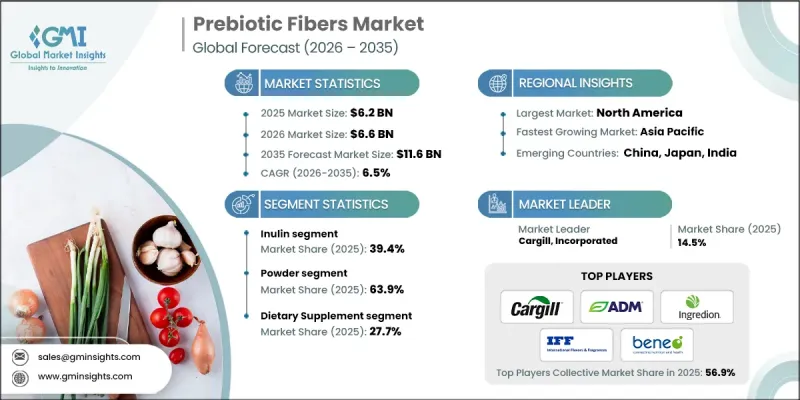
Prebiotic fibers have transitioned from being a niche supplement to a mainstream functional ingredient in everyday food and beverage products. Manufacturers are developing neutral-tasting, stable formulations suitable for integration into dairy alternatives, snack foods, and beverages, allowing consumers to incorporate prebiotics seamlessly into daily routines. The rise of personalized nutrition is further shaping the market, with companies creating targeted prebiotic blends designed to support individual gut microbiomes and align with digital health trends. Prebiotic fibers are no longer just functional additives; they are increasingly recognized as essential components for maintaining digestive wellness. Innovations in clean-label, plant-based, and fortifiable foods are expanding the applications and driving consumer engagement globally. This growth is supported by rising health consciousness, increased disposable income, and regulatory frameworks encouraging dietary supplement and functional food adoption.
| Market Scope | |
|---|---|
| Start Year | 2025 |
| Forecast Year | 2026-2035 |
| Start Value | $6.2 Billion |
| Forecast Value | $11.6 Billion |
| CAGR | 6.5% |
The inulin segment held a 39.4% share in 2025 and is expected to grow at a CAGR of 7% through 2035. Inulin, together with fructooligosaccharides (FOS), represents over half of the total prebiotic fiber market by 2025, reflecting their broad acceptance and functional benefits.
The granular formulations segment accounted for 6.7% share, valued at USD 414.7 million in 2025. These formats are favored for applications in snack bars, cereals, and clinical nutrition products due to their precise dosing capabilities, controlled release properties, and compatibility with low-moisture formulations, enabling versatile integration into functional foods.
North America Prebiotic Fibers Market reached USD 2.3 billion in 2025 and is poised for sustained growth over the forecast period. High consumer awareness about the gut microbiome, health-conscious eating habits, and demand for plant-based and clean-label products underpin this leadership. Regulatory support for dietary supplements and functional foods, along with innovations in baby nutrition and fortified products, further enhances market expansion. The region's maturity, combined with ongoing research and development activities, positions it as a hub for both product innovation and consumer adoption of prebiotic fibers.
Key companies operating in the Global Prebiotic Fibers Market include Archer Daniels Midland Company, Cargill, Incorporated, Royal FrieslandCampina N.V., Tate & Lyle PLC, BENEO GmbH, Ingredion Incorporated, Roquette Freres, International Flavors & Fragrances Inc. (IFF), Sensus BV, and Tereos Group. Companies in the prebiotic fibers market strengthen their market position through several strategic approaches. Product innovation remains central, with firms developing neutral-taste, stable prebiotic formulations for diverse food and beverage applications. Expanding into personalized nutrition solutions allows them to cater to individual gut health needs. Strategic collaborations with food manufacturers, retailers, and healthcare providers enhance distribution reach and brand visibility. Investments in R&D and clinical validation support efficacy claims, building consumer trust. Companies also focus on geographic expansion into emerging markets with growing health awareness. Emphasis on sustainable sourcing and clean-label production practices enhances brand reputation and meets evolving regulatory requirements. Marketing campaigns highlighting digestive wellness benefits further reinforce consumer adoption and loyalty.
Table of Contents
Chapter 1 Methodology & Scope
- 1.1 Research approach
- 1.2 Quality Commitments
- 1.2.1 GMI AI policy & data integrity commitment
- 1.2.1.1 Source consistency protocol
- 1.2.1 GMI AI policy & data integrity commitment
- 1.3 Research Trail & Confidence Scoring
- 1.3.1 Research Trail Components
- 1.3.2 Scoring Components
- 1.4 Data Collection
- 1.4.1 Partial list of primary sources
- 1.5 Data mining sources
- 1.5.1 Paid sources
- 1.5.1.1 Sources, by region
- 1.5.1 Paid sources
- 1.6 Base estimates and calculations
- 1.6.1 Base year calculation for any one approach
- 1.7 Forecast model
- 1.7.1 Quantified market impact analysis
- 1.7.1.1 Mathematical impact of growth parameters on forecast
- 1.7.1 Quantified market impact analysis
- 1.8 Research transparency addendum
- 1.8.1 Source attribution framework
- 1.8.2 Quality assurance metrics
- 1.8.3 Our commitment to trust
Chapter 2 Executive Summary
- 2.1 Industry 360° synopsis
- 2.2 Key market trends
- 2.2.1 Regional
- 2.2.2 Product Type
- 2.2.3 Form
- 2.2.4 End User
- 2.3 TAM Analysis, 2025-2034
- 2.4 CXO perspectives: Strategic imperatives
- 2.4.1 Executive decision points
- 2.4.2 Critical success factors
- 2.5 Future Outlook and Strategic Recommendations
Chapter 3 Industry Insights
- 3.1 Industry ecosystem analysis
- 3.1.1 Supplier landscape
- 3.1.2 Profit margin
- 3.1.3 Value addition at each stage
- 3.1.4 Factor affecting the value chain
- 3.1.5 Disruptions
- 3.2 Industry impact forces
- 3.2.1 Growth drivers
- 3.2.1.1 Increasing consumer focus on digestive wellness is driving demand for prebiotic fiber ingredients.
- 3.2.1.2 Rising preference for functional and clean-label foods supports wider prebiotic fiber incorporation.
- 3.2.1.3 Growing emphasis on preventive healthcare encourages routine consumption of gut-health ingredients.
- 3.2.2 Industry pitfalls and challenges
- 3.2.2.1 Gastrointestinal discomfort at higher doses limits consumer tolerance of certain prebiotic fibers.
- 3.2.2.2 Inconsistent regulatory definitions and health claims create uncertainty for manufacturers.
- 3.2.2.3 Higher costs compared to conventional fibers reduce price competitiveness.
- 3.2.3 Market opportunities
- 3.2.3.1 Development of low-dose, high-efficacy prebiotics addresses tolerance concerns.
- 3.2.3.2 Personalized nutrition creates demand for targeted prebiotic fiber solutions.
- 3.2.3.3 Expansion into animal nutrition broadens applications beyond human consumption.
- 3.2.1 Growth drivers
- 3.3 Growth potential analysis
- 3.4 Regulatory landscape
- 3.4.1 North America
- 3.4.2 Europe
- 3.4.3 Asia Pacific
- 3.4.4 Latin America
- 3.4.5 Middle East & Africa
- 3.5 Porter's analysis
- 3.6 PESTEL analysis
- 3.7 Price trends
- 3.7.1 By region
- 3.7.2 By product type
- 3.8 Future market trends
- 3.9 Technology and Innovation landscape
- 3.9.1 Current technological trends
- 3.9.2 Emerging technologies
- 3.10 Patent Landscape
- 3.11 Trade statistics (HS code)
- 3.11.1 Major importing countries
- 3.11.2 Major exporting countries
- 3.12 Sustainability and environmental aspects
- 3.12.1 Sustainable practices
- 3.12.2 Waste reduction strategies
- 3.12.3 Energy efficiency in production
- 3.12.4 Eco-friendly initiatives
- 3.13 Carbon footprint consideration
Chapter 4 Competitive Landscape, 2025
- 4.1 Introduction
- 4.2 Company market share analysis
- 4.2.1 By region
- 4.2.1.1 North America
- 4.2.1.2 Europe
- 4.2.1.3 Asia Pacific
- 4.2.1.4 LATAM
- 4.2.1.5 MEA
- 4.2.1 By region
- 4.3 Company matrix analysis
- 4.4 Competitive analysis of major market players
- 4.5 Competitive positioning matrix
- 4.6 Key developments
- 4.6.1 Mergers & acquisitions
- 4.6.2 Partnerships & collaborations
- 4.6.3 New Product Launches
- 4.6.4 Expansion Plans
Chapter 5 Market Estimates and Forecast, By Product Type, 2022-2035 (USD Billion) (Kilo Tons)
- 5.1 Key trends
- 5.2 Inulin
- 5.3 Fructooligosaccharides (FOS)
- 5.4 Galactooligosaccharides (GOS)
- 5.5 Human Milk Oligosaccharides (HMOs)
- 5.6 Resistant Starch
- 5.7 Xylooligosaccharides (XOS)
- 5.8 Polydextrose
- 5.9 Lactulose
- 5.10 Resistant Dextrin
- 5.11 Others
Chapter 6 Market Estimates and Forecast, By Form, 2022-2035 (USD Billion) (Kilo Tons)
- 6.1 Key trends
- 6.2 Powder
- 6.3 Liquid/Syrup
- 6.4 Granules
- 6.5 Capsules/Tablets
Chapter 7 Market Estimates and Forecast, By End User, 2022-2035 (USD Billion) (Kilo Tons)
- 7.1 Key trends
- 7.2 Bakery & Confectionery
- 7.3 Dairy Products
- 7.4 Beverages
- 7.5 Cereals & Snack Bars
- 7.6 Processed Foods
- 7.7 Dietary Supplements
- 7.8 Infant Nutrition
- 7.9 Clinical Nutrition
- 7.10 Pharmaceuticals
- 7.11 Poultry Feed
- 7.12 Swine Feed
- 7.13 Ruminant Feed
- 7.14 Aquaculture
- 7.15 Pet Food
Chapter 8 Market Estimates and Forecast, By Region, 2022-2035 (USD Billion) (Kilo Tons)
- 8.1 Key trends
- 8.2 North America
- 8.2.1 U.S.
- 8.2.2 Canada
- 8.3 Europe
- 8.3.1 Germany
- 8.3.2 UK
- 8.3.3 France
- 8.3.4 Spain
- 8.3.5 Italy
- 8.3.6 Rest of Europe
- 8.4 Asia Pacific
- 8.4.1 China
- 8.4.2 India
- 8.4.3 Japan
- 8.4.4 Australia
- 8.4.5 South Korea
- 8.4.6 Rest of Asia Pacific
- 8.5 Latin America
- 8.5.1 Brazil
- 8.5.2 Mexico
- 8.5.3 Argentina
- 8.5.4 Rest of Latin America
- 8.6 Middle East and Africa
- 8.6.1 Saudi Arabia
- 8.6.2 South Africa
- 8.6.3 UAE
- 8.6.4 Rest of Middle East and Africa
Chapter 9 Company Profiles
- 9.1 Archer Daniels Midland Company
- 9.2 BENEO GmbH
- 9.3 Cargill, Incorporated
- 9.4 Royal FrieslandCampina N.V.
- 9.5 Ingredion Incorporated
- 9.6 International Flavors & Fragrances Inc. (IFF)
- 9.7 Roquette Freres
- 9.8 Sensus BV
- 9.9 Tate & Lyle PLC
- 9.10 Tereos Group