
|
시장보고서
상품코드
1936507
스마트 리튬 배터리식 가정용 제설기 시장 : 시장 기회, 성장 요인, 산업 동향 분석 및 예측(2026-2035년)Smart Lithium Battery Operated Household Snow Blower Market Opportunity, Growth Drivers, Industry Trend Analysis, and Forecast 2026 - 2035 |
||||||

세계의 스마트 리튬 배터리식 가정용 제설기 시장은 2025년에 2억 5,960만 달러로 평가되었고, 2035년까지 연평균 복합 성장률(CAGR) 25.5%로 성장할 전망이며, 24억 9,000만 달러에 달할 것으로 예측되고 있습니다.

이 성장은 가정용 장비의 선호에 대한 광범위한 변화를 반영하며, 소비자는 기존의 제설 도구를 대체하는 더 깨끗하고 정숙하며 사용하기 쉬운 대체품을 찾고 있습니다. 배터리식 제설기는 높아지는 환경 의식, 배출 가스, 소음 및 유지관리 부담의 삭감을 요구하는 목소리에 합치하고 있습니다. 리튬 배터리 시스템은 한랭지에서도 안정된 성능을 발휘하는 동시에 연료의 취급이나 기계적인 유지관리를 필요로 하지 않습니다. 주택 소유자는 육체적인 노력을 줄이고, 변화하며 예측하기 어려운 겨울 상황에 효과적으로 적응하는 솔루션을 점점 더 강조하고 있습니다. 이러한 선호도로 스마트하고 자동화된 제설기는 주택 환경에서 편리하고 효율적이며 신뢰할 수 있는 제설 성능을 제공하면서 긴 겨울을 지원하는 신뢰할 수 있는 가정용 도구로서의 지위를 확립하고 있습니다. 제조업체는 사용 편의성 및 신뢰성을 향상시키는 고급 자동화 기술과 스마트 기능을 통합하여 이러한 기대에 부응합니다. 연결 기능을 통해 사용자는 원격으로 성능을 관리할 수 있으며 지능형 시스템은 환경 조건에 따라 동작을 조정합니다. 리튬 이온 배터리 기술의 지속적인 발전은 시장 확대에 중심적인 역할을 하고 있으며 기존 세대의 배터리보다 긴 가동 시간, 향상된 내구성 및 강력한 제설 능력을 제공합니다. 이러한 진보는 폭설 시에도 배터리 구동 시스템에 대한 신뢰성을 강화하고 가솔린 구동 장치로부터의 전환을 더욱 가속화하고 있습니다.
| 시장 범위 | |
|---|---|
| 시작 연도 | 2025년 |
| 예측 연도 | 2026-2035년 |
| 시작 시 가치 | 2억 5,960만 달러 |
| 예측 금액 | 24억 9,000만 달러 |
| CAGR | 25.5% |
GPS 기반 자율 시스템 부문은 2025년에 1억 8,250만 달러의 수익을 창출했습니다. 이러한 시스템은 센서 기반 솔루션을 뛰어넘는 능력, 즉 정확한 네비게이션, 일관된 영역 커버리지, 완전 자동 운전을 실현할 수 있기 때문에 도입을 선도하고 있습니다. 통합 포지셔닝 기술을 통해 기계는 매핑된 영역을 인식하고 정확한 이동 경로를 유지하며 최소한의 사용자 개입으로 안정적인 성능을 제공할 수 있어 완전 자율 제설 솔루션에 대한 수요가 증가하고 있습니다.
온라인 판매 부문은 2025년 63%의 점유율을 차지했습니다. 디지털 플랫폼은 소비자에게 편리한 액세스, 상세한 제품 비교, 구매 의지에 영향을 미치는 투명한 리뷰를 제공합니다. 구매를 결정하기 전에 성능 사양, 배터리 수명, 유지 보수 요구 사항 및 실제 사용자 피드백을 평가하기 위해 구매자는 온라인 채널에 점점 더 의존하고 있습니다.
미국의 스마트 리튬 배터리식 가정용 제설기 시장은 2025년 1억 2,420만 달러 규모를 기록했습니다. 지역 수요는 동계 장기화, 빈번한 강설, 광대한 교외 주거 지역, 리튬 배터리식 공구의 보급에 의해 지원됩니다. 특히 미국과 캐나다에서는 장기간의 한랭 조건이 효율적인 가정용 제설 솔루션의 필요성을 지속적으로 높여 가고 있습니다.
자주 묻는 질문
목차
제1장 조사 방법 및 범위
제2장 주요 요약
제3장 업계 인사이트
- 생태계 분석
- 공급자의 상황
- 이익률
- 각 단계에서의 부가가치
- 밸류체인에 영향을 주는 요인
- 업계에 미치는 영향요인
- 성장 촉진요인
- 스마트 홈 기기 및 자율형 홈 기기의 도입 확대
- 환경 친화적인 저소음 제설 방법에 대한 기호 증가
- 온라인 가용성 확대 및 EC 시장의 견조한 성장
- 업계의 잠재적 위험 및 과제
- 극한의 눈 조건 하에서 배터리 구동 시간 제한 및 성능
- 기존 모델과 비교하여 높은 초기 비용
- 기회
- 고급 네비게이션 및 AI 구동형 자동화의 통합
- 신흥 강설 지역 및 아시아태평양 시장으로 확대
- 성장 촉진요인
- 성장 가능성 분석
- 주요 시장 동향 및 혼란 요인
- 장래 시장 동향
- 리스크 및 경감책의 분석
- 기술 및 혁신 동향
- 현재 기술 동향
- 신흥 기술
- 가격 동향
- 지역별
- 제품별
- 규제 상황
- 북미
- 유럽
- 아시아태평양
- 중동 및 아프리카
- 라틴아메리카
- Porter's Five Forces 분석
- PESTEL 분석
- 소비자 행동 분석
- 구매 패턴
- 기호성 분석
- 소비 행동의 지역 차이
- 전자상거래가 구매 결정에 미치는 영향
제4장 경쟁 구도
- 서문
- 기업의 시장 점유율 분석
- 지역별
- 기업 매트릭스 분석
- 주요 시장 기업의 경쟁 분석
- 경쟁 포지셔닝 매트릭스
- 주요 발전
- 합병 및 인수
- 제휴 및 협업
- 신제품 발매
- 확대 계획
제5장 시장 추계 및 예측 : 제품별(2022-2035년)
- GPS 기반 자율주행
- 비전 기반 자율주행
- 하이브리드 멀티 센서
제6장 시장 추계 및 예측 : 모듈러리티별(2022-2035년)
- 단일 용도(눈 전용)
- 멀티 시즌 대응 모듈러 플랫폼
제7장 시장 추계 및 예측 : 제품 규모별(2022-2035년)
- 컴팩트
- 표준 교외 주택지
- 대규모 교외형
- 부동산
제8장 시장 추계 및 예측 : 유통 채널별(2022-2035년)
- 온라인
- 오프라인
제9장 시장 추계 및 예측 : 지역별(2022-2035년)
- 북미
- 미국
- 캐나다
- 유럽
- 프랑스
- 오스트리아
- 스웨덴
- 핀란드
- 스위스
- 노르웨이
- 덴마크
- 에스토니아
- 아시아태평양
- 대만
- 일본
- 한국
- 몽골
- 라틴아메리카
- 아르헨티나
- 칠레
- 콜롬비아
- 중동 및 아프리카
- 이란
- 모로코
- 남아프리카
제10장 기업 프로파일
- Yarbo
- Mammotion
- Kobi Company
- Swap Robotics
- Snowbot
- EGO Power
- Greenworks
- Toro
- Milwaukee Tool
- Ryobi
- DeWalt
- Snow Joe
- Kobalt
- Craftsman
- Earthwise
The Global Smart Lithium Battery Operated Household Snow Blower Market was valued at USD 259.6 million in 2025 and is estimated to grow at a CAGR of 25.5% to reach USD 2.49 billion by 2035.
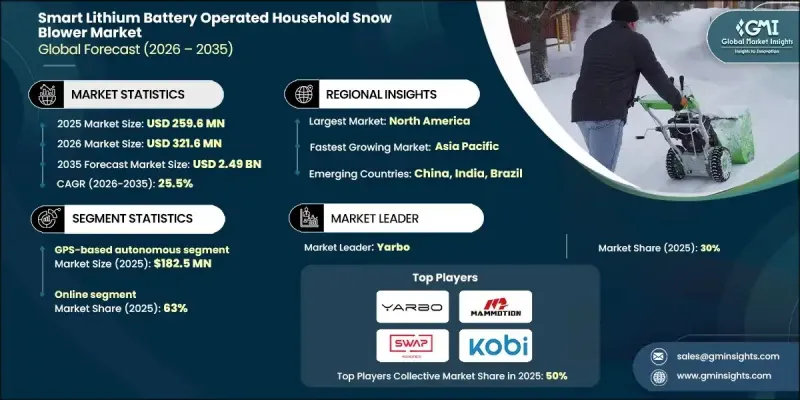
Growth reflects a broader transformation in household equipment preferences, with consumers seeking cleaner, quieter, and easier-to-use alternatives to conventional snow removal tools. Battery-powered snow blowers align well with rising environmental awareness and the growing desire to reduce emissions, noise, and maintenance demands. Lithium-battery systems deliver consistent performance in cold climates while eliminating fuel handling and mechanical upkeep. Homeowners increasingly value solutions that reduce physical effort and adapt effectively to changing and unpredictable winter conditions. These preferences position smart, automated snow blowers as reliable household tools capable of supporting long winters while delivering convenience, efficiency, and dependable clearing performance in residential environments. Manufacturers respond to these expectations by integrating advanced automation and smart functionality that improves usability and reliability. Connected features allow users to manage performance remotely while intelligent systems adjust operation based on environmental conditions. Continued improvements in lithium-ion battery technology play a central role in market expansion, offering longer operating times, improved durability, and stronger snow-clearing capabilities than earlier battery generations. These advances reinforce confidence in battery-powered systems, even during heavier snowfall, and further accelerate the shift away from gas-powered equipment.
| Market Scope | |
|---|---|
| Start Year | 2025 |
| Forecast Year | 2026-2035 |
| Start Value | $259.6 Million |
| Forecast Value | $2.49 Billion |
| CAGR | 25.5% |
The GPS-based autonomous systems segment generated USD 182.5 million in 2025. These systems lead adoption due to their ability to deliver accurate navigation, consistent area coverage, and fully automated operation beyond the capabilities of sensor-based solutions. Integrated positioning technology enables machines to recognize mapped areas, maintain precise movement paths, and deliver reliable performance with minimal user intervention, strengthening demand for fully autonomous snow-clearing solutions.
The online sales segment held 63% share in 2025. Digital platforms offer consumers convenient access, detailed product comparisons, and transparent reviews that influence purchasing confidence. Buyers increasingly rely on online channels to evaluate performance specifications, battery life, maintenance requirements, and real-world user feedback before committing to a purchase.
United States Smart Lithium Battery Operated Household Snow Blower Market generated USD 124.2 million in 2025. Regional demand is supported by extended winter seasons, frequent snowfall, large suburban housing areas, and widespread adoption of lithium-powered tools. Prolonged cold conditions consistently drive the need for efficient residential snow removal solutions, particularly across the US and Canada.
Key companies active in the Global Smart Lithium Battery Operated Household Snow Blower Market include Toro, EGO Power+, Greenworks, Yarbo, Ryobi, DeWalt, Snow Joe, Mammotion, Milwaukee Tool, Craftsman, Kobalt, Kobi Company, Swap Robotics, Earthwise, and Snowbot. Companies in the smart lithium-battery operated household snow blower market strengthen their position by focusing on innovation in automation, battery efficiency, and smart connectivity. Manufacturers prioritize improving runtime, power output, and durability to enhance cold-weather performance. Expanding direct-to-consumer and online retail strategies improves visibility and customer access. Many brands emphasize ease of use, safety, and low maintenance to appeal to residential buyers.
Table of Contents
Chapter 1 Methodology and Scope
- 1.1 Market scope and definition
- 1.2 Research design
- 1.2.1 Research approach
- 1.2.2 Data collection methods
- 1.3 Data mining sources
- 1.3.1 Global
- 1.3.2 Regional/Country
- 1.4 Base estimates and calculations
- 1.4.1 Base year calculation
- 1.4.2 Key trends for market estimation
- 1.5 Primary research and validation
- 1.5.1 Primary sources
- 1.6 Forecast model
- 1.7 Research assumptions and limitations
Chapter 2 Executive Summary
- 2.1 Industry 360° synopsis
- 2.2 Key market trends
- 2.2.1 By Regional
- 2.2.2 By Product
- 2.2.3 By Modularity
- 2.2.4 By Property size
- 2.2.5 By Distribution channel
- 2.3 CXO perspectives: Strategic imperatives
- 2.3.1 Key decision points for industry executives
- 2.3.2 Critical success factors for market players
- 2.4 Future outlook and strategic recommendations
Chapter 3 Industry Insights
- 3.1 Industry ecosystem analysis
- 3.1.1 Supplier landscape
- 3.1.2 Profit margin
- 3.1.3 Value addition at each stage
- 3.1.4 Factor affecting the value chain
- 3.2 Industry impact forces
- 3.2.1 Growth drivers
- 3.2.1.1 Rising Adoption of Smart and Autonomous Home Equipment
- 3.2.1.2 Growing Preference for Eco-Friendly and Low-Noise Snow Removal
- 3.2.1.3 Expanded Online Availability and Strong E-Commerce Growth
- 3.2.2 Industry pitfalls & challenges
- 3.2.2.1 Limited Battery Runtime and Performance in Extreme Snow Conditions
- 3.2.2.2 Higher Upfront Cost Compared to Conventional Models
- 3.2.3 Opportunities
- 3.2.3.1 Integration of Advanced Navigation and AI-Driven Automation
- 3.2.3.2 Expansion into Emerging Snowfall Regions and APAC Markets
- 3.2.1 Growth drivers
- 3.3 Growth potential analysis
- 3.4 Major market trends and Distruptions
- 3.5 Future market trends
- 3.6 Risk and mitigation Analysis
- 3.7 Technology and innovation landscape
- 3.7.1 Current technological trends
- 3.7.2 Emerging technologies
- 3.8 Price trends
- 3.8.1 By Region
- 3.8.2 By Product
- 3.9 Regulatory landscape
- 3.9.1 Noth America
- 3.9.2 Europe
- 3.9.3 Asia-Pacific
- 3.9.4 Middle East and Africa
- 3.9.5 Latin America
- 3.10 Porter's analysis
- 3.11 PESTEL analysis
- 3.12 Consumer behaviour analysis
- 3.12.1 Purchasing patterns
- 3.12.2 Preference analysis
- 3.12.3 Regional variations in consumer behavior
- 3.12.4 Impact of e-commerce on buying decisions
Chapter 4 Competitive Landscape, 2025
- 4.1 Introduction
- 4.2 Company market share analysis
- 4.2.1 By region
- 4.2.1.1 North America
- 4.2.1.2 Europe
- 4.2.1.3 Asia Pacific
- 4.2.1.4 Latin America
- 4.2.1.5 Middle East and Africa
- 4.2.1 By region
- 4.3 Company matrix analysis
- 4.4 Competitive analysis of major market players
- 4.5 Competitive positioning matrix
- 4.6 Key developments
- 4.6.1 Mergers & acquisitions
- 4.6.2 Partnerships & collaborations
- 4.6.3 New product launches
- 4.6.4 Expansion plans
Chapter 5 Market Estimates & Forecast, By Product, 2022-2035 (USD Million) (Thousand Units)
- 5.1 Key trends
- 5.2 Gps-based autonomous
- 5.3 Vision-based autonomous
- 5.4 Hybrid multi-sensor
Chapter 6 Market Estimates & Forecast, By Modularity, 2022-2035 (USD Million) (Thousand Units)
- 6.1 Key trends
- 6.2 Single-purpose snow-only
- 6.3 Multi-season modular platform
Chapter 7 Market Estimates & Forecast, By Property Size, 2022-2035 (USD Million) (Thousand Units)
- 7.1 Key trends
- 7.2 Compact
- 7.3 Standard Suburban
- 7.4 Large Suburban
- 7.5 Estate
Chapter 8 Market Estimates & Forecast, By Distribution Channel, 2022-2035 (USD Million) (Thousand Units)
- 8.1 Key trends
- 8.2 Online
- 8.3 Offline
Chapter 9 Market Estimates and Forecast, By Region, 2022 - 2035 (USD Million) (Thousand Units)
- 9.1 Key trends
- 9.2 North America
- 9.2.1 U.S.
- 9.2.2 Canada
- 9.3 Europe
- 9.3.1 France
- 9.3.2 Austria
- 9.3.3 Sweden
- 9.3.4 Finland
- 9.3.5 Switzerland
- 9.3.6 Norway
- 9.3.7 Denmark
- 9.3.8 Estonia
- 9.4 Asia Pacific
- 9.4.1 Taiwan
- 9.4.2 Japan
- 9.4.3 South Korea
- 9.4.4 Mongolia
- 9.5 Latin America
- 9.5.1 Argentina
- 9.5.2 Chile
- 9.5.3 Colombia
- 9.6 Middle East and Africa
- 9.6.1 Iran
- 9.6.2 Morocco
- 9.6.3 South Africa
Chapter 10 Company Profiles
- 10.1 Yarbo
- 10.2 Mammotion
- 10.3 Kobi Company
- 10.4 Swap Robotics
- 10.5 Snowbot
- 10.6 EGO Power+
- 10.7 Greenworks
- 10.8 Toro
- 10.9 Milwaukee Tool
- 10.10 Ryobi
- 10.11 DeWalt
- 10.12 Snow Joe
- 10.13 Kobalt
- 10.14 Craftsman
- 10.15 Earthwise