|
시장보고서
상품코드
1936511
산업용수용 살생물제 시장 : 시장 기회, 성장 요인, 산업 동향 분석 및 예측(2026-2035년)Biocides For Industrial Water Market Opportunity, Growth Drivers, Industry Trend Analysis, and Forecast 2026 - 2035 |
||||||

세계의 산업용수용 살생물제 시장은 2025년에 21억 달러로 평가되었고, 2035년까지 연평균 복합 성장률(CAGR) 5.9%로 성장할 전망이며, 37억 달러에 이를 것으로 예측됩니다.

이러한 성장은 급속한 산업화, 환경 규제 강화, 지속가능한 물관리 기법에 대한 주목 증가에 의해 추진되고 있습니다. 산업용수용 살생물제는 미생물 증식 억제, 바이오필름 방지, 다양한 분야에서 시스템 효율 유지에 필수적입니다. 산화성 살생물제는 물 회로에서 박테리아, 곰팡이, 바이오필름 퇴적물을 제거하는 효과가 입증되었기 때문에 가장 널리 채택되고 있습니다. 한편, 비산화성 살생물제는 부식방지 및 건설용수 시스템 등의 용도로 주목을 받고 있습니다. 규제 압력 증가와 지속가능성에 대한 노력은 환경 부하를 줄이고 녹색 작업을 선호하는 산업에 호소하는 환경 친화적인 식물 유래 살생물제의 개발을 가속화하고 있습니다. 보일러 처리, 공정수, 폐수 처리 등의 고부가가치 용도는 특히 물 재사용과 엄격한 품질 기준이 필수적인 산업에서 안정적인 수요를 이끌고 있습니다.
| 시장 범위 | |
|---|---|
| 시작 연도 | 2025년 |
| 예측 연도 | 2026-2035년 |
| 시작 시 가치 | 21억 달러 |
| 예측 금액 | 37억 달러 |
| CAGR | 5.9% |
산화성 살생물제 부문은 2025년에 58.7%의 점유율을 차지하였고, 2035년까지 연평균 복합 성장률(CAGR)5.3%를 나타낼 것으로 예측됩니다. 염소, 브롬, 이산화염소, 과아세트산, 오존 등의 화합물은 산업용 냉각수 시스템과 보일러 수 시스템에서 미생물 오염 및 바이오필름 형성의 억제에 뛰어난 효과를 발휘하기 위해 이 부문을 견인하고 있습니다.
냉각수 처리 부문은 44.2%의 점유율을 차지했으며, 2026-2035년 CAGR 5.1%를 나타낼 것으로 예측됩니다. 냉각수 시스템은 가동 효율을 유지하기 위해 지속적인 항균 처리를 필요로 하고 있으며, 특히 신흥경제국에서의 산업 성장의 계속과 수질규제 강화가 이 부문 수요를 계속 견인할 것입니다.
북미의 산업용수용 살생물제 시장은 2025년 4억 9,820만 달러에 이르렀고, 예측 기간을 통해 꾸준한 성장이 예상됩니다. 이 지역은 성숙 시장이며, 규제에 준거한 기술적으로 선진적이고 환경 친화적인 살생물제가 널리 도입되고 있습니다. 성장은 EPA 규제, 산업용수 재사용 프로젝트, 발전, 화학 처리, 식품 음료 생산 등의 분야에서 지속가능성에 대한 노력에 의해 지원되고 있습니다. 디지털 수처리 솔루션은 운영 효율성을 더욱 향상시키고 환경 친화적인 제제의 도입을 촉진합니다.
자주 묻는 질문
목차
제1장 조사 방법 및 범위
제2장 주요 요약
제3장 업계 인사이트
- 생태계 분석
- 공급자의 상황
- 이익률
- 각 단계에서의 부가가치
- 밸류체인에 영향을 주는 요인
- 혁신
- 업계에 미치는 영향요인
- 성장 촉진요인
- 엄격한 수질 규제
- 산업용수의 재이용 및 제로액 배출(ZLD)의 확대
- 신흥 경제국의 산업화
- 업계의 잠재적 위험 및 과제
- 복잡한 살생물제의 등록
- 변동하는 원재료 비용
- 환경 및 생태독성에 대한 우려
- 시장 기회
- 미개척의 폐수 처리 시장
- 친환경 살생물제에 대한 수요 증가
- 디지털 수처리 최적화
- 성장 촉진요인
- 성장 가능성 분석
- 규제 상황
- 북미
- 유럽
- 아시아태평양
- 라틴아메리카
- 중동 및 아프리카
- Porter's Five Forces 분석
- PESTEL 분석
- 가격 동향
- 지역별
- 제품 유형별
- 장래 시장 동향
- 기술 및 혁신 동향
- 현재 기술 동향
- 신흥 기술
- 특허 상황
- 무역 통계(HS코드)
- 주요 수입국
- 주요 수출국
- 지속가능성 및 환경적 측면
- 지속가능한 대처
- 폐기물 감축 전략
- 생산에 있어서 에너지 효율
- 환경에 배려한 대처
- 탄소발자국 고려
제4장 경쟁 구도
- 서문
- 기업의 시장 점유율 분석
- 지역별
- 북미
- 유럽
- 아시아태평양
- 라틴아메리카
- 중동 및 아프리카
- 지역별
- 기업 매트릭스 분석
- 주요 시장 기업의 경쟁 분석
- 경쟁 포지셔닝 매트릭스
- 주요 발전
- 합병 및 인수
- 제휴 및 협업
- 신제품 발매
- 사업 확대 계획
제5장 시장 추계 및 예측 : 제품 유형별(2022-2035년)
- 산화성 살생물제
- 염소계
- 브롬계
- 이산화염소
- 과아세트산
- 오존
- 기타
- 비산화성 살생물제
- 글루타르알데히드
- 이소티아졸리논류
- 제4급 암모늄 화합물(쿼츠)
- DBNPA
- 브로노폴
- 기타
제6장 시장 추계 및 예측 : 용도별(2022-2035년)
- 냉각수 처리
- 보일러 수처리
- 프로세스 수처리
- 폐수 및 배수 처리
- 기타
제7장 시장 추계 및 예측 : 최종 사용자별(2022-2035년)
- 석유 및 가스
- 발전
- 펄프 및 제지
- 화학제품 및 석유화학제품
- 식품 및 음료
- 광업 및 야금업
- 의약품
- 섬유 및 피혁
- 기타
제8장 시장 추계 및 예측 : 지역별(2022-2035년)
- 북미
- 미국
- 캐나다
- 유럽
- 독일
- 영국
- 프랑스
- 스페인
- 이탈리아
- 기타 유럽
- 아시아태평양
- 중국
- 인도
- 일본
- 호주
- 한국
- 기타 아시아태평양
- 라틴아메리카
- 브라질
- 멕시코
- 아르헨티나
- 기타 라틴아메리카
- 중동 및 아프리카
- 사우디아라비아
- 남아프리카
- 아랍에미리트(UAE)
- 기타 중동 및 아프리카
제9장 기업 프로파일
- B&V Chemicals Ltd.
- BASF SE
- Dupont
- Ecolab Inc.(Nalco Water Division)
- Italmatch Chemicals SpA(Advanced Water Solutions)
- Kemira Oyj
- Kurita Water Industries Ltd.(Kurita-GK Chemical)
- Lanxess AG
- Nouryon Chemicals Holding BV
- Solenis LLC
The Global Biocides For Industrial Water Market was valued at USD 2.1 billion in 2025 and is estimated to grow at a CAGR of 5.9% to reach USD 3.7 billion by 2035.
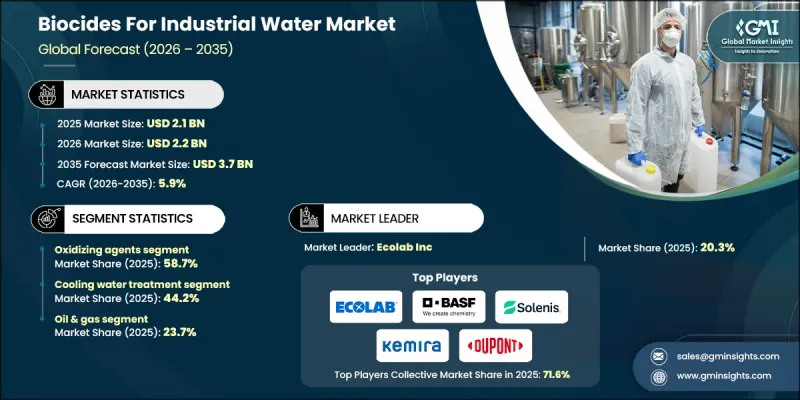
This growth is fueled by rapid industrialization, stricter environmental regulations, and increasing emphasis on sustainable water management practices. Industrial water treatment biocides are critical for controlling microbial growth, preventing biofilms, and maintaining system efficiency across various sectors. Oxidizing biocides remain the most widely adopted due to their proven effectiveness in eliminating bacteria, fungi, and biofilm deposits from water circuits. Meanwhile, non-oxidizing biocides are gaining traction for applications such as corrosion prevention and construction water systems. Rising regulatory pressures and sustainability initiatives are also accelerating the development of eco-friendly and plant-based biocides, which reduce environmental impact and appeal to industries prioritizing green operations. High-value applications such as boiler treatments, process water, and wastewater treatment are driving consistent demand, particularly in industries where water reuse and strict quality standards are essential.
| Market Scope | |
|---|---|
| Start Year | 2025 |
| Forecast Year | 2026-2035 |
| Start Value | $2.1 Billion |
| Forecast Value | $3.7 Billion |
| CAGR | 5.9% |
The oxidizing biocides segment held 58.7% share in 2025 and is projected to grow at a CAGR of 5.3% through 2035. Compounds such as chlorine, bromine, chlorine dioxide, peracetic acid, and ozone lead the segment due to their exceptional efficacy in controlling microbial contamination and biofilm formation in industrial cooling and boiler water systems.
The cooling water treatment segment held 44.2% share and is expected to grow at a CAGR of 5.1% from 2026 to 2035. Cooling water systems require continuous antimicrobial treatment to maintain operational efficiency, and ongoing industrial growth, especially in emerging economies, along with stricter water quality regulations, will continue to drive demand in this segment.
North America Biocides For Industrial Water Market reached USD 498.2 million in 2025 and is expected to experience steady growth throughout the forecast period. The region represents a mature market where regulatory-compliant, technologically advanced, and environmentally friendly biocides are widely implemented. Growth is supported by EPA regulations, industrial water reuse projects, and sustainability mandates in sectors such as power generation, chemical processing, and food and beverage production. Digital water treatment solutions are further enhancing operational efficiency and driving the adoption of eco-friendly formulations.
Key players operating in the Global Biocides For Industrial Water Market include BASF SE, Kemira Oyj, DuPont, Nouryon Chemicals Holding B.V., B&V Chemicals Ltd., Kurita Water Industries Ltd., Lanxess AG, Ecolab Inc. (Nalco Water Division), Italmatch Chemicals SpA (Advanced Water Solutions), and Solenis LLC. Leading companies in the biocides for industrial water market are employing strategies to strengthen their presence and market foothold through innovation, partnerships, and operational efficiency. These strategies include developing eco-friendly and plant-based products to meet sustainability regulations, investing in R&D for next-generation biocide formulations, and forming strategic alliances with industrial end-users to ensure long-term contracts. Companies are also expanding regional production facilities to reduce lead times and logistics costs, implementing digital water treatment platforms for monitoring and efficiency, and optimizing supply chains to secure raw material availability.
Table of Contents
Chapter 1 Methodology & Scope
- 1.1 Research approach
- 1.2 Quality Commitments
- 1.2.1 GMI AI policy & data integrity commitment
- 1.2.1.1 Source consistency protocol
- 1.2.1 GMI AI policy & data integrity commitment
- 1.3 Research Trail & Confidence Scoring
- 1.3.1 Research Trail Components
- 1.3.2 Scoring Components
- 1.4 Data Collection
- 1.4.1 Partial list of primary sources
- 1.5 Data mining sources
- 1.5.1 Paid sources
- 1.5.1.1 Sources, by region
- 1.5.1 Paid sources
- 1.6 Base estimates and calculations
- 1.6.1 Base year calculation for any one approach
- 1.7 Forecast model
- 1.7.1 Quantified market impact analysis
- 1.7.1.1 Mathematical impact of growth parameters on forecast
- 1.7.1 Quantified market impact analysis
- 1.8 Research transparency addendum
- 1.8.1 Source attribution framework
- 1.8.2 Quality assurance metrics
- 1.8.3 Our commitment to trust
Chapter 2 Executive Summary
- 2.1 Industry 360° synopsis
- 2.2 Key market trends
- 2.2.1 Regional
- 2.2.2 Product Type
- 2.2.3 Application
- 2.2.4 End User
- 2.3 TAM Analysis, 2025-2034
- 2.4 CXO perspectives: Strategic imperatives
- 2.4.1 Executive decision points
- 2.4.2 Critical success factors
- 2.5 Future Outlook and Strategic Recommendations
Chapter 3 Industry Insights
- 3.1 Industry ecosystem analysis
- 3.1.1 Supplier landscape
- 3.1.2 Profit margin
- 3.1.3 Value addition at each stage
- 3.1.4 Factor affecting the value chain
- 3.1.5 Disruptions
- 3.2 Industry impact forces
- 3.2.1 Growth drivers
- 3.2.1.1 Stringent Water Quality Regulations
- 3.2.1.2 Rising Industrial Water Reuse & ZLD
- 3.2.1.3 Industrialization in Emerging Economies
- 3.2.2 Industry pitfalls and challenges
- 3.2.2.1 Complex Biocide Registration
- 3.2.2.2 Volatile Raw Material Costs
- 3.2.2.3 Environmental & Ecotoxicity Concerns
- 3.2.3 Market opportunities
- 3.2.3.1 Untapped Wastewater Treatment Market
- 3.2.3.2 Rising Demand for Eco-Friendly Biocides
- 3.2.3.3 Digital Water Treatment Optimization
- 3.2.1 Growth drivers
- 3.3 Growth potential analysis
- 3.4 Regulatory landscape
- 3.4.1 North America
- 3.4.2 Europe
- 3.4.3 Asia Pacific
- 3.4.4 Latin America
- 3.4.5 Middle East & Africa
- 3.5 Porter's analysis
- 3.6 PESTEL analysis
- 3.7 Price trends
- 3.7.1 By region
- 3.7.2 By product type
- 3.8 Future market trends
- 3.9 Technology and Innovation landscape
- 3.9.1 Current technological trends
- 3.9.2 Emerging technologies
- 3.10 Patent Landscape
- 3.11 Trade statistics (HS code)
- 3.11.1 Major importing countries
- 3.11.2 Major exporting countries
- 3.12 Sustainability and environmental aspects
- 3.12.1 Sustainable practices
- 3.12.2 Waste reduction strategies
- 3.12.3 Energy efficiency in production
- 3.12.4 Eco-friendly initiatives
- 3.13 Carbon footprint consideration
Chapter 4 Competitive Landscape, 2025
- 4.1 Introduction
- 4.2 Company market share analysis
- 4.2.1 By region
- 4.2.1.1 North America
- 4.2.1.2 Europe
- 4.2.1.3 Asia Pacific
- 4.2.1.4 LATAM
- 4.2.1.5 MEA
- 4.2.1 By region
- 4.3 Company matrix analysis
- 4.4 Competitive analysis of major market players
- 4.5 Competitive positioning matrix
- 4.6 Key developments
- 4.6.1 Mergers & acquisitions
- 4.6.2 Partnerships & collaborations
- 4.6.3 New Product Launches
- 4.6.4 Expansion Plans
Chapter 5 Market Estimates and Forecast, By Product Type, 2022-2035 (USD Billion) (Kilo Tons)
- 5.1 Key trends
- 5.2 Oxidizing Biocides
- 5.2.1 Chlorine-Based
- 5.2.2 Bromine-Based
- 5.2.3 Chlorine Dioxide
- 5.2.4 Peracetic Acid
- 5.2.5 Ozone
- 5.2.6 Others
- 5.3 Non-Oxidizing Biocides
- 5.3.1 Glutaraldehyde
- 5.3.2 Isothiazolinones
- 5.3.3 Quaternary Ammonium Compounds (Quats)
- 5.3.4 DBNPA
- 5.3.5 Bronopol
- 5.3.6 Others
Chapter 6 Market Estimates and Forecast, By Application, 2022-2035 (USD Billion) (Kilo Tons)
- 6.1 Key trends
- 6.2 Cooling Water Treatment
- 6.3 Boiler Water Treatment
- 6.4 Process Water Treatment
- 6.5 Wastewater & Effluent Treatment
- 6.6 Others
Chapter 7 Market Estimates and Forecast, By End User, 2022-2035 (USD Billion) (Kilo Tons)
- 7.1 Key trends
- 7.2 Oil & Gas
- 7.3 Power Generation
- 7.4 Pulp & Paper
- 7.5 Chemical & Petrochemical
- 7.6 Food & Beverage
- 7.7 Mining & Metallurgy
- 7.8 Pharmaceuticals
- 7.9 Textile & Leather
- 7.10 Others
Chapter 8 Market Estimates and Forecast, By Region, 2022-2035 (USD Billion) (Kilo Tons)
- 8.1 Key trends
- 8.2 North America
- 8.2.1 U.S.
- 8.2.2 Canada
- 8.3 Europe
- 8.3.1 Germany
- 8.3.2 UK
- 8.3.3 France
- 8.3.4 Spain
- 8.3.5 Italy
- 8.3.6 Rest of Europe
- 8.4 Asia Pacific
- 8.4.1 China
- 8.4.2 India
- 8.4.3 Japan
- 8.4.4 Australia
- 8.4.5 South Korea
- 8.4.6 Rest of Asia Pacific
- 8.5 Latin America
- 8.5.1 Brazil
- 8.5.2 Mexico
- 8.5.3 Argentina
- 8.5.4 Rest of Latin America
- 8.6 Middle East and Africa
- 8.6.1 Saudi Arabia
- 8.6.2 South Africa
- 8.6.3 UAE
- 8.6.4 Rest of Middle East and Africa
Chapter 9 Company Profiles
- 9.1 B&V Chemicals Ltd.
- 9.2 BASF SE
- 9.3 Dupont
- 9.4 Ecolab Inc. (Nalco Water Division)
- 9.5 Italmatch Chemicals SpA (Advanced Water Solutions)
- 9.6 Kemira Oyj
- 9.7 Kurita Water Industries Ltd. (Kurita-GK Chemical)
- 9.8 Lanxess AG
- 9.9 Nouryon Chemicals Holding B.V.
- 9.10 Solenis LLC