
|
시장보고서
상품코드
1936534
온수식 라디에이터 시장 : 시장 기회, 성장 요인, 산업 동향 분석 및 예측(2026-2035년)Hydronic Radiator Market Opportunity, Growth Drivers, Industry Trend Analysis, and Forecast 2026 - 2035 |
||||||

세계의 온수식 라디에이터 시장은 2025년에 87억 달러로 평가되었고, 2035년까지 연평균 복합 성장률(CAGR) 6.9%로 성장할 전망이며, 171억 달러에 이를 것으로 예측됩니다.

시장 성장은 환경 의식 증가와 주택 및 상업 공간에서 에너지 효율에 대한 중시 증가에 의해 견인되고 있습니다. 온수식 라디에이터는 보일러에 연결된 배관 네트워크 내에서 온수 또는 증기를 순환시켜 온기를 발생시키는 메커니즘입니다. 현대적인 디자인은 성능과 미관의 융합에 중점을 두고 세련된 프로파일, 최소한의 마무리, 다양한 색상 옵션을 제공하며 디자인을 중시하는 소비자의 요구에 부응합니다. 지속 가능한 난방 솔루션을 홍보하는 정부 인센티브 프로그램 외에도 열전달 발전, 물 순환 개선, 저온 열원과의 호환성 향상도 채택을 더욱 강화하고 있습니다. 뛰어난 쾌적성 관리, 다양한 용도에의 적응성, 스마트 홈 기술과의 통합도 시장 확대를 가속시키고 있으며, 온수식 라디에이터는 에너지 절약을 의식한 건설 및 개수 프로젝트에 있어서 선호되는 선택지가 되고 있습니다.
| 시장 범위 | |
|---|---|
| 시작 연도 | 2025년 |
| 예측 연도 | 2026-2035년 |
| 시작 시 가치 | 87억 달러 |
| 예측 금액 | 171억 달러 |
| CAGR | 6.9% |
콘벡터식 온수 라디에이터 부문은 2025년 16억 달러 규모에 달했습니다. 이 장치는 최적화된 기류와 향상된 열교환 설계로 계속 발전하여 신속한 열 응답과 균일한 열 분포를 보장합니다. 높은 성능을 발휘하면서 설치 공간을 최소화하기 위해 컴팩트하고 수요가 높은 환경에 이상적입니다.
주택 부문은 2025년에 62.4%의 점유율을 차지했으며, 2035년까지 100억 달러에 달할 것으로 예측됩니다. 에너지 절약 의식 증가, 스마트 홈 공조 제어의 보급 확대, 재생에너지 대응 시스템에 대한 관심이 높아져 수요를 견인하고 있습니다. 주택 개수 활동 증가 및 태양광 발전 솔루션과의 통합이 도입을 더욱 가속화하여 주택 용도의 강력한 성장 가능성을 부각하고 있습니다.
유럽의 온수식 라디에이터 시장은 2035년까지 연평균 복합 성장률(CAGR) 7.5%를 나타낼 것으로 예측됩니다. 이러한 성장은 첨단 제어 시스템 채택, 스마트 홈 에코시스템과의 호환성, 지속가능하고 에너지 효율적인 건축 기법을 지원하면서 라이프사이클 비용 절감에 주력하는 움직임에 의해 추진되고 있습니다.
자주 묻는 질문
목차
제1장 조사 방법 및 범위
제2장 주요 요약
제3장 업계 인사이트
- 생태계 분석
- 원재료 가용성 및 조달 분석
- 제조 능력 평가
- 공급망의 탄력성 및 위험 요인
- 유통 네트워크 분석
- 규제 상황
- 업계에 미치는 영향요인
- 성장 촉진요인
- 업계의 잠재적 위험 및 과제
- 성장 가능성 분석
- Porter's Five Forces 분석
- PESTEL 분석
- 온수식 라디에이터의 비용 구조 분석
- 투자분석 및 전망
- 디지털 전환 및 인더스트리 4.0의 통합
- 지속가능성에 대한 노력 및 새로운 기회
제4장 경쟁 구도
- 서문
- 기업의 시장 점유율 분석 : 지역별
- 북미
- 유럽
- 아시아태평양
- 중동 및 아프리카
- 라틴아메리카
- 전략적 대시보드
- 전략적 노력
- 주요 제휴 및 협력관계
- 주요 M&A 활동
- 제품 혁신 및 신제품 출시
- 시장 확대 전략
- 경쟁 벤치마킹
- 혁신 및 지속가능성의 정세
제5장 시장 규모 및 예측 : 제품별(2022-2035년)
- 패널
- 베이스보드
- 콘 벡터
- 팬 코일
- 기타
제6장 시장 규모 및 예측 : 최종 용도별(2022-2035년)
- 주택용
- 상업용
- 산업용
제7장 시장 규모 및 예측 : 지역별(2022-2035년)
- 북미
- 미국
- 캐나다
- 유럽
- 영국
- 독일
- 프랑스
- 이탈리아
- 스페인
- 핀란드
- 덴마크
- 오스트리아
- 벨기에
- 아시아태평양
- 중국
- 일본
- 인도
- 한국
- 호주
- 중동 및 아프리카
- 사우디아라비아
- 아랍에미리트(UAE)
- 튀르키예
- 남아프리카
- 라틴아메리카
- 브라질
- 아르헨티나
- 멕시코
제8장 기업 프로파일
- Advanced Hydronics
- Bosch Thermotechnology
- Cambro Hydronic Heating
- Chappee
- De’ Longhi Appliances
- Embassy Industries
- Fondital
- Governale Company
- Haverland
- Henrad
- Hudson Reed
- IRSAP
- Jaga
- KORADO
- KERMI
- Myson
- Purmo Group
- Runtal North America
- Seltron
- Stelrad
- US Boiler Company
- VASCO
- WISELIVING
- Zehnder Group
The Global Hydronic Radiator Market was valued at USD 8.7 billion in 2025 and is estimated to grow at a CAGR of 6.9% to reach USD 17.1 billion by 2035.
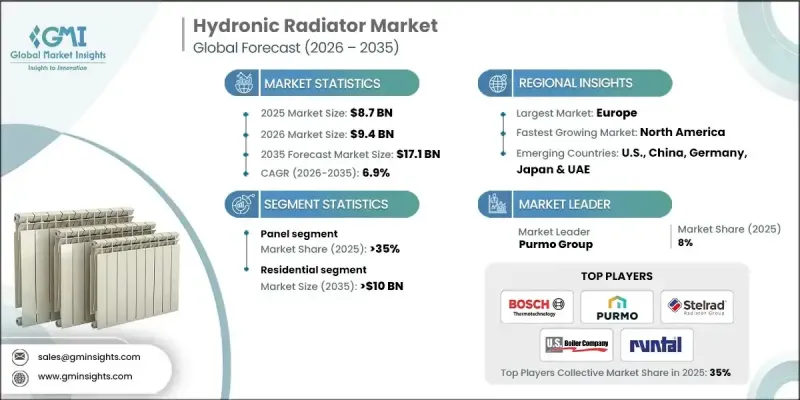
Market growth is driven by rising environmental awareness and increasing emphasis on energy efficiency across residential and commercial spaces. Hydronic radiators function by circulating hot water or steam to generate warmth, operating within a network of pipes connected to a boiler. Modern designs focus on combining performance with aesthetics, offering sleek profiles, minimalist finishes, and diverse color options to cater to design-conscious consumers. Government incentive programs encouraging sustainable heating solutions, along with advancements in heat transfer, improved water circulation, and compatibility with low-temperature sources, are further bolstering adoption. Superior comfort management, adaptability across applications, and the integration of smart home technologies are also accelerating the market expansion, making hydronic radiators a preferred choice in energy-conscious construction and renovation projects.
| Market Scope | |
|---|---|
| Start Year | 2025 |
| Forecast Year | 2026-2035 |
| Start Value | $8.7 Billion |
| Forecast Value | $17.1 Billion |
| CAGR | 6.9% |
The convector hydronic radiator segment was valued at USD 1.6 billion in 2025. These units are evolving with optimized airflow and enhanced heat exchange designs, ensuring rapid thermal response and uniform heat distribution. The systems deliver high performance while minimizing space requirements, making them suitable for compact and high-demand environments.
The residential segment captured 62.4% share in 2025 and is anticipated to reach USD 10 billion by 2035. Rising awareness of energy conservation, increased adoption of smart home climate controls, and interest in renewable energy-compatible systems are driving demand. Growing home renovation activity and integration with solar energy solutions further accelerate adoption, highlighting the strong growth potential of residential applications.
Europe Hydronic Radiator Market is expected to grow at a CAGR of 7.5% through 2035. This growth is fueled by the adoption of advanced control systems, compatibility with smart home ecosystems, and a focus on reducing lifecycle costs while supporting sustainable and energy-efficient building practices.
Key players in the Global Hydronic Radiator Market include Bosch Thermotechnology, KORADO, Stelrad, De'Longhi Appliances, Jaga, Advanced Hydronics, Embassy Industries, IRSAP, Chappee, Myson, Haverland, Purmo Group, Hudson Reed, VASCO, Runtal North America, Zehnder Group, Fondital, Seltron, WISELIVING, Henrad, KERMI, Governale Company, Cambro Hydronic Heating, U.S. Boiler Company. Companies in the hydronic radiator market are employing multiple strategies to strengthen their presence and market position. These include continuous investment in R&D to develop energy-efficient, low-profile, and smart-compatible radiator designs. Manufacturers are expanding their global distribution networks and forming strategic partnerships to enhance market reach. Many players are focusing on sustainability by offering radiators compatible with renewable energy sources and promoting products with reduced carbon footprints. Additionally, personalized design options, digital integration for smart home ecosystems, and targeted marketing campaigns aimed at energy-conscious consumers help in differentiating brands and building customer loyalty.
Table of Contents
Chapter 1 Methodology & Scope
- 1.1 Research approach
- 1.2 Quality commitments
- 1.2.1 GMI AI policy & data integrity commitment
- 1.2.1.1 Source consistency protocol
- 1.2.1 GMI AI policy & data integrity commitment
- 1.3 Research trail & confidence scoring
- 1.3.1 Research trail components
- 1.3.2 Scoring components
- 1.4 Data collection
- 1.4.1 Partial list of primary sources
- 1.5 Data mining sources
- 1.5.1 Paid sources
- 1.5.1.1 Sources, by region
- 1.5.1 Paid sources
- 1.6 Base estimates and calculations
- 1.6.1 Base year calculation for any one approach
- 1.7 Market estimates & forecasts parameters
- 1.8 Forecast model
- 1.8.1 Quantified market impact analysis
- 1.8.1.1 Mathematical impact of growth parameters on forecast
- 1.8.1 Quantified market impact analysis
- 1.9 Research transparency addendum
- 1.9.1 Source attribution framework
- 1.9.2 Quality assurance metrics
- 1.9.3 Our commitment to trust
- 1.10 Market definitions
Chapter 2 Executive Summary
- 2.1 Industry synopsis, 2022 - 2035
- 2.1.1 Business trends
- 2.1.2 Product trends
- 2.1.3 End use trends
- 2.1.4 Regional trends
Chapter 3 Industry Insights
- 3.1 Industry ecosystem analysis
- 3.1.1 Raw material availability & sourcing analysis
- 3.1.2 Manufacturing capacity assessment
- 3.1.3 Supply chain resilience & risk factors
- 3.1.4 Distribution network analysis
- 3.2 Regulatory landscape
- 3.3 Industry impact forces
- 3.3.1 Growth drivers
- 3.3.2 Industry pitfalls & challenges
- 3.4 Growth potential analysis
- 3.5 Porter's analysis
- 3.5.1 Bargaining power of suppliers
- 3.5.2 Bargaining power of buyers
- 3.5.3 Threat of new entrants
- 3.5.4 Threat of substitutes
- 3.6 PESTEL analysis
- 3.6.1 Political factors
- 3.6.2 Economic factors
- 3.6.3 Social factors
- 3.6.4 Technological factors
- 3.6.5 Legal factors
- 3.6.6 Environmental factors
- 3.7 Cost structure analysis of hydronic radiator
- 3.8 Investment analysis & future prospects
- 3.9 Digital transformation & industry 4.0 integration
- 3.10 Sustainability initiatives & emerging opportunities
Chapter 4 Competitive Landscape, 2026
- 4.1 Introduction
- 4.2 Company market share analysis, by region, 2025
- 4.2.1 North America
- 4.2.2 Europe
- 4.2.3 Asia Pacific
- 4.2.4 Middle East & Africa
- 4.2.5 Latin America
- 4.3 Strategic dashboard
- 4.4 Strategic initiatives
- 4.4.1 Key partnerships & collaborations
- 4.4.2 Major M&A activities
- 4.4.3 Product innovations & launches
- 4.4.4 Market expansion strategies
- 4.5 Competitive benchmarking
- 4.6 Innovation & sustainability landscape
Chapter 5 Market Size and Forecast, By Product, 2022 - 2035 (USD Million)
- 5.1 Key trends
- 5.2 Panel
- 5.3 Baseboard
- 5.4 Convector
- 5.5 Fan coil
- 5.6 Others
Chapter 6 Market Size and Forecast, By End Use, 2022 - 2035 (USD Million)
- 6.1 Key trends
- 6.2 Residential
- 6.3 Commercial
- 6.4 Industrial
Chapter 7 Market Size and Forecast, By Region, 2022 - 2035 (USD Million)
- 7.1 Key trends
- 7.2 North America
- 7.2.1 U.S.
- 7.2.2 Canada
- 7.3 Europe
- 7.3.1 UK
- 7.3.2 Germany
- 7.3.3 France
- 7.3.4 Italy
- 7.3.5 Spain
- 7.3.6 Finland
- 7.3.7 Denmark
- 7.3.8 Austria
- 7.3.9 Belgium
- 7.4 Asia Pacific
- 7.4.1 China
- 7.4.2 Japan
- 7.4.3 India
- 7.4.4 South Korea
- 7.4.5 Australia
- 7.5 Middle East & Africa
- 7.5.1 Saudi Arabia
- 7.5.2 UAE
- 7.5.3 Turkey
- 7.5.4 South Africa
- 7.6 Latin America
- 7.6.1 Brazil
- 7.6.2 Argentina
- 7.6.3 Mexico
Chapter 8 Company Profiles
- 8.1 Advanced Hydronics
- 8.2 Bosch Thermotechnology
- 8.3 Cambro Hydronic Heating
- 8.4 Chappee
- 8.5 De’Longhi Appliances
- 8.6 Embassy Industries
- 8.7 Fondital
- 8.8 Governale Company
- 8.9 Haverland
- 8.10 Henrad
- 8.11 Hudson Reed
- 8.12 IRSAP
- 8.13 Jaga
- 8.14 KORADO
- 8.15 KERMI
- 8.16 Myson
- 8.17 Purmo Group
- 8.18 Runtal North America
- 8.19 Seltron
- 8.20 Stelrad
- 8.21 U.S. Boiler Company
- 8.22 VASCO
- 8.23 WISELIVING
- 8.24 Zehnder Group