

|
시장보고서
상품코드
1936610
조리용 코코넛 우유 시장 기회, 성장 촉진요인, 업계 동향 분석 및 예측(2026-2035년)Cooking Coconut Milk Market Opportunity, Growth Drivers, Industry Trend Analysis, and Forecast 2026 - 2035 |
||||||

세계의 조리용 코코넛 우유 시장은 2025년에 5억 9,710만 달러로 평가되었으며, 2035년까지 CAGR 8.5%로 성장하여 13억 달러에 달할 것으로 예측됩니다.
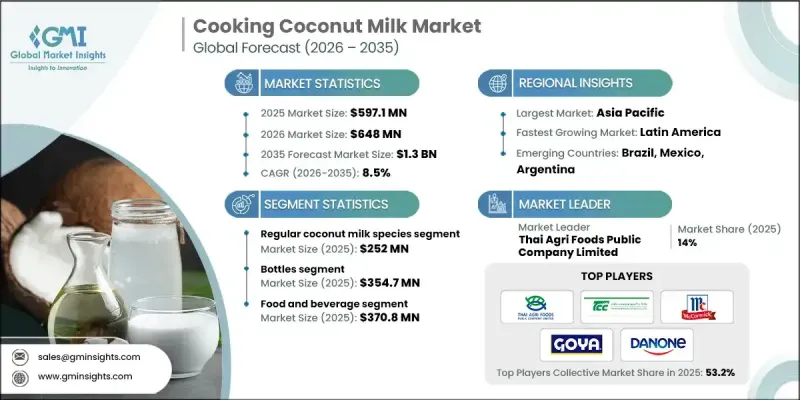
시장 성장은 식물성 유제품 대체품에 대한 수요의 가속화에 의해 주도되고 있습니다. 건강에 대한 인식의 증가, 식생활의 변화, 환경에 대한 관심으로 인해 소비자들이 기존 유제품에서 점차 멀어지는 경향이 강해지고 있기 때문입니다. 코코넛 밀크는 천연 유래이며, 조리 용도가 다양하고 가정 주방, 외식 산업, 가공 식품 제조의 모든 경우에 사용하기에 적합하기 때문에 널리 사용되고 있습니다. 유당 불내증과 유제품 과민증이 증가함에 따라 많은 소비자들이 유제품을 사용하지 않는 대체품에 대한 수요가 증가하고 있으며, 이에 따라 유제품을 사용하지 않는 대체품에 대한 요구가 증가하고 있습니다. 코코넛 밀크는 이러한 요구 사항을 효과적으로 충족시켜 전통적인 요리법과 현대식 식품 제조법 모두에서 사용되고 있습니다. 세계 트렌드에 대한 접촉 기회 증가와 소매 및 외식 산업 채널을 통한 접근성 확대는 꾸준한 판매량 성장과 시장 침투력 강화에 기여하고 있으며, 여러 지역에서 장기적인 수요를 강화하는 데 기여하고 있습니다.
| 시장 범위 | |
|---|---|
| 시작 연도 | 2025년 |
| 예측 연도 | 2026-2035 |
| 개시 금액 | 5억 9,710만 달러 |
| 예측 금액 | 13억 달러 |
| CAGR | 8.5% |
일반 코코넛 밀크 부문은 2025년 2억 5,200만 달러의 매출을 기록했습니다. 이 제품 유형은 가정 요리, 상업용 주방, 산업용 식품 조리에 폭넓게 사용되어 선도적인 위치를 차지하고 있습니다. 균형 잡힌 지방 성분, 풍부한 맛, 그리고 다양한 짠맛과 단맛 요리에 대한 적합성이 안정적인 수요를 뒷받침하고 있습니다. 일반 코코넛 밀크는 소스, 수프, 조리된 음식, 조리 베이스의 기본 재료로 널리 사용되어 소매 및 외식 산업 채널에서 안정적인 소비를 주도하고 있습니다.
병 포장 부문은 2025년 3억 5,470만 달러에 달했습니다. 병은 편리성, 보관의 용이성, 재사용성, 붓기 용이성 때문에 선호되며, 가정용과 상업용 모두에 적합합니다. 이 포장 형태는 가정 내 소비 확대를 지원하는 동시에 매장 내 존재감, 명확한 표시, 고급스러운 프리젠테이션을 제공하여 조직화된 소매 환경에서 제품의 가시성과 호소력을 높입니다.
북미 요리용 코코넛밀크 시장은 2025년 1억 3,430만 달러 규모에 달했으며, 예측 기간 동안 견조한 성장세를 보일 것으로 예상됩니다. 이 지역의 시장 확대는 식물성 식품의 보급 확대, 무유당 식품에 대한 선호도 증가, 건강 인식의 향상으로 뒷받침되고 있습니다. 소매 체인, 전문점, 온라인 플랫폼을 통한 접근성 확대가 소비자의 접근성을 높이는 한편, 외식업계에서는 변화하는 식습관에 대응하기 위해 코코넛 밀크를 메뉴에 도입하는 움직임이 확산되고 있습니다.
자주 묻는 질문
목차
제1장 조사 방법과 범위
제2장 주요 요약
제3장 업계 인사이트
제4장 경쟁 구도
제5장 시장 추정 및 예측 : 제품 유형별, 2022-2035
제6장 시장 추정 및 예측 : 포장별, 2022-2035
제7장 시장 추정 및 예측 : 용도별, 2022-2035
제8장 시장 추정 및 예측 : 지역별, 2022-2035
제9장 기업 개요
KSM 26.03.05The Global Cooking Coconut Milk Market was valued at USD 597.1 million in 2025 and is estimated to grow at a CAGR of 8.5% to reach USD 1.3 billion by 2035.
Market growth is driven by the accelerating demand for plant-based dairy alternatives, as consumers increasingly shift away from traditional dairy products due to health awareness, dietary preferences, and environmental considerations. Coconut milk is gaining widespread acceptance because it is naturally sourced, versatile in cooking applications, and suitable for use across household kitchens, foodservice establishments, and packaged food manufacturing. Rising rates of lactose intolerance and dairy sensitivity are further encouraging adoption, as many consumers seek dairy-free substitutes that deliver comparable texture and flavor. Coconut milk meets these requirements effectively, supporting its use in both conventional cooking and modern food formulations. Growing exposure to global food trends and expanding availability through retail and foodservice channels are contributing to steady volume growth and deeper market penetration, reinforcing long-term demand across multiple regions.
| Market Scope | |
|---|---|
| Start Year | 2025 |
| Forecast Year | 2026-2035 |
| Start Value | $597.1 Million |
| Forecast Value | $1.3 Billion |
| CAGR | 8.5% |
The regular coconut milk segment accounted for USD 252 million in 2025. This product type leads due to its extensive use in home cooking, commercial kitchens, and industrial food preparation. Its balanced fat profile, rich taste, and suitability for a wide range of savory and sweet applications support consistent demand. Regular coconut milk is widely used as a foundational ingredient in sauces, soups, prepared meals, and cooking bases, driving stable consumption across retail and foodservice channels.
The bottled packaging segment reached USD 354.7 million in 2025. Bottles are preferred for their convenience, ease of storage, reusability, and controlled pouring, making them suitable for both household and professional use. This packaging format supports higher consumption in home settings while offering strong shelf presence, clear labeling, and premium presentation, which enhances product visibility and appeal in organized retail environments.
North America Cooking Coconut Milk Market generated USD 134.3 million in 2025 and is expected to experience strong growth throughout the forecast period. Market expansion in the region is supported by rising adoption of plant-based diets, growing preference for lactose-free food products, and increasing health awareness. Wider availability through retail chains, specialty stores, and online platforms is boosting consumer access, while foodservice operators are incorporating coconut milk into menus to align with evolving dietary preferences.
Key companies operating in the Global Cooking Coconut Milk Market include Danone S.A., Goya Foods, Inc., Theppadungporn Coconut Co., Ltd., Nestle Lanka PLC, Thai Agri Foods Public Company Limited, Axelum Resources Corp, Renuka Foods, McCormick & Company, Inc., Pantainorasingh Manufacturer Co., Ltd., KAIRA ORGANIC WORLD., Vietworld Company Limited, and The Coco Factory. Companies in the cooking coconut milk market are strengthening their market position by expanding product portfolios and focusing on clean-label, plant-based formulations. Manufacturers are investing in supply chain optimization and sustainable sourcing to ensure consistent quality and long-term availability. Strategic partnerships with distributors and foodservice operators are improving market reach and brand visibility. Firms are also enhancing packaging formats to improve convenience, shelf life, and consumer appeal. Marketing efforts emphasizing health benefits and dietary suitability are supporting demand growth, while expansion into new geographic markets and e-commerce channels is helping companies capture a broader consumer base and reinforce competitive positioning.
Table of Contents
Chapter 1 Methodology & Scope
- 1.1 Market scope and definition
- 1.2 Research design
- 1.2.1 Research approach
- 1.2.2 Data collection methods
- 1.3 Data mining sources
- 1.3.1 Global
- 1.3.2 Regional/Country
- 1.4 Base estimates and calculations
- 1.4.1 Base year calculation
- 1.4.2 Key trends for market estimation
- 1.5 Primary research and validation
- 1.5.1 Primary sources
- 1.6 Forecast model
- 1.7 Research assumptions and limitations
Chapter 2 Executive Summary
- 2.1 Industry 360° synopsis
- 2.2 Key market trends
- 2.2.1 Regional
- 2.2.2 Product type
- 2.2.3 Packaging
- 2.2.4 Application
- 2.3 TAM Analysis, 2026-2035
- 2.4 CXO perspectives: Strategic imperatives
- 2.4.1 Executive decision points
- 2.4.2 Critical success factors
- 2.5 Future Outlook and Strategic Recommendations
Chapter 3 Industry Insights
- 3.1 Industry ecosystem analysis
- 3.1.1 Supplier Landscape
- 3.1.2 Profit Margin
- 3.1.3 Value addition at each stage
- 3.1.4 Factor affecting the value chain
- 3.1.5 Disruptions
- 3.2 Industry impact forces
- 3.2.1 Growth drivers
- 3.2.1.1 Rising demand for plant-based dairy alternatives
- 3.2.1.2 Growing lactose intolerance & dairy allergies
- 3.2.1.3 Increasing popularity of Asian & tropical cuisines
- 3.2.2 Industry pitfalls and challenges
- 3.2.2.1 High saturated fat content concerns
- 3.2.2.2 Climate change impact on coconut production
- 3.2.3 Market opportunities
- 3.2.3.1 Rising demand for plant-based, clean-label, and health-focused products
- 3.2.3.2 Expansion through packaging innovation and convenience formats
- 3.2.1 Growth drivers
- 3.3 Growth potential analysis
- 3.4 Regulatory landscape
- 3.4.1 North America
- 3.4.2 Europe
- 3.4.3 Asia Pacific
- 3.4.4 Latin America
- 3.4.5 Middle East & Africa
- 3.5 Porter's analysis
- 3.6 PESTEL analysis
- 3.7 Price trends
- 3.7.1 By region
- 3.7.2 Product type
- 3.8 Future market trends
- 3.9 Technology and Innovation Landscape
- 3.9.1 Current technological trends
- 3.9.2 Emerging technologies
- 3.10 Patent Landscape
- 3.11 Trade statistics (HS code) (Note: the trade statistics will be provided for key countries only)
- 3.11.1 Major importing countries
- 3.11.2 Major exporting countries
- 3.12 Sustainability and environmental aspects
- 3.12.1 Sustainable practices
- 3.12.2 Waste reduction strategies
- 3.12.3 Energy efficiency in production
- 3.12.4 Eco-friendly initiatives
- 3.13 Carbon footprint considerations
Chapter 4 Competitive Landscape, 2025
- 4.1 Introduction
- 4.2 Company market share analysis
- 4.2.1 By region
- 4.2.1.1 North America
- 4.2.1.2 Europe
- 4.2.1.3 Asia Pacific
- 4.2.1.4 LATAM
- 4.2.1.5 MEA
- 4.2.1 By region
- 4.3 Company matrix analysis
- 4.4 Competitive analysis of major market players
- 4.5 Competitive positioning matrix
- 4.6 Key developments
- 4.6.1 Mergers & acquisitions
- 4.6.2 Partnerships & collaborations
- 4.6.3 New product launches
- 4.6.4 Expansion plans
Chapter 5 Market Estimates and Forecast, By Product Type, 2022 - 2035 (USD Million) (Kilo Tons)
- 5.1 Key trends
- 5.2 Light coconut milk
- 5.3 Regular coconut milk
- 5.4 Coconut cream
- 5.5 Coconut cream concentrate
- 5.6 Coconut milk powder
- 5.7 Creamed coconut
Chapter 6 Market Estimates and Forecast, By Packaging, 2022 - 2035 (USD million) (Kilo Tons)
- 6.1 Key trends
- 6.2 Bottles
- 6.3 Cans
- 6.4 Pouches
- 6.5 Others
Chapter 7 Market Estimates and Forecast, By Application, 2022 - 2035 (USD million) (Kilo Tons)
- 7.1 Key trends
- 7.2 Food & beverage
- 7.2.1 Curries & gravies
- 7.2.2 Soups & sauces
- 7.2.3 Whipped cream applications
- 7.2.4 Ready-to-drink beverages
- 7.3 Bakery & confectionery
- 7.3.1 Cakes & pastries
- 7.3.2 Donuts & rolls
- 7.3.3 Custards & fillings
- 7.4 Dairy alternatives
- 7.4.1 Non-dairy creamers
- 7.4.2 Vegan cheese alternatives
- 7.4.3 Yogurt alternatives
- 7.5 Industrial / food manufacturing
- 7.5.1 Confectionery centers
- 7.5.2 Bakery fillings
- 7.5.3 Food service ingredients
- 7.6 Cosmetics & personal care
- 7.6.1 Moisturizers & lotions
- 7.6.2 Hair care products
Chapter 8 Market Estimates and Forecast, By Region, 2022 - 2035 (USD million) (Kilo Tons)
- 8.1 Key trends
- 8.2 North America
- 8.2.1 U.S.
- 8.2.2 Canada
- 8.3 Europe
- 8.3.1 Germany
- 8.3.2 UK
- 8.3.3 France
- 8.3.4 Spain
- 8.3.5 Italy
- 8.3.6 Rest of Europe
- 8.4 Asia Pacific
- 8.4.1 China
- 8.4.2 India
- 8.4.3 Japan
- 8.4.4 Australia
- 8.4.5 South Korea
- 8.4.6 Rest of Asia Pacific
- 8.5 Latin America
- 8.5.1 Brazil
- 8.5.2 Mexico
- 8.5.3 Argentina
- 8.5.4 Rest of Latin America
- 8.6 Middle East and Africa
- 8.6.1 Saudi Arabia
- 8.6.2 South Africa
- 8.6.3 UAE
- 8.6.4 Rest of Middle East and Africa
Chapter 9 Company Profiles
- 9.1 KAIRA ORGANIC WORLD.
- 9.2 The Coco Factory
- 9.3 Pantainorasingh Manufacturer Co., Ltd.
- 9.4 Thai Agri Foods Public Company Limited
- 9.5 McCormick & Company, Inc.
- 9.6 Danone S.A.
- 9.7 Nestle Lanka PLC
- 9.8 Axelum Resources Corp
- 9.9 Goya Foods, Inc.
- 9.10 Theppadungporn Coconut Co., Ltd
- 9.11 Vietworld Company Limited
- 9.12 Renuka Foods


