|
시장보고서
상품코드
1936629
전선 및 케이블용 폴리머 시장 기회, 성장 촉진요인, 업계 동향 분석 및 예측(2026-2035년)Wire and Cable Polymer Market Opportunity, Growth Drivers, Industry Trend Analysis, and Forecast 2026 - 2035 |
||||||

세계의 전선 및 케이블용 폴리머 시장은 2025년에 332억 달러로 평가되었으며, 2035년까지 CAGR 6.6%로 성장하여 628억 달러에 달할 것으로 예측됩니다.
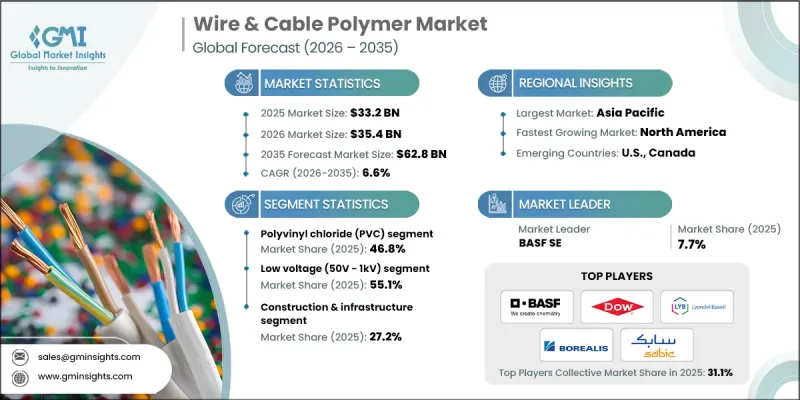
건설, 자동차, 통신, 에너지 등의 분야에서의 수요 증가로 인해 시장은 견조한 성장세를 보이고 있습니다. 시장의 주요 트렌드는 기존 폴리머 소재에서 뛰어난 내구성, 유연성, 안전성을 제공하는 가교 폴리에틸렌(XLPE), 열가소성 엘라스토머(TPE), 난연성 플라스틱과 같은 첨단 고성능 폴리머로 전환하는 것입니다. 이러한 현대식 폴리머는 우수한 전기 절연성, 환경적 스트레스에 대한 내성, 단락 및 전력 손실을 방지하는 능력으로 인해 점점 더 선호되고 있습니다. 전력 및 배선 시스템용 건설 분야, 와이어링 하니스 및 전자부품용 자동차 분야, 광섬유 케이블용 통신 분야, 태양광 및 풍력발전 케이블용 재생에너지 분야 등 다양한 분야에 적용되고 있습니다. 내화학성, 경량 설계, 가공 용이성, 장기적인 신뢰성 등의 주요 장점으로 인해 전 세계 전선 및 케이블 응용 분야에서 폴리머의 채택이 계속 증가하고 있습니다.
| 시장 범위 | |
|---|---|
| 시작 연도 | 2025년 |
| 예측 연도 | 2026-2035 |
| 개시 금액 | 332억 달러 |
| 예측 금액 | 628억 달러 |
| CAGR | 6.6% |
저전압 케이블(50V-1kV) 부문은 55.1%의 점유율을 차지하며 2026년부터 2035년까지 CAGR 6.8%로 성장할 것으로 예상됩니다. 이 부문은 주거 및 상업용 애플리케이션에서 널리 사용되고 있으며, 도시화, 스마트 빌딩 개발, 에너지 효율적인 배선 솔루션의 통합 확대에 힘입어 성장세를 보이고 있습니다. 정부 및 민간 기업의 스마트 그리드 현대화 및 재생에너지 통합에 대한 투자는 안전, 신뢰성, 환경적 지속가능성을 중시하는 동시에 저전압 케이블용 내구성 및 고성능 폴리머에 대한 수요를 더욱 가속화시키고 있습니다.
건설 및 인프라 분야는 2025년 27.2%의 점유율을 차지하며 2035년까지 CAGR 6.9%로 성장할 것으로 예상됩니다. 도시화, 스마트 시티 프로젝트, 대규모 인프라 개발은 견고하고 수명이 긴 배선 시스템의 필요성을 지속적으로 견인하고 있습니다. 또한, 태양광 및 풍력발전과 같은 재생에너지 프로젝트가 확대됨에 따라 열 안정성, 우수한 절연성, 강화된 내구성을 갖춘 폴리머 케이블에 대한 수요가 증가하고 있으며, 열악한 환경 조건을 견디고 안정적인 전력 전송을 보장하기 위해 폴리머 케이블에 대한 수요가 증가하고 있습니다.
북미 전선 및 케이블용 폴리머 시장은 2025년 15.1%의 점유율을 차지했습니다. 이 지역의 확장은 인프라 현대화, 재생에너지 투자, 통신 부문의 성장에 의해 촉진되고 있습니다. 전기자동차의 보급 확대와 스마트 그리드 개념의 발전으로 우수한 절연성, 내화성, 유연성을 겸비한 고성능 폴리머에 대한 수요가 증가하고 있습니다. 이 지역의 엄격한 안전 및 환경 규제로 인해 제조업체들은 환경 친화적이고 난연성 폴리머 케이블의 개발을 장려하고 있으며, 제품 혁신은 지속가능성과 규제 준수에 부합하는 형태로 이루어지고 있습니다.
자주 묻는 질문
목차
제1장 조사 방법과 범위
제2장 주요 요약
제3장 업계 인사이트
제4장 경쟁 구도
제5장 시장 추정 및 예측 : 폴리머 종별, 2022-2035
제6장 시장 추정 및 예측 : 전압별, 2022-2035
제7장 시장 추정 및 예측 : 최종 이용 산업별, 2022-2035
제8장 시장 추정 및 예측 : 지역별, 2022-2035
제9장 기업 개요
KSM 26.03.05The Global Wire and Cable Polymer Market was valued at USD 33.2 billion in 2025 and is estimated to grow at a CAGR of 6.6% to reach USD 62.8 billion by 2035.
The market is experiencing robust growth due to rising demand across sectors such as construction, automotive, telecommunications, and energy. A key trend in the market is the shift from conventional polymer materials to advanced high-performance polymers, including cross-linked polyethylene (XLPE), thermoplastic elastomers (TPE), and flame-retardant plastics, which offer superior durability, flexibility, and safety. These modern polymers are increasingly preferred because of their excellent electrical insulation, resistance to environmental stress, and capacity to prevent short circuits and power loss. Their applications are widespread: in construction for power and wiring systems, in automotive for wiring harnesses and electronic components, in telecommunications for fiber optic cables, and in renewable energy for solar and wind power cabling. Key benefits such as chemical resistance, lightweight design, ease of processing, and long-term reliability continue to drive polymer adoption in wire and cable applications worldwide.
| Market Scope | |
|---|---|
| Start Year | 2025 |
| Forecast Year | 2026-2035 |
| Start Value | $33.2 Billion |
| Forecast Value | $62.8 Billion |
| CAGR | 6.6% |
The low voltage cables (50V-1kV) segment held 55.1% share and is expected to grow at a CAGR of 6.8% from 2026 to 2035. This segment is widely used in residential and commercial applications and has been propelled by urbanization, smart building developments, and the increasing integration of energy-efficient wiring solutions. Investments by governments and private enterprises in smart grid modernization and renewable energy integration have further accelerated demand for durable, high-performance polymers in low-voltage cabling while emphasizing safety, reliability, and environmental sustainability.
The construction and infrastructure sector accounted for 27.2% share in 2025 and is anticipated to grow at a CAGR of 6.9% through 2035. Urbanization, smart city projects, and large-scale infrastructure development continue to drive the need for robust, long-lasting wiring systems. Additionally, the growth of renewable energy projects, such as solar and wind power, has increased demand for polymer cables with higher thermal stability, superior insulation, and enhanced durability to withstand harsh environmental conditions and ensure reliable power transmission.
North America Wire and Cable Polymer Market accounted for 15.1% share in 2025. The region's expansion is fueled by infrastructural modernization, renewable energy investments, and the growth of the telecommunications sector. Rising adoption of electric vehicles and smart grid initiatives has created increasing demand for high-performance polymers that combine excellent insulation, fire resistance, and flexibility. Strict safety and environmental regulations in the region are encouraging manufacturers to develop eco-friendly, flame-retardant polymer cables, aligning product innovation with sustainability and regulatory compliance.
Major companies in the Global Wire and Cable Polymer Market include Dow Inc., Arkema SA, LG Chem Ltd, ExxonMobil Corporation, Borealis AG, LyondellBasell Industries N.V., Solvay SA, Mitsui Chemicals, Inc., Eastman Chemical Company, BASF SE, Sumitomo Chemical Co., Ltd., and SABIC. Leading players in the wire and cable polymer market are adopting several strategies to strengthen their presence and expand market share. They are investing heavily in research and development to create high-performance, eco-friendly polymers with superior insulation, fire resistance, and mechanical properties. Strategic partnerships with manufacturers, construction companies, and energy providers help ensure a consistent supply and market penetration. Companies are also focusing on product diversification to meet the needs of low-, medium-, and high-voltage applications across various industries. Expansion into emerging markets and regional production facilities reduces lead times and cost, while sustainability initiatives, such as biodegradable and flame-retardant polymers, help align with regulatory standards and growing consumer demand for safe, environmentally responsible materials.
Table of Contents
Chapter 1 Methodology & Scope
- 1.1 Market scope and definition
- 1.2 Research design
- 1.2.1 Research approach
- 1.2.2 Data collection methods
- 1.3 Data mining sources
- 1.3.1 Global
- 1.3.2 Regional/Country
- 1.4 Base estimates and calculations
- 1.4.1 Base year calculation
- 1.4.2 Key trends for market estimation
- 1.5 Primary research and validation
- 1.5.1 Primary sources
- 1.6 Forecast model
- 1.7 Research assumptions and limitations
Chapter 2 Executive Summary
- 2.1 Industry 360° synopsis
- 2.2 Key market trends
- 2.2.1 Regional
- 2.2.2 Polymer type
- 2.2.3 Voltage
- 2.2.4 End-user industry
- 2.3 TAM Analysis, 2026-2035
- 2.4 CXO perspectives: Strategic imperatives
- 2.4.1 Executive decision points
- 2.4.2 Critical success factors
- 2.5 Future Outlook and Strategic Recommendations
Chapter 3 Industry Insights
- 3.1 Industry ecosystem analysis
- 3.1.1 Supplier landscape
- 3.1.2 Profit margin
- 3.1.3 Value addition at each stage
- 3.1.4 Factor affecting the value chain
- 3.1.5 Disruptions
- 3.2 Industry impact forces
- 3.2.1 Growth drivers
- 3.2.2 Industry pitfalls and challenges
- 3.2.3 Market opportunities
- 3.3 Growth potential analysis
- 3.4 Regulatory landscape
- 3.4.1 North America
- 3.4.2 Europe
- 3.4.3 Asia Pacific
- 3.4.4 Latin America
- 3.4.5 Middle East & Africa
- 3.5 Porter's analysis
- 3.6 PESTEL analysis
- 3.7 Price trends
- 3.7.1 By region
- 3.7.2 By type
- 3.8 Future market trends
- 3.9 Technology and Innovation landscape
- 3.9.1 Current technological trends
- 3.9.2 Emerging technologies
- 3.10 Patent Landscape
- 3.11 Trade statistics (HS code)
- 3.11.1 Major importing countries
- 3.11.2 Major exporting countries
- 3.12 Sustainability and environmental aspects
- 3.12.1 Sustainable practices
- 3.12.2 Waste reduction strategies
- 3.12.3 Energy efficiency in production
- 3.12.4 Eco-friendly initiatives
- 3.13 Carbon footprint consideration
Chapter 4 Competitive Landscape, 2025
- 4.1 Introduction
- 4.2 Company market share analysis
- 4.2.1 By region
- 4.2.1.1 North America
- 4.2.1.2 Europe
- 4.2.1.3 Asia Pacific
- 4.2.1.4 LATAM
- 4.2.1.5 MEA
- 4.2.1 By region
- 4.3 Company matrix analysis
- 4.4 Competitive analysis of major market players
- 4.5 Competitive positioning matrix
- 4.6 Key developments
- 4.6.1 Mergers & acquisitions
- 4.6.2 Partnerships & collaborations
- 4.6.3 New Product Launches
- 4.6.4 Expansion Plans
Chapter 5 Market Estimates and Forecast, By Polymer Type, 2022-2035 (USD Billion) (Kilo Tons)
- 5.1 Key trends
- 5.2 Polyethylene
- 5.2.1 Low Density Polyethylene (LDPE)
- 5.2.2 High Density Polyethylene (HDPE)
- 5.2.3 Linear Low Density Polyethylene (LLDPE)
- 5.3 Polypropylene
- 5.4 Polyvinyl Chloride (PVC)
- 5.4.1 Flexible PVC
- 5.4.2 Rigid PVC
- 5.5 Elastomers
- 5.5.1 Ethylene Propylene Rubber (EPR)
- 5.5.2 Ethylene Propylene Diene Monomer (EPDM)
- 5.5.3 Silicone Rubber
- 5.5.4 Thermoplastic Elastomers (TPE)
- 5.5.5 Thermoplastic Polyurethane (TPU)
- 5.6 Fluoropolymers
- 5.6.1 Polytetrafluoroethylene (PTFE)
- 5.6.2 Fluorinated Ethylene Propylene (FEP)
- 5.6.3 Perfluoroalkoxy (PFA)
- 5.6.4 Ethylene Tetrafluoroethylene (ETFE)
- 5.7 High-Performance Polymers
- 5.7.1 Polyether Ether Ketone (PEEK)
- 5.7.2 Polyetherimide (PEI)
- 5.7.3 Polyphenylene Sulfide (PPS)
- 5.8 Halogen-Free Flame Retardant (HFFR) Compounds
- 5.9 Others
Chapter 6 Market Estimates and Forecast, By Voltage, 2022-2035 (USD Billion) (Kilo Tons)
- 6.1 Key trends
- 6.2 Low voltage (50V - 1kV)
- 6.3 Medium voltage (1kV - 35kV)
- 6.4 High voltage (35kV - 150kV)
Chapter 7 Market Estimates and Forecast, By End-User Industry, 2022-2035 (USD Billion) (Kilo Tons)
- 7.1 Key trends
- 7.2 Power generation
- 7.3 Telecommunications
- 7.4 Automotive & transportation
- 7.5 Construction & infrastructure
- 7.6 Industrial manufacturing
- 7.7 Oil & gas
- 7.8 Mining & resources
- 7.9 Renewable energy
- 7.10 Data centers & IT
- 7.11 Aerospace & defense
- 7.12 Healthcare
Chapter 8 Market Estimates and Forecast, By Region, 2022-2035 (USD Billion) (Kilo Tons)
- 8.1 Key trends
- 8.2 North America
- 8.2.1 U.S.
- 8.2.2 Canada
- 8.3 Europe
- 8.3.1 Germany
- 8.3.2 UK
- 8.3.3 France
- 8.3.4 Spain
- 8.3.5 Italy
- 8.3.6 Rest of Europe
- 8.4 Asia Pacific
- 8.4.1 China
- 8.4.2 India
- 8.4.3 Japan
- 8.4.4 Australia
- 8.4.5 South Korea
- 8.4.6 Rest of Asia Pacific
- 8.5 Latin America
- 8.5.1 Brazil
- 8.5.2 Mexico
- 8.5.3 Argentina
- 8.5.4 Rest of Latin America
- 8.6 Middle East and Africa
- 8.6.1 Saudi Arabia
- 8.6.2 South Africa
- 8.6.3 UAE
- 8.6.4 Rest of Middle East and Africa
Chapter 9 Company Profiles
- 9.1 Arkema SA
- 9.2 BASF SE
- 9.3 Borealis AG
- 9.4 Dow Inc.
- 9.5 Eastman Chemical Company
- 9.6 ExxonMobil Corporation
- 9.7 LG Chem Ltd
- 9.8 LyondellBasell Industries N.V.
- 9.9 Mitsui Chemicals, Inc.
- 9.10 SABIC
- 9.11 Solvay SA
- 9.12 Sumitomo Chemical Co., Ltd.