

|
시장보고서
상품코드
1959286
발효 식물성 우유 시장 기회, 성장요인, 업계 동향 분석 및 예측(2026-2035년)Fermented Plant Milk Market Opportunity, Growth Drivers, Industry Trend Analysis, and Forecast 2026 - 2035 |
||||||

세계의 발효 식물성 우유 시장은 2025년에 24억 달러로 평가되었고, 2035년까지 연평균 복합 성장률(CAGR) 8.4%로 성장하여 53억 달러에 이를 것으로 예측되고 있습니다.

이러한 강력한 성장 궤적은 국제 시장에서 발효 식물성 우유 대체품에 대한 수요가 가속화되고 있음을 보여줍니다. 발효 식물성 우유는 프로바이오틱스 함량 향상, 맛의 복잡성 개선, 종합적인 영양가 향상을 목적으로 관리된 발효 공정을 거친 식물성 음료를 말합니다. 이 제품들은 소화기 건강 유지에 도움을 주고 영양소의 생체 이용률을 향상시켜 기존 유제품을 대체할 수 있는 유력한 대안으로 널리 인정받고 있습니다. 유당불내증과 유단백질 과민증 사례가 증가하면서 소비 습관이 변화하고 있으며, 소비자들이 식물성 대안을 찾는 경향이 증가하고 있습니다. 또한, 윤리적, 환경적, 건강 지향적 동기에 힘입어 전 세계 비건/채식 인구의 꾸준한 증가는 카테고리의 성장을 지속적으로 촉진하고 있습니다. 발효 식물성 우유 제품은 비타민, 미네랄, 유익한 배양균을 첨가한 강화된 프로파일로 인해 점점 더 많은 사랑을 받고 있습니다. 기능성 식품과 프로바이오틱스가 풍부한 식단에 대한 전 세계적인 관심이 높아지면서 큰 시장 기회를 창출하고 있습니다. 건강한 식습관을 장려하는 정부 주도의 영양 정책도 수요에 기여하고 있습니다. 북미는 높은 소비자 의식과 탄탄한 생산 능력으로 시장을 선도하고 있으며, 아시아태평양은 급속한 도시화와 건강에 대한 인식이 높아지면서 가장 빠르게 성장하고 있는 지역으로 꼽힙니다.
| 시장 범위 | |
|---|---|
| 개시 연도 | 2025년 |
| 예측 연도 | 2026-2035년 |
| 개시 연도 가치 | 24억 달러 |
| 예측 금액 | 53억 달러 |
| CAGR | 8.4% |
견과류 기반 부문은 2025년 40.2%의 점유율을 차지할 것으로 예상되며, 2035년까지 연평균 8.6%의 성장률을 보일 것으로 전망됩니다. 이 카테고리는 광범위한 식물성 우유 대체품 업계에서 소비자의 높은 수용성, 균형 잡힌 영양 성분, 프리미엄 이미지로 인해 선도적인 위치를 유지하고 있습니다. 부드러운 식감과 다양한 식사 장면에서의 적응성이 가정 내 침투를 강화하고 있습니다. 제조업체들은 견과류 기반 발효음료를 고부가가치 상품으로 포지셔닝하고 경쟁 우위를 유지하기 위해 혁신, 포장 개선, 배합 강화에 지속적으로 투자하고 있습니다. 식물 중심의 식생활과 특수한 식습관 증가는 영양가가 높고 유제품을 함유하지 않은 음료를 찾는 건강 지향적인 소비자층 수요를 더욱 가속화시키고 있습니다.
2025년 기준, 떠먹는 요거트 형태는 발효 식물성 우유 시장에서 36%의 점유율을 차지했습니다. 진한 식감, 편의성, 하루 종일 다양한 섭취 장면에 적응할 수 있어 높은 인기를 유지하고 있습니다. 소비자들은 프로바이오틱스의 효능과 기능성 영양 프로파일에 점점 더 매력을 느끼고 있습니다. 이러한 구조로 인해 제조업체는 추가 영양소, 살아있는 유산균, 다양한 맛을 첨가할 수 있어 다양한 소비자층에게 매력적으로 다가갈 수 있습니다. 편의성과 소화기 및 면역 건강 지원에 대한 인식이 결합되어 전체 소매 채널에서 이 부문에 대한 강력한 수요를 계속 주도하고 있습니다.
북미 발효 식물성 우유 시장은 2026년부터 2035년까지 연평균 복합 성장률(CAGR) 8.4%를 나타낼 것으로 예측됩니다. 이 지역 시장 성장은 식물성 영양의 이점에 대한 인식이 높아지고 유제품을 사용하지 않는 대체 식품에 대한 소비자 선호도가 높아짐에 따라 뒷받침되고 있습니다. 발효 공정과 제품 개발 기술의 기술적 진보로 맛, 식감, 영양 성능이 향상되어 채택이 더욱 가속화되고 있습니다. 소매 유통망 확대와 강력한 브랜딩 전략도 지속적인 지역 확장에 기여하고 있습니다.
자주 묻는 질문
목차
제1장 조사 방법과 범위
제2장 주요 요약
제3장 업계 인사이트
제4장 경쟁 구도
제5장 시장 추산 및 예측 : 원료별, 2022-2035
제6장 시장 추산 및 예측 : 제품 형태별, 2022-2035
제7장 시장 추산 및 예측 : 최종 용도별, 2022-2035
제8장 시장 추산 및 예측 : 지역별, 2022-2035
제9장 기업 개요
LSH 26.03.18The Global Fermented Plant Milk Market was valued at USD 2.4 billion in 2025 and is estimated to grow at a CAGR of 8.4% to reach USD 5.3 billion by 2035.
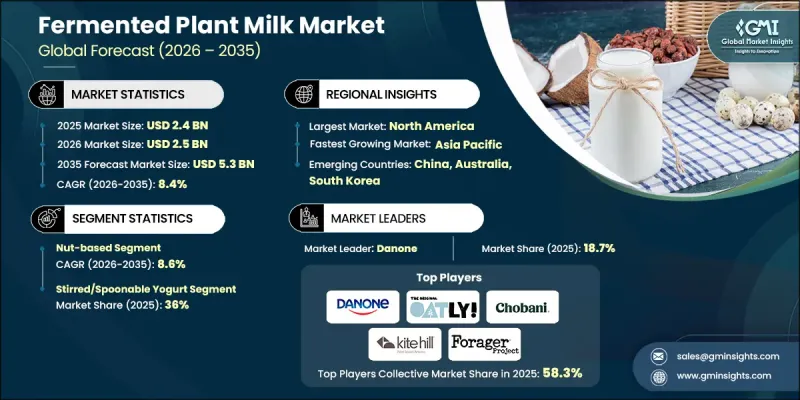
The strong growth trajectory highlights the accelerating demand for fermented plant-based dairy alternatives across international markets. Fermented plant milk refers to plant-derived beverages that undergo controlled fermentation to enhance probiotic levels, improve flavor complexity, and elevate overall nutritional value. These products are widely recognized for supporting digestive health and offering improved nutrient bioavailability, making them a compelling alternative to traditional dairy products. Rising cases of lactose intolerance and milk protein sensitivities are reshaping consumption habits, encouraging consumers to seek plant-based substitutes. In addition, the steady expansion of vegan and vegetarian populations worldwide continues to fuel category growth, supported by ethical, environmental, and health-driven motivations. Fermented plant milk products are increasingly favored for their enriched profiles that include added vitamins, minerals, and beneficial cultures. The growing global focus on functional foods and probiotic-rich diets is creating substantial market opportunities. Government-backed nutrition initiatives promoting healthier eating frameworks are also contributing to demand. North America leads the market due to strong consumer awareness and well-established production capabilities, while Asia Pacific represents the fastest-growing region, supported by rapid urbanization and rising health consciousness.
| Market Scope | |
|---|---|
| Start Year | 2025 |
| Forecast Year | 2026-2035 |
| Start Value | $2.4 Billion |
| Forecast Value | $5.3 Billion |
| CAGR | 8.4% |
The nut-based segment accounted for 40.2% share in 2025 and is forecast to grow at a CAGR of 8.6% through 2035. This category maintains a leading position due to its strong consumer acceptance, balanced nutritional composition, and premium perception within the broader plant-based dairy alternatives industry. Its smooth consistency and adaptability across various meal occasions have strengthened its household penetration. Manufacturers continue to position nut-based fermented beverages as high-value offerings, often investing in innovation, packaging improvements, and enhanced formulations to sustain competitive advantage. The rise in plant-focused and specialty dietary patterns has further accelerated demand among health-conscious consumers seeking nutrient-dense and dairy-free beverage options.
The stirred and spoonable yogurt format captured 36% share in 2025 within the fermented plant milk market. This format remains highly popular because of its thick texture, convenience, and suitability for multiple consumption occasions throughout the day. Consumers are increasingly drawn to its probiotic benefits and functional nutrition profile. Its structure allows manufacturers to incorporate additional nutrients, live cultures, and flavor variations, making it attractive to a broad consumer base. The convenience factor, combined with the perception of digestive and immune health support, continues to drive strong demand for this segment across retail channels.
North America Fermented Plant Milk Market is anticipated to register a CAGR of 8.4% between 2026 and 2035. Market growth in the region is supported by rising awareness of plant-based nutrition benefits and increasing consumer preference for dairy-free alternatives. Technological progress in fermentation processes and product development techniques is enhancing taste, texture, and nutritional performance, further accelerating adoption. Expanding retail distribution networks and strong branding strategies are also contributing to sustained regional expansion.
Key companies operating in the Global Fermented Plant Milk Market include Danone, Oatly, Califia Farms, Kite Hill, Chobani, So Delicious Dairy Free, Lavva, Forager Project, Harmless Harvest, Cocojune, Siggi's, and Daiya Foods. These industry participants are actively competing through product differentiation, clean label positioning, and expansion into emerging markets. Companies in the Fermented Plant Milk Market are reinforcing their market position through continuous product innovation, strategic partnerships, and expansion of production capacities. Many players are investing heavily in research and development to enhance probiotic strains, improve taste profiles, and optimize nutritional content. Brand differentiation through clean label certifications, sustainable sourcing, and environmentally responsible packaging has become a central strategy. Firms are also leveraging mergers, acquisitions, and collaborations to broaden their geographic footprint and diversify product portfolios.
Table of Contents
Chapter 1 Methodology & Scope
- 1.1 Market scope and definition
- 1.2 Research design
- 1.2.1 Research approach
- 1.2.2 Data collection methods
- 1.3 Data mining sources
- 1.3.1 Global
- 1.3.2 Regional/Country
- 1.4 Base estimates and calculations
- 1.4.1 Base year calculation
- 1.4.2 Key trends for market estimation
- 1.5 Primary research and validation
- 1.5.1 Primary sources
- 1.6 Forecast model
- 1.7 Research assumptions and limitations
Chapter 2 Executive Summary
- 2.1 Industry 360° synopsis
- 2.2 Key market trends
- 2.2.1 Regional
- 2.2.2 Raw material
- 2.2.3 Product format
- 2.2.4 End use
- 2.3 TAM Analysis, 2026-2035
- 2.4 CXO perspectives: Strategic imperatives
- 2.4.1 Executive decision points
- 2.4.2 Critical success factors
- 2.5 Future Outlook and Strategic Recommendations
Chapter 3 Industry Insights
- 3.1 Industry ecosystem analysis
- 3.1.1 Supplier landscape
- 3.1.2 Profit margin
- 3.1.3 Value addition at each stage
- 3.1.4 Factor affecting the value chain
- 3.1.5 Disruptions
- 3.2 Industry impact forces
- 3.2.1 Growth drivers
- 3.2.1.1 Rising lactose intolerance & dairy allergy prevalence
- 3.2.1.2 Growing vegan & vegetarian population
- 3.2.1.3 Increasing demand for probiotic & functional foods
- 3.2.2 Industry pitfalls and challenges
- 3.2.2.1 Higher price point vs. Dairy yogurt
- 3.2.2.2 Taste & texture challenges
- 3.2.3 Market opportunities
- 3.2.3.1 Blended plant base formulations
- 3.2.3.2 Protein-enhanced & fortified products
- 3.2.1 Growth drivers
- 3.3 Growth potential analysis
- 3.4 Regulatory landscape
- 3.4.1 North America
- 3.4.2 Europe
- 3.4.3 Asia Pacific
- 3.4.4 Latin America
- 3.4.5 Middle East & Africa
- 3.5 Porter’s analysis
- 3.6 PESTEL analysis
- 3.7 Price trends
- 3.7.1 By region
- 3.7.2 By raw material
- 3.8 Future market trends
- 3.9 Technology and innovation landscape
- 3.9.1 Current technological trends
- 3.9.2 Emerging technologies
- 3.10 Patent Landscape
- 3.11 Trade statistics (HS code)
- 3.11.1 Major importing countries
- 3.11.2 Major exporting countries
- 3.12 Sustainability and environmental aspects
- 3.12.1 Sustainable practices
- 3.12.2 Waste reduction strategies
- 3.12.3 Energy efficiency in production
- 3.12.4 Eco-friendly initiatives
- 3.13 Carbon footprint consideration
Chapter 4 Competitive Landscape, 2025
- 4.1 Introduction
- 4.2 Company market share analysis
- 4.2.1 By region
- 4.2.1.1 North America
- 4.2.1.2 Europe
- 4.2.1.3 Asia Pacific
- 4.2.1.4 LATAM
- 4.2.1.5 MEA
- 4.2.1 By region
- 4.3 Company matrix analysis
- 4.4 Competitive analysis of major market players
- 4.5 Competitive positioning matrix
- 4.6 Key developments
- 4.6.1 Mergers & acquisitions
- 4.6.2 Partnerships & collaborations
- 4.6.3 New Product Launches
- 4.6.4 Expansion Plans
Chapter 5 Market Estimates and Forecast, By Raw Material, 2022-2035 (USD Billion) (Kilo Tons)
- 5.1 Key trends
- 5.2 Legume-based
- 5.2.1 Soy
- 5.2.2 Pea
- 5.2.3 Lupin
- 5.2.4 Others
- 5.3 Nut-based
- 5.3.1 Almond
- 5.3.2 Cashew
- 5.3.3 Others
- 5.4 Cereal-based
- 5.4.1 Oat
- 5.4.2 Rice
- 5.4.3 Others
- 5.5 Others
Chapter 6 Market Estimates and Forecast, By Product Format, 2022-2035 (USD Billion) (Kilo Tons)
- 6.1 Key trends
- 6.2 Stirred/spoonable yogurt
- 6.3 Greek-style/concentrated yogurt
- 6.4 Drinking/drinkable yogurt
- 6.5 Kefir-style cultured beverages
- 6.6 Others
Chapter 7 Market Estimates and Forecast, By End Use, 2022-2035 (USD Billion) (Kilo Tons)
- 7.1 Key trends
- 7.2 Direct consumption
- 7.2.1 Breakfast & snacking
- 7.2.2 On-the-go beverages
- 7.2.3 Others
- 7.3 Culinary/cooking applications
- 7.3.1 Baking & cooking substitute
- 7.3.2 Smoothie base & beverage ingredient
- 7.3.3 Others
- 7.4 Food service/HoReCa
- 7.4.1 Hotels, restaurants & cafes
- 7.4.2 Bulk packaging
- 7.5 Industrial/ingredient use
- 7.5.1 Bakery & confectionery
- 7.5.2 Food manufacturing applications
- 7.6 Others
Chapter 8 Market Estimates and Forecast, By Region, 2022-2035 (USD Billion) (Kilo Tons)
- 8.1 Key trends
- 8.2 North America
- 8.2.1 U.S.
- 8.2.2 Canada
- 8.3 Europe
- 8.3.1 Germany
- 8.3.2 UK
- 8.3.3 France
- 8.3.4 Spain
- 8.3.5 Italy
- 8.3.6 Rest of Europe
- 8.4 Asia Pacific
- 8.4.1 China
- 8.4.2 India
- 8.4.3 Japan
- 8.4.4 Australia
- 8.4.5 South Korea
- 8.4.6 Rest of Asia Pacific
- 8.5 Latin America
- 8.5.1 Brazil
- 8.5.2 Mexico
- 8.5.3 Argentina
- 8.5.4 Rest of Latin America
- 8.6 Middle East and Africa
- 8.6.1 Saudi Arabia
- 8.6.2 South Africa
- 8.6.3 UAE
- 8.6.4 Rest of Middle East and Africa
Chapter 9 Company Profiles
- 9.1 Califia Farms
- 9.2 Chobani
- 9.3 Cocojune
- 9.4 Daiya Foods
- 9.5 Danone
- 9.6 Forager Project
- 9.7 Harmless Harvest
- 9.8 Kite Hill
- 9.9 Lavva
- 9.10 Oatly
- 9.11 Siggi's
- 9.12 So Delicious Dairy Free


